The Media-Savvy Middle School Classroom is a practical guide for teachers of Grades 5-8 who want to help their students achieve mastery of media literacy skills. Today's fake news, alternative facts, and digital manipulations are compromising the critical thinking and well-being of middle grade learners already going through significant personal changes. This actionable book prepares teachers to help their students become informed consumers of online resources. Spanning correct source use, personal versus expert opinions, deliberate disinformation, social media, and more, these ready-to-use activities can be integrated directly into existing language arts and mathematics lesson plans.
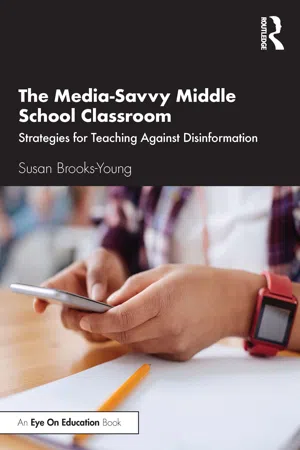
eBook - ePub
The Media-Savvy Middle School Classroom
Strategies for Teaching Against Disinformation
- 82 pages
- English
- ePUB (mobile friendly)
- Available on iOS & Android
eBook - ePub
The Media-Savvy Middle School Classroom
Strategies for Teaching Against Disinformation
About this book
Trusted by 375,005 students
Access to over 1.5 million titles for a fair monthly price.
Study more efficiently using our study tools.
Information
1
Why These Skills? Why Now?
Do you remember when you first heard the term “fake news?” Although many people associate the idea of fake news with the 2016 presidential election in the United States, Jane E. Kirtley, Silha Professor of Media Ethics and Law at the Hubbard School of Journalism and Mass Communication at the University of Minnesota, reminds us that this is not a recent concept. She traces use of the specific term “lying press” back to 1930s Nazi Germany. However, intentional publication of information designed to mislead the public goes back even further in time (Burston et al.). If that’s the case, why do people today appear to be more aware of disinformation and less confident about their ability to identify it than they may have been previously?
It’s tempting to try to identify a single cause of the current proliferation of disinformation, but the reality is that this is a complex issue. Yes, members of the Trump Administration regularly suggest that “alternate facts” must be given credence and accuse mainstream media of promoting misinformation, but this problem is not confined to the United States. Nor is disinformation confined solely to political issues. Here are just a few examples:
- In 2018, the Muslim co-owner of a restaurant in Ampara, Sri Lanka was badly beaten, his restaurant wrecked, and the local mosque burned because a customer found a lump of flour in his dinner. Unknown to the owner, a fabricated story posted on Facebook the previous day claimed that Muslims were trying to suppress the Buddhist population of Sri Lanka by slipping sterilization drugs into food served in restaurants. The customer mistook the flour for medication (Taub and Fisher).
- A 4-year-old child in Pueblo, Colorado died from influenza because his mother did not give him medication that was prescribed by his physician. Instead she decided to follow the advice of members of an anti-vax Facebook group who recommended natural remedies (Capatides).
- At the height of COVID-19 spread, two companies in the UK were prohibited from publishing online ads for face masks. Britain’s Advertising Standards Authority (ASA) determined that the ads violated their code of ethics because they were grounded in fearmongering and misled consumers about the masks’ effectiveness in protecting against the virus (“Face mask ads banned”).
- On a lighter note, in 2014, the company that produces the Red Bull beverage settled a $13 million lawsuit that claimed false advertising was in play when the company used the slogan “Red Bull gives you wings.” Clearly, drinking any beverage does not give a person wings, but the person who filed suit claimed the slogan implied that Red Bull was superior to other energy drinks when, in fact, a cup of coffee contains more caffeine than does an 8.4 oz can of Red Bull. The company stated it settled out of court to avoid high court costs.
Here are a few of the factors that make it easier for us to believe disinformation and increase the likelihood that people will believe lies:
- Humans tend to misremember their original sources of information. For instance, a person may have positive thoughts about a product, forgetting that the basis of those feelings comes from having viewed an advertisement, rather than from personal experience (Matthews).
- Headlines are powerful memory triggers. Individuals or organizations that generate disinformation know their consumers are more likely to remember headlines than the text of articles they read. This is the case even when the article demonstrates that the headline is mostly, even completely inaccurate (Jaffe). This is one reason why clickbait is useful for spreading disinformation.
- Repeating inaccurate information is another effective way to get people to believe something that is not true. This is called the “illusory truth effect.” It means that our brains respond to information repeated over and over again as though it is true. Both politicians and marketing experts are well aware of this (Dreyfuss).
In addition, we now have access to a wide range of technologies developed within the last decade which facilitates anytime, anywhere delivery of targeted disinformation to specific people. A proliferation of radio and cable television stations that broadcast programming 24/7 also increases the ability to deliver continuous streams of disinformation in many formats. Finally, due to shifting priorities handed down through mandates at the local, state, and federal levels, educators are focusing on basic academics and test scores. They have little or no time left in the school day to teach the skills students need to adequately deal with the amounts of information they encounter daily. And truth be told, many adults also find themselves struggling with differentiating between fact and fiction.
So what is the solution? We can begin acknowledging that despite the reality that technology has become a delivery system for disinformation, the challenges we face in this area will not be solved with technology. This is a problem that requires human intervention. Common sense and critical thinking skills ...
Table of contents
- Cover
- Half Title
- Title Page
- Copyright Page
- Contents
- Tables
- 1 Why These Skills? Why Now?
- 2 Who Said That and Why Does It Matter?
- 3 Who’s an Expert?
- 4 Information Echo Chambers
- 5 Fact or Fiction?
- 6 Before You Share
- 7 Can You Believe That?
- 8 Those Pesky Averages
- 9 Framing the Question
- 10 Putting a Slant on Things
- 11 What Are the Chances?
- 12 Going Forward
- Index
Frequently asked questions
Yes, you can cancel anytime from the Subscription tab in your account settings on the Perlego website. Your subscription will stay active until the end of your current billing period. Learn how to cancel your subscription
No, books cannot be downloaded as external files, such as PDFs, for use outside of Perlego. However, you can download books within the Perlego app for offline reading on mobile or tablet. Learn how to download books offline
Perlego offers two plans: Essential and Complete
- Essential is ideal for learners and professionals who enjoy exploring a wide range of subjects. Access the Essential Library with 800,000+ trusted titles and best-sellers across business, personal growth, and the humanities. Includes unlimited reading time and Standard Read Aloud voice.
- Complete: Perfect for advanced learners and researchers needing full, unrestricted access. Unlock 1.5M+ books across hundreds of subjects, including academic and specialized titles. The Complete Plan also includes advanced features like Premium Read Aloud and Research Assistant.
We are an online textbook subscription service, where you can get access to an entire online library for less than the price of a single book per month. With over 1.5 million books across 990+ topics, we’ve got you covered! Learn about our mission
Look out for the read-aloud symbol on your next book to see if you can listen to it. The read-aloud tool reads text aloud for you, highlighting the text as it is being read. You can pause it, speed it up and slow it down. Learn more about Read Aloud
Yes! You can use the Perlego app on both iOS and Android devices to read anytime, anywhere — even offline. Perfect for commutes or when you’re on the go.
Please note we cannot support devices running on iOS 13 and Android 7 or earlier. Learn more about using the app
Please note we cannot support devices running on iOS 13 and Android 7 or earlier. Learn more about using the app
Yes, you can access The Media-Savvy Middle School Classroom by Susan Brooks-Young in PDF and/or ePUB format, as well as other popular books in Education & Classroom Management. We have over 1.5 million books available in our catalogue for you to explore.