- 224 pages
- English
- ePUB (mobile friendly)
- Available on iOS & Android
eBook - ePub
About this book
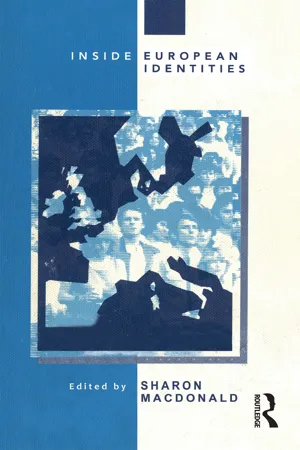
Following recent events in Eastern Europe, questions surrounding European identity seem more pressing than ever. This volume explores, through a series of ethnographic case studies, the construction and experience of identities in Western Europe. All of the case studies are based on fieldwork, and in geographical scope range from Wales to the Basque country; from Corsica to the Lake District. The peoples they look at are similarly diverse: nationalists and members of the Communist party; rural and urban populations. The essays illustrate the ways in which detailed ethnographic case studies can illuminate how identities are lived by ordinary people.
Information
1
Identity Complexes in Western Europe: Social Anthropological Perspectives
Sharon Macdonald
Today, as many of the old political barriers between Western and Eastern Europe are collapsing, and as increased economic and political union within the European community becomes a fact of life, the question of what 'Europe' means – and could come to mean – to its diverse peoples takes on even greater significance. The events of the 1990s would seem to have the potential for radically reshaping people's identities. But will they? Any attempt even to begin to answer questions such as this must address the multiple issues raised by the national, ethnic, regional and local identities within Europe. Where do people's allegiances lie? How deep do identities run? How far does a local identification preclude a supra-local one? And how are such large-scale categories as 'Europe' – or even 'Britain', 'France' or 'Spain' – actually experienced in everyday life?
Questions of identity come to the fore at times of social and political change. While on the one hand it might seem that as borders become weaker – as people and goods traverse them more easily –there will be a consequent relaxing of the sense of allegiance to place and people, very often the reverse is actually the case. Notions of 'us' and 'them' become stronger still; immigrants are perceived as a threat. Witness the revival of aggressive and racist neo-nationalisms in many parts of Europe at this present time. Clearly, the way in which social identities are manifest needs to be understood in terms of the changing social, economic and political contexts of the many social groups within Europe's diverse countries, as well as in terms of the various social and cultural frameworks for thinking about the question 'who are we?'. Who will perceive the present and future changes as a threat, and who will perceive them as an opportunity, depends crucially on the nature of the identity which they hold.
These are all issues which require detailed study and understanding of the peoples and cultures of Europe. In this book we bring together recently completed or ongoing ethnographic research on various regions of Western Europe. This research is based on detailed studies of particular groups and peoples and involves, at least in part, long-term and first-hand study (i.e. ethnography). The theoretical arguments which we bring to bear are for the most part drawn from social anthropology, the discipline which has particularly developed the ethnographic method, and that in which the contributors to this volume were trained. A single narrowly defined theoretical perspective, which would be uncharacteristic of social anthropology, is not reflected in the contributions here. The intention of the book is not to map out a comprehensive picture of West European identities - research is still far too patchily distributed and thin on the ground even to begin to do so. Although the territory covered here is large, and there are some lacunae and imbalances arising from the contingencies of research funding, current ethnographic and individual predilections, and the specific history of this particular collection, we hope to show what can be illuminated by an ethnographic study of identity. In particular, we hope to highlight some of the issues involved in identity formation, maintenance and change 'on the ground' within Western Europe issues which are often overlooked in the recourse to rhetoric and generalisations at a time of social and political change.
What is Western Europe?
Given the changes taking place in Europe, and their ramifications for the whole concept of Europe, it is impossible to introduce a collection such as this without being acutely aware of the historically contingent nature of the categories within which we are working. Perhaps 'Western Europe' might already be said to be a category from the past. What is more, it is, of course, far from being an unequivocally defined and unanimously agreed upon geographical or political entity today, never mind one which can be read back unproblematically into the past. Countries such as Britain and Greece, to take but two examples, have a rather ambiguous and ambivalent allegiance to Europe (though both are members of the European Community). The various European – and it is notable that this term is so often used to refer exclusively to West European – economic and defence organisations, established since the Second World War, have involved discontinuous sets of countries, though a core has remained fairly consistent. Historically, the picture is complicated further by central Europe, a middle region which has dropped out of many conceptual maps of Europe after the Second World War and the East-West polarisation. Nevertheless, 'Western Europe' is a category much used in political discourse, and there has been general agreement, until the re-unification of Germany in 1990, that geographically the line dividing the West from the East stretched from the boundary between Italy and Yugoslavia in the South to that between the two Germanies in the North. More significantly for our purposes here, however, is that Western Europe is typically credited with a number of historical developments of massive global relevance which make it important to consider as a frame of reference, particularly for the study of identities.1
1. I should emphasise that in focusing on Western Europe the aim here is not to reify this as an ethnographic category to the exclusion of all other possibilities. Ethnographers working in the area have used various frames of reference – e.g. the Mediterranean, the British Isles – and our intention is not to deny any validity these may have. For some recent commentaries on the anthropology of Europe, see: American Ethnologist (1991); Ulin (1991).
In addition to, and inextricably linked with, the gestation of industrialisation and capitalism, Western Europe is generally accepted as the birthplace of the nation-state and the rise of nationalism. These, like the ethnonationalism which has followed in their wake, have, of course, been widely exported and are major forces in world politics today. Detailed understanding of the ways in which national, regional and local identities are created and experienced within Western Europe is clearly of importance to any wider understanding of these movements in general.2 Colonialism too is part of the shared history, and its consequences part of the contemporary social and political complexion, of many of the West European countries. Like nationalism and ethnonationalism, colonialism and its consequences raise questions about identity – about cultural sameness and difference and the boundaries between peoples. What is more, the social and political fallout of colonialism – in particular, immigration from formerly colonised regions – has been, and continues to be, a major factor involved in shaping contemporary European identities.
2. Cf. Llobera (1987a: 113). There is a substantial literature now on the development of nationalism, some of it by social anthropologists. See, for example, B. Anderson (1983), Gellner (1983), Llobera (1987b).
Shared historical currents (though felt to greater or lesser degrees in different countries within Western Europe) and common contemporary social and political characteristics and concerns provide a rationale for discussing identity formation within the context of Western Europe. Nationalism, ethnonationalism and colonialism – all deeply rooted, one way or another, in Europe – are, then, among the wider movements which shape the Europe within which more localised identities are realised.
Social Anthropology and European Identities
Shared historical currents within Europe have also shaped anthropology and the social sciences in general. In other words, they have also shaped the ways in which we look at questions of identity and the like. Although various histories of the social sciences can be written, it is generally accepted that the social sciences 'crystallised' in Western Europe in the late eighteenth century (Restivo 1991). That is, they came into being at around the same time as the nation-state, and with growing European expansion. Attempting to understand the social changes brought in the wake of industrialisation – and those associated with the rise of the nation-state and the encounter with 'other' peoples – was the intellectual motivation for the development of the new disciplines.
Right from the beginning a concern with social identity lay at the heart of the social disciplines. A key question was that of the nature of social relationships and social bonds as the industrialised countries apparently became caught up in a wave which shifted the majority of the population's lives from a community-based existence (Gemeinschaft in Tönnies' famous formulation), in which the units of organisation of social life could be readily apprehended through face-to-face contacts, to an association or society (Gesellschaft) based social organisation, whose boundaries and leaders might be various and distant (see Tönnies 1955). Social theorists concerned themselves with questions of what kinds of allegiance to social group, and what kinds of sense of belonging or of alienation, would develop as people moved out of networks of kinship and community and into larger, apparently less personalised, organisations.
At another level too, sociology and anthropology could be seen from their very beginnings to be deeply implicated in questions of identities in Europe. For the attempts to understand social change, and different types of society, were simultaneously attempts to characterise the nature of 'rational', 'developed', urban society. Anthropology –despite (or indeed because of) being apparently about 'exotic' or 'other' cultures – played a significant role in the self-definition in which Europe's intellectuals were involved. These 'others', who unwittingly acted as a kind of alter ego, were not, however, found only in geographically distant lands, but also in the margins of Europe itself (see Chapman 1978; Herzfeld 1987). One consequence of this has been that the study of Europe by social scientists has been marked not only by the political and cultural boundaries erected by Europe's peoples themselves, but also by an overarching binary divide created and sustained partly by social scientists, between the declining Europe, of small rural communities with quaint customs and 'folk-life', and the rapidly expanding Europe of rationality and rationalisation, social problems, urban life, and change. This division into two Europes is not, of course, held only by social scientists – and the interweaving, and feedback, between popular and academic categories is a feature of the study of Europe – but the problem is that it is a division which is often assumed rather than thoroughly investigated and critically assessed.
In the second half of the 1970s a number of anthropologists attempted overviews of the social anthropological study of Europe up to that point (see especially Boissevain 1975; Cole 1977; Davis 1977; Grillo 1980). They were particularly critical of anthropologists' concentration on small rural communities of Europe – and especially of assumptions that these communities somehow existed outside of, and untouched by, the forces of state, nation and capitalism. European anthropologists, the majority of whom conducted detailed studies of individual communities, were accused of engaging in 'an analytically restricting village fetish' (Gilmore 1980: 3) and of ignoring in the process much of that which was characteristic of European life Europe, it was suggested, had been 'tribalised' (Boissevain 1975: 11) by social anthropology itself.
Ralph Grillo complained that 'Anthropological research ... in Europe has often turned its back on precisely those issues on which a "European" anthropology might be constructed' (1980: 4). Important among these issues were: 'the emergence of supra-local identities and cultures (the "nation"); the rise of powerful and authoritative institutions within the public domain (the "state"), and the development of particular ways of organizing production and consumption (the "economy")' (ibid.: 1). Literacy and the existence of documented history, racism and immigration, were also issues which were singled out as not having been adequately taken on board by those working within Europe (see especially Davis 1977: ch. 6; Grillo 1985). In brief, the 'big' issues of Europe, those features which, if not wholly unique to Europe, were surely present in a rather major and even original form (Europe as the cradle of nationalism, for example), had – by and large – been ignored. These big issues, of themselves, raised questions about identity. Centralised government and institutions, economy, communications, immigration and national cultures raised the problem of the autonomy of groups across space, and documented history and change raised the problem of the persistence of social groups over time.
It is at least partly in response to this critique, and in an attempt to move beyond it, that most of the studies in this volume ...
Table of contents
- Cover
- Half Title
- Series Page
- Title Page
- Copyright Page
- Contents
- Preface
- 1 Identity Complexes in Western Europe: Social Anthropological Perspectives
- 2 Ethnicity as Revolutionary Strategy: Communist Identity Construction in Italy
- 3 Who can Tell the Tale? Texts and the Problem of Generational and Social Identity in a Tuscan Rural Comune
- 4 At Play with Identity in the Basque Arena
- 5 Good To Be French? Conflicts of Identity in North Catalonia
- 6 Becoming Celtic in Corsica
- 7 The Marching Season in Northern Ireland: An Expression of Politico-Religious Identity
- 8 Wales from Within: Conflicting Interpretations of Welsh Identity
- 9 Copeland: Cumbria's Best-Kept Secret
- 10 The Construction of Difference: An Anthropological Approach to Stereotypes
- Notes on Contributors
- Index
Trusted by 375,005 students
Access to over 1.5 million titles for a fair monthly price.
Study more efficiently using our study tools.
Frequently asked questions
Yes, you can cancel anytime from the Subscription tab in your account settings on the Perlego website. Your subscription will stay active until the end of your current billing period. Learn how to cancel your subscription
No, books cannot be downloaded as external files, such as PDFs, for use outside of Perlego. However, you can download books within the Perlego app for offline reading on mobile or tablet. Learn how to download books offline
Perlego offers two plans: Essential and Complete
- Essential is ideal for learners and professionals who enjoy exploring a wide range of subjects. Access the Essential Library with 800,000+ trusted titles and best-sellers across business, personal growth, and the humanities. Includes unlimited reading time and Standard Read Aloud voice.
- Complete: Perfect for advanced learners and researchers needing full, unrestricted access. Unlock 1.5M+ books across hundreds of subjects, including academic and specialized titles. The Complete Plan also includes advanced features like Premium Read Aloud and Research Assistant.
We are an online textbook subscription service, where you can get access to an entire online library for less than the price of a single book per month. With over 1.5 million books across 990+ topics, we’ve got you covered! Learn about our mission
Look out for the read-aloud symbol on your next book to see if you can listen to it. The read-aloud tool reads text aloud for you, highlighting the text as it is being read. You can pause it, speed it up and slow it down. Learn more about Read Aloud
Yes! You can use the Perlego app on both iOS and Android devices to read anytime, anywhere — even offline. Perfect for commutes or when you’re on the go.
Please note we cannot support devices running on iOS 13 and Android 7 or earlier. Learn more about using the app
Please note we cannot support devices running on iOS 13 and Android 7 or earlier. Learn more about using the app
Yes, you can access Inside European Identities by Sharon Macdonald in PDF and/or ePUB format, as well as other popular books in Social Sciences & Anthropology. We have over 1.5 million books available in our catalogue for you to explore.