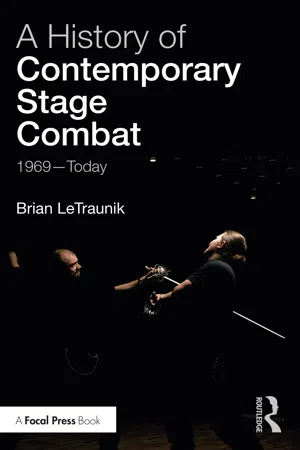
A History of Contemporary Stage Combat chronicles the development of stage combat from the origins of the Society of British Fight Directors in 1969 to the modern day.
Featuring interviews with some of the pioneers of this art form, the book analyzes how stage combat developed in response to the needs of the industry and the changing social mores in the United States, United Kingdom, Canada, the European Continent, Australia, and New Zealand. It also explores the quality of theatrical weaponry, as well as outcropping of stage combat such as intimacy design and theatrical jousting.
A History of Contemporary Stage Combat is an excellent resource for actors, directors, stage combatants, theatre historians, and anyone with a love of action on stage and film.
Theatre is an art form that is over 2,500 years old. Thespis, considered history’s first actor, flourished around 534 bc. The Persians by Aeschylus, the oldest extant play, dates from around 472 bc. There have been many revolutions and evolutions since then, from the outdoor Greek theatres of antiquity to today’s technological marvels. One relative newcomer to the landscape of contemporary theatre is the art of stage combat. Simply defined, stage combat is the art of truthfully and safely depicting a moment of violence in a theatrical milieu. It seems that in the 21st century, as violence becomes a mainstay on television news and entertainment programs, in the movies, and in popular culture, it is only natural it would be a prevalent aspect of theatrical literature, which, as Hamlet says “holds as ‘twere the mirror up to nature.” We live in a violent society, and as such violence is largely represented in the arts and media.
As long as theatre has existed, violence has been a part of it; Oedipus blinds himself with Jocasta’s brooches, Hamlet and Laertes duel with poisoned weapons, Katurian in Martin McDonagh’s The Pillowman is shot point blank in the head, to name but a scant few. But while all this violent conflict has existed, the dedicated job of a specific individual to oversee these moments to ensure safety, clarity, and excitement is relatively recent. Richard Tarleton, who was a comedian in Shakespeare’s company of actors, was also a qualified English Master of Fence (fencing master). He studied with the English Master Naylor and in 1587 successfully played his Master’s Prize, essentially engaging in public bouts with other Masters to demonstrate his skill and prove himself a Master.1 While there is no definitive evidence that Tarleton staged or choreographed fights for Shakespeare’s plays, it could be presumed he had a hand in arranging the violent conflicts on stage. Indeed, in Elizabethan England, public sword duels were quite common. In some instances, they may be two people trying to kill one another, but it could also be a demonstration, friendly contest, or the aforementioned prize play. It would have been sound business practice for theatre managers, such as Shakespeare and his leading man Richard Burbage, to send their younger actors to the local fencing master, or even study swordplay themselves.2
In the eighteenth century, especially in England, theatre flourished. The popularity of earlier Restoration comedy and Shakespeare led to a demand for actors of the time to be able to wield a sword as well as they could recite a soliloquy. Undoubtedly, one of the best-known fencing masters in England at the time was one Domenico Angelo Malevoti Tremamondo (1716–1802). His fame and notoriety were such that he needed only one name to identify himself, Angelo. He was Italian and taught in the French style. A superb fencer, he found himself in London after falling in love with the actress Peg Woffington and, giving up his life in Italy, followed her to England. There he quickly set up a fencing school and became familiar with such names as the actor Garrick and the playwright Richard Brinsley Sheridan.3 He also taught the great English actor Edmund Kean.4 Angelo’s son Henry, a highly respected and sought after fencing master in his own right, even set up his own Academy in the Opera House Buildings in Haymarket.5 While we do not know for sure if Angelo (either the father or the son) ever choreographed a duel on stage, it can be inferred that the upper echelon of the English theatre had the best of education in the sword!
Theatre-going audiences in the late 1800s and early 1900s were always in the mood for a good fight scene. Many of the melodramas and adaptations of literature (such as Dumas’s Count of Monte Cristo or Boucicault’s The Corsican Brothers) called for a thrilling sword fight at its climax. Stage combat at this period was little more than banging swords together in a prearranged pattern that was easy to remember. In fact, there existed a number of stock phrases known as “Standard Combats” with such names as “The Round Eights” and “Two Up, Two Down” that all actors would learn as part of their training. This was very beneficial in the days when Romeo met Tybalt or Macbeth met Macduff a few days before their first performance and had precious little rehearsal time.6 In some cases, stage fights, duels, and punch-ups were improvised, with only the final hit or throw actually choreographed. These, needless to say, were quite dangerous and executed by only the most skilled (or foolhardy) tragedians.7
For instance, in the play The Dead Heart, actors S.B. Bancroft and the great Henry Irving hammered away at each other in the climactic duel. The irony is that they were both quite short-sighted and neither wore their glasses on stage. With seemingly sharp swords, it was only their great skill that kept them out of harm’s way.8 Indeed, it would seem that in the Victorian era, it was more important for an actor to look good than to be technically proficient. In his 1861 Guide to the Stage, Leman Thomas Rede suggests: “I should recommend an actor studying fencing under a brother performer, rather than a professor, who will trouble him with the technicalities, not the utilities of the art.”9 To this end, at this period, the duels were often staged at the fencing salle (school) rather than the theatre. The salle of Felix Bertrand, one of England’s most celebrated fencing masters at the turn of the 20th century, was a hotbed of theatrical activity. To quote from noted fight director William Hobbs:
The great Master of Fence of the mid-Victorian period was Felix Bertrand, who set many stage combats, including the duel between Tree and Fred Terry in Hamlet, Forbes Robertson’s Macbeth and Hamlet, Ben Greet’s Nelson’s Enchantress and Wyndom’s Cyrano de Bergerac; in fact, many of the leading actors of the day were pupils of Bertrand. Besides Tree, Forbes Robertson, Fred Terry and Ben Greet, these included Irving, Bancroft and Lewis Waller, as well as such writers as Thackeray and Dickens. Actors of the day considered the ability to fence an important asset, which must of course have made Bertrand’s task much easier when it came to setting a fight.10
Interestingly, as important as it became in subsequent decades, safety did not seem to be of paramount concern. It was not unusual for actors, lost in the ecstasy of their roles, to drive themselves, not to mention their scene partners, to the brink of exhaustion, just so the audience could witness a spectacular fight scene. Numerous reports from the era cite actors looking physically weakened, even bloody, at the culmination of a battle. It seems that nothing less than the most opulent displays would satisfy, including literal showers of sparks emanating from the actors’ swords. Accidents in the theatre, especially during combats, were somewhat common. Numerous reports of gashes to the head and face, as well as thrusts through the breast and even the eyes, can be seen in contemporary accounts. The well-known Restoration playwright George Farquhar gave up a life of acting when he accidentally wounded a fellow actor in a fight scene.11
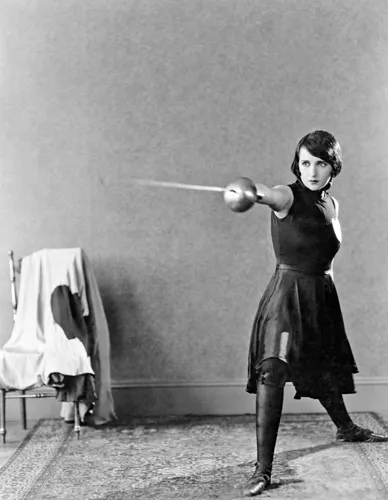
One of the most well-known performers of this era to wield a sword was the English actress Esme Beringer (1875–1972) (Figure 1.1). Ms. Beringer studied formally in London with two men who were prominent historians and fencers, Captain Alfred Hutton, who also arranged fights for her on stage, and Egerton Castle.12 She made her mark playing many roles that involved swordplay, including Shakespeare’s Romeo and Geoffrey in At the Point of the Sword, both in 1902. Castle seemed to be more concerned with the performance aspects of fight scenes. He believed there should be some psychological background to the violence, and that an actor simply drawing a sword or executing choreography was not enough. The performers must maintain an emotional connection to the character, even when fighting.13 Additionally, Sarah Bernhardt, in many of her roles, including the title role of Hamlet, picked up the sword on several occasions. Her final duel was actually captured on film and can be viewed here: www.youtube.com/watch?v=Mp_v_dP8s-8
FIGURE 1.1 Esme Beringer
We will pause a moment and look at the actual term “stage combat.” Today, it is a very common term in both theatrical and academic settings. It has come to, somewhat universally, signify a series of techniques that safely and truthfully depict a moment of violence. Throughout the history of the theatre, it has gone by many names, including “fencing,” “stage fighting,” “stage fencing,” and many others. The actual term has been in use as early as 1889. In his autobiography, the famous American actor Joseph Jefferson mentions an actor who was “a superb swordsman, and I do not remember to have seen a stage combat fought with finer effect.”14 In November of 1903, the New York Times published an article titled “Stage Combats with Sword, Rapier and Pistol – An Incident at the French Performance – Little Stories of Theatrical People.” It seems the term came to modern prominence in the mid-to-late 1960s. While there is no definitive etymology, and indeed it is still referred to by various names, stage combat is the most common nomenclature found in the industry.
As theatre training evolved in both England and the United States, fencing became a requisite asset, along with diction, dance, and general physical fitness, for any actor or actress with professional aspirations. By the early 20th century, fencing matches on stage looked to be merely that, a fencing match. Regardless of the period in which the play was set, the actors used French foils and adopted the stance of modern competitive fencers, as seen in this 1928 short film from British Pathe: www.britishpathe.com/video/thrust-and-parry/query/fencing
These concerns were addressed by American military fencing instructor Fred Gilbert Blakeslee in his 1905 book Sword Play for Actors: A Manual of Stage Fencing. This could be considered the first modern book published dealing exclusively with combat for the theatre. In the book, Blakeslee does deal with modern fencing and all the techniques surrounding that, but he also goes into detail about fighting with the great sword (medieval longsword), sword and buckler (small shield), the rapier, rapier and dagger, rapier and cloak, case of rapiers (a rapier in each hand), and the Restoration smallsword, all for the theatre.
Blakeslee lays out what he sees as the primary differences between fencing in the salle and fencing on the stage. He states: “In the presentation of a stage fight the first thing to always be considered is the period in which the play occurs, for this determin...
Table of contents
Cover
Half-Title
Title
Copyright
Contents
Introduction
1. What Is Stage Combat?: What Is a Fight Director?
2. Patrick “Paddy” Crean
3. Stage Combat in the UK: The Start of a New Era and the Growth of an Art Form
4. Stage Combat in the United States
5. Stage Combat in Canada
6. Stage Combat in Europe, Australia, and New Zealand
7. Outgrowths of Stage Combat
8. Tools of the Trade
Appendix
Bibliography
Index
Trusted by 375,005 students
Access to over 1.5 million titles for a fair monthly price.
Study more efficiently using our study tools.
Frequently asked questions
Yes, you can cancel anytime from the Subscription tab in your account settings on the Perlego website. Your subscription will stay active until the end of your current billing period. Learn how to cancel your subscription
No, books cannot be downloaded as external files, such as PDFs, for use outside of Perlego. However, you can download books within the Perlego app for offline reading on mobile or tablet. Learn how to download books offline
Perlego offers two plans: Essential and Complete
Essential is ideal for learners and professionals who enjoy exploring a wide range of subjects. Access the Essential Library with 800,000+ trusted titles and best-sellers across business, personal growth, and the humanities. Includes unlimited reading time and Standard Read Aloud voice.
Complete: Perfect for advanced learners and researchers needing full, unrestricted access. Unlock 1.5M+ books across hundreds of subjects, including academic and specialized titles. The Complete Plan also includes advanced features like Premium Read Aloud and Research Assistant.
Both plans are available with monthly, semester, or annual billing cycles.
We are an online textbook subscription service, where you can get access to an entire online library for less than the price of a single book per month. With over 1.5 million books across 990+ topics, we’ve got you covered! Learn about our mission
Look out for the read-aloud symbol on your next book to see if you can listen to it. The read-aloud tool reads text aloud for you, highlighting the text as it is being read. You can pause it, speed it up and slow it down. Learn more about Read Aloud
Yes! You can use the Perlego app on both iOS and Android devices to read anytime, anywhere — even offline. Perfect for commutes or when you’re on the go. Please note we cannot support devices running on iOS 13 and Android 7 or earlier. Learn more about using the app
Yes, you can access A History of Contemporary Stage Combat by Brian LeTraunik in PDF and/or ePUB format, as well as other popular books in Media & Performing Arts & Acting & Auditioning. We have over 1.5 million books available in our catalogue for you to explore.