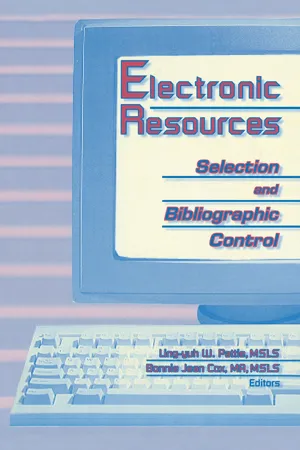
Electronic Resources
eBook - ePub

Electronic Resources

Selection and Bibliographic Control

  1. 268 pages
  2. English
  3. ePUB (mobile friendly)
  4. Available on iOS & Android
eBook - ePub

Electronic Resources

Selection and Bibliographic Control

About this book

The universe of electronic resources is indeed diverse, expansive, intimidating, and unstructured compared to the finite, prepackaged print world upon which the information delivery infrastructure has been constructed. Electronic Resources: Selection and Bibliographic Control addresses the resultant concerns of information professionals as they struggle to define, select, and control electronic resources in libraries and information centers today. This book offers readers an overview of issues and provides a common ground for deliberations and decisionmaking. Librarians and students concerned with the Internet and related issues will appreciate the broad scope and in-depth discussions in Electronic Resources: Selection and Bibliographic Control. From both conceptual and pragmatic standpoints, this book enlightens the reader on such topics as:

  • Internet resources
  • the relationship between OPAC and Internet
  • Standard Generalized Markup Language (SGML) versus USMARC
  • Text Encoding Initiative (TEI)
  • Core Language and the Information Bus
  • Dublin Core Metadata as a discovery/retrieval tool
  • decision-making matrix model
  • e-texts and e-theses
  • digital materials and digital librariesThis book also gives the reader an inside look at a number of specific emerging projects from around the world. Highlighted here are the CATRIONA project from the U.K.--designing an Internet discovery and retrieval system; the ALCUIN project--using traditional infrastructure to handle Internet resources; the Center for Electronic Texts in the Humanities (CETH) and the Electronic Text Center at the University of Virginia; the OCLC Internet Cataloging project; and the National Digital Library Program (NDLP), Encoded Archival Description (EAD), and electronic CIP projects at the Library of Congress.Electronic Resources: Selection and Bibliographic Control clearly illustrates the evolving role of librarian fro

Frequently asked questions

Yes, you can cancel anytime from the Subscription tab in your account settings on the Perlego website. Your subscription will stay active until the end of your current billing period. Learn how to cancel your subscription.
No, books cannot be downloaded as external files, such as PDFs, for use outside of Perlego. However, you can download books within the Perlego app for offline reading on mobile or tablet. Learn more here.
Perlego offers two plans: Essential and Complete
  • Essential is ideal for learners and professionals who enjoy exploring a wide range of subjects. Access the Essential Library with 800,000+ trusted titles and best-sellers across business, personal growth, and the humanities. Includes unlimited reading time and Standard Read Aloud voice.
  • Complete: Perfect for advanced learners and researchers needing full, unrestricted access. Unlock 1.4M+ books across hundreds of subjects, including academic and specialized titles. The Complete Plan also includes advanced features like Premium Read Aloud and Research Assistant.
Both plans are available with monthly, semester, or annual billing cycles.
We are an online textbook subscription service, where you can get access to an entire online library for less than the price of a single book per month. With over 1 million books across 1000+ topics, we’ve got you covered! Learn more here.
Look out for the read-aloud symbol on your next book to see if you can listen to it. The read-aloud tool reads text aloud for you, highlighting the text as it is being read. You can pause it, speed it up and slow it down. Learn more here.
Yes! You can use the Perlego app on both iOS or Android devices to read anytime, anywhere — even offline. Perfect for commutes or when you’re on the go.
Please note we cannot support devices running on iOS 13 and Android 7 or earlier. Learn more about using the app.
Yes, you can access Electronic Resources by Ling Yuh W Pattie,Bonnie J Cox in PDF and/or ePUB format, as well as other popular books in Computer Science & Library & Information Science. We have over one million books available in our catalogue for you to explore.

Index

Page numbers in italics indicate figures; page numbers followed by "t" indicate tables.
AACR2. see Anglo-American Cataloging Rules
Abstracts, for e-theses, 110111
Access. see also Bibliographic control
in Alcuin Project, 165166
in Australia, 8790
in CATRIONA model, 134135, 139
e-theses information, 114
to Internet resources, 203206, 226
to University of Virginia Library, 7678
Access control, in CATRIONA model, 134135
Access time, in Stanford Integrated Digital Library Project, 68t, 69
Acquisitions. see Selection
Acrobat, 108, 122123
Addresses, 204205, 220221. see also Electronic mail; URL
Adelaide, University of, 93
Adobe Acrobat, 108, 122123
ALAWON MARC record, 150151, 152-154
Alcuin Project, 5, 149168
access in, 165166
adding items, 165
Alex and gateway scripts, 151, 158-164
Alex and Hunter Monroe database, 149150
formalizing, 160
gateway scripts and, 150, 152-157
process, 166167
purpose, 166
selection in, 160, 164-165
URLs, 167168
Alcuin’s Little Helper, 151, 160, 161-163, 165
Alex database, 149160
ALIWEB, address, 230231
Anglo-American Cataloging Rules (2d., rev.) (AACR2), 4, 7, 48, 100
fore-theses, 110114
OCLC Internet cataloging projects, 217219
Archie, 213214, 216t
Archival materials, 27
microform sets, 100
SGML Document Type Definition, 174175
ASCII, vs. PDF, 108
Australia, 6, 8596
access networks, 8788
bibliographic control, 8587
government policy, 87
indexes, 9093
libraries, 9...

Table of contents

  1. Cover
  2. Half Title
  3. Title Page
  4. Copyright Page
  5. Table of Contents
  6. About the Editors
  7. Foreword
  8. Introduction
  9. Selecting Electronic Resources: Developing a Local Decision-Making Matrix
  10. Intellectual Access to Digital Documents: Joining Proven Principles with New Technologies
  11. Metadata for Internet Resources: The Dublin Core Metadata Elements Set and Its Mapping to USMARC
  12. Cataloging for Digital Libraries
  13. Selection, Access, and Control in a Library of Electronic Texts
  14. Control of Electronic Resources in Australia
  15. “Parallel Universes” or Meaningful Relationships: Envisioning a Future for the OPAC and the Net
  16. Electronic Theses and Dissertations: Merging Perspectives
  17. Catriona: A Distributed, Locally-Oriented, Z39.50 OPAC-Based Approach to Cataloguing the Internet
  18. Possible Solutions for Incorporating Digital Information Mediums into Traditional Library Cataloging Services
  19. Cataloging at the Library of Congress in the Digital Age
  20. Cataloging Internet Resources: The Convergence of Libraries and Internet Resources
  21. Index