Anyone who deals with people from different cultures needs intercultural communication skills whether they are in the workplace, on a business trip overseas, dealing with foreign guests or simply socializing with friends. This is not just a matter of knowing how to bow in Japan or what gifts to give in Korea. Rather, it is necessary to understand the dynamics of different cultures and intercultural communication.
Communicating with Asia is a comprehensive guide to cultural literacy for Australians who deal with Asians and vice versa. It is abundantly illustrated with examples from Japan, China, Hong Kong, Taiwan, Singapore, Malaysia, Thailand, Indonesia and other countries.
- 200 pages
- English
- ePUB (mobile friendly)
- Available on iOS & Android
eBook - ePub
About this book
Information
CHAPTER 1
The intercultural communication imperative
Human beings draw close to one another by their common nature, but habits and customs keep them apart.
Confucian saying
What breeds conflict is the contradiction between growing economic independence and enduring cultural differences. Nations are increasingly interconnected economically but remain divided by religion, ethnicity and history.
Robert Samuelson, 1990
Business cards-meishi-are essential in doing business with the Japanese. If you don’t have meishi, don’t bother showing up. You’ll only be ignored. Don’t write on a meishi; doing so is tantamount to writing on the face of the person who gave it to you. Don’t put the card in your back pocket, sitting on it is even more offensive than writing on it.
Japan Air Lines brochure, 1994
What is ‘Asia’?
While some argue that Australia is a part of Asia and others answer that such a claim is geographically, historically and culturally absurd, there can be no denying that Australia’s future is inextricably linked with that of Asia. Commonplace labels like ‘Asia-Pacific’, ‘Pacific Rim’, ‘Pacific Basin’, and the more recent ’Asia-South Pacific’ are all used to include Australia along with the nations of Northeast and Southeast Asia. The labels vary according to whether countries like Canada, the United States (US), Mexico or Chile are included in the grouping.
The label Asia is problematic. ‘Asia’ may be ‘a useful piece of shorthand, but it is a wholly European construct, slightly more relevant than “The East” or worse still, the “Far East” but still blurring fundamental differences within the region’ (Milson 1993, p. 27). While ‘Asia’ refers to that large part of the world where Asianness predominates, Asia has no clear boundaries. What is included in, and thus excluded from, Asia, is often a matter of personal preference or a decision taken according to the purpose of an argument.
A danger of ‘thinking Asia’ is to think, erroneously, of an amorphous mass, homogeneous in the majority of its characteristics. Even those who know and understand Asia well occasionally fall into that trap. For example, a former secretary of the Australian Department of Foreign Affairs and Trade, a member of numerous trade and diplomatic missions to Asian countries, wrote in a recent Bulletin/Newsweek article (Woolcott 1993, p. 28) that ‘as Asia matures as a nation, it will …’ (emphasis added). Asia is no more a nation than is Europe. Asia is a collection of nations, at least as it is constructed in Western minds. Although these Asian nations have much in common, they are as different from one another as are the nations of Europe. The diversity of Asia is important to keep in mind throughout all discussions of communication across cultural boundaries.
For the purposes of this book, Asia is taken to include the countries that are generally grouped as Northeast Asia and Southeast Asia and which thus share Pacific Ocean contact with Australia. Included are Japan, China (PRC), Korea (ROK), Taiwan, Hong Kong, Laos (which has no coastline), Vietnam, Thailand, Cambodia, Singapore, Malaysia, the Philippines and Indonesia. Excluded here are the West-Asian countries of India and Myanmar (formerly Burma) and Middle Eastern countries, including Turkey (Asia Minor), which have been included by some within the boundaries of Asia as they would wish to define it. Thus, the view adopted in this book is that which might be labelled ‘East Asia’ or ‘Pacific Asia’, that is, the Asia of the Asia-Pacific or the Pacific Rim.
Asia and Australia
Australia is actively realigning economically, socially, psychologically and culturally with Asia after a period of nearly 200 years of existence as-in the words of Peter Luck, producer of the 1988 Bicentennial television series A Time to Remember-a ‘ship of fools’, a ‘hermetically sealed, largely European time capsule on the bottom of the world’ (1991, p. iii).
Paradoxically, changes in the world order have placed Australia more distant from Europe than it has ever been despite impressive advances in transport and information technology (IT) and the ‘shrinking globe’. Geographical proximity and a high level of complementarity in economic activity have encouraged and facilitated trade to the extent that Australia’s major trading partners are now Asian nations. Table 1.1 illustrates the relative importance of Asian countries as destinations of exports and sources of imports in Australian merchandise trade in recent years. In 1992–93, the countries listed took 58 per cent of Australia’s exports and accounted for 39 per cent of Australia’s imports. The data make clear the crucial importance of Japan as a trading partner, and the growing significance to Australia of all the Asian countries listed.
| $ million | Percentage of total | |||||
|---|---|---|---|---|---|---|
| 1990–91 | 1991–92 | 1992–93 | 1990–91 | 1991–92 | 1992–93 | |
| | ||||||
| Exports | ||||||
| China | 1348 | 1458 | 2268 | 3 | 3 | 4 |
| Hong Kong | 1560 | 2106 | 2596 | 3 | 4 | 4 |
| Japan | 14378 | 14574 | 15;?04 | 27 | 26 | 25 |
| Korea | 3237 | 3365 | 3969 | 6 | 6 | 7 |
| Taiwan | 1962 | 2519 | 2682 | 4 | 5 | 4 |
| Indonesia | 1462 | 1627 | 1715 | 3 | 3 | 3 |
| Malaysia | 985 | 1103 | 1310 | 2 | 2 | 2 |
| Singapore | 2769 | 3189 | 3781 | 5 | 6 | 6 |
| Thailand | 665 | 816 | 1:?05 | 1 | 1 | 2 |
| Other ASEAN | 452 | 532 | 650 | 1 | 1 | 1 |
| 58% | ||||||
| Imports | ||||||
| China | 1503 | 1976 | 2557 | 3 | 4 | 4 |
| Hong Kong | 741 | 792 | 796 | 2 | 2 | 1 |
| Japan | 8849 | 9290 | 11139 | 18 | 18 | 19 |
| Korea | 1254 | 1213 | 1696 | 3 | 2 | 3 |
| Taiwan | 1752 | 1979 | 2213 | 4 | 4 | 4 |
| Indonesia | 784 | 995 | 1305 | 2 | 2 | 2 |
| Malaysia | 732 | 867 | 974 | 1 | 2 | 2 |
| Singapore | 1271 | 1301 | 1509 | 3 | 3 | 3 |
| Thailand | 505 | 647 | 756 | 1 | 1 | 1 |
| Other ASEAN | 170 | 225 | 227 | – | – | – |
| 39% | ||||||
Source: Modified from Foreign Trade, Merchandise Exports and Imports Australia, 1993 (ABS Catalogue 5410.0).
There is widespread recognition of Asia’s dynamic growth and place in the new world order. In the 1970s and 1980s, total output of the region expanded six-fold and trade with the region expanded twelve-fold. The economies of Asia account for half of global production and over 40 per cent of global trade. In the 1990s Japan’s economic power is likely to grow further and the four economic ‘tigers’ of Asia-Korea, Taiwan, Singapore and Hong Kong-are well positioned to seriously chase Japan’s development. China is undergoing an unprecedented period of economic advancement, four ‘tiger cubs’ are emerging in the ASEAN (Association of Southeast Asian Nations) growth economies of Thailand, Malaysia, Indonesia and the Philippines (Cragg, 1992), and Vietnam is developing rapidly.
While Asia-Australia trade has involved conventionally exchanged commodities like cars, electronic goods, coal and wheat, it has also increasingly involved the provision of tourism and travel services and, from Australia’s point of view, the ‘export’ of education. As well, there has been significantly increased immigration to Australia.
Ignorance of Asia will need to be overcome quickly if maximum benefit for all is to flow from the new opportunities provided by dramatic increases in trade and cross-cultural contact. Individuals and organisations face significant and immediate challenges if they are to be successful in the intercultural communication which will be demanded in the forthcoming Pacific Century.
Within Australia, there are frequent calls for a more positive approach to Asia and effort to penetrate its mysteries. An editorial on doing business with Asian neighbours in the Australian (20 December 1991) drew attention to the diffidence of Australian business towards grasping Asian business opportunities. That diffidence was explained as arising from shyness, ignorance and a (misplaced) sense of superiority along with the legacy of discriminatory policies of a long succession of Australian governments. The writer argued that Australians have failed to come to terms with the whole range of diverse cultures, politics, religions and social organisations of Asia. Nor have they understood the social and familial courtesies of Asian societies, social customs and etiquette related to the negotiation of business contracts, women’s status and issues relating to such matters as dress and humour. Asia continues as a mystery, even to those who live close by.
A conference on Asia’s relations with Pacific nations, held in Sydney late in 1992, arrived at similar conclusions (Williams 1992). One speaker, the head of the Asia-Australia Institute at the University of New South Wales (UNSW), reported research that revealed Australian senior managers held naive views about Asia. They tended to see Asia as an ‘amorphous mass’ without any clear differentiation of its diversity and to hold the vague view that Asian nations were becoming ‘like the West’.
Recent world economic history has been characterised by a move to freer trade, economic co-operation and the development of trading blocs and economic consultative forums. Membership of five Asia-Pacific region forums-Association of Southeast Asian Nations (ASEAN); ASEAN Free Trade Area (AFTA); North American Free Trade Agreement (NAFTA); East Asian Economic Caucus (EAEC); and Asia-Pacific Economic Cooperation (APEC) forum-is shown in Figure 1.1. Australia’s economic future is closely tied to membership of some of these groups and to interaction with all of them. Given the overlapping and interlocking membership of these organisations and that the dynamism of economic development throughout Asia is such that forum membership is likely to change frequently, Australia, more than ever before, will need to interact effectively with all Asian nations.
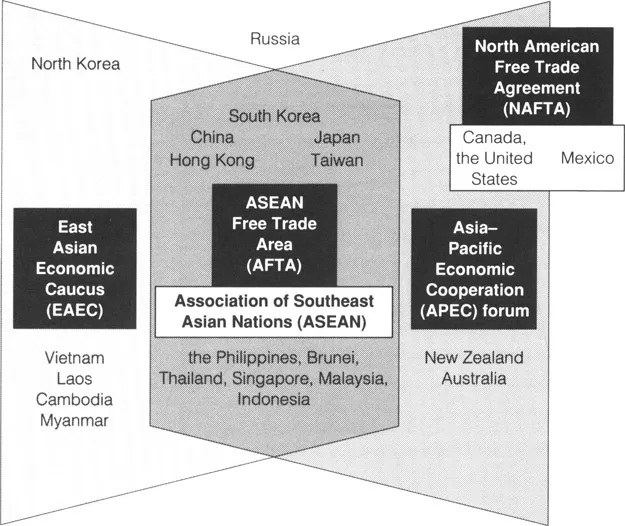
Figure 1.1 Economic consultative forums in the Asia-Pacific region
Source: ASEAN ‘93 Supplement, Japan Times, 4 November 1993.
It is interesting to note that Asian nations that have long histories of living separately are now discovering one another as tourist destinations, and are discovering the fascinating differences between their cultures as expressed in the visual and performing arts, and in culinary diversity. In 1992 nearly 12 million Japanese travelled overseas and, from the ASEAN nations, about 2.45 million people (Singapore 1 million; Thailand 568 000; Indonesia 400 000; Malaysia 248 000; the Philippines 220 000) travelled abroad. Much of this travel was within the Asia-Pacific. Several Asian countries-most notably Japan-have experienced what they have termed an ‘ethnic boom’ involving the appearance of ethnic restaurants, the performance of theatre, dance and music across national boundaries, travelling art and film festivals and cultural exchanges (Nakamura 1993).
Travel and tourism between Australia and Asian nations is occurring at an unprecedented level and is increasing rapidly. Australia has become a major travel destination for Asians. According to data from the Australian Tourist Commission (Harris & Farmer 1993, p. 1 and p. 4), almost 500 000 Japanese visited Australia in the first nine months of 1993. During the same period visitors from other Asian countries included: 9...
Table of contents
- Cover
- Half Title
- Title Page
- Dedication Page
- Contents
- Acknowledgements
- List of tables and figures
- Abbreviations
- 1 The intercultural communication imperative
- 2 Understanding intercultural communication
- 3 Customs
- 4 Identities
- 5 Achieving cultural literacy
- References
- Index
Trusted by 375,005 students
Access to over 1.5 million titles for a fair monthly price.
Study more efficiently using our study tools.
Frequently asked questions
Yes, you can cancel anytime from the Subscription tab in your account settings on the Perlego website. Your subscription will stay active until the end of your current billing period. Learn how to cancel your subscription
No, books cannot be downloaded as external files, such as PDFs, for use outside of Perlego. However, you can download books within the Perlego app for offline reading on mobile or tablet. Learn how to download books offline
Perlego offers two plans: Essential and Complete
- Essential is ideal for learners and professionals who enjoy exploring a wide range of subjects. Access the Essential Library with 800,000+ trusted titles and best-sellers across business, personal growth, and the humanities. Includes unlimited reading time and Standard Read Aloud voice.
- Complete: Perfect for advanced learners and researchers needing full, unrestricted access. Unlock 1.5M+ books across hundreds of subjects, including academic and specialized titles. The Complete Plan also includes advanced features like Premium Read Aloud and Research Assistant.
We are an online textbook subscription service, where you can get access to an entire online library for less than the price of a single book per month. With over 1.5 million books across 990+ topics, we’ve got you covered! Learn about our mission
Look out for the read-aloud symbol on your next book to see if you can listen to it. The read-aloud tool reads text aloud for you, highlighting the text as it is being read. You can pause it, speed it up and slow it down. Learn more about Read Aloud
Yes! You can use the Perlego app on both iOS and Android devices to read anytime, anywhere — even offline. Perfect for commutes or when you’re on the go.
Please note we cannot support devices running on iOS 13 and Android 7 or earlier. Learn more about using the app
Please note we cannot support devices running on iOS 13 and Android 7 or earlier. Learn more about using the app
Yes, you can access Communicating with Asia by Harry Irwin in PDF and/or ePUB format, as well as other popular books in Social Sciences & Communism, Post-Communism & Socialism. We have over 1.5 million books available in our catalogue for you to explore.