If you're studying part time you're probably juggling study with work or family commitments or both. You need to make every minute count.
Studying Part Time Without Stress shows you how to make the most of your time from day one. It explains how you can identify your own learning style and take advantage of your strengths. It gives you the tools to develop the academic skills you need, and suggests short-cuts you can use every day.
With tips based on the experiences of the many students she has counselled, Teresa De Fazio explains how to:
* Choose the right course
* Maintain your motivation
* Avoid stress
* Use technology effectively
* Read efficiently
* Write essays, reports and theses
* Give presentations
* Do well in exams
Written for students taking courses at all levels at college and at university, Studying Part Time Without Stress will help you succeed in your study-without losing control of your life!
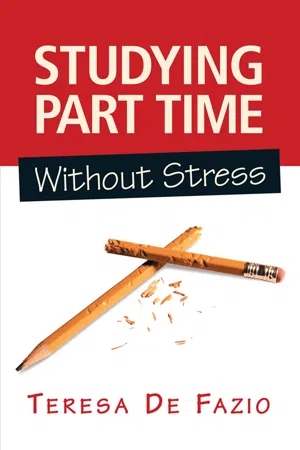
- 216 pages
- English
- ePUB (mobile friendly)
- Available on iOS & Android
eBook - ePub
Studying Part Time Without Stress
About this book
Information
1
Choosing to study part time
A wise man will make more opportunities than he finds.
Francis Bacon, Of Ceremonies and Requests
Universities and colleges are becoming more responsive to training, vocational and commercial factors and offer a broader range of courses and delivery modes than a few years ago. Colleges and universities can seem rather daunting in terms of the number of departments, information services, student support services and other aspects that make up study life. This chapter looks at issues in navigating through the system to make it work for you. It outlines course delivery modes and the kinds of support offered. Knowing how the academic system works will ensure that you make effective use of your time and energy.
CHOOSING TO STUDY
Before you commit yourself to studying part time you need to carefully consider the reason behind your decision in terms of what you want to achieve. You may be motivated to study for practical reasons—for a promotion or to expand your work opportunities. You may be determined to study because you have never had the opportunity before and want to prove you can do it. It might be that pure interest and a desire to learn more about a discipline are driving you. Your motivation may be a combination of work-oriented reasons and personal interest. Certainly, having a healthy interest in the subjects you choose helps to maintain the motivation levels to get through what might be a number of years devoted to study, although some students do very well when driven to study purely as a means to a work-related end. While there is no right or wrong reason for studying, keeping in mind the rationale behind undertaking a course will help you maintain focus. The checklist below may help you identify your underlying reasons.
✓ CHECKLIST: REASONS FOR CHOOSING TO STUDY
- ❑ To learn about a particular topic
- ❑ To upgrade my skills
- ❑ To upgrade my qualifications
- ❑ To meet others in my field
- ❑ To widen my area of interests
- ❑ To learn or sharpen my study skills
- ❑ To extend my intellectual interests and skills
- ❑ To prove to myself I can do it
- ❑ To prove to others I can do it
- ❑ To make new friends
- ❑ To get a promotion
- ❑ To widen my work opportunities
CHOOSING A COURSE
Once you have considered your reasons for taking up study you are in a better position to work out your study pathway. If you want to study purely for interest’s sake, it might not matter that you take a sprinkling of courses in different disciplines, say languages, biomedicine, chemistry and dramatic arts. If you are motivated by vocational or further educational purposes then you should consider arranging your pathway so that the course and subjects you select provide you with the skills and knowledge (and perhaps networks) you need to pursue your objectives.
There are a huge number of courses available from numerous academic institutions. Through distance learning programs you may select a course in another part of the country or even overseas. With so much choice the selection process can be rather difficult. Below is a checklist to help you ascertain the best course for you.
✓ CHECKLIST: CHOOSING THE RIGHT COURSE
- ❑ Do you know what the course involves? You need to do more than just read the title and brief description provided in the course handbook or leaflet. Talk to the course coordinator about the topics covered, previous study or experience required, assessment tasks and set reading.
- ❑ Do the subjects interest you? Are they of value to your study objectives?
- ❑ Do the subjects make up a solid program that will assist you on your study pathway?
- ❑ Will you be able to gain any credits towards the completion of the course as a result of past studies or experience in the field? (See Recognition of prior learning on p. 9)
- ❑ Do you need to take any preparatory courses? You might consider taking a summer school course if you have no experience with a particular subject; for instance, if you are doing a postgraduate course which involves research you might choose to do an introductory research methodology course during the summer months. You should talk to the course coordinator regarding the need to undertake preparatory courses.
Using handbooks
Institutional handbooks provide a useful outline of the courses offered and the topics covered in each course. If the topics are not detailed in the handbook it might be worthwhile contacting the course coordinator to find out more. Most lecturers or course coordinators will be able to provide you with a more detailed outline and answer questions regarding preparatory reading, assessment and entry requirements. Handbooks also explain the different degree programs and entry requirements, institutional regulations and particular study options you may wish to take up, such as distance mode, flexible mode, recognition of prior learning, return-to-study programs and so on. Handbooks can be purchased from the institutional bookshop or may be consulted in the library. Course information is usually available online as well. Most institutions will have their handbooks or course outlines available from a link on their homepage.
CHOOSING YOUR SUBJECTS
Every course is made up of a number of subjects. In some courses you must take every prescribed subject, in others you have many options. The subjects must be selected carefully, according to your study purpose and interests. Some might be very appealing in terms of their content and your personal interests, but consider their practicality for your purposes, and the demands on your time—the scheduling of classes, the number of classes you need to attend, the delivery mode (distance or face-to-face), assessment requirements and so on. You might be tempted to do a number of interesting but rather demanding subjects in one year or semester. A knowledge of the practical aspects involved may suggest it would be better to stagger them over a longer period.
FLEXIBLE LEARNING PROGRAMS
Undertaking a flexible learning program means that you do not necessarily have to undertake a course according to a rigid, systematic pathway but can choose, within reason, to customise a course to suit your study situation and study purposes. These days interdisciplinary study programs are quite common, that is, programs that do not lock you into taking, for instance, a strict business course. Instead you may take integrated studies that include units on psychology and a language as well as business-oriented subjects. Depending on previous experience and study you may not have to undertake every unit in the course (see Recognition of prior learning, below). You might be able to undertake units either in semester breaks or during intensive sessions held during summer or winter breaks. Every institution has different policies regarding the flexibility of a program, and this aspect is worth looking into.
DISTANCE LEARNING
Many tertiary institutions offer subjects or whole courses by distance. This might mean that documents are sent out to you by mail, or that you can access subject information over the Internet, or a combination of the two. Some institutions arrange for local tutors to be available to assist with tasks and assignments. As technology is integrated into education, different equipment is coming into use; for instance, some lectures are held via video-conferencing. It is important to clarify how the subjects are organised if you are thinking of taking up a course by distance education. Ask about what you can expect in terms of learning materials, assistance with tasks, access to lecturers, the sort of services you have access to (library, study groups, etc.) and the equipment you will need. Importantly, consider whether the distance mode suits you. Are you good at working alone, for instance, or do you need the stimulus of face-to-face interaction?
RECOGNITION OF PRIOR LEARNING
Recognition of prior learning (RPL) is a process by which you can obtain credit towards a degree for past courses or subjects studied, or for relevant work experience. You need to provide evidence of such studies or experience: certificates you have been awarded or a statement of results, or a letter from your employer that outlines the duties in which you are involved. You may be credited with equivalent points instead of actually undertaking all or part of a subject.
ENROLLING, WITHDRAWING, DEFERRING
Student expectations of the value of a course may not match its reality. It is always worth asking about the cut-off date for withdrawing from a course; if you leave it too late you may find that a fail result appears on your academic records instead of a witdrawal. Sometimes it is not possible to continue studying a subject because of illness, family responsibilities or a change in your work situation. Talk to your lecturer about your circumstances to see if there is any way of salvaging the situation (late submission of work, for instance). Otherwise it is worth deferring a subject or withdrawing from the whole course rather than failing completely (again check for the cut-off date). Disappearing from a course and then reappearing can be rather confusing so let the lecturer(s) involved know that you intend to resume studies at a later date.
FINANCING YOUR STUDIES
Scholarships and bursaries are a way of easing the financial burden of studying. They may be funded by various institutions as well as by the educational institution itself—for instance, community groups such as Rotary, and pharmaceutical companies. Tertiary institution websites have information on general and institutional scholarships and grants or check with the student services officer or postgraduate officer at the institution in which you are enrolled (or will enrol) for details. If you find that financing your studies becomes difficult, rather than dropping out speak to someone in student services; there may be some assistance available in the form of student loans.
SUPPORT SERVICES
Most tertiary institutions provide a number of student support services and you should never feel embarrassed about accessing them. They are there because there is a need.
Learning support
Seek guidance from learning support advisors. They are there to help all students, not just students with second-language problems (as is sometimes believed). Even students who are doing well in their studies find that some tasks are difficult—exam preparation, for instance, reading skills or essay planning. It is important to get guidance on study issues that are concerning you.
Disability support
The disability support office is there to provide guidance a...
Table of contents
- Cover
- Half Title
- Title Page
- Dedication Page
- Contents
- Acknowledgments
- Introduction
- 1 Choosing to study part time
- 2 Yourself as learner and critical thinker
- 3 Organising your study time
- 4 Participating in classes
- 5 Reading and note-taking
- 6 Developing your writing skills
- 7 Essay writing
- 8 Report writing
- 9 Referencing
- 10 Exams
- 11 Research projects and theses
- 12 Using technology
- Appendices
- Glossary
- References
- Index
Trusted by 375,005 students
Access to over 1.5 million titles for a fair monthly price.
Study more efficiently using our study tools.
Frequently asked questions
Yes, you can cancel anytime from the Subscription tab in your account settings on the Perlego website. Your subscription will stay active until the end of your current billing period. Learn how to cancel your subscription
No, books cannot be downloaded as external files, such as PDFs, for use outside of Perlego. However, you can download books within the Perlego app for offline reading on mobile or tablet. Learn how to download books offline
Perlego offers two plans: Essential and Complete
- Essential is ideal for learners and professionals who enjoy exploring a wide range of subjects. Access the Essential Library with 800,000+ trusted titles and best-sellers across business, personal growth, and the humanities. Includes unlimited reading time and Standard Read Aloud voice.
- Complete: Perfect for advanced learners and researchers needing full, unrestricted access. Unlock 1.5M+ books across hundreds of subjects, including academic and specialized titles. The Complete Plan also includes advanced features like Premium Read Aloud and Research Assistant.
We are an online textbook subscription service, where you can get access to an entire online library for less than the price of a single book per month. With over 1.5 million books across 990+ topics, we’ve got you covered! Learn about our mission
Look out for the read-aloud symbol on your next book to see if you can listen to it. The read-aloud tool reads text aloud for you, highlighting the text as it is being read. You can pause it, speed it up and slow it down. Learn more about Read Aloud
Yes! You can use the Perlego app on both iOS and Android devices to read anytime, anywhere — even offline. Perfect for commutes or when you’re on the go.
Please note we cannot support devices running on iOS 13 and Android 7 or earlier. Learn more about using the app
Please note we cannot support devices running on iOS 13 and Android 7 or earlier. Learn more about using the app
Yes, you can access Studying Part Time Without Stress by Teresa De Fazio in PDF and/or ePUB format, as well as other popular books in Study Aids & Education General. We have over 1.5 million books available in our catalogue for you to explore.