This book presents an emotion centered research framework titled "emoha" for design innovation. It defines emoha and underlines the importance of the developed framework in culturalization of technology and thereby design innovation. The book explains the detailed research on product styling which leads to the creation of "Emoha" and how to use it in product design.
- 228 pages
- English
- ePUB (mobile friendly)
- Available on iOS & Android
eBook - ePub
Managing Emotion in Design Innovation
About this book
Trusted by 375,005 students
Access to over 1 million titles for a fair monthly price.
Study more efficiently using our study tools.
In this introductory chapter, the fundamental concept of the book is augmented through two exploratory studies of Social Cultural Segmentation of Biking in India and Styling Differences within the Biking Segments, done by the author which lead to an understanding of the core concept of emotion-centered product styling, with a specific emphasis on bikes.
1.1 Importance of Emotions in Product Styling
Styling is an integral part of any product design and development process. During the styling process, a designer imparts emotive qualities to products. With the diminishing technological differences among products, these emotive qualities (or “emotional benefits” as referred by Desmet, 2002) play an increasingly significant role in enhancing the desirability and sense of ownership toward the product. This therefore increases the certainty of the product’s success in the marketplace. Knowledge of these emotive qualities would certainly enhance designers’ competency in styling products for different ownership experiences.
However, the absence of quantitative tools to evaluate and determine the emotive quality required in products leads to uncertainty in the styling process. Also, the great diversity in people’s preferences and product styles makes it extremely difficult to study the emotive quality of each product ownership experience. Therefore, investigating the set of emotive-quality-of-ownership experiences associated with a specific product category in a specific market becomes indispensable to any product styling.
This book introduces a methodology in the form of a framework that can potentially be applied across different product categories in different markets. It is in this context that this work deals with the study of motorbikes in the social cultural environment of the Indian two-wheeler market.
1.2 Need for Studying Emotions Associated with Motorbikes
Vehicles constitute a category of products that give a quantum jump to the social mobility and professional reach of individuals by facilitating the projection of their self to the outside world. In the process, vehicles become a part of users’ personality and in turn an expression of their emotions. Motorbikes, being one of the most popular vehicles, reflect the emotions of millions of riders across the world (Figure 1.1).
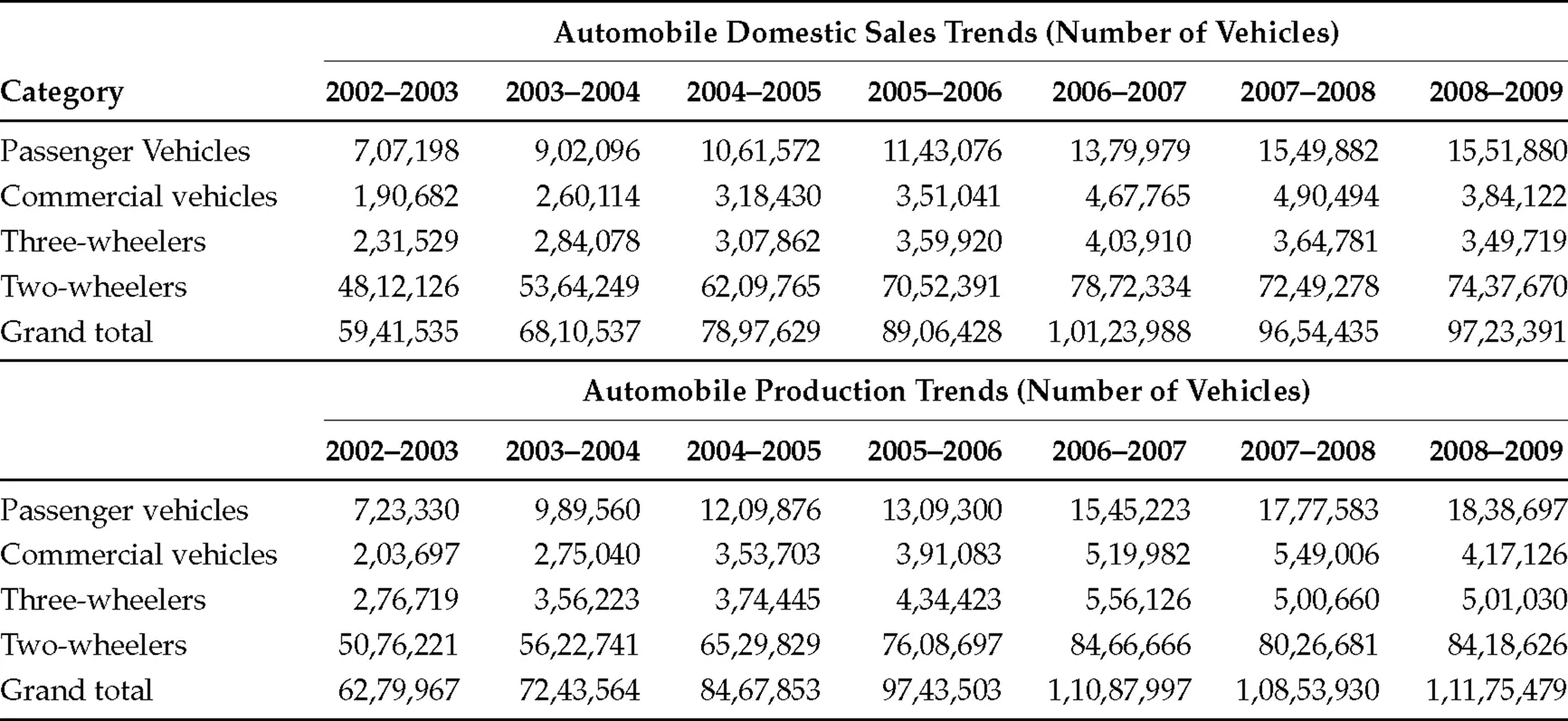
According to the Automotive Mission Plan 2006–2016 (AMP, 2006), released by the Department of Heavy Industries, Government of India, Asia, with a 90% global market share, is the major producer of motorbikes in the world. Within Asia, China accounts for largest motorbike production followed by India. Out of the 40 million motorbikes that were produced globally in 2005, 7.7 million units were produced in India alone (AMP, 2006). As per the AMP report, the automobile industry is expected to grow from 34 billion USD (5% of the GDP) in 2006 to 145 billion USD (10% of the GDP) in 2016. As shown in Table 1.1, the two-wheelers sales in India grew from 48,12,126 vehicles in 2002–2003 to 74,37,670 vehicles in 2008–2009. More than 88% of the two-wheelers were produced in India in 2008–2009 were sold in domestic markets (Table 1.1).
According to the Society of Indian Automobile Association (SIAM, 2009), two-wheelers (primarily motorbikes) constitute more than 76% of the totalautomobile sales and are therefore seen as significant drivers for economic growth in India at present and in the future (Figure 1.2). Unlike the West, where motorbikes are essentially used for fun and sports, in India these are the most common mode of personal transport. The surge in the number of people with growing aspirations and high purchasing power, along with strong economic growth, over the past few years has attracted major motorbike manufacturers to the Indian market. Companies have put in much-needed investments in R&D, realizing that product design, development, and innovations are crucial for surviving the competitiveness in the industry. With the increase in competition and diminishing technological differences, design rather than technology has become the prime differentiator among various products (Dumanine, 1991; Thackara, 1997, as cited in Desmet, 2002). This is also seen in the case of motorbikes in India. The use of design as a strategic tool for business advantage offers a range of choices to Indian consumers. More than 100 motorbike models are seen on Indian roads, which are primarily differentiated by users on the basis of their aesthetic and emotive qualities in the first instance.

FIGURE 1.1 (See color insert)
Motorbike is an expression of rider’s emotions. (From Sunil Gupta of xbhp.com, personal communication, Jan. 27, 2013.)
Motorbike is an expression of rider’s emotions. (From Sunil Gupta of xbhp.com, personal communication, Jan. 27, 2013.)
TABLE 1.1
Automobile Domestic Sales and Production Trend for India
Automobile Domestic Sales and Production Trend for India
Source: Retrieved May 12, 2009, from http://www.siamindia.com/scripts/domestic-sales-trend.aspx.

FIGURE 1.2 (See color insert)
Category-wise market share of automobiles in India in 2008–2009. (Retrieved May 12, 2009, from http://www.siamindia.com/scripts/market-share.aspx.)
Category-wise market share of automobiles in India in 2008–2009. (Retrieved May 12, 2009, from http://www.siamindia.com/scripts/market-share.aspx.)
It is seen that while several motorbikes are introduced in the Indian market every year, only a few may evoke sustained emotional attachment among a large number of customers. The motorbike industry in India and in Southeast Asia is essentially a volume-driven industry, and a certain critical sales figure is a prerequisite to justify the expenditure incurred on product development. The failure of a motorbike model to satisfy the needs and aspirations of the prospective owner can critically dent the manufacturer’s business objectives. It is for this reason that most unsuccessful motorbike models are often relaunched with frequent styling changes in the hope of enticing the customers and rationalizing the business strategy. Knowledge of “Designing for whom?” rather than “How to design?” has become one of the key parameters to measure a manufacturer’s design competency.
1.3 Development of an Emotion-Centered Research Framework
The core focus of this book is to develop an emotion-centered research framework for product styling in the context of motorbikes in India. This is envisioned to assist the design researcher’s knowledge and understanding of the emotive quality required in different products for different market segments, by augmenting the manufacturer’s design competency.
The following reasons emphasize the significance of developing an emotion-centered research framework for product styling:
1. Most of the time, the design briefs and potential design directions are left to the arbitrary interpretation of designers and market researchers. Similarly, the aesthetic design (sketch, clay model, and prototype model) evaluations too are left to the arbitrary interpretation of the evaluators. The subjective criterion for design selections often leads to conflicts between designers and evaluators over the suitability of a design to meet the business interests.2. User research studies are at present the focus of the marketing department in most Indian industries and business consultancies. Designers do not possess the appropriate research framework to conduct these on their own. It is for this reason that in spite of participating in user studies, designers often face difficulty in converting the research findings into suitable design concepts. The personal differences in interpreting the research findings also hinder the unblemished dissemination of relevant information to the entire team involved in product development.3. Though ample equipment and tools are available for designing, simulation, testing, and validation of the objective parameters of design (such as fuel efficiency, drivability, endurance, safety, performance, emissions, etc.), there is a dearth of similar tools to evaluate and determine the emotive content of product styling.4. Unlike the technical specifications, the emotional concept of a product is not defined on a measurement scale. The lack of a uniform vocabulary or measurement criterion deters the seamless communication of the emotional concept of the product to all stakeholders who interface with the customers. This often leads to an incongruity between design intent and communication.5. A trained designer often attempts to accomplish popular styling expressions by taking inspiration from existing products in the marketplace while respecting their intellectual property rights. In spite of being uncertain, this approach may work at times, but it restricts the designer’s creativity to a skeleton of predefined styling characteristics. This also makes it difficult for designers to develop styling for unexplored markets.6. Furthermore, manifold challenges are linked to customer research studies in India. The sociocultural diversity, nonhomogeneous nature of users, and differences in product preferences in different states, regions, cities, villages, and streets as well as in a same household make such studies exceedingly complicated.
The above-mentioned concerns and challenges were personally experienced during the writer’s term as a styling designer in Indian motorbike industry. Similar concerns were also shared by other designers working in various ...
Table of contents
- Cover
- Half Title
- Title Page
- Copyright Page
- Dedication
- Table of Contents
- List of Figures
- List of Tables
- Foreword
- Author’s Preface
- Acknowledgements
- The Author
- 1. Introduction
- 2. Literature-Oriented Research Framework
- 3. Evolution of Research Methodology
- 4. The Sociocultural Segmentation of Biking
- 5. Emotive Quality of Biking Segments
- 6. Emotion-Centered Research Framework for Design Innovation
- References
- Index
Frequently asked questions
Yes, you can cancel anytime from the Subscription tab in your account settings on the Perlego website. Your subscription will stay active until the end of your current billing period. Learn how to cancel your subscription
No, books cannot be downloaded as external files, such as PDFs, for use outside of Perlego. However, you can download books within the Perlego app for offline reading on mobile or tablet. Learn how to download books offline
Perlego offers two plans: Essential and Complete
- Essential is ideal for learners and professionals who enjoy exploring a wide range of subjects. Access the Essential Library with 800,000+ trusted titles and best-sellers across business, personal growth, and the humanities. Includes unlimited reading time and Standard Read Aloud voice.
- Complete: Perfect for advanced learners and researchers needing full, unrestricted access. Unlock 1.4M+ books across hundreds of subjects, including academic and specialized titles. The Complete Plan also includes advanced features like Premium Read Aloud and Research Assistant.
We are an online textbook subscription service, where you can get access to an entire online library for less than the price of a single book per month. With over 1 million books across 990+ topics, we’ve got you covered! Learn about our mission
Look out for the read-aloud symbol on your next book to see if you can listen to it. The read-aloud tool reads text aloud for you, highlighting the text as it is being read. You can pause it, speed it up and slow it down. Learn more about Read Aloud
Yes! You can use the Perlego app on both iOS and Android devices to read anytime, anywhere — even offline. Perfect for commutes or when you’re on the go.
Please note we cannot support devices running on iOS 13 and Android 7 or earlier. Learn more about using the app
Please note we cannot support devices running on iOS 13 and Android 7 or earlier. Learn more about using the app
Yes, you can access Managing Emotion in Design Innovation by Amitoj Singh in PDF and/or ePUB format, as well as other popular books in Business & Consumer Behaviour. We have over one million books available in our catalogue for you to explore.