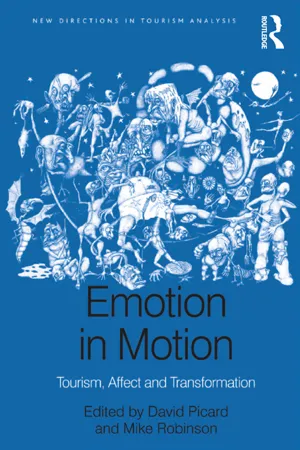
eBook - ePub
Emotion in Motion
Tourism, Affect and Transformation
- 308 pages
- English
- ePUB (mobile friendly)
- Available on iOS & Android
eBook - ePub
Emotion in Motion
Tourism, Affect and Transformation
About this book
What happens when tourists scream with fear, shout with anger and frustration, weep with joy and delight, or even faint in the face of revealed beauty? How can certain sites affect some tourists so deeply that they require hospitalisation and psychiatric treatment? What are the inner contours of tourist experience and how does it relate to specific emotional cultures? What are the consequences of the emotional cultures of tourists upon destinations? How are differences in emotional culture mobilized and played out in the transnational contact zones of international tourism? While many books have engaged with the structural frames of tourist practice and experience, this is the first to deal with the emotional dimensions of tourism, travel and contact and the ways in which they can transform tourists, destinations and travel cultures through emotional engagements. The book brings together an international array of scholars from anthropology, psychiatry, history, cultural geography and critical tourism studies to explore how the movement to, and through, the realms of exotic people, wild natures, subliminal art, spirit worlds, metropolitan cities and sexualised 'others' variably provoke emotions, peak experiences, travel syndromes and inner dialogues. The authors show how tourism challenges us to engage with concepts of self, other, time, nature, sex, the body and death. Through a set of ethnographic and historic cases, they demonstrate that such engagements usually have little to do with the actual destination but rather, are deeply anchored in personal memories, repressed fears and desires, and the collective imaginaries of our societies.
Chapter 1
Tourism, Awe and Inner Journeys
Tears ran down Eberhard’s cheeks. His face was red and sweaty. Interrupted by heavy breathing, he screamed out fragments of sentences, ‘all this beauty’, ‘we would have all come back’, ‘we should have done like the Romanians did’ and, later, ‘we should have killed them all’. Eberhard was standing on a view point above the wide empty plain of the volcanic caldera. He seemed far away with too many things happening too quickly in his mind. The other tourists, initially unaware of his state, taking photos and exchanging smiles and kisses, became silent. They looked away. A woman, a work colleague of Eberhard’s, approached him. It was his idea to do this trip together, to escape the ‘sadness’ and ‘stress of work life’ as he later explained. She gently touched his arm. Eberhard shook his head, and then looked at her. ‘How is it possible that someone had the right to prohibit someone else to see all this beauty?’, he asked. In the evening, having a beer before dinner, Eberhard started to talk about his emotions at the volcano. He told me that he was from East Germany and, while under the ruling Socialist regime, travel outside the (former) German Democratic Republic (GDR) had been strictly regulated. ‘Let us out!’ was one of the refrains shouted during the Monday demonstrations in East Germany that preceded the eventual fall of the Berlin Wall in November 1989. Travel especially beyond the Iron Curtain, and by extension the experience of faraway exotic locales in Cuba, East Africa or South America had become a tool to gratify citizens for their work and submission to the political rule of the Socialist party. On the other hand, the non-granting of tourist visas had become a tool to punish those with whom the regime felt uncomfortable. Following the opening of the borders Eberhard, along with millions of other people from East Germany, travelled for the first time to countries in Western Europe, the Caribbean and the USA.
I met Eberhard in 1998 in the Indian Ocean island of La Réunion, on his first trip to what he described as an ‘exotic island destination’. As a PhD student at the Anthropology Department of the University of La Réunion, I was studying social transformations brought about by the development of European mass tourism (Picard 2011). I was particularly interested in the role of tourist experience and the representations of tropical island space through which this experience was framed both before and after the actual trip. To observe actual tourist practice from an inductive perspective I had found employment as a tour guide and driver for a local tour agency. Within the two years of this employment, from 1998 to 2000, I had the chance to observe a great number of tourists, mainly Germans, who travelled on a 3-day round trip itinerary through the island. Through open interviews in the evenings after the trip and during visits I later made at their homes, I deepened, in dialogical fashion, my understanding of what appears to stimulate emotions in the tourists and the different modalities of their unfolding. Among the tourists observed in my study, it was not uncommon that they spontaneously started to cry, laugh, smile or felt faint when surrounded by something they found beautiful or captivating, or deceiving. In this sense, Eberhard’s oddly ‘extreme’ reaction provides clues to what other tourists may have lived through in a milder way. It was quite common that certain spaces, such as the volcano, left them speechless for a moment. Seemingly unable to find words for what happened in their mind, many were left with their eyes and mouth wide open, inhaling air and shaking their heads. While some tourists appeared overwhelmed by the encounter of certain landscapes, others showed similar reactions when looking at art works, listening to music, inhaling the atmospheres of a crowded market, etc. It happened that tourists felt they needed to sit down ‘to keep their balance’ or shake their heads to ‘come back to reality’ (in their words). In most cases, the initial emotion induced by the encounter of a particular touristic realm triggered further emotions unrelated to the actual encounter. In Eberhard’s case, it is unlikely that his anger was a direct emotional reaction to the ‘beauty’ of the site. It is more plausible that the aesthetic emotion induced by the encounter with the site fed an inner dialogue that only partly surfaced and that, in turn, generated his anger. This dialogue was about an apparently still unresolved trauma related to the injustices committed by the former Socialist regime of the GDR. Referring to the strict travel regulations under Socialist rule, he questioned how ‘some people could prohibit others to see such beauty’. ‘We would have all come back’, he affirmed. Referring to the execution of the former Socialist dictator of Romania, Nicolae Ceauçescu, by a revolutionary military court, he claimed, ‘we should have killed them all’.
Exploring Emotions in Tourism and Travel
Tourism is one of those fields of social practice in which the relation between the physical motion of the body and the emotions subjectively experienced by a person becomes most obvious. It thus offers itself as a field par excellence for the study of the articulation between personal subjective experience of the world and collective emotional and cognitive cultures through which this experience is framed, learnt, and put into meaningful words, images and categories. Tourism moves tourists out of their quotidian environment and changes the daily rhythms of life. Tourists are in some cases confronted with previously unfamiliar places, stories and people. In other cases, they almost ceremonially return to sites they are familiar with, to visit friends and relatives, to indulge in their passions for artworks or religious shrines, to revitalize memories of earlier travels and childhood places, or to simply find the comfort and security of familiar holiday environments. What is common to these different cases is that tourism generates an emotionally heightened social realm that both distances tourists from their daily routines and challenges them to create order in the changed environment. The distance from home weakens social norms and thus allows them to test the boundaries and foundations of their being in the world. It allows and actively challenges them to experiment with new identities, engage in new social practices, and renew relationships (Lanfant et al. 1995). The destinations and peoples visited often function as a mirror in which tourists discover facets of themselves (Chabloz and Raout 2009). Tourists frequently recognize here a link between their own person and the locale visited. The physical and moral boundaries that a priori separate destination from home become – at least temporarily – blurred. In many cases tourists experience sensations of transhumance, or deep connections to nature or the divine. At the same time they frequently feel physically aroused by certain sites, – often without being offered, by their own culture, any meaningful explanation or story for such arousal. It usually leaves them perplex and often makes them search for a form of rationalisation. Nancy Frey (1998), for instance, relates the case of a female pilgrim who, at the sight of a particular landscape on the way to Santiago in Spain, experienced spontaneous orgasms. Similarly, Elvi Whitaker, in Chapter 3 of this book, observes the speechless awe that accompanies the peak experiences of nature tourists in Canada. Such touristic emotions are usually amplified where they are subjected to intense pre-travel anticipations. Hannah Wadle, in a personal communication, relates the case of a German woman, the child of post-World War II Polish refugees to Germany, who, after years of anticipating the trip to her ‘homeland’, Poland, spontaneously soils herself once she sets foot on Polish ground. These cases indicate that the experience of emotions in tourism and travel relate to forms of embodied ‘emotional knowledge’ (Lakoff and Johnson 1999) which evolves at the interface between personal experiences of the world and collectively held moral orders of specific tourist attractions (MacCannell 1976). Tourism disturbs and destabilizes such moral order. It challenges tourists to reflect about their desires and ideas of belonging, also about their fears of loneliness, time, mortality and the (hopefully not too) soon-to-come event of death. As a result of their exposure to alterity, tourists often realize the fact or at least the potential that what they hold as true about the world is bound to cultural norms.
While emotions are experienced at the individual level they are collectively framed, both in terms of the actual experience and the way this experience is articulated and communicated to others.2 Both, the experience and the expression of emotions are subjected to cultural conventions, normalization and processes of learning. Emotion and emotional culture can thus be studied as an anthropological object within specific social and historical contexts. One aspect of this study developed in the first and second part of this book, focuses on the social processes of forming, maintaining and reproducing such emotional cultures within specific society contexts. The chapters of this first part of this book in particular will explore how personally experienced emotions relate to wider normative frameworks prescribing and, to a certain extent, disciplining how certain emotions shall be felt and how these feelings shall be expressed. The chapters of the second part then explore processes of producing and maintaining emotional cultures formed around specific tourist sites. The chapters of the third part of the book subsequently investigate the consequences of such touristic emotional cultures at a wider political and sociological scale. If destinations have a mirror function in tourism, then this mirror is not a blank surface reflecting a lifelike image of the tourists’ self. What this ‘mirror’ reflects has been produced and remains usually stage-managed. It thus anticipates an image to be thrown back onto tourists prior to the latter’s entry into the performance. In this sense, destinations can be seen as large theatrical grounds that, by means of their décor, the roles played by locals and the scripted temporality of touristic activity programmes, lead tourists through a tourism specific play and liturgy. From that point of analysis, it makes sense to approach destinations within the enlarged social sphere of what has been called ‘world society’ (Burton 1972). Such an approach implies important questions about the identities, social roles and political order this highly ceremonialized tourist play fashions at the global scale.
Emotions of Awe and Inner Journeys
Emotions are generated by what psychologists call stimulus. Stimulus can be external, for example, related to the encounter of specific sites that spontaneously induce emotions of surprise, anxiety, awe, thrill, and even love. In the context of tourism, in such situations, tourists often remain initially speechless, in search of references. Certain types of natural sites, architectural monuments, art works, religious shrines or local people seem able to induce deeply felt emotions of affect and even wonder.3 Often, tourists feel that such sites exert power over them and destabilize their identity. Many describe sensations of mystic encounters with ‘forces’ and ‘spirits’, but also uncanny4 sentiments, such as when they spontaneously recognize ‘hidden’ facets of their selves in the visited other. Since the romanticist revolutions of the 18th and 19th centuries in Western Europe and North America, the emotions related to the experience of ‘fearful beauty’ or ‘sublime magic’ of certain places have been called ‘awe’ (Spode 2003). Awe and tourism are historically interconnected. For the romantics, experiencing awe in face of specific natural sites, e.g. ‘wild’ mountains and sea fronts, was considered a liberating process. The painting, Der Wanderer über dem Nebelmeer (The Wanderer Above the Sea of Fog) by Caspar David Friedrich, is a good example for an expression of such awe. The image is composed of a man standing on top of a rock, under a colourful sky, apparently gazing over a ‘sea of clouds’. For John Gaddis (2004), the image epitomises the ideological underpinning of the romanticist movement, in particular the idea of a profound contradiction of the human condition, on the one hand working to tame nature, and, on the other, being aware of their insignificance within the wider cosmos of space and time. For the 18th- and 19th-century Romantics the experience of awe was considered a means to reveal this contradiction. It was considered a form of moral learning. It is remarkable that this painting continues to supply one of the most reproduced visual tropes in contemporary nature tourism advertisement. It may seem that the experience of awe as a tourism related emotion never disappeared. The surrealists of the early 20th century – artists, writers, ethnographers – claimed that the experience of awe in the face of alterity was able to reveal latent desires e.g. related to sexuality, death or violence whose satisfaction has been regulated or prohibited by public morals. Travel and the immersion in exotic cultures, found both in faraway places and in local immigrant groups and working classes, became a means to make such experience happen (Clifford 1988).
Emotions can also be induced by forms of inner stimulus. While the encounter with certain touristic sites has the ability to generate emotions, the cognition of these emotions – the memories these bring alive, the images and associations they evoke – can, in turn, become a stimulus for further emotions. In this sense, the cognitive processes dealing with these emotions may, in turn, evoke and ‘bring to life’ other personal memories, unrelated to the actual site, that had long been ‘buried’, such as childhood memories, previous holidays, memories of youth and first love, etc. (Lerner and Keltner 2000). The mental work accompanying the touristic journey thus entails an ongoing inner dialogue where emotions become stimulus for new emotions and where the outer experience of sites is progressively interiorized and articulated with a mental ‘inner journey’.5 In many cases, tourists chose a particular destination to find answers or at least some form of stimulus to specific personal hobbies and pre-occupations (Hennig 1997).
Travel Syndromes
Cases, such as that of Eberhard recalled at the beginning of this chapter, are extreme but they demonstrate what most tourists experience in a much milder way, i.e. how emotions are experienced and articulated. His case is neither unique nor particularly astonishing. The literature produced by travellers of various époques, but also the more recent scientific literature by psychiatrists working in hospitals near major tourist sites, describe numerous similar occurrences of what has come to be called ‘travel syndrome’. One of the most famous cases is that of French 19th-century author Stendhal (1990) – real name Marie-Henri Beyle – who relates the symptoms of increased heartbeat and sensations of vertigo he experienced when facing the sublime art displayed in the city of Florence, Italy in 1817. Apparently similar cases are related by Berta Spafford-Vester, a late-19th-century American emigrant to Israel (cf. Witztum and Kalian, Chapter 6). In her memories, she describes various characters encountered in Jerusalem who, seemingly overwhelmed by spirituality, temporarily lost their references and identity thinking they were saints on a holy mission. In a more contemporary context, various authors relate cases of Japanese tourists who suffer from what is now called the ‘Paris syndrome’ (Viala et al. 2004; Graburn, Chapter 3). Similar to what had been observed in Florence and Jerusalem, this syndrome is characterized by psychiatric symptoms such as acute delusional states, hallucinations, feelings of persecution, depersonalization, and anxiety, and also by psychosomatic manifestations such as dizziness, tachycardia and sweating. The first systematic study of this extreme form of touristic awe was produced during the 1980s by Graziella Magherini (1989), a medical doctor in the psychiatric ward of a hospital in Florence. Magherini notes that the spontaneous ‘attacks’ to which certain foreigners were subjected when facing Renaissance art and culture in Florence can usually be related to previously existing repressed trauma. According to Magherini, the combination of anticipation, stress, culture shock and the deep veneration of the artworks in question pulled such trauma to the surface. Similarly, for the Japanese tourists in Paris, the syndrome appears to be triggered by the combination of disappointments related to the intercultural context (e.g. different language and modes of interpersonal communication), idealized images of Paris and travel stress. In their reaction to an earlier publication on the so-called Jerusalem syndrome,6 Witztum and Kalian (cf. Chapter 6 of this book) equally claim that all patients treated in Jerusalem hospitals had previous psychiatric conditions.
Contrary to a widespread popular belief (also among many academics), it is unlikely, based on available evidence, that specific sites, landscapes or objects have an inherent power to trigger travel syndromes in people with no previous health or spiritual conditions7 – unless their culture has strong expectations that they will. Before venturing into the slippery realms of what could be termed ‘esoteric anthropology’ (presuming that certain sites or objects actually are imbued with specific forms of ‘energy’ or ‘power’), it seems prudent to explore the emotional reactions of tourists initially in terms of a soc...
Table of contents
- Cover Page
- Half Title page
- Series page
- Title Page
- Copyright Page
- Contents
- List of Figures
- List of Contributors
- Introduction
- Part I: Emotions and Inner Journeys
- Part II: The Emotions of Attractions
- Part III: Institutionalizing Emotions in Tourism
- Index
Trusted by 375,005 students
Access to over 1.5 million titles for a fair monthly price.
Study more efficiently using our study tools.
Frequently asked questions
Yes, you can cancel anytime from the Subscription tab in your account settings on the Perlego website. Your subscription will stay active until the end of your current billing period. Learn how to cancel your subscription
No, books cannot be downloaded as external files, such as PDFs, for use outside of Perlego. However, you can download books within the Perlego app for offline reading on mobile or tablet. Learn how to download books offline
Perlego offers two plans: Essential and Complete
- Essential is ideal for learners and professionals who enjoy exploring a wide range of subjects. Access the Essential Library with 800,000+ trusted titles and best-sellers across business, personal growth, and the humanities. Includes unlimited reading time and Standard Read Aloud voice.
- Complete: Perfect for advanced learners and researchers needing full, unrestricted access. Unlock 1.5M+ books across hundreds of subjects, including academic and specialized titles. The Complete Plan also includes advanced features like Premium Read Aloud and Research Assistant.
We are an online textbook subscription service, where you can get access to an entire online library for less than the price of a single book per month. With over 1.5 million books across 990+ topics, we’ve got you covered! Learn about our mission
Look out for the read-aloud symbol on your next book to see if you can listen to it. The read-aloud tool reads text aloud for you, highlighting the text as it is being read. You can pause it, speed it up and slow it down. Learn more about Read Aloud
Yes! You can use the Perlego app on both iOS and Android devices to read anytime, anywhere — even offline. Perfect for commutes or when you’re on the go.
Please note we cannot support devices running on iOS 13 and Android 7 or earlier. Learn more about using the app
Please note we cannot support devices running on iOS 13 and Android 7 or earlier. Learn more about using the app
Yes, you can access Emotion in Motion by Mike Robinson, David Picard, Mike Robinson,David Picard in PDF and/or ePUB format, as well as other popular books in Business & Hospitality, Travel & Tourism Industry. We have over 1.5 million books available in our catalogue for you to explore.