The Routledge Course on Media, Legal and Technical Translation
eBook - ePub

The Routledge Course on Media, Legal and Technical Translation

English-Arabic-English

  1. 184 pages
  2. English
  3. ePUB (mobile friendly)
  4. Available on iOS & Android
eBook - ePub

The Routledge Course on Media, Legal and Technical Translation

English-Arabic-English

About this book

The Routledge Course on Media, Legal and Technical Translation: English-Arabic-English is an indispensable and engaging coursebook for university students wishing to develop their English-Arabic-English translation skills in these three text types. Taking a practical approach, the book introduces Arab translation students to common translation strategies in addition to the linguistic, syntactic, and stylistic features of media, legal, and technical texts. This book features texts carefully selected for their technical relevance. The key features include:

• comprehensive four chapters covering media, legal, and technical texts, which are of immense importance to Arab translation students;

• detailed and clear explanations of the lexical, syntactic, and stylistic features of English and Arabic media, legal, and technical texts;

• up-to-date and practical translation examples in both directions offering students actual experiences of professional translators;

• authentic texts extracted from various sources to promote students' familiarity with language features and use;

• extensive range of exercises following each section of the book to enable students to test and practice the knowledge and skills they developed from reading previous sections;

• glossaries following most exercises containing the translation of difficult words;

and

• a list of recommended readings following each chapter.

The easy, practical, and comprehensive approach adopted in the book makes it a must-have coursebook for intermediate and advanced students studying translation between English and Arabic. University instructors and professional translators working on translation between English and Arabic will find this book particularly useful.
Frequently asked questions

Yes, you can cancel anytime from the Subscription tab in your account settings on the Perlego website. Your subscription will stay active until the end of your current billing period. Learn how to cancel your subscription.
At the moment all of our mobile-responsive ePub books are available to download via the app. Most of our PDFs are also available to download and we're working on making the final remaining ones downloadable now. Learn more here.
Perlego offers two plans: Essential and Complete
  • Essential is ideal for learners and professionals who enjoy exploring a wide range of subjects. Access the Essential Library with 800,000+ trusted titles and best-sellers across business, personal growth, and the humanities. Includes unlimited reading time and Standard Read Aloud voice.
  • Complete: Perfect for advanced learners and researchers needing full, unrestricted access. Unlock 1.4M+ books across hundreds of subjects, including academic and specialized titles. The Complete Plan also includes advanced features like Premium Read Aloud and Research Assistant.
Both plans are available with monthly, semester, or annual billing cycles.
We are an online textbook subscription service, where you can get access to an entire online library for less than the price of a single book per month. With over 1 million books across 1000+ topics, we’ve got you covered! Learn more here.
Look out for the read-aloud symbol on your next book to see if you can listen to it. The read-aloud tool reads text aloud for you, highlighting the text as it is being read. You can pause it, speed it up and slow it down. Learn more here.
Yes! You can use the Perlego app on both iOS or Android devices to read anytime, anywhere — even offline. Perfect for commutes or when you’re on the go.
Please note we cannot support devices running on iOS 13 and Android 7 or earlier. Learn more about using the app.
Yes, you can access The Routledge Course on Media, Legal and Technical Translation by Mahmoud Altarabin in PDF and/or ePUB format, as well as other popular books in Languages & Linguistics & Languages. We have over one million books available in our catalogue for you to explore.

Information

1
TRANSLATION: BASIC CONCEPTS AND DEFINITIONS

1.1 What is translation?

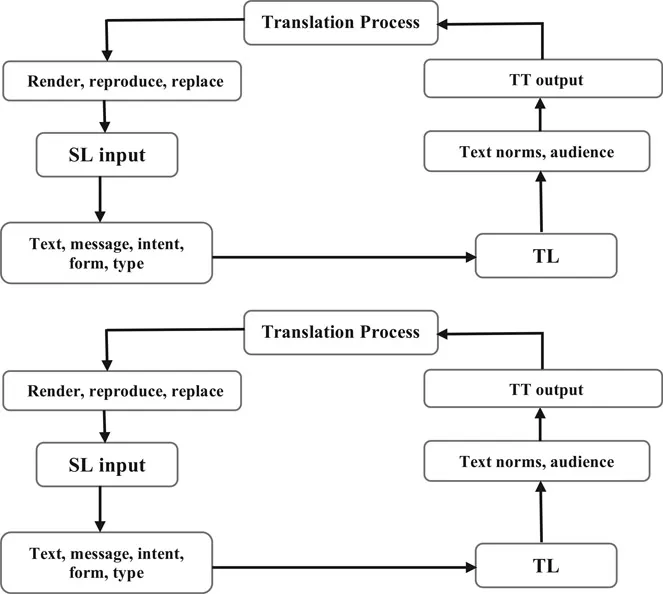
It is commonplace to begin a translation course with defining basic concepts such as translation, equivalence, and translation strategies to develop readers’ awareness of such basic concepts in the translation industry. Translation refers to a “process” of “rendering” a text into another language (Simpson & Weiner, 1989) where translators take definite actions to achieve their task. It can also mean “reproducing” a “natural equivalent” of a source language (SL) message (Nida & Taber, 1969) taking into consideration the target language (TL) norms that aim for naturalness. Reproducing a natural equivalent text into a TL, whether English or Arabic, can be a challenging task for a number of factors, as shown in section 1.2. Additionally, translation is defined as the “replacement” of a text by an “equivalent text” (Catford, 1965); “interpretation of verbal signs” into another language (Steiner, 1975), and producing texts that account for target readers’ circumstances (Vermeer, 1987). The concept of translating is sometimes linked to more complex paratextual elements as the intention of the ST author (Newmark, 1988) and the sociocultural context (Hatim & Munday, 2004) or what Toury (1995) calls cultural traditions. In Arabic,1 the word ترجم means “to explain speech into another language” (Al Bustani, 1998, p. 69) and “transfer speech into another language” (Al-Basha, 1992, p. 253). Rida (1958, p. 391) defines ترجم كلامه as “explained it.” Naturally, one cannot expect one definition to be an ideal match for a wide range of contexts, languages, purposes, and readership. Brislin and Freimanis (2001, p. 39) maintain that “The goal of translation is to achieve linguistic, cultural and psychological equivalence and judging its quality is a great concern, especially since there are no specific criteria to guide that process.” Newmark (1991, p. 1) says:
Translation is concerned with moral and with factual truth. This truth can be effectively rendered only if it is grasped by the reader, and that is the purpose and the end of translation. Should it be grasped readily, or only after some effort? That is a problem of means and occasions.
Figure 1.1 summarizes the key concepts of translation definitions, which are central components in the translation process.
Figure 1.1 Translation process
FIGURE 1.1 Translation process

Need for translation

The profound multidimensional significance of translation throughout history lies in not only providing foundations for global interaction but also enabling different countries to promote interactive relationships aiming at advancements in technology, politics, trade, and peace. Being a traditional means of communication, translation promotes transmitting knowledge and protects cultural heritage. Toury (1995) maintains that the value behind translation is based on two elements: (1) being a text and occupying a position in a certain language and culture and (2) constituting a representation in that language or culture of another. In her Why Translation Matters, Grossman (2010, pp. x–ix) says:
Translation not only plays its important traditional role as the means that allows us to access literature originally written in one of the countless languages we cannot read, but it also represents a concrete literary presence with the crucial capacity to ease and make more meaningful our relationships to those with whom we may not have had a connection before. Translation always helps us to know, to see from a different angle, to attribute new value to what once may have been unfamiliar.
Translation protects literature and promotes the understanding of the other. In the present fast-paced world, spreading news, academic literature, medical advances, scientific innovations, and other aspects of knowledge is only possible through translation. On a country level, translation can promote external affairs and boost the tourism sector, which can include public or private bodies. As we shall see in Chapter 2, translation, however, is an ideal tool for self-presentation and denial of the other through ideologically motivated rewritings of news stories. Additionally, legal documents between individuals or states are usually translated when the parties to these agreements speak different languages. It should thus be highlighted that translation serves different purposes, texts, and people. Without such a must-activity, the world could remain disconnected areas.

1.2 Equivalence: an illusion

There has been no consensus on translation equivalence, which has encouraged a continuous debate among translation theorists for decades. The concept is linked to complex factors beyond simply replacing words. Nida (1964) introduced formal equivalence focusing on SL message form and content and dynamic equivalence aiming at an “equivalent effect.” Practically, formal equivalence between Arabic and English does not pose a challenge unlike the dynamic equivalence because the chances of achieving the latter heavily rely on paralinguistic factors. This is reflected in Catford’s (1965) argument that TL translation equivalents are a central problem of translation activity. Newmark (1981) argues that translation equivalence is useless and that “perfect translation is illusionary” (1991). Biguenet and Schulte (1989) and Baker (2018) stress the impossibility of achieving exact equivalence between any language pair. Baker (2018), Koller (1995), Ivir (1996), House (1997), Snell-Hornby (1988), Bassnett (2002), Hatim and Munday (2004), and Fawcett (1997) maintain that linguistic and cultural factors make equivalence relative. Venuti (1995) believes that translation causes violent effects at home and abroad. He highlights the massive power of translation in constructing national identities for foreign cultures and points out that translation potentially figures in ethnic discrimination, geopolitical confrontations, colonialism, terrorism, and war.
On the intralingual level, finding two words bearing the same meaning in all contexts is “a luxury a language can do without” (Jackson, 1988, p. 65). Although a language can express certain meanings using a limited number of words, another may express the same with a larger number (Biguenet & Schulte, 1989), which points to non-equivalence at the linguistic level. Broeck (1978) explains that a strict equivalence relationship does not apply to translation. Lack of equivalence can be attributed to lexical, syntactic, or pragmatic differences between different languages that makes it difficult to provide perfect guidelines to deal with various types of non-equivalence (Baker, 2018). Differences in the components and relations of meaning between a pair of languages can lead to two consequences for translation as well as equivalence issues (Fawcett, 1997). Being the basis for any translation practice that heavily relies on equivalence relations, meaning is usually determined through situation and context rather than through the dictionary. Meaning can also be governed by translators’ interference in transferring texts between a pair of languages. Regardless of the debate on the practicality of translation equivalence, no translation practice is expected to take place without exploring corresponding TL lexical units. Differences between an SL text and its extra-textual elements and those of the TL control the level of equivalence relativity.

Equivalence and translation

Problems of translation equivalence appear at different language levels and in different text domains. A word can have different meanings depending on the context of its occurrence as in issue, which can mean مسألة, إصدار, يُصدر, or وريث. It can also mean قريب (relative). Depression can mean انهيار or كآبة in psychology, منخفض in weather forecast, and كساد or ركود in economics. This highlights the immense significance of context awareness in determining the specific and intended meaning of a word.
Another source of difficulty that can affect the selection of appropriate equivalents is attributed to lexical relations. Consider the word يبدأ which can be translated into English as start, begin, or commence. These have similar meanings, but each is used in a different context and each has a different antonym. The difficulty here arises when translating the word يبدأ into English. Shall we translate it as start, which is used to denote physical activity; begin, which does not mainly denote a physical activity; or commence, which is used in formal contexts like court proceedings as in commence a lawsuit يرفع دعوى. Begin is less formal as in he began talking بدأ التحدث.
Lexical gaps pose another challenge that requires careful consideration. These do not always reflect that an SL word is not understood in the TL, as in the case of bedsit, which refers to a one-room flat used as a living room, kitchen, and bedroom. The term exists in Arabic but has no equivalent word. It ...

Table of contents

  1. Cover
  2. Half Title
  3. Series Page
  4. Title Page
  5. Copyright Page
  6. Dedication Page
  7. Contents
  8. List of figures
  9. List of tables
  10. Foreword
  11. Acknowledgments
  12. Introduction
  13. 1 Translation: Basic concepts and definitions
  14. 2 Translating news
  15. 3 Translating legal texts
  16. 4 Technical and scientific translation
  17. References
  18. Index