A Particular Kind of Black Man
eBook - ePub

A Particular Kind of Black Man

A Novel

  1. 272 pages
  2. English
  3. ePUB (mobile friendly)
  4. Available on iOS & Android
eBook - ePub

A Particular Kind of Black Man

A Novel

About this book

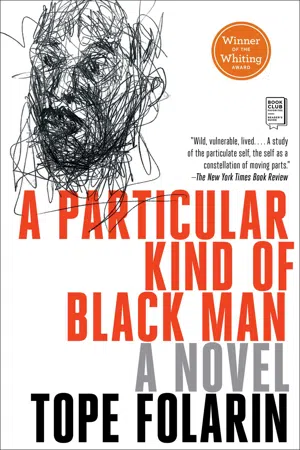
An NPR Best Book of 2019 A New York Times, Washington Post, Telegraph, and BBC' s most anticipated book of August 2019 One of Time' s 32 Books You Need to Read This Summer A stunning debut novel, from Rhodes Scholar and winner of the Caine Prize for African Writing, Tope Folarin about a Nigerian family living in Utah and their uncomfortable assimilation to American life. Living in small-town Utah has always been an uneasy fit for Tunde Akinola's family, especially for his Nigeria-born parents. Though Tunde speaks English with a Midwestern accent, he can't escape the children who rub his skin and ask why the black won't come off. As he struggles to fit in and find his place in the world, he finds little solace from his parents who are grappling with their own issues.Tunde's father, ever the optimist, works tirelessly chasing his American dream while his wife, lonely in Utah without family and friends, sinks deeper into schizophrenia. Then one otherwise-ordinary morning, Tunde's mother wakes him with a hug, bundles him and his baby brother into the car, and takes them away from the only home they've ever known.But running away doesn't bring her, or her children, any relief from the demons that plague her; once Tunde's father tracks them down, she flees to Nigeria, and Tunde never feels at home again. He spends the rest of his childhood and young adulthood searching for connection—to the wary stepmother and stepbrothers he gains when his father remarries; to the Utah residents who mock his father's accent; to evangelical religion; to his Texas middle school's crowd of African-Americans; to the fraternity brothers of his historically black college. In so doing, he discovers something that sends him on a journey away from everything he has known.Sweeping, stirring, and perspective-shifting, A Particular Kind of Black Man is a beautiful and poignant exploration of the meaning of memory, manhood, home, and identity as seen through the eyes of a first-generation Nigerian-American.
Frequently asked questions

Yes, you can cancel anytime from the Subscription tab in your account settings on the Perlego website. Your subscription will stay active until the end of your current billing period. Learn how to cancel your subscription.
At the moment all of our mobile-responsive ePub books are available to download via the app. Most of our PDFs are also available to download and we're working on making the final remaining ones downloadable now. Learn more here.
Perlego offers two plans: Essential and Complete
  • Essential is ideal for learners and professionals who enjoy exploring a wide range of subjects. Access the Essential Library with 800,000+ trusted titles and best-sellers across business, personal growth, and the humanities. Includes unlimited reading time and Standard Read Aloud voice.
  • Complete: Perfect for advanced learners and researchers needing full, unrestricted access. Unlock 1.4M+ books across hundreds of subjects, including academic and specialized titles. The Complete Plan also includes advanced features like Premium Read Aloud and Research Assistant.
Both plans are available with monthly, semester, or annual billing cycles.
We are an online textbook subscription service, where you can get access to an entire online library for less than the price of a single book per month. With over 1 million books across 1000+ topics, we’ve got you covered! Learn more here.
Look out for the read-aloud symbol on your next book to see if you can listen to it. The read-aloud tool reads text aloud for you, highlighting the text as it is being read. You can pause it, speed it up and slow it down. Learn more here.
Yes! You can use the Perlego app on both iOS or Android devices to read anytime, anywhere — even offline. Perfect for commutes or when you’re on the go.
Please note we cannot support devices running on iOS 13 and Android 7 or earlier. Learn more about using the app.
Yes, you can access A Particular Kind of Black Man by Tope Folarin in PDF and/or ePUB format, as well as other popular books in Literature & Literature General. We have over one million books available in our catalogue for you to explore.

Information

1991–92

A few weeks after the arrival of our new family members from Nigeria, my father called all of us into the living room and told us that he would be leaving his job at the Kodak plant in Salt Lake City. He asked us to sit on the couch and he sat down with us, and then he stood up and sat down again. With tears in his eyes, he told us that he had walked into his office, laughing with a coworker about something or other, and then he saw it: a crude drawing hanging by a red thread from the side of his cubicle. Someone had drawn a picture of my father with his facial features greatly exaggerated, and blood dripping from the extra-wide nose. The drawing was meant to be a representation of my father, an effigy, but he said the thing actually resembled an evil monkey.
Mom seemed shocked—her eyes grew large and she kept saying, “It can’t be so. It can’t be so.” Femi rubbed Mom’s back and Ade smiled like Dad had just announced that we were all going to Disney World. Tayo and I glanced at each other, and then Tayo stared down at the yellowing carpet. I could not help but shake my head. Though we were both scared, and angry, we weren’t really surprised: We had heard different versions of this speech before. This was just the latest in a long series of job disappointments for him.
We knew that things had been easier for Dad once. At other times, in other settings, Dad had regaled Tayo and me with stories about happier moments in his life. He would tell us how, as a young student in Nigeria almost fourteen years before, he had applied to a college in Utah on a whim, a school no one in his family had heard of, and how he’d learned shortly afterward that he’d been awarded a full scholarship. How his new school, Weber State University, had sponsored his trip to Utah, and covered the airfare for his new bride as well. How—unlike his siblings, his friends, almost everyone he knew—he had received a visa to travel to the United States on his first visit to the US Embassy in Lagos. How he felt hopeful even when he could not find a job in his chosen field, how he believed that his American dream would inevitably come true.
But then Mom got sick and left. Afterward Dad did all kinds of stuff—he worked as a mechanic, and then as a janitor at an amusement park, and then as a street sweeper, and then as a security guard. At first, each job seemed to present him with a host of possibilities, a chance to move up and make his mark, but then, inevitably, disappointment would follow. Sometimes he was laid off without explanation, and other times he quit because he was tired of being bullied. A threatening note left on his desk. An ugly word flung at his face.
Dad was always telling us that things would be getting better soon, but after a while we could tell that he had stopped believing this himself.
I still remember the day when Dad came home, so excited that it seemed like he was blushing, and told Tayo and me that he had been hired by Kodak. This was just a few months before our new mom and brothers arrived from Nigeria. Dad told us that the job didn’t pay very much, but that he would get to wear a suit and tie every day. I remember being in awe of the idea that my father would actually have to dress up to go to work, instead of wearing one of the gray, drab jumpsuits that lined his musty closet. I helped Dad iron his favorite brown suit the night before his first day, the one with the missing top button and the small tear in the middle of the right sleeve. The next morning I felt so proud of him that I lingered in the car after he pulled up in front of my school, and I smiled at him like my face could do nothing else. Even though I’d spent my entire life in America, at that moment I felt as if we had all just arrived, and that everything was about to change.

After leaving Kodak, my father quickly found another job at a shop in Layton called Layton Rental. The place was filled with an assortment of machines that could be rented for varying periods of time. Dad seemed happy there, and he always answered the phone when I called:
“Hello, Layton Rental. Segun speaking!”
Sometimes I called just to hear his voice. He always sounded cheerful, even if he’d left home carrying sorrow in his eyes:
“Hello, Daddy! Can I have a lawn mower, please?”
“Yes, for how long?”
“I only need it for a couple minutes.”
“Okay, that’s fourteen million dollars.”
“Daddy! I only have seven cents!”
“Okay, I will give you the Akinola discount. We will hold it for you. When are you coming?”
He often brought Tayo, Femi, and me to the shop, and I loved talking with Dad’s coworkers as Dad worked the cash register, or showed a customer around. I also loved staring at the machines—lawn mowers, riding lawn mowers, chainsaws, all sputtering, oil-filled contraptions. They all seemed exotic at the time, even when my father turned a key or pulled a string or pressed a button to summon them to life. He always had a fun story for us after work, sometimes about an especially boorish customer, other times about a power drill he had repaired against all odds.
After a few months, though, my father began to come home angry. He told us he had decided that his accent was preventing him from getting ahead.
I had never heard him complain about his accent before. I didn’t really know what an accent was. I knew Dad’s voice was different—he didn’t speak like my teachers or the social workers who occasionally stopped by our apartment to check up on Tayo and me after Mom returned to Nigeria—but in my mind the difference was a positive one. His voice sounded royal to me; I thought he had the kind of voice that everyone wanted, that through effort or fate, or perhaps a combination of both, he’d been blessed with a deep, forceful voice that instantly marked him as someone who was important.
Dad felt otherwise. At home he began to slam the phone down after repeating the same word four or five times to the person—always an American—on the other end. And then there was his charge to Tayo, Femi, and me as we sat around the dinner table one evening:
“Look here, you must have a perfect American accent,” he said, calmly, icily. “People can say anything they want about the way you look, about your skin. But if you learn to speak better than them, there is nothing they can do. They cannot prevent you from moving ahead. Remember, everyone in this country is a racist. Even me. But if you learn to speak good, no one can hold you back.”
At this Mom made a clucking noise. “Are you sure this is what you want to be telling your children?”
Tayo, Femi, and I began staring at our plates like they contained every dream we’d ever prayed for. Even Femi—who’d only been in America for a few weeks by then—knew better than to glance at Dad when he was being challenged. We knew that it was better for us to stare at the wall, our food, each other, to act as if we had no idea what was happening.
“What do you mean?” Dad growled.
“I mean, should you be teaching these children that everyone in America is a racist? Do you even believe that yourself?”
“Woman, I have been living in this country for more years than you have been working. I know what I am talking about. Why don’t you keep quiet and bring me more food?”
Mom kept sitting, maybe for a second too long, but then she rose and picked up Dad’s plate. Tayo, Femi, and I waited for a few beats, and then we stood as one and excused ourselves. We didn’t hear a word from either of them for the rest of the night.
Dad began to make us watch the evening news so we’d learn how to speak what he called “professional English.” I began to notice the differences.
My father said “chumorrow” and the white, well-coifed hosts said “tomorrow.”
“Tomorrow, negotiations begin.”
“Tomorrow, the president will meet with the grieving families.”
“Tomorrow, the cease-fire goes into effect.”
My father said “haboh” instead of “harbor.” He said “biro” instead of “pen.” He said “paloh” instead of “living room.” My third-grade teacher asked me where my homework was, the day I forgot to bring it to school.
“I left it in my paloh, on the couch.”
“Your paloh?”
I looked, confused, at my classmates, who tittered around me.
“My paloh. With the TV, couch, rug . . .”
My teacher smiled in recognition.
“Oh. You mean your living room. Okay, that’s fine. Don’t forget to bring it in tomorrow. And try to remember, when you’re at school, it’s a living room.”
I burned with shame, then anger. Years later, I finally figured out that my father was saying “parlor.”
Over time, I realized that an American would have to pass through two rooms before reaching my father’s living room. First she would have to walk through a room of accent, a room brimming with thickets of syllables that were being twisted against their natural purpose. Then she would have to walk through a room crammed with old-world British terms. Weighty, abstracted words that my father had learned as a student in Nigeria in the 1950s, words that mean almost nothing in Britain today, and mean even less in America. And if she was patient enough to pass through both rooms, without even knowing what she was searching for, there was a chance she would happen upon the destination, the place my father had mentioned many moments before. Was it worth the effort? For some, yes. To others, though, my father didn’t know what he was talking about. He was to be ignored.

My father became obsessed with the idea of starting his own business the moment my stepmother began working as a nurse at St. Benedict’s Hospital—the biggest in town. She got the job about four months after she arrived, and Femi, Tayo, and I soon discovered (by huddling near our parents’ bedroom door as they argued quite loudly one evening) that Mom’s salary was substantially higher than Dad’s. In the days following their argument my father began to complain even more about Layton Rental, about how his accent scared everyone because he sounded like the popular stereotype of the modern male African. I didn’t know what a stereotype was, and when I asked him he told me to be quiet and go read my books.
Dad began to deliver rousing pep talks to himself at all hours of the day, even when he was driving us to school:
“. . . that is the promise of this country! I must become an entrepreneur! That is my fate in this world! That is why God put me here! I am wasting my talents giving all my skill to these people! That’s why I’m not getting ahead! I must take the horn by the bulls!”
He spoke this way for many weeks, but nothing really changed.
In January of ’92, we moved from our apartment to a small brown house on Belnap Circle. It had three bedrooms and two bathrooms, and we actually had a garage, with an off-white garage door that clattered up or down after you flicked a switch inside. Tayo, Femi, and I took turns doing it whenever Mom and Dad were gone.
A few months later, in late spring, my father woke me up early on a rainy Saturday morning and told me we had somewhere special to go. He took me to the post office headquarters in Salt Lake City. We drove around the place until we saw the massive parking lot filled with dozens of gleaming white mail trucks; from afar they looked almost like large immobile sheep.
“My truck is there,” he said, pointing toward the lot. “Trust me, Tunde, our lives will be changing very soon.”
At the time I had no idea what he was talking about. When I asked him if he planned on becoming a mailman he smiled but he wouldn’t answer. I thought his smile meant that I was right, and I tried to imagine him dropping letters off at the houses in our neighborhood instead of Mr. Peters, the kindly old man with the white, wispy mustache. I was suddenly scared for Mr. Peters because I didn’t want him to lose his job because of my father.
Dad told us his plan a few days later, on the Friday before our last week of school, after waking my brothers and me up and asking us to gather in the paloh.
“Today, I am beginning my life again,” he said. “I’ve quit my job at Layton Rental. I’ve purchased an old post office truck from the government. I...

Table of contents

  1. Cover
  2. Dedication
  3. Epigraph
  4. 1987–88
  5. 1988–91
  6. 1991–92
  7. November 7, 2000
  8. 1995–96
  9. September 9, 2001
  10. 2004
  11. Acknowledgments
  12. About the Author
  13. Copyright