The Longest Line on the Map
eBook - ePub

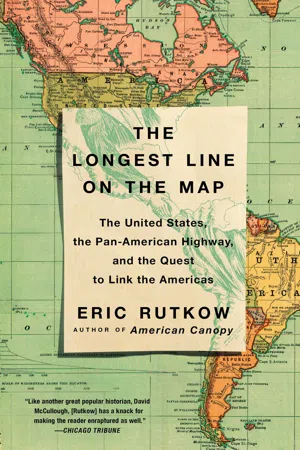
The Longest Line on the Map

The United States, the Pan-American Highway, and the Quest to Link the Americas

  1. 448 pages
  2. English
  3. ePUB (mobile friendly)
  4. Available on iOS & Android
eBook - ePub

The Longest Line on the Map

The United States, the Pan-American Highway, and the Quest to Link the Americas

About this book

From the award-winning author of American Canopy, a dazzling account of the world’s longest road, the Pan-American Highway, and the epic quest to link North and South America, a dramatic story of commerce, technology, politics, and the divergent fates of the Americas in the nineteenth and twentieth centuries.

The Pan-American Highway, monument to a century’s worth of diplomacy and investment, education and engineering, scandal and sweat, is the longest road in the world, passable everywhere save the mythic Darien Gap that straddles Panama and Colombia. The highway’s history, however, has long remained a mystery, a story scattered among government archives, private papers, and fading memories. In contrast to the Panama Canal and its vast literature, the Pan-American Highway—the United States’ other great twentieth-century hemispheric infrastructure project—has become an orphan of the past, effectively erased from the story of the “American Century.”

The Longest Line on the Map uncovers this incredible tale for the first time and weaves it into a tapestry that fascinates, informs, and delights. Rutkow’s narrative forces the reader to take seriously the question: Why couldn’t the Americas have become a single region that “is” and not two near irreconcilable halves that “are”? Whether you’re fascinated by the history of the Americas, or you’ve dreamed of driving around the globe, or you simply love world records and the stories behind them, The Longest Line on the Map is a riveting narrative, a lost epic of hemispheric scale.
Frequently asked questions

Yes, you can cancel anytime from the Subscription tab in your account settings on the Perlego website. Your subscription will stay active until the end of your current billing period. Learn how to cancel your subscription.
At the moment all of our mobile-responsive ePub books are available to download via the app. Most of our PDFs are also available to download and we're working on making the final remaining ones downloadable now. Learn more here.
Perlego offers two plans: Essential and Complete
  • Essential is ideal for learners and professionals who enjoy exploring a wide range of subjects. Access the Essential Library with 800,000+ trusted titles and best-sellers across business, personal growth, and the humanities. Includes unlimited reading time and Standard Read Aloud voice.
  • Complete: Perfect for advanced learners and researchers needing full, unrestricted access. Unlock 1.4M+ books across hundreds of subjects, including academic and specialized titles. The Complete Plan also includes advanced features like Premium Read Aloud and Research Assistant.
Both plans are available with monthly, semester, or annual billing cycles.
We are an online textbook subscription service, where you can get access to an entire online library for less than the price of a single book per month. With over 1 million books across 1000+ topics, we’ve got you covered! Learn more here.
Look out for the read-aloud symbol on your next book to see if you can listen to it. The read-aloud tool reads text aloud for you, highlighting the text as it is being read. You can pause it, speed it up and slow it down. Learn more here.
Yes! You can use the Perlego app on both iOS or Android devices to read anytime, anywhere — even offline. Perfect for commutes or when you’re on the go.
Please note we cannot support devices running on iOS 13 and Android 7 or earlier. Learn more about using the app.
Yes, you can access The Longest Line on the Map by Eric Rutkow in PDF and/or ePUB format, as well as other popular books in History & 20th Century History. We have over one million books available in our catalogue for you to explore.

Information

Publisher
Scribner
Year
2019
Print ISBN
9781501103919
eBook ISBN
9781501103926

PART I

The Rail

CHAPTER ONE

The Magnificent Conception

“Why Not by Rail?”
The swells of the southern Atlantic Ocean pummeled the sailing ship Lord Clarendon, splashing the decks and straining the riggings. Four days earlier, on November 26, 1866, the British-flagged passenger vessel had departed under calm skies from Buenos Aires, destined for New York City, but conditions had soured quickly once the Lord Clarendon veered into the path of an “unusually violent” Argentine pampero, a polar wind blowing off the fertile plains of lower South America. Belowdecks, supine in his bunk, thirty-six-year-old Hinton Rowan Helper, the outgoing US consul to Buenos Aires, contemplated his fate.
Helper tossed and fretted, wracked by what he described as “the torture of seasickness” and “Neptunian nausea.” The physical distress mixed with feelings of impatience and disgust as he wondered how long the Lord Clarendon’s ceaseless rocking might endure and when he might reach the United States. Then, according to Helper, in the midst of the fourth day of punishment, “[at] about 2 o’clock in the afternoon, taxing my mind with redoubled duty to devise a means for others, if not for myself, to travel more pleasantly and expeditiously between far-distant points of our sister continents, the distinct answer to my mental inquiry, a sort of Yankee answer, came like a flash, ‘Why not by rail?’ ”1
For an ordinary man, such an outlandish insight might have dissipated, along with the nausea, as soon as the pampero abated. But Helper was anything but ordinary. At the outbreak of the Civil War, shortly before he had departed for Buenos Aires, he was considered “the best known and most widely hated man in America.”2
* * *
Helper’s life had begun unremarkably enough in December 1829. He was the youngest of five children in a middle-class family of mixed English and German origin that had settled in the North Carolina Piedmont. His father had made cabinets and found enough success to afford four slaves but died from the mumps when Helper was barely nine months old. The surviving Helper clan avoided penury through the support of relatives. A teenaged Helper even spent several years at an elite local private school and was developing into what one admirer later described as “a very athletic man, above six feet in height, straight as an arrow, and broad-shouldered as a giant.” At seventeen, he started apprenticing as a store clerk but soon grew restless and, in a moment of desperation, stole $300 from his employer. The theft, which Helper eventually acknowledged and tried to repay, would haunt him for the rest of his life, though his crime likely provided the funds for his first great adventure outside of North Carolina.3
In early 1851, Helper determined to set out for California, a land that the United States had wrested from Mexico three years earlier. A settlement rush had been sweeping California following the discovery of gold at Sutter’s Mill in 1848, and Helper had found this excitement irresistible. However, like the countless other easterners trying to get west, he faced a transportation dilemma: no developed overland route connected the settled portions of the United States with its new western holdings. One possible solution for Helper was to join a schooner caravan and risk his life crossing any of several continental trails with origins older than the nation. A second option combined ocean travel with shorter overland crossings through the malarial tropical lowlands of Mexico or Central America. The longest, but seemingly least precarious, itinerary involved an unbroken fifteen-thousand-mile ocean voyage around the entirety of South America.
Helper selected this last alternative. His decision appeared wise until midway through the journey, with his ship rounding Cape Horn, when a violent storm struck and, according to Helper, “for seven successive days and nights kept us almost completely submerged.” A weary Helper finally disembarked at his destination in May 1851, nearly four months after his departure.4
Life in the newly settled lands of California, where ethnicities mixed and licentious behavior flourished, differed radically from that of North Carolina. For Helper, who possessed a healthy dose of both southern propriety and racism, moral offense quickly proved easier to find than gold. Moreover, the hard work of prospecting suited his tastes less than the joys of literary pomposity and self-promotion. He returned to North Carolina in 1854, choosing this time to risk an overland crossing in Nicaragua rather than face the potential fury of Cape Horn once more.
Helper arrived home short of funds and soon authored a critique of California, Land of Gold: Reality Versus Fiction. The book sold poorly, but the experience left Helper determined to find success as an author, and soon his focus turned to the defining issue of his age, the “peculiar institution” of slavery, which Helper had recently begun to question. He feared that the forced labor of blacks had both undercut the economic prospects of poor southern whites and impeded the South’s ability to industrialize. The dehumanizing treatment of the actual slaves, however, mattered little to Helper, whose racism equaled that of any plantation master.5
By the spring of 1857, he had drafted a polemic over four hundred pages long built around data drawn from the last national census. The manuscript, titled The Impending Crisis of the South: How to Meet It, sought to provide an economic counterweight to the moral case put forth five years earlier in Harriet Beecher Stowe’s Uncle Tom’s Cabin. Or, in Helper’s words, “it is all well enough for women to give the fictions of slavery; men should give the facts.” Helper’s approach blended abolitionism with racism and used economic reasoning to discard with the ethical and religious argument against slavery popular in New England. Others had previously discussed some of the economic criticisms that Helper employed, but never so systematically and almost never when the author was a proud southerner. The twenty-seven-year-old Helper, a bona fide son of Dixie, child of a slaveholder, had dared to challenge the central institution of his homeland in print.6
* * *
The northern publishing establishment, worried about offending southern readers, shut out Helper entirely until a minor New York book agent agreed to publish The Impending Crisis for an upfront fee.
When the book finally appeared in the summer of 1857, scandals came as fast as sales. Across the South, rumors spread of people being lynched or imprisoned on mere suspicion of ownership, and the Dixie press pilloried both the book and its author. One writer even managed to discover Helper’s juvenile theft of $300 and painted him as an untrustworthy vagrant.
Soon the fracas over Helper spilled into Congress. The controversy there began when a group of nearly seventy northern Republican congressmen signed a petition of support for the beleaguered Helper. This pro-Helper document predictably enraged many southern legislators, who viewed their colleagues’ action as an unpardonable capitulation to radical sentiments. In late 1859, one of the petition’s signatories, Representative John Sherman of Ohio, lost his leading campaign for House Speaker after southerners disqualified anyone who had endorsed Helper’s work.7
During the subsequent presidential campaign of 1860, an abridged version of Helper’s Impending Crisis flooded hotly contested counties throughout the border states. Election results suggested that Lincoln, whose early views on slavery shared more with Helper than with Harriet Beecher Stowe, did particularly well in areas that saw heavy distribution of this abridgment. By the close of 1860, Helper’s book had sold over 140,000 copies, and his name had become among the best-known and most divisive in the nation.8
For Helper, however, fame brought little success. He earned virtually nothing from The Impending Crisis, and his pariah status left him unemployable throughout the South. He soon appealed directly to Lincoln, seeking a patronage position as reward for his role in the president’s victory. Lincoln balked at first, likely fearing the repercussions of a Helper appointment among southern politicians, but in November 1861, seven months after the shelling of Fort Sumter and the outbreak of the Civil War, Helper received a minor appointment as US consul to Buenos Aires, Argentina, then a city of about a hundred thousand people.9
* * *
Only two US-flagged sailing ships at the time offered passenger service from New York to Buenos Aires. The few easterners who traveled to South America typically detoured first through Europe upon foreign-flagged steamers. The Old World powers—Great Britain especially—controlled commercial and passenger shipping throughout the Western Hemisphere and had created a sort of hub-and-spoke system anchored on the far side of the Atlantic. The patriotic Helper nonetheless insisted that as consul he ought to travel on a US-flagged vessel, even if that meant forgoing the faster and more reliable European steamers.
Helper initially anticipated a sea voyage of approximately two months’ duration, but, as he later explained, “prolonged calms . . . and an immoderate superfluity of kelp in the brine” turned the journey aboard a US-flagged sailing ship into a ninety-eight-day-long nightmare. The ocean had again betrayed him. He finally landed in Argentina on April 12, 1862.10
The inauspicious start to his official tenure nonetheless gave way to one of the happiest times in Helper’s life. The European-inspired architecture and culture of Buenos Aires delighted him, and he began courting an Argentine woman reportedly of “pure Spanish descent,” who had spent five years in the United States and was, according to Helper, “as thoroughly American as if she had been born in the Capitol at Washington.” They married in early 1863.11
Helper’s time in Buenos Aires also convinced him of the enormous potential that Latin American markets held for US manufacturers. He spoke of “an immense demand” and pleaded in dispatches to Washington for the establishment of subsidized steamer service between the New World’s two continents. But these entreaties garnered little response, and the same could be said of his frequent requests for a salary increase, a situation that grew increasingly dire as Helper assumed several thousand dollars in debts. Finally, in late 1866, with the Civil War over, his debts increasing, and his salary demands summarily unmet, he tendered his resignation to the State Department.12
The prospect of a return sea voyage, however, created a new dilemma for Helper. The two US-flagged ships that earlier traveled to Buenos Aires had disappeared, casualties of a Civil War that had wholly disrupted the meager north–south sea trade of the United States. Eventually Helper decided to ride a British-flagged sailing ship named Lord Clarendon, but his oceanic transit turned disastrous for a third time when the pampero struck shortly after his departure from Buenos Aires. This latest misfortune led Helper to imagine his wild alternative, a fantastical vision, a futuristic reverie that seemed ripped from the pages of a Jules Verne novel: a ten-thousand-mile-long hemispheric railway between North and South America.13
Helper’s outlandish insight stemmed not merely from his personal discomfort and fear, but also from his grandiloquent patriotism. The railway’s greatest benefit, in Helper’s view, related to a potential impact on US commerce, on helping his nation to gain market share in Latin America. “From the very first,” Helper later explained, “it has been . . . my object to acquire (because geographically and politically and socially and otherwise it belongs to us) the bulk of that vast and rapidly augmenting business. . . . The time has now come for us to reach out into distant lands, and to open avenues abroad for our merchants and manufacturers.”14
Helper’s railway idea aligned with his earlier diplomatic pleas for increased steamship service, but a railway offered benefits to the United States that steamers could never match: an overland travel corridor impervious to European competition; and access to the southern continent’s great, resource-rich interior. One newspaper later compared this strategy with “the piercing to the centre of the nut at once, extracting the kernel while foreign nations are looking for an opening on the outside.”15
* * *
The broader geopolitical objectives that Helper hoped to advance through his hemispheric railway had a history of their own, one that first gained voice in the United States during the late 1810s. At that time, a dispute was under way among the nation’s leaders over diplomatic recognition for a wave of independence movements that had spread throughout Spain’s colonies in Mexico, Central America, and South America. Those US politicians opposing recognition feared upsetting the Spanish empire or abandoning the nation’s professed commitment to neutrality, while those in favor saw a moral imperative to aid potential democracies. But in the opinion of the liberation movements’ greatest congressional champion, House Speaker Henry Clay of Kentucky, far more than principle stood to be gained.16
Clay saw the potential autonomy of Spain’s New World colonies through the prism of his own nation’s struggle for greatness. When the anti-Spanish agitation had first started to gain international attention around 1810, the United States was already several years into a dispute with England and France over their refusal to let US merchants trade neutrally and safely with all parties. This commercial conflict had sparked a war with England in 1812 that lasted thirty months before the United States emerged victorious. Following this, Clay had become convinced that Spain’s rebellious colonies held the key for the United States to forge a new trading system that could replace the one the War of 1812 had largely dismantled.17
As he explained in an 1820 speech, “It is in our power to create a system of which we shall be the centre, and in which all South America will act with us. . . . Our citizens engaged in foreign trade . . . must take new channels for it, and none so advantageous could be found as those which the trade with South America would afford.” The liberated Spanish territories, in Clay’s view, would allow the United States to transform from an agrarian satellite of England into the manufacturing and commercial hub of the New World.18
The European powers, however, had their own designs for the future of a potentially liberated Spanish empire. Merchants both in England and on the Continent intended to compete aggressively for the Western Hemisphere’s trade and to fold any freed Spanish colonies into a European-centered commercial system. Moreover, the proposed Holy Alliance among the Russ...

Table of contents

  1. Cover
  2. Dedication
  3. Introduction
  4. Part I: The Rail
  5. Interlude
  6. Part II: The Road
  7. Conclusion
  8. Photographs
  9. Acknowledgments
  10. About the Author
  11. Notes
  12. Sources
  13. Image and Map Credits
  14. Index
  15. Copyright