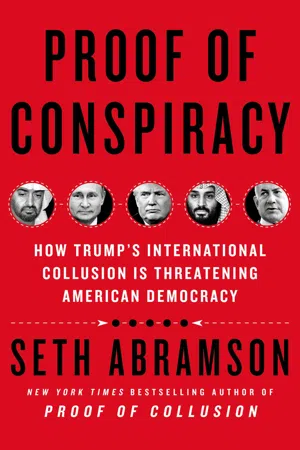
Proof of Conspiracy
eBook - ePub

Proof of Conspiracy

  1. 384 pages
  2. English
  3. ePUB (mobile friendly)
  4. Available on iOS & Android
eBook - ePub

Proof of Conspiracy

About this book

The dramatic and meticulously researched new book from former criminal defence attorney and criminal investigatorSeth Abramson into the complex web of ties surrounding Donald Trump, showing how Proof of Collusion was only the beginning of the story. In late 2015, international dealmaker and current cooperating witness in Special Counsel Robert Mueller's Russia investigation George Nader convened a secret meeting aboard a massive luxury yacht in the Red Sea. Nader pitched to several Middle Eastern leaders a plan for a new pro-US, pro-Israel alliance of Arab nations that would fundamentally alter the geopolitics of the Middle East while marginalising Iran, Syriaand Turkey. To succeed, the plan would need a highly placed American politician willing to drop sanctions on Russia so that Vladimir Putin would in turn agree to end his support for Iran. The gathered leadersagreed their perfect American partner was Donald Trump, who had benefited immensely from his Saudi, Emiratiand Russian dealings for many years, and whohad, months earlier, become the only USpresidential candidate to argue for a unilateral end to Russian sanctions.So begins New York Times bestselling author Seth Abramson's explosive new book Proof of Conspiracy: How Trump's International Collusion Threatens American Democracy, a story of international intrigue whose massive cast of characters includes Israeli intelligence operatives, Russian oligarchs, Saudi death squads, American mercenary companies, Trump's innermost circleand several members of the Trump family - allpart of a clandestine multinational agreement that takes us from Washington, DCand Moscow to the Middle Eastern capitals of Riyadh, Abu Dhabi, Jerusalem, Cairo, Tehranand Doha. Proof of Conspiracy is a chilling and unforgettable depiction of the dangersthe world now faces.

Frequently asked questions

Yes, you can cancel anytime from the Subscription tab in your account settings on the Perlego website. Your subscription will stay active until the end of your current billing period. Learn how to cancel your subscription.
No, books cannot be downloaded as external files, such as PDFs, for use outside of Perlego. However, you can download books within the Perlego app for offline reading on mobile or tablet. Learn more here.
Perlego offers two plans: Essential and Complete
  • Essential is ideal for learners and professionals who enjoy exploring a wide range of subjects. Access the Essential Library with 800,000+ trusted titles and best-sellers across business, personal growth, and the humanities. Includes unlimited reading time and Standard Read Aloud voice.
  • Complete: Perfect for advanced learners and researchers needing full, unrestricted access. Unlock 1.4M+ books across hundreds of subjects, including academic and specialized titles. The Complete Plan also includes advanced features like Premium Read Aloud and Research Assistant.
Both plans are available with monthly, semester, or annual billing cycles.
We are an online textbook subscription service, where you can get access to an entire online library for less than the price of a single book per month. With over 1 million books across 1000+ topics, we’ve got you covered! Learn more here.
Look out for the read-aloud symbol on your next book to see if you can listen to it. The read-aloud tool reads text aloud for you, highlighting the text as it is being read. You can pause it, speed it up and slow it down. Learn more here.
Yes! You can use the Perlego app on both iOS or Android devices to read anytime, anywhere — even offline. Perfect for commutes or when you’re on the go.
Please note we cannot support devices running on iOS 13 and Android 7 or earlier. Learn more about using the app.
Yes, you can access Proof of Conspiracy by Seth Abramson in PDF and/or ePUB format, as well as other popular books in Politics & International Relations & Politics. We have over one million books available in our catalogue for you to explore.
CHAPTER 1

THE PEDOPHILE, THE MERCENARY, AND THE FLACK

As future Trump advisers George Nader, Erik Prince, and Elliott Broidy establish deep Israeli and Arab ties, Trump and his son-in-law, Jared Kushner, engage in a series of suspicious business transactions with foreign nationals, and Paul Manafort begins years of work for pro-Kremlin interests. The Kremlin’s intense focus on connecting with Trump advisers during the 2016 election underscores foreign nationals’ ongoing interest in pursuing relationships with Trump and those close to him both before and after his entrance into presidential politics.
In 2002, George Nader shutters Middle East Insight and “disappear[s]” from Washington.1 A likely explanation for his disappearance is that in 2003 Nader receives a one-year prison sentence in the Czech Republic after he is convicted of ten counts of sexually abusing minors.2 According to the New York Times, at some point thereafter Nader begins working for Vice President Dick Cheney.3 He subsequently shows up in Iraq—shortly after the second American invasion of that country—having developed “close ties to national security officials in the Bush White House.”4 Nader’s ties by this point extend well beyond the U.S. government, however. He is also now connected to the newly arrived private contractors who are working in Iraq post-invasion, most notably Blackwater USA, a “private security company” whose founder, future Trump national security adviser and Steve Bannon confidant Erik Prince, has hired him as a Middle East dealmaker.5 Under oath during a 2010 deposition, Prince will claim—contradicting numerous American government officials who have worked with Nader over the years—that while in Prince’s employ Nader was “unsuccessful” in making deals in the Middle East, “did not work directly” with either Prince or anyone in Blackwater despite having been hired by the company, and “pretty much worked on his own.”6
Erik Prince will feature as a significant player in the many future interactions between Donald Trump, his inner circle of advisers and associates, and powerful Israelis, Saudis, Russians, and Emiratis. The Mueller Report will describe Prince as someone with “relationships with various individuals associated with the [2016] Trump Campaign, including Steve Bannon, Donald Trump Jr., and Roger Stone. . . . [He] sent unsolicited policy papers [to Trump campaign adviser and later CEO] Bannon on issues such as foreign policy, trade, and Russian election interference.”7 The report adds that after Election Day in 2016, Prince “frequently visited transition offices at Trump Tower, primarily to meet with Bannon but on occasion to meet Michael Flynn and others. Prince and Bannon would discuss, inter alia, foreign policy issues and Prince’s recommendations regarding who should be appointed to fill key national security positions.”8 By the time of the presidential transition, Nader, by then an adviser to Mohammed bin Zayed, had “received assurances . . . that the incoming [Trump] Administration considered Prince a trusted associate.”9
The Intercept, an online news organization, has referred to Prince as “America’s most famous mercenary,” but also, more important, as a man who has long been on an idiosyncratic personal mission: “He continues to dream of deploying his military services in the world’s failed states,” the digital media outlet writes, “and persists in hawking a crackpot scheme of privatizing the U.S. war in Afghanistan . . . [but] Prince has diversified his portfolio. No longer satisfied with contracting out former special forces operators to the State Department and Pentagon, Prince is now [in 2019] attempting to offer an entire supply chain of warfare and conflict. He wants to be able to skim a profitable cut from each stage of a hostile operation, whether it be overt or covert, foreign or domestic. His offerings range from the traditional mercenary toolkit, military hardware and manpower, to cell phone surveillance technology and malware, to psychological operations and social media manipulation in partnership with shadowy operations like James O’Keefe’s Project Veritas.”10
While Prince’s present ambitions are grand—if chilling—The Intercept positions him, too, as a figure who poses a danger to international peace and stability as much because of his personality as his geopolitical designs. Prince is, the outlet reports, “a man desperately trying to avoid U.S. tax and weapons trafficking laws even as he offers military services, without a license, in no fewer than 15 countries around the world. Prince’s former and current associates describe him as a visionary . . . who is nonetheless so shady and incompetent that he fails at almost every enterprise he attempts.”11 Prince’s long string of failures appears to end at the dawn of the Trump era, however, as he finds in Trump and his aides, allies, and associates willing compatriots in some of his most audacious schemes.
In the late aughts, Prince’s sudden resurgence on the global stage was still well in the future, however. At the time, he was reeling from September 2007 allegations that mercenaries in his employ had murdered seventeen Iraqis in Baghdad, a federal criminal investigation in which Prince had been, the Nation wrote in 2009, “implicated.”12 As Prince licked his wounds and considered his next moves, he was developing close ties to the Israeli government as well as to strongmen across the Middle East, with Haaretz reporting that Prince’s “deep Israeli connections” came to include a long-standing business relationship with Ari Harow—former bureau chief and chief of staff to Israeli prime minister Benjamin Netanyahu—and another with Dorian Barak, Harow’s onetime business partner.13 By 2018, Harow will have been convicted of fraud and breach of trust and be working with Israeli prosecutors to testify against Netanyahu—who in 2019 becomes the first-ever sitting Israeli prime minister to face charges of bribery and breach of trust—but when Prince first entered Harow’s milieu the latter was a well-connected businessman, and being linked to him put Prince in good stead in Israeli political circles.14
From 2012 on, Prince will hold an investment stake in a company co-managed by Harow and Barak, and by dint of his association with the two men he begins investing in Israeli security companies as well.15 Barak also tries—it isn’t known whether successfully or not—to get Prince to join billionaire Vincent Tchenguiz as a major investor in a new investment project: SCL Group, the parent company of the Trump campaign’s data firm, Cambridge Analytica. Tchenguiz is known as well for being a close business associate of Dmitry Firtash, who is himself a business associate of 2016 Trump campaign manager Paul Manafort.16 Tchenguiz is also an investor in Black Cube and Terrogence, two Israeli intelligence companies that will intersect consequentially with the Trump campaign, transition, and administration (see chapters 3, 4, and 8).17 Black Cube, in particular, has ties to the Israeli government through many employees who are former members of the Israel Defense Forces (IDF), and its advertising “openly” features its “ties to Israeli spy agencies, including Mossad,” according to the New Yorker.18
By 2018, Prince will be notorious in the United States for misleading Congress and the public on the subject of his activities in the Middle East—including a key January 2017 meeting in the Seychelles with a Kremlin agent that Nader successfully set up for Prince on behalf of MBZ and the Trump transition team (see chapter 6).19
Given his history of dealings with Nader, and Nader’s history of dealings with men to whom Prince is also connected, the mercenary’s mid-aughts account of Nader’s incompetence in the midst of sensitive Middle Eastern negotiations seems to be at odds both with Prince’s continued association with him and with an observation by a veteran State Department negotiator for the Middle East, Aaron David Miller, who will tell Politico in 2018 that Nader had “an absolutely amazing degree of contact with the people we [at the State Department] were talking to” in the Middle East.20 Al-Monitor, an American media outlet covering the Middle East, says that at the time Prince claims Nader was ineffectual at making deals in the Middle East, he was in fact “a deal broker in Iraq.”21 The outlet adds that “in Iraq in the mid-2000s, [Nader was] looking to translate his Rolodex of connections from his Middle East Insight days into work advising various Iraqi political clients, including some of Iraq’s new Shiite political leaders, as well as Kurdish officials.” According to Iraqi sources, Nader “helped arrange meetings for the 2005 visit to Washington of leading members of an Iraqi Shiite political party with close ties to Iran, the Supreme Council for the Islamic Revolution in Iraq.”22
After his wide-ranging high-level work in Iraq, however, Nader falls off the grid again. Reached by CNN in 2018, the director of the Atlantic Council’s Middle East center will call Nader a “man of mystery” whose name he hadn’t heard mentioned by anyone in the field of Middle East studies for a dozen years, while another Middle East expert will express surprise “at finding out Nader was still alive” when contacted for comment about Nader’s reemergence into the American news cycle.23
• • •
As Erik Prince is providing private security services in the Middle East during the early years of America’s occupation of Iraq, another future Trump adviser, Elliott Broidy, is in the same place doing the same thing. In 2005, Broidy, described by the New York Times as a “Republican fund-raiser who is [also] a California-based investor with a strong interest in the Middle East,” founds a private security company called Circinus, which, like Prince’s Blackwater (later renamed Academi), “provides services to both United States agencies and foreign governments.”24 It is unclear whether Nader, who is working for Prince in the mid-aughts, crosses paths with Broidy at this point; what is certain is that the two men will be closely linked by the beginning of the Trump administration.
At approximately the same time Broidy is founding Circinus, he is also beginning what becomes a “long history” with onetime and future Israeli prime minister Benjamin Netanyahu, according to Israel’s Haaretz. In 2003, the outlet writes, “then-Finance Minister Netanyahu took credit for convincing the New York State pension fund to invest $250 million in [the Broidy-led] Markstone [Capital Group]”—a firm whose success is later found to have been partly the result of bribes Broidy paid to the New York State comptroller.25 Broidy will be convicted of a misdemeanor for these bribes in 2012.26 Nader eventually establishes “long-standing connections” with Israel through Broidy, according to the Middle East Eye, including being “sent” by MBZ “during the [2016 U.S.] presidential elections” to “meet Israeli officials to discuss how the two states [UAE and Israel] can cooperate”—a course of negotiation that raises the question of whether Israeli officials were the first to point Nader in the direction of a key Israeli figure in the Trump campaign’s orbit, Joel Zamel (see chapters 3 and 4).27 The result of all these intertwining connections is that by the time of the 2016 election, three men who will be among Trump’s foremost clandestine foreign policy advisers—Nader, Prince, and Broidy—all have longtime ties to the Israeli government and deep roots in Middle Eastern geopolitics.
• • •
Donald Trump spends the 2000s augmenting his own existing ties to the Middle East. In 2005, for instance, he attempts to partner with a billionaire from the United Arab Emirates, Hussain Sajwani, to build two massive Trump-branded towers in Dubai.28 The project is ultimately unsuccessful.29
As the New York City businessman is building connections in Abu Dhabi, D.C. political consultant Paul Manafort is busy building connections in a former Soviet republic, Ukraine—a course of ingratiation and shilling that will lead directly to revelations, during the course of Robert Mueller’s investigation into Russian election interference years hence, that not only implicate Donald Trump but also provide a window into how and why several foreign nations saw such promise in the 2016 Trump campaign.
Manafort begins his work as a flack in Ukraine by agreeing to consult for the Party of Regions, a pro-Russia political party funded in substantial part by Rinat Akhmetov, a Ukrainian tycoon who is one of the richest men in the country.30 Manafort was working at the time for Akhmetov’s System Capital Management (SCM).31 During the Trump-Russia scandal following the 2016 presidential election, Manafort will be accused by special counsel Robert Mueller of secretly transmitting proprietary Trump campaign polling data to foreign nationals through a man “the FBI assesses to have ties to Russian intelligence,” Konstantin Kilimnik, with the evidence suggesting that Manafort intended this information to ultimately be seen by, among others, Akhmetov “and another Ukrainian oligarch” (see chapter 4).32
Manafort’s work for the Party of Regions—a political outfit “aligned with Moscow,” according to CNN—begins in 2005 and ends in 2012, a seven-year period during which Manafort, who in 2016 will offer to work for Donald Trump for “free,” earns $60 million for his services. Even after the Party of Regions payments cease, Manafort continues meeting with pro-Kremlin Ukrainian politicians, including a 2014 meeting with Viktor Medvedchuk—a man who will ultimately fall under U.S. sanctions for his role in the Russia-Ukraine conflict, and who is so close to Putin that the Russian president is his daughter’s godfather—that takes place after Trump has made it known to GOP officials that he plans to run for president (see chapter 2).33
Most of Manafort’s Party of Regions work comes in support of Ukrainian politician Viktor Yanukovych, a pro-Kremlin candidate for the presidency of Ukraine hobbled in significant part by the fact that he speaks fluent Russian but has “a hard time speaking Ukrainian.”34 A 2006 U.S. embassy cable describes Yanukovych as not only enjoying the backing of the Kremlin as Manafort tries to give him an “extreme makeover,” but also as belonging to a political party that is “a haven . . . [for] mobsters.”35 A 2017 Time article will describe Yanukovych’s mid-aughts political career as that of an “oafish and inarticulate” man with “rough manners and [a] criminal past,” including past convictions for both violence and theft.36 In the same article, the Party of Regions is described as “stained with blood” due to the abduction and beheading, organized by “some of Yanukovych’s political patrons,” of an investigative journalist, Georgiy Gongadze, who had been exposing high-level corruption in Ukraine.37 When Manafort successfully orchestrates a Yanukovych victory in Ukraine’s 2010 presidential election, “among the first official acts of [Yanukovych’s] tenure [will be] to legally bar Ukraine from seeking NATO membership—a move that effectively granted Russia one of its core geopolitical demands.”38 Six years later, Manafort finds work with another presidential candidate, this time in the United States, whose candidacy is both supported by the Kremlin and marked by an intense hostility to NATO.
Another of Yanukovych’s first acts as Ukrainian president is to jail his chief political opponent, former prime minister Yulia Tymoshenko, the “gold-braided heroine of the Orange Revolution”—a political movement that had successfully protested Yanukovych’s elevation to the presidency back in 2004, partly on the grounds that the Kremlin had interfered in that election.39 This, too, offers an echo of Manafort’s subsequent work as a U.S. campaign adviser, with Donald Trump calling for the jailing of his own chief political opponent, Hillary Clinton, just five years after Yanukovych jails Tymoshenko, and winning higher office only after substantial Kremlin interference in his 2016 election as president. In the case of Yanukovych, writes Reuters, Putin “bankrolled” the Manafort-managed candidate during his bid to become Ukrainian prime minister in 2006, “sowed division” in Ukraine as part of his plan to back his desired candidate, was suspected of supporting an attack against his chosen candidate’s opponent—Yanukovych’s anti-Kremlin rival was “not-so-mysteriously poisoned,” writes Reuters—and watched with satisfaction as Manafort “airbrushed” his favored candidate’s “record of corruption, mismanagement, and alleged ties to Russia.”40
Of Manafort’s first presidential campaign of the 2010s—Trump’s 2016 presidential campaign being his second—Reuters observes that “the [2010 Yanukovych] campaign came from Washington, but the money came from Moscow.”41 “There was no daylight between Yanukovych and Putin,” the media outlet writes of the Manafort-run campaign, “and no daylight between Yanukovych and Manafort.”42 Indeed, as part of his “more than a decade of service to a Putin puppet,” Manafort aided Yanukovych as the Ukrainian politician ensured that Ukraine was “allied with Russia,” anti-NATO, and gave preferential economic treatment to Moscow—an agenda strikingly similar to the one Manafort’s second candidate of the 2010s, Donald Trump, would propose in March 2016, in the midst of the Republican primaries.43
In 2006, Manafort signs a $10 million-a-year consulting and public relations contract with a man Reuters calls a “Putin crony,” Oleg Deripaska, who not coincidentally had also been the man who originally connected Manafort to Akhmetov’s Party of Regions.44 In May 2019, U.S. Senator Ben Sasse (R-NE) will quote a Treasury Department document to describe Deripaska as “a designated [U.S.-sanctioned] individual. He possesses a Russian diplomatic passport. He regularly claims to represent the Russian government. He’s an aluminum—and other metals—billionaire and he’s been investigated by the U.S. government and by . . . our allies for money laundering. He’s been accused of threatening the lives of his business rivals. He’s been charged with illegal wire tapping [and] taking part in extortion and racketeering schemes. He’s bribed government officials; he’s ordered the murder of a businessman; and he has many links to Russian organized crime . . . he’s a bad dude . . . a bottom-feeding scum-sucker and . . . he has absolutely no alignment with the interests of the U.S. people.”45 Deripaska is also, beginning in 2006 and extending into the 2010s, Paul Manafort’s boss and the source of much of his annual income.
While the precise scope of the 2006 Manafort-Deripaska contract is unknown, just months earlier Manafort had pitched Deripaska a course of advocacy that would see Manafort working to “ ‘greatly benefit the Putin government’ by influencing politics, business dealings, and news coverage inside the United States” and abroad.46
Shortly after he begins working for Deripaska, Manafort purchases a $3.7 million condo in Trump Tower—Trump’s home—using an LLC called John Hannah rather than a personal accou...

Table of contents

  1. Cover
  2. Dedication
  3. Author’s Note on Endnotes, Prefatory Material, and Names
  4. Introduction: The Red Sea Conspiracy and the Grand Bargain
  5. Chapter 1. The Pedophile, the Mercenary, and the Flack
  6. Chapter 2. The Iran Nuclear Deal, the Center for the National Interest, and the Valdai Discussion Club
  7. Chapter 3. The Young Prince, Israeli Spies, the NRA Junket, and the Flynn Intel Group
  8. Chapter 4. The Emirati Ambassador, the Mayflower Hotel, and Project Rome
  9. Chapter 5. The Grand Havana Room, the Trump-Nader Meeting, and the Middle East Marshall Plan
  10. Chapter 6. CSMARC, the Incognito Prince, the Seychelles, and the Chairman’s Dinner
  11. Chapter 7. The Gang of Six, WhatsApp, and the Qatar Blockade
  12. Chapter 8. Tel Aviv, the Purge, the Chairman, and the Spy Army
  13. Chapter 9. 1MDB, MESA, the Saudi Quartet, the Trump Doctrine, and the Death of Jamal Khashoggi
  14. Chapter 10. The Syria Withdrawal, the Yemeni Civil War, Secret Summits, and the Saudi Nuclear Deal
  15. Chapter 11. The Mueller Report
  16. Epilogue: The Point of Return
  17. Acknowledgments
  18. Index
  19. Copyright