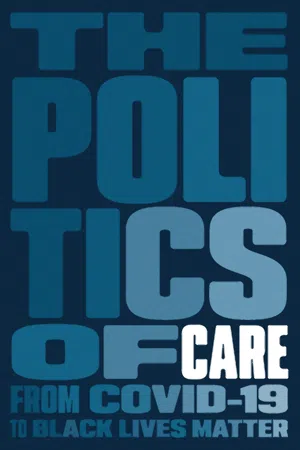
From the COVID-19 pandemic to uprisings over police brutality, we are living in the greatest social crisis of a generation. But the roots of these latest emergencies stretch back decades. At their core is a politics of death: a brutal neoliberal ideology that combines deep structural racism with a relentless assault on social welfare. Its results are the failing economic and public health systems we confront today-those that benefit the few and put the most vulnerable in harm's way.
Contributors to this volume not only protest these neoliberal roots of our present catastrophe, but they insist there is only one way forward: a new kind of politics-a politics of care-that centers people's basic needs and connections to fellow citizens, the global community, and the natural world. Imagining a world that promotes the health and well-being of all, they draw on different backgrounds-from public health to philosophy, history to economics, literature to activism-as well as the example of other countries and the past, from the AIDS activist group ACT-UP to the Black radical tradition. Together they point to a future, as Simon Waxman writes, where "no one is disposable."
CONTRIBUTORS
Robin D. G. Kelley, Gregg Gonsalves and Amy Kapczynski, Walter Johnson, Anne L. Alstott, Melvin Rogers, Amy Hoffman, Sunaura Taylor, Vafa Ghazavi, Adele Lebano, Paul Hockenos, Paul Katz and Leandro Ferreira, Shaun Ossei-Owusu, , Colin Gordon, Jason Q. Purnell, Jamala Rogers, Dan Berger, Julie Kohler, Manoj Dias-Abey, Simon Waxman, Farah Griffin
A co-publication between Boston Review and Verso Books.
- 224 pages
- English
- ePUB (mobile friendly)
- Available on iOS & Android
eBook - ePub
The Politics of Care
About this book
Information
NO ONE
IS
DISPOSABLE
IS
DISPOSABLE
COVID-19 AND THE POLITICS OF DISPOSABILITY
Shaun Ossei-Owusu
IN THE FINAL CHAPTER of his 1992 book Faces at the Bottom of the Well: The Persistence of Racism, Derrick Bell, Harvard Law School’s first tenured Black professor, describes a fictional world eerily similar to the one we know today. Local and federal governments ostensibly have no money. “Decades of conservative, laissez-faire capitalism had emptied the coffers of all but a few of the very rich,” the narrator says. Because of a host of poor choices, the country “was struggling to survive like any third-world nation,” and financial exigencies “curtailed all but the most necessary services.” The parallels are acute: “the environment was in shambles, as reflected by the fact that the sick and elderly had to wear special masks whenever they ventured out-of-doors.”
In the story, English-speaking extraterrestrial beings land on the shores of New Jersey and offer to solve everything: gold to bail out companies, chemicals to clean the environment. The country can have this deal for one sweet price: “all the African Americans who lived in the United States.” This is the central, controversial claim in Bell’s work of science fiction: that white people would sell Black people to aliens for the right price. The story concludes with a successful trade. Twenty million Black men, women, and children are stripped to just one undergarment, lined up, chained, and whisked away, like many of their ancestors’ centuries before.
Bell’s story lays bare the politics of disposability. But unlike the world of the story, the world of COVID-19 is not divided solely into Black and white. It is also white and non-white; poor and not poor; essential and nonessential; white collar and blue collar; Asian and not Asian; undocumented and citizen; able-bodied and sick; young and elderly; first-generation college students and blue bloods; free and imprisoned; celebrities with access to instant testing and plebeians; red states and blue states; and countless other binaries. From these overlapping inequities, we get a glimpse of who is disposable: the people who occupy any of the wrong categories. The scholar and cultural critic Henry Giroux analyzes this politics in his book Against the Terror of Neoliberalism (2008). “It is a politics in which the unproductive (the poor, weak and racially marginalized) are considered useless and therefore expendable,” Giroux writes, and “in which entire populations are considered disposable, unnecessary burdens on state coffers, and consigned to fend for themselves.”
Tragically, demographic data about COVID-19 deaths have borne out this vision. In April Kaiser Health News was among the first outlets to report that “A Disproportionate Number Of African-Americans Are Dying, But The U.S. Has Been Silent On Race Data.” Months later, the disproportionate death toll caused by COVID-19 is clearer. People of color, and Black people in particular, have the highest death-to-population ratio in most states around the country. Beyond the latest numbers, we have other data points: history, what is visible from news and experience, and media accounts. These are imperfect, but they supply some information, and the implications are grim.
This is certainly not to say that there is some sinister grand plot to harm vulnerable populations. In Bell’s allegory, intent can often be a sideshow, if not an outright distraction. The truth is more banal: systemic social inequalities have made some groups more vulnerable than others, and the question of intent is therefore irrelevant. As a criminal law professor, I teach my students that intent matters—but in reality, sometimes it doesn’t. In this context, malfeasance, misguided policies, and indifference suffice. Moreover, while government is the easy and most identifiable culprit, popular complicity is at play here too, which makes this version of disposability different from Bell’s telling.
The people whose disposability has been most flouted are those who work in immediate-risk industries. The financially precarious service workers out with the epidemiological wolves so the rest of society can buy groceries. The health care workers plastered on the news, who labor in a profession that tasks minority and women nurses, physician assistants, and technicians with what sociologist Adia Harvey Wingfield calls “equity work”: labor that makes health institutions more available to marginalized groups. The homeless population, which was already noticeable in U.S. cities, but is now more conspicuous because of their inability to shelter in place.
Then there are the undocumented agricultural workers in the West and Southwest who can’t work on Zoom like their white-collar counterparts and have now become more precious in a country that has insisted on calling them illegal. There are Native Americans—some of whom have been facing a long-standing water crisis—who have uniquely high rates of diseases that make COVID-19 more lethal. There are the Asian Americans who have been subject to hate crimes since this virus surfaced in the United States. And there are the residents in poorly serviced public housing projects in places such as Chicago, Baltimore, and my native South Bronx, where in April 2,000 public housing residents woke up to no water during an epidemic that requires vigilant hand washing.
The recent history of U.S. disasters is also telling. The Chicago heatwave of 1995 killed more than 700 people, mostly poor and elderly, and necessitated refrigerated trucks for the dead, just as happened in New York this spring. A decade later, Hurricane Katrina took the lives of more than 1,800 people in Louisiana, many of whom were poor and could not leave their homes as advised. Poor people in New York City face the same today: they do not have the benefit of escaping to second homes in Long Island and New England. And then there was Hurricane Maria, which was a little more than eighteen months ago. That disaster, which killed approximately 3,000 people in Puerto Rico, elicited similar criticisms of the federal government’s slow response, and accusations that the death count was severely understated. Jason Cortés has described President Donald Trump’s paper-towel-throwing spectacle during his visit to Puerto Rico as “the American commander-in-chief [choosing] to toss disposable paper to disposable people.”
On Palm Sunday, Surgeon General Jerome Adams gave an ominous warning. “This is going to be the hardest and the saddest week of most Americans’ lives, quite frankly,” he cautioned. “This is going to be our Pearl Harbor moment, our 9/11 moment. Only, it’s not going to be localized, it’s going to be happening all over the country. And I want America to understand that.” But who exactly has been disposed of? It certainly hasn’t been all of us. Collective pronouns—the “we” and “our” and “us” of public discourse—are dangerously comforting. They give the impression of equal susceptibility, while celebrities and other prominent figures gain access to testing and top-flight health care. COVID-19 is not discriminatory as a biological matter, but history and available accounts indicate that the epidemiological fallout has been and will continue to be weighty and uneven.
During the debates about the Affordable Care Act, hysteria emerged around government-run “death panels”: committees of doctors who would ration care and decide who would receive treatment. This alarm ignored the long history of rationing and unequal access to health care—the subject of Beatrix Hoffman’s book Rights and Rationing in the United States Since 1930 (2012)—but it echoes legitimate dismay about bureaucrats making decisions about who lives and who dies. People with disabilities, racial minorities, undocumented immigrants, prisoners, and the poor did not figure prominently in the frenzy around death panels, but they have reason to be worried now. The uninsured, elderly, and an ever-growing portion of the middle class should be added to that list.
Social science data has already shown that African Americans are often denigrated, disregarded, and disbelieved by medical professionals when they claim they are in pain. Where will they fit in the treatment queues? Can we rest assured that American doctors will not take a cue from those in Italy, who deprioritized the lives of COVID-19 patients who were chronically ill, disabled, or elderly? What about the Latinx folk who constitute a third of uninsured people in the country? Bioethical scenarios usually reserved for grad school seminars are likely to be actualized.
This is not to say that rural whites have been exempt from the virus or its economic impact. COVID-19 has now worked its way into the rural and whiter parts of the country with suboptimal health care infrastructures. Rural residents live in areas that have been battered by closing hospitals, physician shortages, and poverty. Many of these people perceive themselves to be “strangers in their own land,” as the title of sociologist Arlie Hochshild’s 2018 book put it. Will they be disregarded too? If so, what are the electoral consequences of their political expendability, and if there turn out to be none, what does that say about the disposability of everyone else?
Bell’s story struck a nerve because it highlighted the vulnerability of an entire class of people. The difference now is that the people being sacrificed extends beyond African Americans, and responsibility can be tethered not only to government but to the private sector, the media, and parts of the general public. The outcome of this story is uncertain. But when the dust settles, there will be a tale to tell of who mattered and who was sacrificed.
COVID-19 AND THE COLOR LINE
Colin Gordon, Walter Johnson,
Jason Q. Purnell, & Jamala Rogers
Jason Q. Purnell, & Jamala Rogers
AS THE COVID-19 CRISIS unfolds, its toll on African Americans is coming into sharper focus. In almost every setting, African Americans are contracting the virus—and dying from it—at startlingly disproportionate rates. In Alabama, African Americans account for 27 percent of the population, 44 percent of COVID-19 cases, and 45 percent of COVID-19 deaths. In Illinois, African Americans account for 14 percent of the population, 22 percent of COVID-19 cases, and 28 percent of COVID-19 deaths. In Wisconsin, African Americans account for just 6 percent of the population but nearly a quarter of COVID-19 deaths. Starkest of all, in the city of St. Louis, African Americans account for 47 percent of the population, almost 60 percent of COVID-19 cases, and over two thirds of those who have died.
How do we account for this damage, for what New York Times columnist Charles Blow aptly dubbed the racial time bomb at the heart of the COVID-19 crisis? The answer to that question has deep and tangled historical roots. It is a story not just of discrimination, but of systematic exploitation, exclusion, subordination, and predation. The ability to live a long and healthy life is predicated on access to a range of social and economic resources systematically denied African American families and communities. In St. Louis, as elsewhere, African American workers are overrepresented among frontline service workers, among whom low wages are the rule and the luxury of social distancing is not. In order to get to work, or even to shop at a grocery store, many must spend hours on public transportation. Because health care in our society is generally allocated according to employment, it is least accessible to those who need it the most. In St. Louis, African Americans are more than twice as likely as whites to be uninsured. Without economic security or options, and without adequate protection on the job, these workers and their communities have been delivered to disease by their history—by U.S. history.
The slow violence that we see unfolding in St. Louis has been structured into the fabric of the city, built brick-by-brick by those who have sought profit in segregation and comfort in social distance. Its racialized patterns of disadvantage are the result of decades of conscious choices by actors at every level of government, aided and abetted by private industries such as banking, insurance, and real estate, to name but a few. St. Louis’s history of imposed Black deprivation is both unique to it and reflective of the broader patterns that have made COVID-19 a charnel house for Black Americans nationwide.
WHITE ST. LOUIS has been in a sort of self-imposed social distancing for most of the century. In 1916 it passed a racial zoning law by popular referendum. After the Supreme Court struck down racial zoning on equal protection grounds the next year (in Buchanan v. Warley), St. Louis realtors, developers, and homeowners turned to the use of racial restrictions written into property deeds—“covenants” that bound neighborhoods and new subdivisions to whiteness. The “uniform restriction agreement” in wide use in St. Louis by the early 1930s sought to “preserve the character of said neighborhood as a desirable place of residence for persons of the Caucasian Race,” holding that homeowners could not “erect, maintain, operate, or permit to be erected, maintained or operated any slaughterhouse, junk shop or rag-picking establishment” or “sell, convey, lease, or rent to a negro or negroes.” These restrictions, written into the deed as a condition of sale, still turn up in property transactions all over the city today.
By the end of the 1940s, such agreements prohibited the “nuisance” of Black occupancy in nearly a third of the city’s housing stock. For realtors and landlords, these covenants were money in the bank. On the white side of the lines, they could extract a premium price by promising that the new resident or renter would never need to worry about having a Black neighbor. On the Black side of the line, they could extract ever-higher rents from a population that was growing through the years of the Great Migration (the massive movement of African Americans from the South in the first half of the twentieth century), but legally confined to a few areas of the city. It was in Black St. Louis that the real money was to be made: slicing up buildings into ever-smaller kitchenette apartments while skimping on upkeep and improvement. At the time of World War II, indoor plumbing was still rare in many of the Black neighborhoods in St. Louis.
In 1948 the Supreme Court, in a case originating in St. Louis (Shelley v. Kraemer), declared that restrictive covenants were legally unenforceable. (Only six of the nine justices voted—the other three recused themselves because they, too, lived in covenanted racial enclaves.) Segregation, however, remained. Increasingly, it took the form of federal, state, and local subsidies that were in reality available almost exclusively to whites—for example, G.I. Bill housing benefits available only to white veterans and Federal Housing Association loan guarantees distributed according to racist protocols in a pattern that has come to be known as “redlining.” This meant that loan guarantees were hived off from neighborhoods where Blacks lived, while white St. Louis expanded into the emerging suburban frontier in St. Louis County. Whites moved west along an unfolding network of interstate highways, which were themselves an economic subsidy to whiteness—built by white construction workers through Black neighborhoods for the purpose of making it easier for white suburbanites to get to work downtown.
As well as by police harassment and vigilante violence, Black mobility into the suburbs was limited by the seemingly mundane tools of municipal incorporation and land-use zoning. “White flight” suburbs popped up like mushrooms west of the city (there are almost ninety municipalities in St. Louis County today). Many of these brand-new cities had zoning codes which excluded multifamily dwellings and stipulated large minimum sizes for home lots, thus ensuring that only the right sort of people (read: comparatively wealthy and almost entirely white) could move in. To this day, many of the municipalities in the broad westward corridor out of the city are 95 percent (or more) white. While similar patterns of white flight and urban decline unfolded elsewhere—indeed, this is the enduring pattern of U.S. life—St. Louis was its apotheosis. “St. Louis is not a typical city,” as one reporter noted in the late 1970s, “but, like a Eugene O’Neill play, it shows a general condition in stark and dramatic form.”
The mutually exacerbating patterns of federal preference and municipal connivance were reinforced by the state government of Missouri—a Confederate-claimed and Jim Crow state in which social, economic, and tax policy have been shaped by a long history of systematic racism. Like all slaveholding states, Missouri was reluctant to tax property. This left many of its cities and towns without the capacity to sustain decent public goods and services—a constraint exaggerated by the 1980 Hancock Amendment, which put a hard cap on property tax increases. And, like most southern states, Missouri underdeveloped its social safety net, underfunding education, paring eligibility and benefits in federal–state unemployment and cash assistance programs, and recently declining to expand Medicaid coverage under the Affordable Care Act.
Over the second half of the twentieth century, St. Louis became—and now remains—one of the most segregated cities in the country. The so-called “Delmar Divide” splits St. Louis into two worlds: north of that line (over 97 percent African American by 1970), the housing stock has crumbled, economic opportunities have vanished, and public goods—especially schools—are scarce and deteriorating. Today, you can map virtually any index of social well-being—rates of childhood asthma, access to broadband, level of education upon leaving school, life expectancy—and a stark disparity will be evident along the east–west path of Delmar Boulevard.
Many in Black St. Louis point to the early 1970s as the beginning of the end for North City. In response to a 1973 RAND Corporation report, future U.S. congressman and Democratic presidential candidate Richard Gephardt introduced to the Board of Aldermen a motion declaring North St. Louis “an insignificant residential area not worthy of special maintenance effort.” Gephardt’s brazen indifference was developed by the urban planning firm Team 4 into a comprehensive plan for the city that recommended a strategy of “triage”: continuing investment in thriving areas of the city, targeted investment in “marginal areas,” and abandonment of the North Side. The report provoked widespread outrage and was officially disavowed by the city—but it is, in effect, exactly what happened. In 1979, in the face of widespread public outcry and sustained street-level resistance, the city closed Homer G. Phillips Hospital, which had served the North Side since the 1930s, and had gained a national reputation for Black medical excellence. It was, one of the white city leaders explained in justifying the closing, too hard to get all way up there from city hall.
As the city rapidly deteriorated, those African Americans who could afford to do so tried to migrate to the inner-ring suburbs of central and north St. Louis County. They were met with overt hostility and sustained resistance. The city of Ferguson, to give only a single example, considered building a ten-foot wall along the entirety of its border with the majority-Black city of Kinloch—in 1976. Gradually, these suburbs were integrated, and thus began a second wave of federally subsidized white flight along widened interstates pushing farther and farther west away from the city.
IT IS THIS HISTORY—of white cupidity supported at every level of government and woven into the fabric of daily life—that has rendered up African Americans in St. Louis and St. Louis County to the virus. “The resources that are necessary to live a long and productive life are not equally distributed throughout the St. Louis region,” as a comprehensive report on Segregation in St. Louis concluded in 2018. “They are not randomly distributed either. This unequal distribution of opportunity is the result of decades of policy at the local, state, and federal levels of government, and it is reinforced by systems, institutions, and industries … that reproduce unequal outcomes.”
As investment, economic development, and employment followed the highways west, the combination of sustained segregation and dramatic deindustrialization in Greater St. Louis ensured that while capital could move, the African American working class could not. The scattering of jobs that remained offered lower wages, fewer benefits, or long and expensive commutes. The median income of African Americans in Greater St. Louis is half that of white median income, while the rates of poverty and unemployment are three times as great. Since 1980, by one estimate, the incomes of young Black men in the city of St. Louis have fallen from $29,443 to just over $11,000.
All this comes with physical risk...
Table of contents
- Cover Page
- Halftitle Page
- Title Page
- Copyright Page
- Contents
- Editors’ Note
- The New Politics of Care
- In This Together
- COVID-19 and Political Cultures
- No One is Disposable
- Getting to Freedom City
- Contributors
Trusted by 375,005 students
Access to over 1.5 million titles for a fair monthly price.
Study more efficiently using our study tools.
Frequently asked questions
Yes, you can cancel anytime from the Subscription tab in your account settings on the Perlego website. Your subscription will stay active until the end of your current billing period. Learn how to cancel your subscription
No, books cannot be downloaded as external files, such as PDFs, for use outside of Perlego. However, you can download books within the Perlego app for offline reading on mobile or tablet. Learn how to download books offline
Perlego offers two plans: Essential and Complete
- Essential is ideal for learners and professionals who enjoy exploring a wide range of subjects. Access the Essential Library with 800,000+ trusted titles and best-sellers across business, personal growth, and the humanities. Includes unlimited reading time and Standard Read Aloud voice.
- Complete: Perfect for advanced learners and researchers needing full, unrestricted access. Unlock 1.5M+ books across hundreds of subjects, including academic and specialized titles. The Complete Plan also includes advanced features like Premium Read Aloud and Research Assistant.
We are an online textbook subscription service, where you can get access to an entire online library for less than the price of a single book per month. With over 1.5 million books across 990+ topics, we’ve got you covered! Learn about our mission
Look out for the read-aloud symbol on your next book to see if you can listen to it. The read-aloud tool reads text aloud for you, highlighting the text as it is being read. You can pause it, speed it up and slow it down. Learn more about Read Aloud
Yes! You can use the Perlego app on both iOS and Android devices to read anytime, anywhere — even offline. Perfect for commutes or when you’re on the go.
Please note we cannot support devices running on iOS 13 and Android 7 or earlier. Learn more about using the app
Please note we cannot support devices running on iOS 13 and Android 7 or earlier. Learn more about using the app
Yes, you can access The Politics of Care by Boston Review in PDF and/or ePUB format, as well as other popular books in Politics & International Relations & Essays in Politics & International Relations. We have over 1.5 million books available in our catalogue for you to explore.