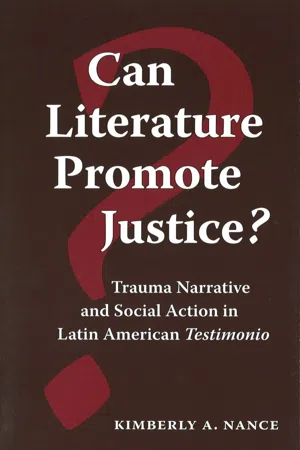
Can Literature Promote Justice?
eBook - PDF

Can Literature Promote Justice?

Trauma Narrative and Social Action in Latin American Testimonio

  1. 224 pages
  2. English
  3. PDF
  4. Available on iOS & Android
eBook - PDF

Can Literature Promote Justice?

Trauma Narrative and Social Action in Latin American Testimonio

About this book

As if in direct response to The New Yorker's question of "The Power of the Pen: Does Literature Change Anything?" Kimberly Nance takes up the relationship between ethics and literature. With the 40th anniversary of the testimonio occurring in 2006, there has never been a better time to reconsider its role in achieving social justice.

The advent of the testimonio--loosely, a political autobiography of a Latin American activist who hopes, through the telling of her life story, to bring about change--was met with a great deal of excitement by scholars who posited it as a radical new form of literature. Those accolades were almost immediately followed by a series of critical problems. In what sense were testimonios "true"? What right did privileged scholars in the U.S. have to engage accounts of suffering with traditional modes of criticism? Were questions of veracity or aesthetics more important? Were these texts autobiography or political screeds? It seemed critics didn't know quite what to make of the testimonio and so, after a brief bout of engagement, disregarded it.

Nance, however, argues that any form as prolific as the testimonio is well worth examining and that these questions, rather than being insurmountable, are exactly the questions with which scholars ought to be wrestling. If, as critics claim, that the testimonio is one of the most pervasive contemporary Latin American cultural genres, then it is high time for a comprehensive study of the genre such as Nance's.

Frequently asked questions

Yes, you can cancel anytime from the Subscription tab in your account settings on the Perlego website. Your subscription will stay active until the end of your current billing period. Learn how to cancel your subscription.
At the moment all of our mobile-responsive ePub books are available to download via the app. Most of our PDFs are also available to download and we're working on making the final remaining ones downloadable now. Learn more here.
Perlego offers two plans: Essential and Complete
  • Essential is ideal for learners and professionals who enjoy exploring a wide range of subjects. Access the Essential Library with 800,000+ trusted titles and best-sellers across business, personal growth, and the humanities. Includes unlimited reading time and Standard Read Aloud voice.
  • Complete: Perfect for advanced learners and researchers needing full, unrestricted access. Unlock 1.4M+ books across hundreds of subjects, including academic and specialized titles. The Complete Plan also includes advanced features like Premium Read Aloud and Research Assistant.
Both plans are available with monthly, semester, or annual billing cycles.
We are an online textbook subscription service, where you can get access to an entire online library for less than the price of a single book per month. With over 1 million books across 1000+ topics, we’ve got you covered! Learn more here.
Look out for the read-aloud symbol on your next book to see if you can listen to it. The read-aloud tool reads text aloud for you, highlighting the text as it is being read. You can pause it, speed it up and slow it down. Learn more here.
Yes! You can use the Perlego app on both iOS or Android devices to read anytime, anywhere — even offline. Perfect for commutes or when you’re on the go.
Please note we cannot support devices running on iOS 13 and Android 7 or earlier. Learn more about using the app.
Yes, you can access Can Literature Promote Justice? by Kimberly A. Nance,Kimberly Nance in PDF and/or ePUB format, as well as other popular books in Literature & Latin American & Caribbean History. We have over one million books available in our catalogue for you to explore.

Table of contents

  1. Cover
  2. Title Page
  3. Table of Contents
  4. Acknowledgments
  5. Introduction
  6. 1. A Genre Without a Strategy?
  7. 2. A Genre Without an Addressee?
  8. 3. A Genre Without a Chance?
  9. 4. The Capacities and Constraints of Testimonio's Speakers and Experiencing Writers
  10. 5. The Capacities and Constraints of Collaborating Writers, Translators, Editors, and Publishers
  11. 6. The Capacities and Constraints of Critics
  12. Conclusion
  13. Appendix
  14. Notes
  15. Works Cited
  16. Index