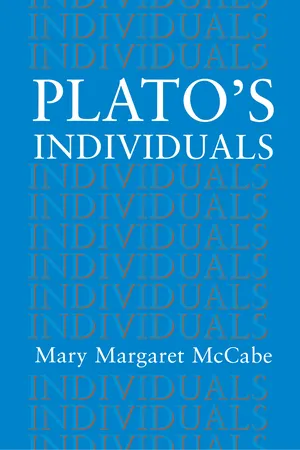
Contradicting the long-held belief that Aristotle was the first to discuss individuation systematically, Mary Margaret McCabe argues that Plato was concerned with what makes something a something and that he solved the problem in a radically different way than did Aristotle. McCabe explores the centrality of individuation to Plato's thinking, from the Parmenides to the Politicus, illuminating Plato's later metaphysics in an exciting new way.
Tradition associates Plato with the contrast between the particulars of the sensible world and transcendent forms, and supposes that therein lies the center of Plato's metaphysical universe. McCabe rebuts this view, arguing that Plato's thinking about individuals--which informs all his thought--comes to focus on the tension between "generous" or complex individuals and "austere" or simple individuals. In dialogues such as the Theaetetus and the Timaeus Plato repeatedly poses the question of individuation but cannot provide an answer. Later, in the Sophist, the Philebus, and the Politicus, Plato devises what McCabe calls the "mesh of identity," an account of how individuals may be identified relative to each other. The mesh of identity, however, fails to explain satisfactorily how individuals are unified or made coherent. McCabe asserts that individuation may be absolute--and she questions philosophy's longtime reliance on Aristotle's solution.
- 358 pages
- English
- PDF
- Available on iOS & Android
eBook - PDF
Plato's Individuals
About this book
Information
Publisher
Princeton University PressYear
2020Print ISBN
9780691029399
9780691073514
eBook ISBN
9780691219448
Topic
PhilosophySubtopic
Ancient & Classical PhilosophyTable of contents
- Cover Page
- Half-title Page
- Title Page
- Copyright Page
- Dedication Page
- Contents
- Acknowledgments
- List of Abbreviations
- One: The Problem of Individuation
- Part One: Preliminary: Plato's Middle Period Metaphysics
- Part Two: The Problem Emerges
- Part Three: Two Answers
- Appendix A: On the Order of the Dialogues
- Appendix B: Arguments from First Principles
- Select Bibliography
- Index Locorum
- Index of Persons
- General Index
Trusted by 375,005 students
Access to over 1.5 million titles for a fair monthly price.
Study more efficiently using our study tools.
Frequently asked questions
Yes, you can cancel anytime from the Subscription tab in your account settings on the Perlego website. Your subscription will stay active until the end of your current billing period. Learn how to cancel your subscription
No, books cannot be downloaded as external files, such as PDFs, for use outside of Perlego. However, you can download books within the Perlego app for offline reading on mobile or tablet. Learn how to download books offline
Perlego offers two plans: Essential and Complete
- Essential is ideal for learners and professionals who enjoy exploring a wide range of subjects. Access the Essential Library with 800,000+ trusted titles and best-sellers across business, personal growth, and the humanities. Includes unlimited reading time and Standard Read Aloud voice.
- Complete: Perfect for advanced learners and researchers needing full, unrestricted access. Unlock 1.5M+ books across hundreds of subjects, including academic and specialized titles. The Complete Plan also includes advanced features like Premium Read Aloud and Research Assistant.
We are an online textbook subscription service, where you can get access to an entire online library for less than the price of a single book per month. With over 1.5 million books across 990+ topics, we’ve got you covered! Learn about our mission
Look out for the read-aloud symbol on your next book to see if you can listen to it. The read-aloud tool reads text aloud for you, highlighting the text as it is being read. You can pause it, speed it up and slow it down. Learn more about Read Aloud
Yes! You can use the Perlego app on both iOS and Android devices to read anytime, anywhere — even offline. Perfect for commutes or when you’re on the go.
Please note we cannot support devices running on iOS 13 and Android 7 or earlier. Learn more about using the app
Please note we cannot support devices running on iOS 13 and Android 7 or earlier. Learn more about using the app
Yes, you can access Plato's Individuals by Mary Margaret McCabe,Mary M. McCabe in PDF and/or ePUB format, as well as other popular books in Philosophy & Ancient & Classical Philosophy. We have over 1.5 million books available in our catalogue for you to explore.