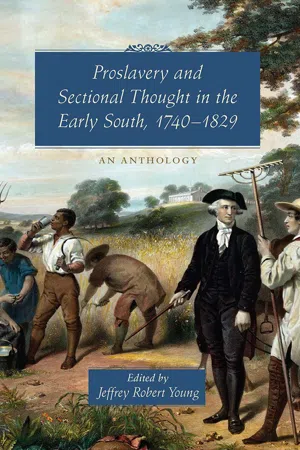
Proslavery and Sectional Thought in the Early South, 1740-1829
eBook - PDF

Proslavery and Sectional Thought in the Early South, 1740-1829

An Anthology

  1. 272 pages
  2. English
  3. PDF
  4. Available on iOS & Android
eBook - PDF

Proslavery and Sectional Thought in the Early South, 1740-1829

An Anthology

About this book

Thirteen treatises recall the history of slavery's defenders beginning in the colonial South

In Proslavery and Sectional Thought in the Early South, 1740–1829, Jeffrey Robert Young has assembled thirteen texts that reveal the development of proslavery perspectives across the colonial and early national South, from Maryland to Georgia. The tracts, lectures, sermons, and petitions in this volume demonstrate that defenses of human bondage had a history in southern thought that long predated the later antebellum era traditionally associated with the genesis of such positive defenses of slavery. Previous anthologies, notably Drew Gilpin Faust's The Ideology of Slavery, have made the perspectives of antebellum slavery's defenders widely available to scholars and students, but earlier proslavery thinkers have remained largely inaccessible to modern readers. Young's anthology offers a corrective.

In his introduction to the volume, Young explores the relationship between proslavery thought, Christianity, racism, and sectionalism. He emphasizes the ways in which justifications for slavery were introduced into the American South by reformers who hoped to integrate the region into a transatlantic religious community. These early proponents of slavery tended to minimize racial distinctions between master and slave, and they hoped to minimize the cultural distance between southern plantations and English society.

Only in the early nineteenth century—with the rise of an increasingly influential abolition movement—did proslavery thinkers begin to justify their beliefs with approaches that underscored differences between North and South. Even then the theorists included in this anthology emphasized the extent to which southern slaveholders' claims to mastery were rooted in a Western moral tradition that reached back to antiquity.

Frequently asked questions

Yes, you can cancel anytime from the Subscription tab in your account settings on the Perlego website. Your subscription will stay active until the end of your current billing period. Learn how to cancel your subscription.
At the moment all of our mobile-responsive ePub books are available to download via the app. Most of our PDFs are also available to download and we're working on making the final remaining ones downloadable now. Learn more here.
Perlego offers two plans: Essential and Complete
  • Essential is ideal for learners and professionals who enjoy exploring a wide range of subjects. Access the Essential Library with 800,000+ trusted titles and best-sellers across business, personal growth, and the humanities. Includes unlimited reading time and Standard Read Aloud voice.
  • Complete: Perfect for advanced learners and researchers needing full, unrestricted access. Unlock 1.4M+ books across hundreds of subjects, including academic and specialized titles. The Complete Plan also includes advanced features like Premium Read Aloud and Research Assistant.
Both plans are available with monthly, semester, or annual billing cycles.
We are an online textbook subscription service, where you can get access to an entire online library for less than the price of a single book per month. With over 1 million books across 1000+ topics, we’ve got you covered! Learn more here.
Look out for the read-aloud symbol on your next book to see if you can listen to it. The read-aloud tool reads text aloud for you, highlighting the text as it is being read. You can pause it, speed it up and slow it down. Learn more here.
Yes! You can use the Perlego app on both iOS or Android devices to read anytime, anywhere — even offline. Perfect for commutes or when you’re on the go.
Please note we cannot support devices running on iOS 13 and Android 7 or earlier. Learn more about using the app.
Yes, you can access Proslavery and Sectional Thought in the Early South, 1740-1829 by Jeffrey Robert Young, Jeffrey Robert Young,Jeffrey R. Young in PDF and/or ePUB format, as well as other popular books in Social Sciences & North American History. We have over one million books available in our catalogue for you to explore.

Table of contents

  1. Cover
  2. Proslavery and Sectional Thought in the Early South, 1740–1829
  3. Title
  4. Copyright
  5. Dedication
  6. CONTENTS
  7. Preface
  8. Acknowledgments
  9. Introduction A Transatlantic Perspective on the Problem of Proslavery Thought
  10. 1 George Whitefield, 1740
  11. 2 Alexander Garden, 1740
  12. 3 Thomas Bacon, 1749
  13. 4 Samuel Davies, 1757
  14. 5 William Knox, 1768
  15. 6 Petition to the Virginia Assembly, 1785
  16. 7 Henry Pattillo, 1787
  17. 8 William Graham, 1796
  18. 9 Edmund Botsford, 1808
  19. 10 William Meade, 1813
  20. 11 William Smith, 1818, 1820
  21. 12 Richard Furman, 1823
  22. 13 Charles Cotesworth Pinckney, 1829
  23. Index