In 1998, roughly 2 million visitors came to see what there was to see in Nashville. By 2018, that number had ballooned to 15.2 million.
In that span of two decades, the boundaries of Nashville did not change. But something did. Or rather, many somethings changed, and kept changing, until many who lived in Nashville began to feel they no longer recognized their own city. And some began to feel it wasn't their own city at all anymore as they were pushed to its fringes by rising housing costs. Between 1998 and 2018, the population of Nashville grew by 150,000. On some level, Nashville has always packaged itself for consumption, but something clicked and suddenly everyone wanted a taste. But why Nashville? Why now? What made all this change possible?
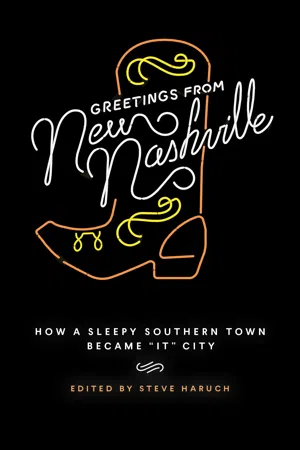
This book is an attempt to understand those transformations, or, if not to understand them, exactly, then to at least grapple with the question: What happened?
- 222 pages
- English
- ePUB (mobile friendly)
- Available on iOS & Android
eBook - ePub
About this book
Information
Dish Network
STEVE CAVENDISH, 2019
THERE IS NOT MUCH Randy Rayburn hasn’t seen.
Over coffee at his Midtown Cafe—where a walk through the packed dining room at lunch will find politicians, business leaders, and more than a few members of the music industry—Rayburn enjoys regaling an audience with stories about the city and, specifically, the dining scene. What’s left of his hair is silver now, but with his five decades in Nashville restaurants, there are few more expert.
“Nashville was a chain town from the 1950s through the 1980s,” Rayburn says. He’s right. During that stretch, people like Ray Danner built an empire out of Shoneys, Fifth Quarter, and Sailmaker. Mrs. Winner’s and Kenny Rogers Roasters were based here, and other chains like J. Alexanders used Nashville as their launch site. As Paul Hemphill notes in his 1970 book The Nashville Sound, “So many of the stars were sinking their money into fast-food franchises (Minnie Pearl’s Fried Chicken, Tennessee Ernie Steak ‘n’ Biscuits, Tex Ritter’s Chuck Wagon System) that some people were touting Nashville as the franchise center of the nation.”
And while there were a few independent standouts like Julian’s or Mario’s, there was little to differentiate Nashville dining from Columbus or Charlotte. In fact, Nashville’s relative acceptance of everything is what led longtime West End staple Houston’s to land here in 1977. (That location—which like Midtown Cafe is often crowded with elites—is now home to one of BrickTop’s eight southeast franchises.)
“Contrary to revisionist history, there were actually excellent restaurants and top-notch, acclaimed chefs in Nashville in the late 1990s and throughout the 2000s,” Rayburn says. Deb Paquette got national mentions for her work at Zola and Bound’ry. And Rayburn still beams a bit when he mentions being named wine marketer of the year by the influential Wine Enthusiast in 1998 while his Sunset Grille was at its peak in Hillsboro Village.
But Nashville didn’t truly arrive as a culinary destination until the new millennium, the culmination of factors as diverse as tourism growth, a rise in disposable income, and good old-fashioned dumb luck. The Nashville metro area passed one million residents in the mid-1990s, making it a target for larger corporate entities to relocate or put big operations here, including Nissan and Dell. Large numbers of the employees who came to work at those new arrivals wanted to live in the city, not a county away in the suburbs. Those new residents brought with them new tastes and sometimes a desire to recreate them, like in the case of Sarah Gavigan, a music industry transplant whose love of LA izakayas led her to open a couple of ramen shops and a gleaming, Tokyo-inspired bar in the Gulch—a neighborhood that until the mid-2000s had been a mostly industrial strip bisected by train tracks, holding little more than a couple restaurants, the bluegrass club The Station Inn, and a blocks-long refrigeration plant.
In many ways, too, the city’s dining scene has mirrored tastes across the country that have become more sophisticated thanks to multiple cable channels devoted to fetishizing food and chefs—or, to put it more simply, we knew what we were missing and we wanted it in Nashville. If an Iron Chef could make a shabu shabu on TV, couldn’t a chef here make it as well? Some of those celebrities on TV relocated to Nashville, like Top Chef finalist Dale Levitski and Chopped star Maneet Chauhan, whose Morph Hospitality group now includes four restaurants. Even those TV chefs who didn’t relocate became regular visitors, thanks in part to the massive Music City Food and Wine Festival, started in 2006—a glitzy, gawky sort of event put on by a perhaps unlikely group of event planners that includes chef Jonathan Waxman and rock band Kings of Leon.
Other Nashville chefs have found national notoriety in the pages of Food + Wine and other national publications, like rising star Julia Sullivan, a Nashville native who returned from the line at Franny’s in New York to open Henrietta Red, a wood-fired, seafood-first place she opened with Max and Benjamin Goldberg. It was hailed by Bon Appetit as one of the country’s best new restaurants in 2017.
And while Rayburn is right that there were some quality restaurants here before the late 1990s, there was nowhere near the number of talented chefs and restaurateurs that compete for attention and dollars today. Much of that is fueled by tourism—those extra five million visitors we added between 2012 and 2018 have to eat somewhere, right?—but both the quality and quantity of our offerings has changed.
Nashville chefs regularly appear on nomination lists for the prestigious James Beard Award—Josh Habiger, Matt Bolus, Hal Holden-Bache, Sullivan, Margot McCormack, the Goldbergs and others have been nominated at various points—and Tandy Wilson, the proprietor and force behind the acclaimed City House, won one in 2016. City House, in many ways, was the culmination of all of those forces in a Nashville restaurant, a restaurant built by a local talent who saw the world, returned with an idea, and then set a standard others had to live up to. Along the way, the quality of restaurants was elevated as well as our expectations for what a good dining experience should be.
I would argue there are four elements that have been enormously, though not exclusively, responsible for elevating the city’s dining scene in the last two decades.
First, there needs to be an anchor, a restaurant of immense quality that paves the way for others to follow. A single restaurant’s sustained excellence can elevate an entire city. Don’t believe me? Look at what Frank Stitt and Highlands Bar & Grill have done for Birmingham, wowing local and national diners for more than three decades and spinning off talent to open places of their own. In Nashville, that place is Margot, the Southern-ingredients-by-way-of-France stalwart at Five Points in East Nashville.
Margot McCormack set out to be a writer and worked in kitchens to support her academic habit. When she moved to New York after college, she thought she could split her time between the two vocations until she made it as a wordsmith. Instead, kitchen life became all-consuming, and she realized a passion for food that eventually led to the Culinary Institute of America and then back to Nashville. The radical idea at her eponymous Margot was that the offerings shouldn’t just change quarterly or even weekly, but rather daily, depending on what was available. Asparagus is out of season? Well it wouldn’t be on the menu.
Margot opened the door for the flood of restaurants that would eventually open in East Nashville, and her kitchen became a breeding ground for talent, including another returning Nashvillian, Tandy Wilson, who had been cooking in California.
Second, Nashville needed entrepreneurs who were willing to push the boundaries of what the city’s food scene could be. If the only places brothers Max and Ben Goldberg had ever opened were places like Paradise Park, Merchants, and Pinewood Social—to name three of Strategic Hospitality’s very successful restaurants—they would be well respected. But with Patterson House and The Catbird Seat the Goldbergs changed how Nashville would drink and eat, with the former turning cocktails into more than a couple of shakes and a garnish, and the latter deliberately creating provocative dishes that diners may love or hate, but would never forget.
Third, we needed someone to pay more attention to our core cuisine. For Southerners, the word “barbecue” might mean different things but it is ubiquitous throughout the region. In Tennessee, the tradition is pork, and for most aficionados, West Tennessee and Memphis have produced the state’s best barbecue for decades. In Nashville, there were a few decent outposts, but there was never someone who stood out the way Pat Martin did. Embracing his whole-hog roots, Martin brought a dedication to technique that was previously unseen, and it made the commissary pork sitting in local chains seem bland. At his restaurants, Martin has fought the perception of barbecue as a cheap dish unworthy of the care that more expensive restaurants might provide.
And finally, we needed a signature dish to call our own. Of course, it had been here all along: André Prince Jeffries, the matriarch of Prince’s Hot Chicken, had bubbled beneath the surface for decades while the rest of Nashville discovered and then embraced the cayenne-soaked goodness of her family’s famous product. Sitting in a nondescript strip mall off Dickerson Pike, Prince’s inspired imitators (many of them delicious) and accolades, including a Beard Award for Jeffries and her crew. And while cynics might look at a certain Colonel’s appropriation of hot chicken as evidence that it’s a fad, a bite into the original with its perfectly crispy skin and atomic glow will dispel that notion quickly. You might get tired of “Nashville-style hot ________” showing up everywhere, but ask yourself this: Has there ever been a Charlotte-style anything?
What follows are the voices of some of the people who have propelled Nashville’s dining scene forward, from a place better known for chains and meat-and-threes to a city full of surprising, challenging, and often amazing cuisine.
ANDRÉ PRINCE JEFFRIES
It is impossible to consider food in Nashville today without two words: hot chicken.
Whether or not you believe the apocryphal story of Thornton Prince’s girlfriend taking revenge on the womanizer by putting a cayenne seasoning on his fried chicken—and the way his great niece André Prince Jeffries tells the story, you will want to trust that it’s true—there can be little doubt that the dish is universally recognized as the city’s signature food. Prince’s Hot Chicken Shack was named one of the country’s most important restaurants by the James Beard Foundation, and the trend (and imitators) that it inspired, both locally and nationally, has been a real phenomenon for something that is, essentially, just a twist on Southern fried chicken. Ask Jeffries about it, and she’ll tell you that hot chicken fans love a little bit of pain (but not too much) with their dinner. Ask Bill Purcell, the former mayor and one of Prince’s most loyal customers, and he’ll tell you that people have a hard time going back to plain after they’ve tried hot chicken.
And ask almost any resident and they’ll tell you that hot chicken is Nashville.
Let’s go back into the mid ’90s. How popular was the restaurant? How did it get to this point?
Well, this restaurant has been going for a while. I took over in 1980, and of course back then, it was my great uncle that’s right there on that picture on the wall, that started it. Of course, that was the first one on 28th and Jefferson, over there by Tennessee State. After Will Prince passed, his wife, Maude, took over. When Maude came down with ill health, she asked my mother, who was dying of cancer at the time, if she knew anybody who wanted to take over, and my mother suggested me because I was the only one in the family, the immediate family, that was divorced. My mother and father were helping me with my two children, making ends meet. So she suggested that I take over.
It was a shock to me. I had only been to the restaurant twice, because it was a late-night place. It opened up at 6 o’clock in the evenings, and stayed open until midnight. My father took us down there only when it was closed. So I knew nothing about the operation of the restaurant. But again, my purpose was to keep something in the family. Try to keep something a mom-and-pop place, which it’s always been, in the family. I can’t pat myself on the back for something that was already established.
When I took over, I renamed it for the family, because I wanted the family to get the recognition. And that’s why I renamed it in August of 1980, to Prince’s Hot Chicken.
How hot was it?
It was one way back then, and I do give myself credit for changing it to the different variations. To the plain, because people wanted their children to eat it, so I started serving the plain. The mild was the regular chicken way. It was the only way that they served it, when I started. That was all mild, which is our mild today, but I changed it [because] some people wanted it hotter. Medium, plain, mild, medium, hot, extra hot. But, I give myself credit for those. That is what I changed in the ’80s, along with changing the name.
As far as we knew, for a long time, there was no other place called Hot Chicken. No other place. Mayor Purcell always ate it. That’s the only way he eats it, is a one-leg order hot. He always has.
When he left as being mayor, he was no longer mayor of Nashville, he got a job. He got a job. He was over at the Kennedy Center at Harvard. And while he was there, he did research on hot chicken. When he came back to Nashville, he told me about this research that he had done, and he said, “Andre, I found out that you all were the first to cook and serve chicken hot in the country.” I said, “What?” He said as far as this research could go, he could find no other place that served any hot chicken. I said, “Oh, my goodness. What a compliment!”
So that’s why when that got out, the mayor, like I said, Mayor Purcell is the one that really took the lid off the box in a persistent way. He had it put in the airline magazines, about Nashville’s hot chicken, on the main airlines. People were telling me, “Hey, I read about—” They were coming straight from the airport to the new place on Ewing and saying, “I read about it on American Airlines, Southwest.” I couldn’t believe it, I said, “What?” I said, “Mayor Purcell.”
And you started noticing people from all over?
Oh, people come in from all over the world. I couldn’t believe it. A lot of Australians. Italians, European. Camilla’s son—the Camilla that’s married to who?
Prince Charles.
Yeah, her son comes all the time and I didn’t know it, of course. Mayor Purcell had to tell me. He said, “You know, Camilla’s son is coming here and he’s sending his friends here.” I don’t know him. I think I had talked to him on the phone, because he would send his buddies to Prince, and the deal was they had to call him, call him when they got to Prince. Of course, he didn’t announce himself. But I couldn’t believe it.
All of those publications, them talking about it . . . Now of course, they were coming in, even from Dubai. They wanted me to come to Dubai and to Europe, put a place in Europe, but I’m just too old to travel. But Lord have mercy, it is just amazing. So I don’t know what year it was, but progressively every year, it has gotten more and more popular.
A lady I met somewhere, and she had come up to me when she found out that I owned Prince Hot Chicken, and she said, “I am 82 years old,” and she said, “I grew up in East Nashville and still live in East Nashville. I would always come to your uncle’s place, old Charlotte.” It was very popular, old Charlotte, when it was on 17th and Charlotte, over there by Krystal. And she said, “I told my friends that I had come here on Charlotte, and it’s so because I couldn’t go home drunk.” That was the late-night stop.
And the people from Grand Ole Opry would always come down. Back then, of course, during my uncle’s time, my great uncle’s time, they had segregation but they had a backdoor for them to come into. If they came into the front door, they’d come through the kitchen into that, I remember, a green room, my father showing us. And it was for whites only. Can you imagine? Have mercy.
What makes hot chicken better?
It’s different, that’s all. I tell a lot of my people I have interviews with, I said, “If you have a boring date, or somebody who you’re on your first date or something, and they’re not talking, it’s, ‘Where you get some hot chicken?’” They’re going to open up. So it’s a conversation piece, because somebody is going to have an opinion after they taste it. Some people think they can eat it hot, and hey, they find out, hey, they can’t. More women eat it hot than men, though.
Do they really?
Yes, more women maintain hot.
Do you think women can take it a little better?
Yeah, yeah, yeah, they maintain it. They maintain it. Men will try it, because they don’t want to be known as wimps. They’re going to try it, but women maintain. And once they start getting it hot, that’s it. They don’t change. But men will come on back down, but hey. Those women, I don’t know how they do it.
How often does somebody come in here to try it for the first time, and they look up at that board, and they say, “Very hot”?
Oh, yeah. They do that all the time. Then, they get to hollering, and then they get to sweating, and then they’re putting their fingers in the ice water.
What’d you think the first time you heard that Kentucky Fried Chicken was going to do a...
Table of contents
- Cover
- Title Page
- Copyright
- Dedication
- Contents
- Introduction
- Nashville’s Band of Outsiders
- Miracles and Ice
- Burned Out
- An Open Letter
- Demolition Derby
- Gimme Shelter
- Black Nashville Now and Then
- Dish Network
- Nashville
- Welcome to Bachelorette City
- Desegregation and Its Discontents
- Next Big Something
- Tomato Toss
- The End of the Beginning
- Tech of the Town
- The Promise
- A Monument the Old South Would Like to Ignore
- Who Will Hold the Police Accountable?
- Florida Nashville Line
- Perverse Incentives
- Acknowledgments
- Contributors
Trusted by 375,005 students
Access to over 1.5 million titles for a fair monthly price.
Study more efficiently using our study tools.
Frequently asked questions
Yes, you can cancel anytime from the Subscription tab in your account settings on the Perlego website. Your subscription will stay active until the end of your current billing period. Learn how to cancel your subscription
No, books cannot be downloaded as external files, such as PDFs, for use outside of Perlego. However, you can download books within the Perlego app for offline reading on mobile or tablet. Learn how to download books offline
Perlego offers two plans: Essential and Complete
- Essential is ideal for learners and professionals who enjoy exploring a wide range of subjects. Access the Essential Library with 800,000+ trusted titles and best-sellers across business, personal growth, and the humanities. Includes unlimited reading time and Standard Read Aloud voice.
- Complete: Perfect for advanced learners and researchers needing full, unrestricted access. Unlock 1.5M+ books across hundreds of subjects, including academic and specialized titles. The Complete Plan also includes advanced features like Premium Read Aloud and Research Assistant.
We are an online textbook subscription service, where you can get access to an entire online library for less than the price of a single book per month. With over 1.5 million books across 990+ topics, we’ve got you covered! Learn about our mission
Look out for the read-aloud symbol on your next book to see if you can listen to it. The read-aloud tool reads text aloud for you, highlighting the text as it is being read. You can pause it, speed it up and slow it down. Learn more about Read Aloud
Yes! You can use the Perlego app on both iOS and Android devices to read anytime, anywhere — even offline. Perfect for commutes or when you’re on the go.
Please note we cannot support devices running on iOS 13 and Android 7 or earlier. Learn more about using the app
Please note we cannot support devices running on iOS 13 and Android 7 or earlier. Learn more about using the app
Yes, you can access Greetings from New Nashville by Steve Haruch in PDF and/or ePUB format, as well as other popular books in Social Sciences & North American History. We have over 1.5 million books available in our catalogue for you to explore.