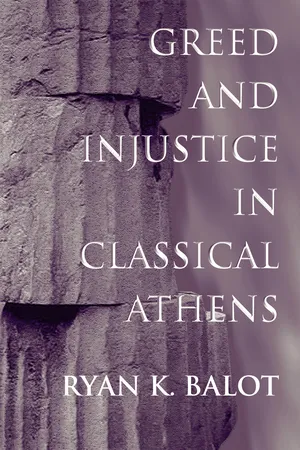
In this original and rewarding combination of intellectual and political history, Ryan Balot offers a thorough historical and sociological interpretation of classical Athens centered on the notion of greed. Integrating ancient philosophy, poetry, and history, and drawing on modern political thought, the author demonstrates that the Athenian discourse on greed was an essential component of Greek social development and political history.
Over time, the Athenians developed sophisticated psychological and political accounts of acquisitiveness and a correspondingly rich vocabulary to describe and condemn it. Greed figures repeatedly as an object of criticism in authors as diverse as Solon, Thucydides, and Plato--all of whom addressed the social disruptions caused by it, as well as the inadequacy of lives focused on it. Because of its ethical significance, greed surfaced frequently in theoretical debates about democracy and oligarchy. Ultimately, critiques of greed--particularly the charge that it is unjust--were built into the robust accounts of justice formulated by many philosophers, including Plato and Aristotle. Such critiques of greed both reflected and were inextricably knitted into economic history and political events, including the coups of 411 and 404 B.C.
Balot contrasts ancient Greek thought on distributive justice with later Western traditions, with implications for political and economic history well beyond the classical period. Because the belief that greed is good holds a dominant position in modern justifications of capitalism, this study provides a deep historical context within which such justifications can be reexamined and, perhaps, found wanting.
- English
- ePUB (mobile friendly)
- Available on iOS & Android
eBook - ePub
Greed and Injustice in Classical Athens
About this book
Information
1 ________________________
Introduction
GREED is central to ancient Athenian history, ideology, and political thought. It motivated political action and occupied the attention of contemporary analysts of civic conflict and imperialism. I want to explore various facets of greed in Athenian society and political discourse from roughly 600 to 300 B.C. I use the term greed to refer to acquisitiveness or an excessive desire to get more. Greed is a primarily materialistic type of desire, which is characteristically expressed by the attempt to satisfy bodily urges through the acquisition of money, material goods, and power. Occasionally, materialistic acquisitiveness shades off into an excessive desire to get power for its own sake. But, for reasons that will become clear, I do not focus in the first instance on ambition, that is, the excessive desire for honor or status.1
The most important observation we can make is that greed is rarely something an agent predicates of himself. Rather, members of a moral community use the concept to criticize others, and classical Athenians developed a wide array of terms for precisely this purpose. In archaic and classical Athens, this critique tended to take one of two basic forms. The first is more important from the perspective of society and hence more important for the present book: the idea that greedy agents violated canons of fair distribution among equal individuals or groups. As a violation of equality and fairness, greed was inevitably linked to injustice and therefore identified as a leading cause of civic strife. Perceptions of greed thereby became a primary stimulus to political action, and greed itself became a dominant feature of political thought. The second form of critique focused on the greedy individual himself, rather than his violation of the just claims of others. Here the critique is that greedy desires reveal an impoverished conception of what it means to live as a human being. They diminish the person as such and detract from his genuine happiness and well-being. This is the ethical perspective on greed and it tends to focus on individuals apart from their social setting. Because the second critique tends to occupy philosophers rather than practical political agents, it is less important than the first for understanding the relationship between ideas and history.
Greed not only featured in the contemporary perceptions of politics but also motivated individuals and groups—and even Athens itself— throughout Athenian history in the archaic and classical periods. Greed does not respect the scholar’s distinction between social history and literary representation. As Greenblatt has said, “Language, like other sign systems, is a collective construction; our interpretive task must be to grasp more sensitively the consequences of this fact by investigating both the social presence to the world of the literary text and the social presence of the world in the literary text.”2 My working hypothesis is that as political events influenced literary and philosophical condemnations of greed, so too did key texts help stimulate certain types of political action.3 Accusations of greed inspired radical attempts at self-justification; they unified the self-proclaimed “oppressed” and motivated them to seek justice; they led to philosophical defenses of self-aggrandizement and critiques of conventional morality. Finally, as I argue in the epilogue, traditional critiques of greed stimulated Plato to conceive of justice in a distinctive way and to develop a hierarchical opposition between material appetites and other, “higher,” forms of desire.
To substantiate and complicate this account of greed, I first analyze Aristotle’s treatment of greed in Nicomachean Ethics book 5 and in his analysis of human nature, commercial trade, and civic strife in the Politics. This chapter, by far the most technical discussion in the book, deals with questions of the psychology of action and the difficult Aristotelian schema of the virtues and vices. Having elicited from Aristotle a working concept of greed and its place in Greek moral evaluation, I then turn to the heart of the book—the evolving role of greed in Athenian history and political thought.
The complexity of Aristotle’s account, I argue, results from the long Athenian discourse on greed, which began in the sixth century, when Solon adapted traditional ethical models in order to censure the greed and injustice he witnessed among both the upper and lower classes. Solon articulated a civic definition of the individual according to which self-restraint and distributive fairness are the core features of proper political participation. In the fifth century, Herodotus and Thucydides realigned the terms of Solon’s discourse. They proposed that Athenian democracy created ideological harmony between the elite and the demos, which enabled Athenians to solve the problem of greed within the polis by channeling their acquisitive impulses outward against other Greeks. The greed that had once characterized competing groups within Athens now became the prevailing attribute of the city as a unified whole. But this ideological consensus was destroyed in the late fifth century, when members of the elite, resentful over the demos’s greed in managing the empire, initiated two oligarchic revolutions. Their conduct justified the contemporary interpretation of the oligarchic coups of 411 and 404 as exemplifying elite greed in action. In the post-revolutionary period, Lysias used the Athenian experience of elite greed as a democratic rhetorical weapon, while Xenophon rehabilitated the aristocratic ideal by showing that civic worth was the exclusive prerogative of the traditional aristocracy. In the Republic, Plato confronted the legacy of aristocratic greed by designing a polis that was specifically free from greed and injustice and ruled by self-controlled, fair-minded aristocrats.
Although I trace the history of and discourse on greed from Homer through Plato, my analysis is selective rather than comprehensive. I focus on turning points in the archaic and classical periods—the Solonian crisis, the advent of imperialism, the oligarchic revolutions in the late fifth century, and the early fourth-century recollection of those revolutions. I have excluded material that would naturally figure in an encyclopedic study. In particular, I do not offer an account of the Peisistratid tyranny, because our sources on the contemporary discourse in that period are basically non-existent. I also forgo treatment of the Attic orators, because my specific focus is on how the discourse on greed was made practically effective in the oligarchic revolutions of the late fifth century, and on how Plato’s philosophical account of justice constituted a response to those revolutions.4
My focus on greed, I am aware, runs the risk of anachronistically inventing a category of investigation that the Greeks themselves would not have recognized. A more familiar approach, no doubt, would be to conduct a semantic study of the Greek term pleonexia (greediness), and to footnote passages where other words seem to mean the same thing; Weber did exactly this in a Bonn dissertation of 1967.5 The past decade, in fact, has witnessed the publication of two wide-ranging semantic studies, Fisher’s Hybris and Cairns’s Aidōs. Both aim to identify the precise meaning and semantic range of their key words. Both employ a rigorous philological method that scrutinizes the usage of these important terms in an extraordinary range of texts in the archaic and classical periods. Both are fundamentally similar to North’s excellent study Sophrosyne in 1966. The result, in each case, is a comprehensive account that illuminates the meaning of the targeted words and, secondarily, the meaning of passages in which they are found. In their scope and discipline these works are the worthy fruits of classical philology and demonstrate its formidable powers to clarify meaning.6
Still, I have chosen to call this a book about greed, rather than pleonexia, for several reasons. First, although greed provoked criticism in the works of Homer, Hesiod, and Solon, none of them used the term pleonexia. Barring one exception, this term is found only in extant prose literature.7 Hence, focusing on the term pleonexia runs the risk, in its own right, of artificially hiving off entire domains of culture that are relevant to the concept of greed. The enabling assumption of this project is the possibility of expressing the concept of greed in other words. Thus, even though pleonexia is the most important single term for my history,8 I also discuss passages where the concept of greed is being discussed in other words. Among the more significant of these synonyms are koros (greed or satiety), philochrēmatia (love of money), aischrokerdeia (base covetousness), and epithumia chrēmatōn (desire for money), along with a variety of periphrastic expressions suggesting the idea of grasping for more in excess of what is needed, useful, or just.
Second, a more straightforwardly lexical method would itself construct arbitrary categories of analysis. The semantic range of key cultural abstractions—such as hubris, aidōs, and sōphrosunē—is wide enough that tracing instances of a particular term and its associated forms sometimes involves discussing passages that have little in common with each other, apart from the presence of the term in question. The lexical method usually makes no attempt to clarify the connections between apparently disparate passages, or to show what intervening events and thoughts brought about a transformation.9 The method depends on the desired goal, and my goal here is to explain how the social practices of greed gave rise to a sophisticated discourse and how, in turn, that discourse shaped and stimulated cultural practices, self-representations, and political behavior in a particularly important period of Athenian history.
Before I turn to Aristotle, a variety of specifically Greek concepts about ethics and politics must be set in relation to one another. The most straightforward way to erect a framework is to examine a paradigmatic figure, who reappears throughout this book—the Callicles of Plato’s Gorgias.10 Callicles, I stress, is a useful paradigm, but, like all paradigms, he fails to capture the specificity of many cases that must be understood on their own terms. Callicles is best known for his attack on conventional justice, and his assertion of another, in his view more genuine, conception of justice based on what he calls the “law of nature.” Callicles disparages conventional morality as a self-interested tool of power. The craven masses, he argues, “frighten the stronger and those able to have more [pleon echein], so that they do not have more [pleon echōsin] than themselves, and they say that the desire to get more [to pleonektein] is shameful and unjust, and that injustice [to adikein] consists in seeking to have more than others [to pleon tōn allōn zetein echein]” (483c1–5). The ordinary mass of humanity, in other words, has set up a self-regarding system of law and morality in order to prevent the powerful from taking whatever they happen to desire.
Callicles’ representation of conventional justice already invokes the key terms of the first critique of greed—that it is unjust. Even before describing his own desires, he begins by contesting the notions of justice and injustice promoted by the masses of ordinary citizens. His formulation must be understood against the background of the Greek conception of citizenship as a form of sharing in the political, economic, and religious life of the community.11 The usual Greek expression for this “sharing” is metechein tēs politeias (to share in the political community).12 Citizens perceive themselves as possessing in common all the divisible goods of the community, in particular power (kratos), political office or honor (timē), and material goods (chrēmata). The simplest formulation we can offer is that citizens view justice as having an “equal share” (to isori), or a “just share” (to dikaion)—notions that are given content by an agreedupon principle of distribution.13 Consequently, citizens are opposed to those who want to have “more,” or to have a “greater share” (to pleon), and they therefore construe “injustice” as meaning “having more than a fair share.”14 Callicles’ argument, then, is that through defining appropriate “shares” in collective goods and through convincing others of the justice of thei...
Table of contents
- Cover Page
- Title Page
- Copyright Page
- Contents
- Preface and Acknowledgments
- Abbreviations
- 1. Introduction
- 2. Greed in Aristotle’s Political Thought
- 3. Solonian Athens and the Archaic Roots of Greed
- 4. Herodotus and the Greed of Imperialism
- 5. Thucydides, Greed, and the Breakdown of Political Community
- 6. “Revolution Matters”? Oligarchic Rebellion and Democratic Hegemony in Athens
- 7. Epilogue: Plato’s Republic in Context
- Bibliography
- Index Locorum
- General Index
Trusted by 375,005 students
Access to over 1.5 million titles for a fair monthly price.
Study more efficiently using our study tools.
Frequently asked questions
Yes, you can cancel anytime from the Subscription tab in your account settings on the Perlego website. Your subscription will stay active until the end of your current billing period. Learn how to cancel your subscription
No, books cannot be downloaded as external files, such as PDFs, for use outside of Perlego. However, you can download books within the Perlego app for offline reading on mobile or tablet. Learn how to download books offline
Perlego offers two plans: Essential and Complete
- Essential is ideal for learners and professionals who enjoy exploring a wide range of subjects. Access the Essential Library with 800,000+ trusted titles and best-sellers across business, personal growth, and the humanities. Includes unlimited reading time and Standard Read Aloud voice.
- Complete: Perfect for advanced learners and researchers needing full, unrestricted access. Unlock 1.5M+ books across hundreds of subjects, including academic and specialized titles. The Complete Plan also includes advanced features like Premium Read Aloud and Research Assistant.
We are an online textbook subscription service, where you can get access to an entire online library for less than the price of a single book per month. With over 1.5 million books across 990+ topics, we’ve got you covered! Learn about our mission
Look out for the read-aloud symbol on your next book to see if you can listen to it. The read-aloud tool reads text aloud for you, highlighting the text as it is being read. You can pause it, speed it up and slow it down. Learn more about Read Aloud
Yes! You can use the Perlego app on both iOS and Android devices to read anytime, anywhere — even offline. Perfect for commutes or when you’re on the go.
Please note we cannot support devices running on iOS 13 and Android 7 or earlier. Learn more about using the app
Please note we cannot support devices running on iOS 13 and Android 7 or earlier. Learn more about using the app
Yes, you can access Greed and Injustice in Classical Athens by Ryan K. Balot in PDF and/or ePUB format, as well as other popular books in History & Greek Ancient History. We have over 1.5 million books available in our catalogue for you to explore.