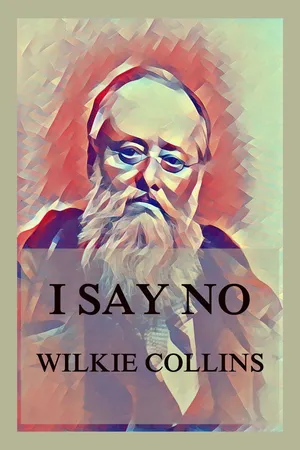
The popularity of Wilkie Collins is as unquestionable as his mannerism, and when this story bears the title 'I Say No', it is characteristic of him that the meaning of this title is not made clear until three fourths of the novel has been read. The plot is, as usual, very carefully and strongly conceived, and the reader is allowed to think that he has the clue to the secret at an early period, whereas the secret is really quite different from what seems most probable. The general effect of 'I Say No' is much less sensational than many of the author's former stories. The situations are not void of theatrical tone, but they are distinctly quieter and more subdued. It is in fact more the society play than the melodrama, but it is dramatic. The women of, Mr. Collins's novels are usually weaker than his men, and his old and eccentric women are better than his young girls. Perhaps this is because all his women are really men worked over, so to speak, and his old women are the most natural because age has a tendency to assimilate the characteristics of the sexes. Miss La Sor, in the new story, is decidedly disagreeable, but her vices are rather those of human nature than of a woman, and she is drawn with a certain vague indeterminateness, as though the author originally meant her to fill a much more important place, but had thought better of his purpose. The story indeed is considerably shorter than most of Mr. Collins's novels, and the plot is far less intricate. This the reader will be apt to resent, for it is plot, and plenty of it, he wants when he goes to this author. Wilkie Collins has always had a large audience, however, and unless his powers fail, as this latest of his works certainly does not appear to indicate, he always will be read widely. And this is right, for he is a thoroughly wholesome and sweet writer, whoever punishes Vice and rewards Virtue, and gives us the most fascinating and complicated of plots, and thrills us with cunning detective enterprises, and surprises us with novel modes of committing crimes, and getting married, and perpetrating, bigamy, and all kinds of exciting affairs. And the world will prob ably always prefer novelists of this school to those who delight in analyzing thoughts and sentiments, and who eschew action and plot as vulgar and coarse.
eBook - ePub
I Say No
About this book
Trusted by 375,005 students
Access to over 1.5 million titles for a fair monthly price.
Study more efficiently using our study tools.
Information
Subtopic
ClassicsIndex
LiteratureBOOK THE SECOND—IN LONDON.
CHAPTER XII. MRS. ELLMOTHER.
The metropolis of Great Britain is, in certain respects, like no other metropolis on the face of the earth. In the population that throngs the streets, the extremes of Wealth and the extremes of Poverty meet, as they meet nowhere else. In the streets themselves, the glory and the shame of architecture—the mansion and the hovel—are neighbors in situation, as they are neighbors nowhere else. London, in its social aspect, is the city of contrasts.
Toward the close of evening Emily left the railway terminus for the place of residence in which loss of fortune had compelled her aunt to take refuge. As she approached her destination, the cab passed—by merely crossing a road—from a spacious and beautiful Park, with its surrounding houses topped by statues and cupolas, to a row of cottages, hard by a stinking ditch miscalled a canal. The city of contrasts: north and south, east and west, the city of social contrasts.
Emily stopped the cab before the garden gate of a cottage, at the further end of the row. The bell was answered by the one servant now in her aunt’s employ—Miss Letitia’s maid.
Personally, this good creature was one of the ill-fated women whose appearance suggests that Nature intended to make men of them and altered her mind at the last moment. Miss Letitia’s maid was tall and gaunt and awkward. The first impression produced by her face was an impression of bones. They rose high on her forehead; they projected on her cheeks; and they reached their boldest development in her jaws. In the cavernous eyes of this unfortunate person rigid obstinacy and rigid goodness looked out together, with equal severity, on all her fellow-creatures alike. Her mistress (whom she had served for a quarter of a century and more) called her “Bony.” She accepted this cruelly appropriate nick-name as a mark of affectionate familiarity which honored a servant. No other person was allowed to take liberties with her: to every one but her mistress she was known as Mrs. Ellmother.
“How is my aunt?” Emily asked.
“Bad.”
“Why have I not heard of her illness before?”
“Because she’s too fond of you to let you be distressed about her. ‘Don’t tell Emily’; those were her orders, as long as she kept her senses.”
“Kept her senses? Good heavens! what do you mean?”
“Fever—that’s what I mean.”
“I must see her directly; I am not afraid of infection.”
“There’s no infection to be afraid of. But you mustn’t see her, for all that.”
“I insist on seeing her.”
“Miss Emily, I am disappointing you for your own good. Don’t you know me well enough to trust me by this time?”
“I do trust you.”
“Then leave my mistress to me—and go and make yourself comfortable in your own room.”
Emily’s answer was a positive refusal. Mrs. Ellmother, driven to her last resources, raised a new obstacle.
“It’s not to be done, I tell you! How can you see Miss Letitia when she can’t bear the light in her room? Do you know what color her eyes are? Red, poor soul—red as a boiled lobster.”
With every word the woman uttered, Emily’s perplexity and distress increased.
“You told me my aunt’s illness was fever,” she said—“and now you speak of some complaint in her eyes. Stand out of the way, if you please, and let me go to her.”
Mrs. Ellmother, still keeping her place, looked through the open door.
“Here’s the doctor,” she announced. “It seems I can’t satisfy you; ask him what’s the matter. Come in, doctor.” She threw open the door of the parlor, and introduced Emily. “This is the mistress’s niece, sir. Please try if you can keep her quiet. I can’t.” She placed chairs with the hospitable politeness of the old school—and returned to her post at Miss Letitia’s bedside.
Doctor Allday was an elderly man, with a cool manner and a ruddy complexion—thoroughly acclimatized to the atmosphere of pain and grief in which it was his destiny to live. He spoke to Emily (without any undue familiarity) as if he had been accustomed to see her for the greater part of her life.
“That’s a curious woman,” he said, when Mrs. Ellmother closed the door; “the most headstrong person, I think, I ever met with. But devoted to her mistress, and, making allowance for her awkwardness, not a bad nurse. I am afraid I can’t give you an encouraging report of your aunt. The rheumatic fever (aggravated by the situation of this house—built on clay, you know, and close to stagnant water) has been latterly complicated by delirium.”
“Is that a bad sign, sir?”
“The worst possible sign; it shows that the disease has affected the heart. Yes: she is suffering from inflammation of the eyes, but that is an unimportant symptom. We can keep the pain under by means of cooling lotions and a dark room. I’ve often heard her speak of you—especially since the illness assumed a serious character. What did you say? Will she know you, when you go into her room? This is about the time when the delirium usually sets in. I’ll see if there’s a quiet interval.”
He opened the door—and came back again.
“By the way,” he resumed, “I ought perhaps to explain how it was that I took the liberty of sending you that telegram. Mrs. Ellmother refused to inform you of her mistress’s serious illness. That circumstance, according to my view of it, laid the responsibility on the doctor’s shoulders. The form taken by your aunt’s delirium—I mean the apparent tendency of the words that escape her in that state—seems to excite some incomprehensible feeling in the mind of her crabbed servant. She wouldn’t even let me go into the bedroom, if she could possibly help it. Did Mrs. Ellmother give you a warm welcome when you came here?”
“Far from it. My arrival seemed to annoy her.”
“Ah—just what I expected. These faithful old servants always end by presuming on their fidelity. Did you ever hear what a witty poet—I forget his name: he lived to be ninety—said of the man who had been his valet for more than half a century? ‘For thirty years he was the best of servants; and for thirty years he has been the hardest of masters.’ Quite true—I might say the same of my housekeeper. Rather a good story, isn’t it?”
The story was completely thrown away on Emily; but one subject interested her now. “My poor aunt has always been fond of me,” she said. “Perhaps she might know me, when she recognizes nobody else.”
“Not very likely,” the doctor answered. “But there’s no laying down any rule in cases of this kind. I have sometimes observed that circumstances which have produced a strong impression on patients, when they are in a state of health, give a certain direction to the wandering of their minds, when they are in a state of fever. You will say, ‘I am not a circumstance; I don’t see how this encourages me to hope’—and you will be quite right. Instead of talking of my medical experience, I shall do better to look at Miss Letitia, and let you know the result. You have got other relations, I suppose? No? Very distressing—very distressing.”
Who has not suffered as Emily suffered, when she was left alone? Are there not moments—if we dare to confess the truth—when poor humanity loses its hold on the consolations of religion and the hope of immortality, and feels the cruelty of creation that bids us live, on the condition that we die, and leads the first warm beginnings of love, with merciless certainty, to the cold conclusion of the grave?
“She’s quiet, for the time being,” Dr. Allday announced, on his return. “Remember, please, that she can’t see you in the inflamed state of her eyes, and don’t disturb the bed-curtains. The sooner you go to her the better, perhaps—if you have anything to say which depends on her recognizing your voice. I’ll call to-morrow morning. Very distressing,” he repeated, taking his hat and making his bow—“Very distressing.”
Emily crossed the narrow little passage which separated the two rooms, and opened the bed-chamber door. Mrs. Ellmother met her on the threshold. “No,” said the obstinate old servant, “you can’t come in.”
The faint voice of Miss Letitia made itself heard, calling Mrs. Ellmother by her familiar nick-name.
“Bony, who is it?”
“Never mind.”
“Who is it?”
“Miss Emily, if you must know.”
“Oh! poor dear, why does she come here? Who told her I was ill?”
“The doctor told her.”
“Don’t come in, Emily. It will only distress you—and it will do me no good. God bless you, my love. Don’t come in.”
“There!” said Mrs. Ellmother. “Do you hear that? Go back to the sitting-room.”
Thus far, the hard necessity of controlling herself had kept Emily silent. She was now able to speak without tears. “Remember the old times, aunt,” she pleaded, gently. “Don’t keep me out of your room, when I have come here to nurse you!”
“I’m her nurse. Go back to the sitting-room,” Mrs. Ellmother repeated.
True love lasts while life lasts. The dying woman relented.
“Bony! Bony! I can’t be unkind to Emily. Let her in.”
Mrs. Ellmother still insisted on having her way.
“You’re contradicting your own orders,” she said to her mistress. “You don’t know how soon you may begin wandering in your mind again. Think, Miss Letitia—think.”
This remonstrance was received in silence. Mrs. Ellmother’s great gaunt figure still blocked up the doorway.
“If you force me to it,” Emily said, quietly, “I must go to the doctor, and ask him to interfere.”
“Do you mean that?” Mrs. Ellmother said, quietly, on her side.
“I do mean it,” was the answer.
The old servant suddenly submitted—with a look which took Emily by surprise. Sh...
Table of contents
- BOOK THE FIRST—AT SCHOOL.
- BOOK THE SECOND—IN LONDON.
- BOOK THE THIRD—NETHERWOODS.
- BOOK THE FOURTH—THE COUNTRY HOUSE.
- BOOK THE FIFTH—THE COTTAGE.
- BOOK THE SIXTH—HERE AND THERE.
- BOOK THE LAST—AT HOME AGAIN.
- POSTSCRIPT. GOSSIP IN THE STUDIO.
Frequently asked questions
Yes, you can cancel anytime from the Subscription tab in your account settings on the Perlego website. Your subscription will stay active until the end of your current billing period. Learn how to cancel your subscription
No, books cannot be downloaded as external files, such as PDFs, for use outside of Perlego. However, you can download books within the Perlego app for offline reading on mobile or tablet. Learn how to download books offline
Perlego offers two plans: Essential and Complete
- Essential is ideal for learners and professionals who enjoy exploring a wide range of subjects. Access the Essential Library with 800,000+ trusted titles and best-sellers across business, personal growth, and the humanities. Includes unlimited reading time and Standard Read Aloud voice.
- Complete: Perfect for advanced learners and researchers needing full, unrestricted access. Unlock 1.5M+ books across hundreds of subjects, including academic and specialized titles. The Complete Plan also includes advanced features like Premium Read Aloud and Research Assistant.
We are an online textbook subscription service, where you can get access to an entire online library for less than the price of a single book per month. With over 1.5 million books across 990+ topics, we’ve got you covered! Learn about our mission
Look out for the read-aloud symbol on your next book to see if you can listen to it. The read-aloud tool reads text aloud for you, highlighting the text as it is being read. You can pause it, speed it up and slow it down. Learn more about Read Aloud
Yes! You can use the Perlego app on both iOS and Android devices to read anytime, anywhere — even offline. Perfect for commutes or when you’re on the go.
Please note we cannot support devices running on iOS 13 and Android 7 or earlier. Learn more about using the app
Please note we cannot support devices running on iOS 13 and Android 7 or earlier. Learn more about using the app
Yes, you can access I Say No by Wilkie Collins in PDF and/or ePUB format, as well as other popular books in Literature & Classics. We have over 1.5 million books available in our catalogue for you to explore.