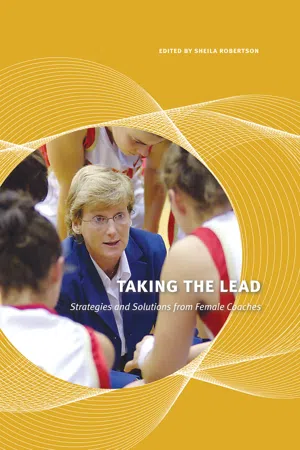
- 312 pages
- English
- ePUB (mobile friendly)
- Available on iOS & Android
eBook - ePub
About this book
In an extensive and frank exploration, leaders in women's coaching discuss the values women bring to the coaching profession, their quest for equal access, ways career aspirations and motherhood are juggled, how to negotiate contracts, and encounters with homophobia, harassment, and bullying. They also identify the challenges to progress and highlight the essential changes that need to be made. This volume will be of interest to sports organizations, leaders, and educators; athletes and parents; researchers in sports and gender studies; and politicians and policy makers. Women in leadership roles in business, public service, education, and their communities will find the wisdom contained in Taking the Lead readily transferable to their respective arenas. Introduction by Dru Marshall.
Information
PART ONE
Issues
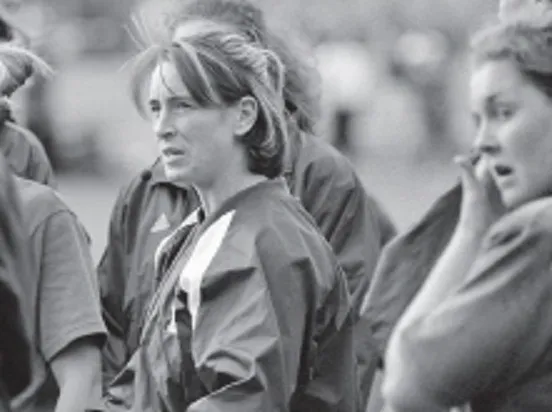
Natascha Wesch coached Canada’s women’s sevens rugby team to a sixth-place finish at the Rugby World Cup Sevens 2009.
PHOTO: COURTESY OF NATASCHA WESCH
ONE
THE PERILS AND PLEASURES
OF COACHING AND MOTHERHOOD
THE PERILS AND PLEASURES
OF COACHING AND MOTHERHOOD
Sheila Robertson
Introduction
That the coaching profession is demanding is a hard fact of life. The strains and stresses are well documented—odd hours, working weekends, frequent travel, lengthy away-from-home training camps, parental interference, under-funded programs, demanding boards of directors. The list goes on. Balancing these demands are the rewards—guiding athletes to achieve physical and social skills, building their self-esteem and positive self-images, enabling them to achieve and even exceed their potential, making a positive difference in their lives.
When asked what drives them, most coaches cite passion for their profession as the powerful motivator. It’s an emotion that can conflict, often irreconcilably, with the equally passion-inspiring state of motherhood. This conflict drives many female coaches from the profession, some forever, and others for extended periods.
This chapter features five coaches who were profiled in the spring of 2007. These coaches could be called successful by most measuring sticks. One was a well-established and successful coach who was “on sabbatical.” The other four represented the next generation, young mothers who were breaking into the upper levels of coaching. For each coach, I “fast forward” to 2009 to revisit them and see what, if any, differences have occurred in their circumstances. In all but one case, the changes are substantial, and not necessarily positive.
As always, when trying to make sense of a female coach’s life, there are more questions than answers. Their stories illustrate the complexities and challenges of combining coaching and motherhood to the detriment of neither.
Staying in the Profession
IN APRIL 2007, in a matter-of-fact tone, Sheilagh Croxon talked about her decision not to renew her contract as head coach of Canada’s synchronized swimming team. Fresh from coaching her athletes to the team bronze medal at the 2000 Olympic Games, and two world championship medals in 2001, she asked Synchro Canada for a seven-month maternity leave when she became pregnant with her third child.
The organization agreed, but when Croxon requested some compensation, she was turned down flat. After a period of reflection, she decided to move in new directions. “I felt I had no choice. My position was based on a yearly contract and provided no benefits. Nor was I eligible for unemployment insurance. Marley was born on February 6, 2002, one week after I stepped off the pool deck. I would have preferred to have stopped coaching earlier, but I wasn’t going to get paid.”
Croxon, whose older children are Nicolas and Natalie, had stated her case in writing to the Synchro Canada board. She felt herself to be in a strong position. The Olympic medal (one of Canada’s fourteen won at Sydney) and the world championship medals indicated a national team on the upswing after several down years. Implicit in her argument was her belief that refusing her leave with compensation would send a negative message to the organization’s coaches, all of whom are women. “I wasn’t looking for anything huge, just some sign of good faith, something to show that they valued me, that they understood, but they said no.” No reason was given other than the board would stick to her contract as written. End of discussion.
Although Croxon fulfilled the balance of her contract after taking the seven months off without pay, her decision to resign was firm. “I would have stayed had the environment been more supportive. Since it wasn’t, I realized I had to look out for myself and get into a better working arrangement, one that allowed some family consideration. It was painful, a real slap in the face, almost humiliating. I thought they would understand, and when they didn’t, I took it as a sign that it was time to move on.”
Croxon had fared better with her first two pregnancies, both of which occurred when she was a club consultant, even though she took only eight weeks off with each child. “I made the case for some support, and my club board paid someone else to coach for me and paid my salary as well. It may have been because a board of parents knows you better than a national board does. Maybe my personal interaction with that board made my situation more human for them.”
Croxon’s supportive husband, Jean Constantin, took paternity leave for each child. When Nicolas was born, he also took a leave-of-absence so that the family could relocate to Edmonton for nine months when the team centralized there before the 1996 Olympic Games. “The move was possible because Jean said he would come, and that shows what an open-minded man he is. Some people are not that supportive, because it goes against the norm.”
Once her decision to leave was made, Croxon put her disappointment behind her and moved on to work that not only was good for her but was improving conditions for other female coaches. She is the Coaching Association of Canada’s consultant responsible for its Women in Coaching program, a national campaign to increase the number of coaching opportunities for women at all levels of sport. In demand as an international consultant, she works with Olympic and national teams from around the world. Within Canada, she is a regular presenter of clinics, camps, and consultations, and is a mentor to several National Coaching Certification Program Level 4 candidates. In 2005, she established the Toronto-based International Centre of Excellence, where athletes and coaches flock to work with her. She served on the executive of the Canadian Professional Coaches Association (now Coaches of Canada) and is the chair of the Coaches Association of Ontario.
Croxon was heartened by the fact that Biz Price, her immediate successor, was made a Synchro Canada employee, and although Price’s was also a one-year contact, she received benefits equivalent to those of the national office staff. Unfortunately, the structure around the national coach position was not strong enough to provide adequate support to Price. The learnings following disappointing results at the 2003 world championships were lost when Price was dismissed. Canada’s loss was Spain’s gain, as she played an integral role as assistant coach with the Spanish national team through 2004 and 2005. Since 2006, Price has been National Performance Director for synchronized swimming with British Swimming, a position she will hold through 2013.
Price’s successor, Isabelle Taillon, was given a long-term contract. Said Croxon, “I felt that by leaving, I could do some good for the coaches who followed. My decision woke up a few people and made a difference, because now the coaches have acceptable working conditions. I’ve always been a ground breaker. I’ve had to fight for everything in my coaching career, but there is some satisfaction in knowing that you have made a difference for those who follow.”
These days, one-year coaching contracts are generally frowned upon because they do not build stability or show long-term vision. Nor do they acknowledge that, in sport, it takes more than one year to produce success. Croxon said, “It’s people like me, people who come up short, who spark change for the next generation. That’s often the way it is.”
Croxon is committed to encouraging sport organizations to understand the importance of creating conditions that work for the woman coach. “They need to realize that good people are everything, and that intellectual capital is not easily replaced. Key to that is identifying champions for women within Canada’s sport system—men and women who really understand what being a mother is all about and what the demands are on the coach.”
Fast Forward
In 2009, Sheilagh Croxon remains the Women in Coaching consultant, and the International Centre of Excellence continues to thrive, with athletes from Britain and Argentina seeking her coaching expertise. She took two New Zealand athletes—the duet team of Nina and Lisa Daniels—to the 2008 Olympic Games. Their goal during the three-and-a-half years they trained with her was to qualify for Beijing and when they succeeded, it marked New Zealand’s first qualification in synchronized swimming in 24 years.
However, Croxon has made one crucial lifestyle change. In August 2007, she returned to full-time coaching, not to high performance but as head coach of a grassroots program, albeit at the Granite Club, one of Toronto’s most prestigious sport venues.
Scepticism was her initial reaction to the unexpected job offer. She firmly believed she had left grassroots coaching behind twenty years earlier. After several discussions, however, she realized she was being offered the professional working conditions for which she has long advocated, including full-time employment and excellent benefits. Instead of a parent volunteer board—the bane of so many coaches—she reports to the director of athletics and has been able to hire qualified coaches, either full- or part-time, as needed. “This is a more professional situation than I ever had as a national coach. At first it was very challenging because you forget how tough it is to build a program from the base. But it forced me to become a better coach because I had to get in there and roll up my sleeves. It’s reconnected me with what coaching is all about and I’m more in touch with the challenges coaches face.”
Two years into the job, Croxon reports some impressive milestones. Offering both recreational and competitive programs, she notes that the competencies of the athletes have risen dramatically. Enrollment has increased by 21% to over 80 swimmers. “Now that we are having success, people are knocking at the door. This may be grassroots, but you can turn something around pretty quickly with a high performance mindset. People are starting to see what can be done when good coaching is available.”
Included in the arrangement Croxon struck with the Granite Club was being able to train her international athletes in their pool. She coached Jennifer Knobbs, who won the national solo title in 2008 and, with Erin Wilson, also took the senior duet championship. Both are now at the sport’s national training centre in Montreal. “Athletes like these have helped to build the club because they are role models for the younger kids and that has really, really helped the growth.”
The Granite Club arrangement offers Croxon the best of both worlds. “I love coaching; I don’t see it as a job, but I never thought that I would find such good working conditions at this level. A club! You’re kidding!”
Stand Your Ground
IN 2007, NATASCHA Wesch was an upwardly mobile rugby coach. She had coached Rugby Canada’s U-19 women’s team and the Ontario U-17, U-19, and U-23 teams, and she was the head coach of the women’s varsity team at the University of Western Ontario, where she was working on a doctorate in sport psychology. She spent five years as the Ontario Rugby Union’s director of women’s rugby. In December 2006, she became head coach of the National Women’s Sevens Team. And oh, yes, on December 5, 2005, she gave birth to her daughter Machaila.
Wesch greeted the news of her pregnancy with delight and, like so many first-time mothers, assumed that her life wouldn’t change. “To be honest, and I think it’s the same for everybody, I had no idea what to expect, and I didn’t believe it when people told me I was crazy to expect to carry on as usual.”
Throughout the pregnancy, she coached non-stop, even flying with her university team to the national championship in her eighth month. And she informed Rugby Canada that she would coach after the birth and spelled out how she intended it to happen.
Wesch was frank about her needs. “I told them that it ...
Table of contents
- Cover Page
- Title Page
- Copyright Page
- Contents
- Message from the Coaching Association of Canada
- Message from the Canadian Association for the Advancement of Women and Sport and Physical Activity
- Preface
- Introduction
- Part One—Issues
- Part Two—Skills
- Part Three—Advice
- Afterword
- Appendix 1: A Five-Point Collaborative Strategy for Change
- Appendix 2: Provincial and National Coaching Associations
- Appendix 3: A Decade of Articles from the Canadian Journal for Women in Coaching
- Contributors
- Index
Trusted by 375,005 students
Access to over 1.5 million titles for a fair monthly price.
Study more efficiently using our study tools.
Frequently asked questions
Yes, you can cancel anytime from the Subscription tab in your account settings on the Perlego website. Your subscription will stay active until the end of your current billing period. Learn how to cancel your subscription
No, books cannot be downloaded as external files, such as PDFs, for use outside of Perlego. However, you can download books within the Perlego app for offline reading on mobile or tablet. Learn how to download books offline
Perlego offers two plans: Essential and Complete
- Essential is ideal for learners and professionals who enjoy exploring a wide range of subjects. Access the Essential Library with 800,000+ trusted titles and best-sellers across business, personal growth, and the humanities. Includes unlimited reading time and Standard Read Aloud voice.
- Complete: Perfect for advanced learners and researchers needing full, unrestricted access. Unlock 1.5M+ books across hundreds of subjects, including academic and specialized titles. The Complete Plan also includes advanced features like Premium Read Aloud and Research Assistant.
We are an online textbook subscription service, where you can get access to an entire online library for less than the price of a single book per month. With over 1.5 million books across 990+ topics, we’ve got you covered! Learn about our mission
Look out for the read-aloud symbol on your next book to see if you can listen to it. The read-aloud tool reads text aloud for you, highlighting the text as it is being read. You can pause it, speed it up and slow it down. Learn more about Read Aloud
Yes! You can use the Perlego app on both iOS and Android devices to read anytime, anywhere — even offline. Perfect for commutes or when you’re on the go.
Please note we cannot support devices running on iOS 13 and Android 7 or earlier. Learn more about using the app
Please note we cannot support devices running on iOS 13 and Android 7 or earlier. Learn more about using the app
Yes, you can access Taking the Lead by Sheila Robertson in PDF and/or ePUB format, as well as other popular books in Social Sciences & Gender Studies. We have over 1.5 million books available in our catalogue for you to explore.