- 56 pages
- English
- ePUB (mobile friendly)
- Available on iOS & Android
eBook - ePub
About this book
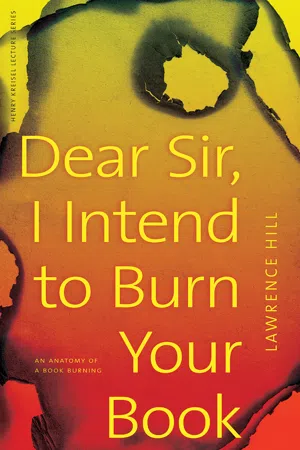
Censorship and book burning are still present in our lives. Lawrence Hill shares his experiences of how ignorance and the fear of ideas led a group in the Netherlands to burn the cover of his widely successful novel, The Book of Negroes, in 2011. Why do books continue to ignite such strong reactions in people in the age of the Internet? Is banning, censoring, or controlling book distribution ever justified? Hill illustrates his ideas with anecdotes and lists names of Canadian writers who faced censorship challenges in the twenty-first century, inviting conversation between those on opposite sides of these contentious issues. All who are interested in literature, freedom of expression, and human rights will enjoy reading Hill's provocative essay. Introduction by Ted Bishop.
Information
Burn Your Book
IN JUNE 2011, less than a month after launching the Dutch edition of my novel, The Book of Negroes, in The Netherlands, I received the most surprising email of my life. It is worth quoting verbatim:
Dear Sir Lawrence Hill,We, descendants of enslaved in the former Dutch colony Suriname, want let you know that we do not accept a book with the title “The book of Negroes.”We struggle for a long time to let the word “nigger” disappears from Dutch language and now you set up your book of Negroes! A real shame!That’s why we make the decision to burn this book on the 22nd of June 2011.Maybe you do not know, but June is the month before the 1st of July, the day that we remember the abolition from the Dutch, who put our ancestors in slavery.Sincerely,ROY GROENBERG,
Chairman Foundation Honor and Restore Victims of Slavery in Suriname
Attached to the email was a handwritten poster saying, in Dutch, “Summons to Afro-Surinamese-Dutch people to come to Bookburning in Oosterpark near the monument.”
I wrote a reply that, in retrospect, seems outrageously Canadian in its politeness and tact. Here’s what I said:
Dear Mr. Groenberg,I am very sorry to hear of your plans to burn my book.Are you aware of the historical origins of the title? It is a historical novel. “The Book of Negroes” is the name of a British military ledger, that documented the exodus of 3,000 African Americans from New York City to Nova Scotia, Canada at the end of the American Revolutionary War. It is a very important genealogical document, as it provides a great deal of biographical information about the Blacks who migrated from the USA to Canada in 1783. The original copy of this document is kept in the National Archives in the UK. The document is central to my novel. My main character must have her name entered into “The Book of Negroes” before she, like 3,000 other Blacks fleeing American slavery, is allowed to sail to Canada.The use of the title, “The Book of Negroes” (or “Het Negerboek” in Dutch) has offered me the opportunity to explain this history, which is fascinating, important and troubling, to many thousands of readers in Canada, the UK, The Netherlands and elsewhere. I have found that when given the opportunity to see what I am doing in this book and with this title, readers understand that the title is not intended to be offensive, but that it is used historically, to shed light on a forgotten document and on a forgotten migration (that of thousands of Blacks from the USA to Canada in 1783).Did you know that I gave a talk recently about this book, its historical origins, and the title, to the Surinamese group NiNsee in Amsterdam last month?Before you proceed with your plans to burn my novel, would you like to have a conversation about this?Thank you,LAWRENCE HILL
As you may imagine, the conversation never took place. Mr. Groenberg went on to burn not the real book, but copies of the cover of my novel for Dutch TV cameras in the popular Oosterpark in Amsterdam, next to a monument commemorating the victims of Dutch slavery. I am not certain about the motivation for his actions. Perhaps his actions were inspired by a previous incident of book destruction in Amsterdam. I don’t know why Mr. Groenberg pulled back. Maybe the burning of the covers sufficed for the photographers. From a comfortable chair on this side of the ocean, I suppose that some might find the entire episode laughable. It really shook me up. Obviously, I felt deeply troubled that a work to which I had given five years of passion and attention and integrity should attract such a hateful act. To me, the entire point of the novel was to offer dignity, depth and dimensionality to a person whose very humanity would have been assaulted as a slave. From my perspective, Mr. Groenberg and I should have been on the same side of issues having to do with the treatment and depiction of people in the African Diaspora. My publisher felt ashamed to see the book assailed in this manner and defended the book vigorously. She received a death threat and decided not to attend the book cover burning to see it for herself.
It wasn’t the first time the title of my novel has encountered difficulties. Several months after it appeared in Canada under the title The Book of Negroes, my American publisher informed me right before going to the printer that it was changing the name of the novel. Why? Because US bookstores were refusing to place advance orders for my novel because the word “Negroes” was in the title. I was on book tour in Germany at the time that I received this last-minute email from my editor in Manhattan, and the most I could negotiate was that I would be the one to come up with a new title for the American edition. I had about 72 hours to conjure up a new title, and found it with the assistance of my then ten-year-old stepdaughter Eve Freedman—more on her later—in a little hotel in the town of Greifswald in the former East Germany on the Baltic Sea. In the United States, and later in Australia and New Zealand, my novel was published under the title Someone Knows My Name.
It was a frustrating exercise. I didn’t like having the title changed on me, but as time went on I came to appreciate that the word “Negroes” has become offensive in American culture—particularly in Black urban culture, where its meaning has evolved over time.
My father proudly called himself a Negro for most of his life. Indeed, when he was named Chair of the Ontario Human Rights Commission in 1973, the Globe and Mail ran a headline that said “Commission appoints Negro Chair.” It was meant to be a polite headline, at the time. But that was 1973 and times have changed. These days, on the streets of urban America, calling a person a “Negro” implies that he or she is an inauthentic Black person with no self-pride and no self-respect. While I have been on book tours in the United States, over and over again African Americans have come up to me and said, “It’s a good thing you changed the title of your book, because I would never have bought your book or come hear you speak if you had called it The Book of Negroes down here.”
So, in joining J.K. Rowling and Alice Munro as just some of the many British and Canadian writers whose titles have been altered to suit the whims of American publishers, I eventually came to appreciate that there was a deep, simmering anger ove...
Table of contents
- Cover
- Title Page
- Copyright
- Contents
- Foreword
- Liminaire
- Introduction
- Dear Sir, I Intend to Burn Your Book
- Notes
- About the Author
- Henry Kriesel Lecture Series
Trusted by 375,005 students
Access to over 1.5 million titles for a fair monthly price.
Study more efficiently using our study tools.
Frequently asked questions
Yes, you can cancel anytime from the Subscription tab in your account settings on the Perlego website. Your subscription will stay active until the end of your current billing period. Learn how to cancel your subscription
No, books cannot be downloaded as external files, such as PDFs, for use outside of Perlego. However, you can download books within the Perlego app for offline reading on mobile or tablet. Learn how to download books offline
Perlego offers two plans: Essential and Complete
- Essential is ideal for learners and professionals who enjoy exploring a wide range of subjects. Access the Essential Library with 800,000+ trusted titles and best-sellers across business, personal growth, and the humanities. Includes unlimited reading time and Standard Read Aloud voice.
- Complete: Perfect for advanced learners and researchers needing full, unrestricted access. Unlock 1.5M+ books across hundreds of subjects, including academic and specialized titles. The Complete Plan also includes advanced features like Premium Read Aloud and Research Assistant.
We are an online textbook subscription service, where you can get access to an entire online library for less than the price of a single book per month. With over 1.5 million books across 990+ topics, we’ve got you covered! Learn about our mission
Look out for the read-aloud symbol on your next book to see if you can listen to it. The read-aloud tool reads text aloud for you, highlighting the text as it is being read. You can pause it, speed it up and slow it down. Learn more about Read Aloud
Yes! You can use the Perlego app on both iOS and Android devices to read anytime, anywhere — even offline. Perfect for commutes or when you’re on the go.
Please note we cannot support devices running on iOS 13 and Android 7 or earlier. Learn more about using the app
Please note we cannot support devices running on iOS 13 and Android 7 or earlier. Learn more about using the app
Yes, you can access Dear Sir, I Intend to Burn Your Book by Lawrence Hill in PDF and/or ePUB format, as well as other popular books in Literature & Literary Essays. We have over 1.5 million books available in our catalogue for you to explore.