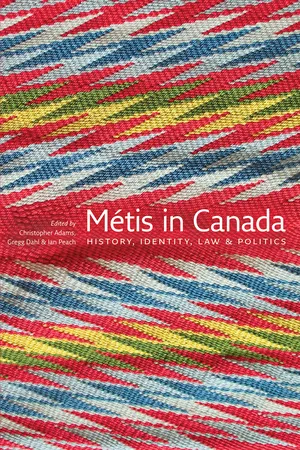
eBook - ePub
Métis in Canada
History, Identity, Law and Politics
- 560 pages
- English
- ePUB (mobile friendly)
- Available on iOS & Android
eBook - ePub
Métis in Canada
History, Identity, Law and Politics
About this book
These twelve essays constitute a groundbreaking volume of new work prepared by leading scholars in the fields of history, anthropology, constitutional law, political science, and sociology, who identify the many facets of what it means to be Métis in Canada today. After the Powley decision in 2003, Métis peoples were no longer conceptually limited to the historical boundaries of the fur trade in Canada. Key ideas explored in this collection include identity, rights, and issues of governance, politics, and economics. The book will be of great interest to scholars in political science and Indigenous studies, the legal community, public administrators, government policy advisors, and people seeking to better understand the Métis past and present. Contributors: Christopher Adams, Gloria Jane Bell, Glen Campbell, Gregg Dahl, Janique Dubois, Tom Flanagan, Liam J. Haggarty, Laura-Lee Kearns, Darren O'Toole, Jeremy Patzer, Ian Peach, Siomonn P. Pulla, Kelly L. Saunders.
Information
Subtopic
North American HistoryIndex
History
| 1
Oscillating Identities
Re-presentations of Métis in the Great Lakes Area in the Nineteenth Century
PEOPLE OF Indian (Cree, Iroquois, Ojibwa) and European (English, French, Irish, Scottish) heritage, métis, have existed in the Great Lakes region for several centuries, yet their identities have oscillated over time.[1] The record of their presence varies depending on who is telling the story or creating the image. Nineteenth-century travellers and artists including Frances Anne Hopkins, Anna Jameson, William Keating, Henry Rowe Schoolcraft, George Winter and others described and depicted métis peoples in order to entertain non-Native audiences, to create government reports, and to legitimize colonial expansion. Analyzing this written and visual documentation will shed light on how métis, who were conceived of as “other” for their combination of races and their threats to Eurocentric notions of racial and cultural superiority, were perceived by a broad public audience. Descriptions of how métis dressed will be useful in understanding what their clothing communicated to Euro-Canadian, American and British audiences and also how they understood their own cultural identities. Because these literary and visual depictions are not merely reflective of ideas, but “participate in the production of meaning, in the dynamic construction of identities,” they provide a particularly rich lens through which to explore how métis were understood in frontier society by non-Natives.[2] How did métis people negotiate these images and depictions? While there are no existing written records by métis within the Great Lakes area, their material culture (sashes, beadwork and quillwork on coats, bags, leggings) evidences how their identities shifted depending on employment, kin networks and trade relations.
As I will argue, identities in the nineteenth century for métis within the Great Lakes area were not conceived of on a nationalistic scale. For this reason then, I will refer to historical configurations of métis identity within the Great Lakes using a lower-case “m,” as scholars such as John E. Foster have done.[3] When referring to Métis from the Red River Settlement, Manitoba, I will use an upper-case “M” to highlight their collective efforts to form a Métis consciousness.[4]
Historiography
Most curators and scholars argue that the development of the Métis nation occurred at the Red River Settlement and that Métis families dispersed from there to other regions. As will be discussed, both Ted Brasser, a former curator at the Canadian Museum of Civilization, and Sherry Farrell Racette, a Native Studies scholar and artist, acknowledge the presence of métis in the Great Lakes area but do not describe them as having a distinct nation similar to the Métis of the Red River Settlement.[5] Historian Susan Sleeper Smith has argued that within the Great Lakes region ties of kinship established through relationships with Aboriginal women (female kinship ties) were essential to fur trade routes, expansion and trading itself, and she cites the community of St. Joseph, Michigan, as a prime example. However, she also notes that the Métis did not identify themselves as unique. She argues, “nor were the residents of eighteenth century St. Joseph a distinct Métis people. Identity was embedded in kin networks. People defined themselves by their relatives, while outsiders identified them as either French or Indian.”[6] Sleeper Smith’s argument is useful for thinking about métis families in the Great Lakes area, and her argument raises a question that is critical to my research. At what point in the mingling between First Nations and Europeans would a family identify as métis? For example, if a Cree woman and a European man had a family, how would they identify their children? Would the children identify with the culture of the Cree mother or the European father, or was this co-mingling the first instance of métis culture?
There is also disagreement among historians about the stability of métis identity in the Great Lakes area in the nineteenth century. Scholar Jacqueline Peterson argues that métis did not exist within the Great Lakes region; rather, they were organized networks of individuals. She states, “the very diffuseness of fur trade communities whose members had married among and were related to more than a dozen tribes—Algonkian, Siouan, and Iroquoian speakers—made group solidarity and combined action difficult to sustain under pressure. In the end, the identity of the Great Lakes Métis, like the transitional economy, which gave it life, was to prove a fragile construction. Between 1815 and 1850, years which witnessed the sudden fluorescence of a distinctive Métis population and culture radiating outward from the junction of the Assinboine and Red Rivers, present-day Winnipeg, the old fur trade communities of the Great Lakes region collapsed, drowned in the flood of American settlement and capitalist expansion.”[7] Peterson’s argument is generally acknowledged as accurate, as evidenced by the many curators and scholars who have followed in her train of thought, acknowledging the presence of métis culture in the Great Lakes region. Because she does not see them as developing a long-term identity, they would not, by implication, have developed a distinctive artistic production comparable to that of the Métis in western Canada. Was the identity of the métis in the Great Lakes a “fragile construction” as Peterson argues?[8]
One could argue that over time métis identities were unstable, rather than fragile. Scholars such as Karen J. Travers argue that the métis in the Great Lakes area developed along an alternate trajectory. She discusses the migration of métis from Drummond Island to support her argument. Travers notes, “Great Lakes Métis are continually compared to Red River but they never quite measure up; they are the ‘beginning,’ the ‘prelude,’ the ‘genesis,’ and ‘in the process of becoming,’ but they always fall short. As a result, histories tend to focus on the ‘real’ Métis, where the identity was focused in the resistance led by Riel at Red River. Great Lakes Métis villages, of which Drummond Island is one of many, had an entirely different evolution and came before those settlements at Red River. They hunted, fished, gathered all kinds of vegetables, and other products. Both women and men intermarried with Anishinaabe, Iroquois, and Cree in a much earlier period. Thus, the history of the Great Lakes Métis cannot be told solely within this context.”[9] Travers’s research shows that the métis who are now based in Penetanguishine, Ontario, originally migrated from Drummond Island. She makes her case based on a census from 1901 and discusses the population, religion and living patterns of the community. Travers implies and I argue that métis communities in Ontario should be considered primarily within their own historical context and not necessarily in conjunction with the development of Métis nationalism in western Canada. Travers’s research is important in that she establishes that there were métis communities in the Great Lakes region. Indeed, the Powley case, a significant legal victory for the Métis of Ontario, was based on a similar argument that a distinct métis community had existed in Sault Ste. Marie. The case was won in 2003 and allows Métis in Ontario and other provinces their harvesting rights.[10] Significantly, there is a rapidly growing number of individuals registering as Métis Citizens with the Métis Nation of Ontario (MNO) and across Canada.[11]
More research needs to be done to investigate communities within Ontario although it presents many challenges, primarily in the identification of métis in the historical record. Further, I agree with scholars such as Peterson who note that caution should be advised in consideration of the historical evidence and reading “Métis’’ identities back into nineteenth-century documents. Peterson argues, “thus, when contemporary scholars embrace terms such as the Ontario Métis Nation and consciously translate nineteenth-century English-language terms like Half-breeds or mixed-bloods from the documentary record into the politicized French-language term Métis (as in Métis Nation), they change the intended meanings of the original writers and of the terms themselves. Whatever the intent, the use of Métis in this context has implanted Métis communities, Métis identity, and Métis political consciousness into regions and times where they did not exist before.”[12] Understanding the complexities of identifying métis in the historical record, remains important to re-examine literary and visual descriptions to grasp how identities may have developed in a more dynamic and fluid fashion.
Julia Harrison, an anthropologist and former curator of Glenbow Museum’s ethnology department, supports the view that the Métis are still a strong and distinct nation within Canada. Harrison’s book Metis: People Between Two Worlds was based on her exhibition of the same title, which examined the Métis from their early inception to present day. However, Harrison focusses predominantly on the Métis in western Canada, at the Red River Settlement and in the Northwest Territories, thereby excluding consideration that there were communities of métis in the Ontario region.
Harrison offers a crucial explanation of why Métis have struggled within western Canada, which could also apply to many other Métis in Canada. She explains the difficulties they have faced in integrating with society. She argues, “Because scrip had denied the Metis any of their privileges of the ward status of the Treaty Indian population, they were often poverty stricken and unable to have access to schooling, health care, and, most critically, land. Some managed to become members of the community, but this was often at the price of denying their ancestry. At the same time, the differences in status between Indians and Metis drove a rift between them that still exists today.”[13] Harrison also reported on a major 1956 study of Metis in Manitoba, directed by Jean Lagasse for the Social and Economic Research Office. Legasse found that many people who technically qualified as Metis did not self-identify because they felt humiliated. Harrison states, “Many of those who qualified denied being Metis because they had been taught to be ashamed of their heritage, and as a result, identification was sometimes made by another individual.”[14] According to Harrison, Metis suffered prejudice and were isolated and excluded from both the “white” way of life, and Aboriginal communities.[15] Harrison’s proposal that we look at...
Table of contents
- Cover
- Half Title Page
- Title Page
- Copyright Page
- Dedication
- Contents
- Introduction
- Part One: Identity
- Part Two: History
- Part Three: Law
- Part Four: Politics
- Conclusion
- Contributors
- Other Titles from The University of Alberta Press
Trusted by 375,005 students
Access to over 1.5 million titles for a fair monthly price.
Study more efficiently using our study tools.
Frequently asked questions
Yes, you can cancel anytime from the Subscription tab in your account settings on the Perlego website. Your subscription will stay active until the end of your current billing period. Learn how to cancel your subscription
No, books cannot be downloaded as external files, such as PDFs, for use outside of Perlego. However, you can download books within the Perlego app for offline reading on mobile or tablet. Learn how to download books offline
Perlego offers two plans: Essential and Complete
- Essential is ideal for learners and professionals who enjoy exploring a wide range of subjects. Access the Essential Library with 800,000+ trusted titles and best-sellers across business, personal growth, and the humanities. Includes unlimited reading time and Standard Read Aloud voice.
- Complete: Perfect for advanced learners and researchers needing full, unrestricted access. Unlock 1.5M+ books across hundreds of subjects, including academic and specialized titles. The Complete Plan also includes advanced features like Premium Read Aloud and Research Assistant.
We are an online textbook subscription service, where you can get access to an entire online library for less than the price of a single book per month. With over 1.5 million books across 990+ topics, we’ve got you covered! Learn about our mission
Look out for the read-aloud symbol on your next book to see if you can listen to it. The read-aloud tool reads text aloud for you, highlighting the text as it is being read. You can pause it, speed it up and slow it down. Learn more about Read Aloud
Yes! You can use the Perlego app on both iOS and Android devices to read anytime, anywhere — even offline. Perfect for commutes or when you’re on the go.
Please note we cannot support devices running on iOS 13 and Android 7 or earlier. Learn more about using the app
Please note we cannot support devices running on iOS 13 and Android 7 or earlier. Learn more about using the app
Yes, you can access Métis in Canada by Christopher Adams, Gregg Dahl, Ian Peach, Christopher Adams,Gregg Dahl,Ian Peach in PDF and/or ePUB format, as well as other popular books in History & North American History. We have over 1.5 million books available in our catalogue for you to explore.