- 104 pages
- English
- ePUB (mobile friendly)
- Available on iOS & Android
eBook - ePub
About this book
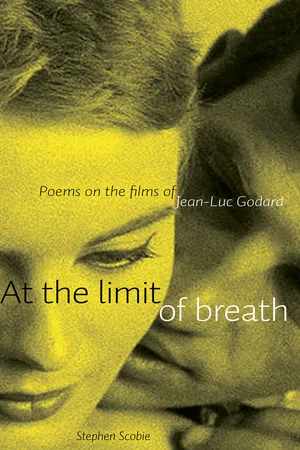
"I wanted this to be a narrative. So finally Jean-Luc went all the way: every line in the script a quotation from somewhere else. Every blessed line. Love doesn't die. It's people who die. Love just goes away." -from "NOUVELLE VAGUE / New Wave (1990)" Stephen Scobie celebrates "the greatest film director of his age" with poetry exploring 44 of Godard's films. Subtle yet profound unities play from poem to poem. Characters, locations, images, and the generous use of quotation jump-cut and recur to send the imagination reeling through the larger works of both artists. Readers will be seduced to linger within the writing and encouraged to seek beyond, to Godard's own oeuvre. The book is sharply envisioned and carefully cadenced so as to delight readers who may not be familiar with Godard's films. Those already acquainted with Godard's work will find At the limit of breath a most rewarding experience.
Information
Notes
For over fifty years, Jean-Luc Godard has been one of the leading figures in world cinema; many people (including me) would say that he is the greatest film director of his age. Although he is still most widely identified with the early years of the French New Wave, the early 1960s, Godard’s career is remarkable for its persistence and longevity. Throughout his later decades, he has continued to make films which challenge, like no others, the most fundamental aspects of cinematic narrative and language, while still producing images of piercing clarity and beauty.
My own fascination with Godard began in 1965, with the first movie of his I ever saw: Bande à Part (the circumstances of that first viewing are recorded on pages 9–10). It has continued unabated ever since, even through the “difficult” years of his political cinema.
In this book, I set myself the goal of celebrating Godard by writing poems based on his films: one poem for each film, written and presented in chronological order. I made it a condition that I should re-view each film before writing about it. Over the years, I have accumulated a near-complete collection of Godard on VHS and DVD (even if some of the more dubiously acquired copies are of wretched visual quality). I am missing several of the films from the political period: Un film comme les autres (1968), One American Movie (1968), and Ici et Ailleurs (1974). Of the later titles, the major omission is Grandeur et décadence d’un petit commerce de cinéma (1986). I have for the most part omitted Godard’s short films, as well as sketches he contributed to compilation films by several directors; nor have I attempted to deal with most of his very extensive work for television. I did include the short film Letter to Jane, co-directed with Jean-Pierre Gorin, and also Anne-Marie Miéville’s short film, Le livre de Marie, which is an integral part of the package release of Je vous salue, Marie (see page 83, notes to pages 47–49). Mainly, however, the poems deal with the theatrically released features. The general rule was one poem per film, but a few exceptions did enforce themselves.
The poems are closely keyed to the films. Most of the poetic images are taken from the film in question, and I quote extensively from the soundtrack dialogue. Such quotation is one of Godard’s own fundamental techniques: his films are full of other people’s words, sometimes openly acknowledged, frequently not. Godard has filmed more images of people reading than any other ten directors combined. (For an extended discussion of this topic, in relation to Godard and also to one of my other idols, Bob Dylan, see my essay “Plagiarism, Bob, Jean-Luc, and Me,” published in the proceedings of the conference “Refractions of Bob Dylan,” University of Vienna, 2011.)
The poems will thus be most fully appreciated by readers who have seen the films. But my hope is that the images and ideas will still have force even for those who are not familiar with their sources.
The following Notes make no attempt to account for all of the quotations I make from Godard’s dialogue; the reader can assume that any given poem contains a number of lines drawn from the film being written about. I have tried to account for some of the major echoes from sources other than Godard himself (especially Dylan). As to the use to which I put such quotations, the extent to which I make of them something new or different, readers must judge for themselves.
- p. V People in love
This quotation is adapted from Godard on Godard, trans. Tom Milne, New York, 1972, page 173. In the original, the first line reads “People in life quote as they please.” I mistyped “life” as “love” (no doubt a significant slip); but when I eventually discovered my error, I had grown so fond of the misquoted version that I decided to let it stand. - p. VII An image
This passage is freely adapted and translated from the writing of the French poet and critic Pierre Reverdy. It first appeared in his magazine Nord-Sud, number 13, March 1918. The later Godard seized upon it almost as a manifesto. It appears first in Passion (1982), and is quoted in several other films, most extensively in King Lear (1987). - p. 1 at the limit of breath
Richard Brody, in his definitive biography of Godard, Everything Is Cinema (New York: Metropolitan Books, 2008), writes: “To be precise, A bout de souffle should be translated as ‘Out of Breath’: ‘Breathless’ has a positive quality of joyful astonishment or satiety with pleasure that is absent from ‘à bout de souffle,’ which refers to a state of exhaustion” (page 638). I am indebted to Brody for providing the source for several other citations in these Notes. - p. 1 pointing you the way to go
Bob Dylan, “Tears of Rage.” For the comparison between Godard and Dylan, see my essay, cited above, “Plagiarism, Bob, Jean-Luc, and Me,” which includes the following summary: “Both [Dylan and Godard] burst on the scene in the early 60s as the enfants terribles of their arts; both of them survived motorcycle accidents, Dylan in 1966 and Godard in 1971; both of them went through periods of extreme ideological rigidity, Godard with Maoism and Dylan with evangelical Christianity; both of them are problematic, to say the least, in their depiction of women; both of them emerged to produce some of their finest work in the fourth or fifth decades of their careers.” Dylan therefore figures as a persistent sub-text in these poems.
In the film, the anonymous man in the street who points out to the police the way to go to follow the fugitive Belmondo is played, in a Hithcockian gesture, by Godard himself. - p. 2 Which side are you on?
1931 Trade Union song by Florence Reece. Quoted by Dylan in “Desolation Row.” - p. 2 By the waters of Leman
As used by T.S. Eliot in The Waste Land, Part III: “By the waters of Leman I sat down and wept,” adapted from Psalm 137, where it reads “By the rivers of Babylon, there we sat down, yea, we wept, when we remembered Zion.”
“Leman,” without the French accent, is an old English word for lover or sweetheart. “Lac Léman,” with the accent, is the French name for Lake Geneva. Le Petit Soldat is set in Geneva. Later in his career, when he settled in Rolle, Switzerland, images of Lac Léman become a ubiquitous presence in Godard’s films. - p. 2 her Danish hair
Anna Karina, the star of many early Godard films, and also his first wife, was Danish by birth. The most adored face in 1960s cinema. - p. 2 Lie to me
Opening line of a famous, romantically ironic dialogue exchange between Joan Crawford and Sterling Hayden in Johnny Guitar (1954, directed by Nicholas Ray). A favourite moment, frequently quoted by Godard; see also pages 62, 65, 70, 71. - p. 4 Raoul
Raoul Coutard, inventive cinematographer on all Godard’s early films. - p. 4 moderato cantabile
As a musical direction: in a moderate time, in a flowing style. Title of a 1958 novel by Marguerite Duras, filmed in 1960, directed by Peter Brook and starring Jeanne Moreau and Jean-Paul Belmondo. - p. 4 a rose is a rose
Motto of Gertrude Stein. For a discussion of the phrase, see Stephen Scobi...
Table of contents
- Cover
- Title Page
- Copyright
- Contents
- À bout de souffle / Breathless
- Le petit soldat / The Little Soldier
- Une femme est une femme / A Woman is a Woman
- Vivre sa vie / My Life to Live
- Les Carabiniers / The Riflemen
- Le Mépris / Contempt
- Bande à part / Band of Outsiders
- Bande à part / Band of Outsiders
- Une femme mariée / A Married Woman
- Alphaville: une étrange aventure de Lemmy Caution / Alphaville: A Strange Adventure of Lemmy Caution
- Pierrot le fou / Pierrot Goes Wild
- Masculin féminin / Masculine Feminine
- Masculin féminin / Masculine Feminine
- Made in USA
- Made in USA, Deux ou trois choses que je sais d’elle / Two or Three Things That I Know About Her
- Deux ou trois choses que je sais d’elle / Two or Three Things That I Know About Her
- La chinoise / The Chinese Woman
- Weekend
- Le Gai savoir / Joyful Wisdom; The Gay Science
- One Plus One a.k.a. Sympathy for the Devil
- British Sounds a.k.a. See You at Mao
- Pravda
- Vent d’est / Wind from the East
- Lotte in Italia / Struggles in Italy
- Vladimir et Rosa / Vladimir and Rosa
- Tout va bien / It’s all good
- Letter to Jane
- Numéro deux / Number Two
- Comment ça va? / How’s It Going?
- Sauve qui peut (la vie) / Every Man for Himself, a.k.a. Slow Motion
- Passion
- Scénario du film Passion / Screenplay for the film Passion
- Prénom Carmen / First Name: Carmen
- Le livre de Marie / The Book of Mary
- Je vous salue, Marie / Hail Mary
- Détective / Detective
- Soft and Hard: Soft Talk on a Hard Subject between Two Friends
- Soigne ta droite: une place sur la terre / Keep Your Right Up: A Place on the Earth
- King Lear
- Nouvelle vague / New Wave
- Allemagne année 90 neuf zero / Germany Year 90 Nine Zero
- Hélas pour moi / Alas for me
- JLG / JLG : autoportrait de décembre / JLG / JLG : Self-Portrait in December
- For Ever Mozart
- Histoire(s) du cinéma / History(ies) of Cinema
- Eloge de l’amour / In Praise of Love
- Notre musique / Our Music
- Film socialisme / Film Socialism
- À bout de souffle / Breathless
- Notes
- About the Author
- Other Titles from The University of Alberta Press
Trusted by 375,005 students
Access to over 1.5 million titles for a fair monthly price.
Study more efficiently using our study tools.
Frequently asked questions
Yes, you can cancel anytime from the Subscription tab in your account settings on the Perlego website. Your subscription will stay active until the end of your current billing period. Learn how to cancel your subscription
No, books cannot be downloaded as external files, such as PDFs, for use outside of Perlego. However, you can download books within the Perlego app for offline reading on mobile or tablet. Learn how to download books offline
Perlego offers two plans: Essential and Complete
- Essential is ideal for learners and professionals who enjoy exploring a wide range of subjects. Access the Essential Library with 800,000+ trusted titles and best-sellers across business, personal growth, and the humanities. Includes unlimited reading time and Standard Read Aloud voice.
- Complete: Perfect for advanced learners and researchers needing full, unrestricted access. Unlock 1.5M+ books across hundreds of subjects, including academic and specialized titles. The Complete Plan also includes advanced features like Premium Read Aloud and Research Assistant.
We are an online textbook subscription service, where you can get access to an entire online library for less than the price of a single book per month. With over 1.5 million books across 990+ topics, we’ve got you covered! Learn about our mission
Look out for the read-aloud symbol on your next book to see if you can listen to it. The read-aloud tool reads text aloud for you, highlighting the text as it is being read. You can pause it, speed it up and slow it down. Learn more about Read Aloud
Yes! You can use the Perlego app on both iOS and Android devices to read anytime, anywhere — even offline. Perfect for commutes or when you’re on the go.
Please note we cannot support devices running on iOS 13 and Android 7 or earlier. Learn more about using the app
Please note we cannot support devices running on iOS 13 and Android 7 or earlier. Learn more about using the app
Yes, you can access At the limit of breath by Stephen Scobie in PDF and/or ePUB format, as well as other popular books in Literature & Canadian Poetry. We have over 1.5 million books available in our catalogue for you to explore.