eBook - ePub
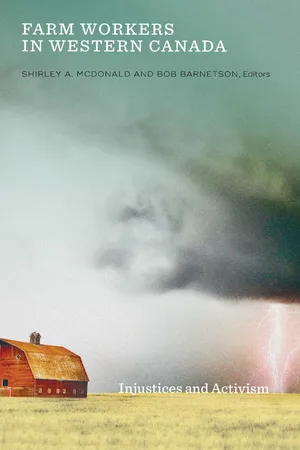
Farm Workers in Western Canada
Injustices and Activism
- 272 pages
- English
- ePUB (mobile friendly)
- Available on iOS & Android
eBook - ePub
Farm Workers in Western Canada
Injustices and Activism
About this book
Bill 6, the government of Alberta's contentious farm workers' safety legislation, sparked public debate as no other legislation has done in recent years. The Enhanced Protection for Farm and Ranch Workers Act provides a right to work safely and a compensation system for those killed or injured at work, similar to other provinces.
In nine essays, contributors to Farm Workers in Western Canada place this legislation in context. They look at the origins, work conditions, and precarious lives of farm workers in terms of larger historical forces such as colonialism, land rights, and racism. They also examine how the rights and privileges of farm workers, including seasonal and temporary foreign workers, conflict with those of their employers, and reveal the barriers many face by being excluded from most statutory employment laws, sometimes in violation of the Canadian Charter of Rights and Freedoms.
Contributors: Gianna Argento, Bob Barnetson, Michael J. Broadway, Jill Bucklaschuk, Delna Contractor, Darlene A. Dunlop, Brynna Hambly (Takasugi), Zane Hamm, Paul Kennett, Jennifer Koshan, C.F. Andrew Lau, J. Graham Martinelli, Shirley A. McDonald, Robin C. McIntyre, Nelson Medeiros, Kerry Preibisch, Heidi Rolfe, Patricia Tomic, Ricardo Trumper, and Kay Elizabeth Turner.
Information
1 Capitalist Farms, Vulnerable Workers
The Political Economy of Farm Work in Alberta
Until 2016, Alberta excluded farm workers from the employment rights and protections it accorded to virtually every other worker. For example, the government excluded farm workers from employment standards (including child labour) laws and health and safety laws, and prevented them from forming or joining unions. In addition, employers were not required to enrol farm employees in the workers’ compensation system. The former Progressive Conservative government (1971–2015) justified these exclusions by claiming they were necessary to protect so-called family farms from bankruptcy. The concentration of paid farm workers on physically and financially large farms invites scepticism of this rationale.
This chapter identifies the political and economic factors that contributed to the regulatory exclusion of farm workers under the Progressive Conservative regime. One of these factors is the tendency of farmers to cope with increasing costs of production and decreasing profits by, in part, externalizing their production costs onto farm workers in the forms of long hours of labour for low wages and denial of benefits including coverage under workers’ compensation. Government policy makers ignored these working conditions due to the presence of a political quid pro quo wherein the government exchanged favourable regulation (and other preferential treatment) for electoral support from voters in rural communities.
Both proponents and opponents of regulation use politically powerful but factually inaccurate terms such as “family farm” and “industrial farm” when discussing which farms should be subject to employment law. The view of those who oppose regulation is that the so-called family farm should not be governed by laws that seem more appropriate for regulation of farms that are best categorized as industrial operations. Yet, as this chapter demonstrates, neither term accurately describes the nature of farming activities that take place, nor do they delineate clear division between the two categories. Indeed, most farms in Alberta are family owned, including physically and financially large farms. As I intend to demonstrate, more analytically meaningful categories of farms are available, but their utility in politically charged debate has yet to be made clear.
Agro-industrialization, Capitalistic, and Capitalist Farms
Over the past 200 years, Canadian food production has transformed from a subsistence sector of the economy into one profoundly shaped by agroindustrialization. Agro-industrialization is characterized by the growth of commercial and off-farm processing, distribution, and input provisioning activities; changing relationships between producers and suppliers/distributors via vertical integration and contract-based procurement; and changes in product composition, technologies, and market structure (Reardon & Barrett, 2000; Troughton, 2005; Weis, 2010). The focus of this chapter is on paid employment in primary production, which entails farming, ranching, and fishing. Primary production is one of seven agro-food chains that constitute Canada’s agro-food system. The other agro-food chains include food processing, wholesale and retail, institutional food services, inputs and servicing, state regulation, and higher education (Winson, 1993).
Within each agro-food chain there are often heterogeneous groups of actors, such as suppliers, producers, and processors, with differing interests and levels of influence. Due to concentration and conglomeration, individual firms may participate in multiple agro-food chains. Some chains are oligopolies, wherein a small number of firms set prices. For example, large retailers are the most powerful actors in the agro-food complex because they are able to exert significant economic pressure on small retailers and food processors (Konefal, Maccarenhas, & Hatanaka, 2005; Sommerville & Magnan, 2015). Similarly, processers have the power to coerce producers (Lopez, Azzam, & Liron-Espana, 2002). The implementation of neoliberal policies by governments has had a significant global effect on agriculture. Key neoliberal agricultural policies include those that reduce state subsidies and regulation, and promote intra- and inter-state trade. As a result of these policies, there has been intensifying concentration, integration, and globalization of agro-food systems (Busch, 2010; Carton de Grammont & Lara Flores, 2010; Du Toit & Ewert, 2002; McMichael, 1996).
In spite of evidence of vertical integration that crosses various agro-food chains, executives of agribusiness corporations have been reluctant to invest in farming and ranching and, instead, deploy a more cost-effective strategy of externalizing production (and the attendant risks) onto producers. The continued existence of individual producers obscures fundamental changes in the composition and operation of the agro-food complex (Winson, 1993, 1996). In spite of these changes, some producers have carried on in the owner-operator tradition of physically and financially small operations on farms where the owner-operator and/or family members perform the majority of the work with the additional help of waged labourers during peak production periods. Other producers have responded to the pressures of agro-industrialization via concentration, intensification, and specialization (Qualman & Weibe, 2002; Smithers & Johnson, 2004; Stirling, 2001). These kinds of farms can be termed capitalistic operations in that they exhibit increasing accumulations of capital (e.g., land, machinery, money), but the owner-operator and family members continue to do much of the work with seasonal help supplied by waged workers. Capitalistic farms differ from capitalist farms because the latter rely heavily upon waged labour to complete work (Ghorayshi, 1987).
This trend toward capitalistic agricultural is evident in Canada’s long-term transition toward the rise to dominance in the industry by a small number of producers who operate large farms. Expansion of farm size through consolidation has been the objective of a long-term federal policy designed to increase farm income without increasing the cost of food (Agriculture and Agri-Food Canada, 1981, 1993, 2009; Federal Task Forc...
Table of contents
- Cover
- Title Page
- Copyright Page
- Dedication
- Contents
- Acknowledgements
- Introduction
- 1 Capitalist Farms, Vulnerable Workers
- 2 The Personal Experiences of an Alberta Farm Worker and Activist
- 3 Georgic Themes and Myths of Entitlement in the Life Writing of Prairie Settlers
- 4 Cows, Meat, People
- 5 A Temporary Program for Permanent Gains?
- 6 Working Away
- 7 Farming the Constitution
- 8 BC-Grown
- 9 Labouring in the “Four-Season Paradise”
- Contributors
- Index
- Other Titles from The University of Alberta Press
Trusted by 375,005 students
Access to over 1.5 million titles for a fair monthly price.
Study more efficiently using our study tools.
Frequently asked questions
Yes, you can cancel anytime from the Subscription tab in your account settings on the Perlego website. Your subscription will stay active until the end of your current billing period. Learn how to cancel your subscription
No, books cannot be downloaded as external files, such as PDFs, for use outside of Perlego. However, you can download books within the Perlego app for offline reading on mobile or tablet. Learn how to download books offline
Perlego offers two plans: Essential and Complete
- Essential is ideal for learners and professionals who enjoy exploring a wide range of subjects. Access the Essential Library with 800,000+ trusted titles and best-sellers across business, personal growth, and the humanities. Includes unlimited reading time and Standard Read Aloud voice.
- Complete: Perfect for advanced learners and researchers needing full, unrestricted access. Unlock 1.5M+ books across hundreds of subjects, including academic and specialized titles. The Complete Plan also includes advanced features like Premium Read Aloud and Research Assistant.
We are an online textbook subscription service, where you can get access to an entire online library for less than the price of a single book per month. With over 1.5 million books across 990+ topics, we’ve got you covered! Learn about our mission
Look out for the read-aloud symbol on your next book to see if you can listen to it. The read-aloud tool reads text aloud for you, highlighting the text as it is being read. You can pause it, speed it up and slow it down. Learn more about Read Aloud
Yes! You can use the Perlego app on both iOS and Android devices to read anytime, anywhere — even offline. Perfect for commutes or when you’re on the go.
Please note we cannot support devices running on iOS 13 and Android 7 or earlier. Learn more about using the app
Please note we cannot support devices running on iOS 13 and Android 7 or earlier. Learn more about using the app
Yes, you can access Farm Workers in Western Canada by Shirley A. McDonald,Bob Barnetson, Shirley A. McDonald, Bob Barnetson in PDF and/or ePUB format, as well as other popular books in Law & Labour & Employment Law. We have over 1.5 million books available in our catalogue for you to explore.