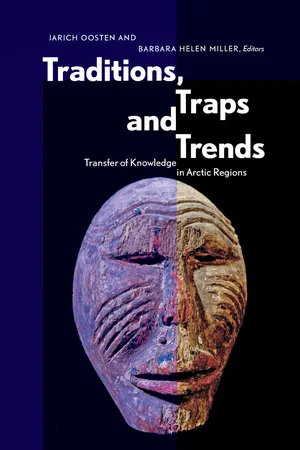
eBook - ePub
Traditions, Traps and Trends
Transfer of Knowledge in Arctic Regions
- 384 pages
- English
- ePUB (mobile friendly)
- Available on iOS & Android
eBook - ePub
Traditions, Traps and Trends
Transfer of Knowledge in Arctic Regions
About this book
The transfer of knowledge is a key issue in the North as Indigenous Peoples meet the ongoing need to adapt to cultural and environmental change. In eight essays, experts survey critical issues surrounding the knowledge practices of the Inuit of northern Canada and Greenland and the Northern Sámi of Scandinavia, and the difficulties of transferring that knowledge from one generation to the next. Reflecting the ongoing work of the Research Group Circumpolar Cultures, these multidisciplinary essays offer fresh understandings through history and across geography as scholars analyze cultural, ecological, and political aspects of peoples in transition. Traditions, Traps and Trends is an important book for students and scholars in anthropology and ethnography and for everyone interested in the Circumpolar North.
Contributors: Cunera Buijs, Frédéric Laugrand, Barbara Helen Miller, Thea Olsthoorn, Jarich Oosten, Willem Rasing, Kim van Dam, Nellejet Zorgdrager
Information
Subtopic
Education Theory & PracticeIndex
Social Sciences1
The Transformation and Transfer of Inuit Knowledge
Notes on isumaqsajuq, ilisaijuq, and qaujimajatuqangit
Introduction
This chapter discusses the nature of the knowledge used and transmitted by the Inuit of the northeastern parts of Canada,1 which changed suddenly and fundamentally in the 20th century. It will trace and examine these changes, and try to understand them within the context of the transformation of the Inuit way of life from semi-nomadic subsistence hunters to mixed-economy residents of settlements in the second half of the century. The first section deals with the nature of the information that the Inuit used for their survival and well-being during the subsistence-hunting days, and with the ways in which this knowledge, referred to by the Inuit as isumaqsajuq, was acquired. In the second section, the focus is on the nature and contents of the formal education that was, and is, transferred by (southern-style) schools, which the Inuit refer to as ilisaijuq. Particular attention will be paid to the impact of boarding schools, as these were instrumental in creating a generation of young Inuit who organized themselves into a nationwide political movement. This new generation succeeded, after years of tedious negotiations, in establishing Nunavut as a distinct territory within the Canadian federation. This section briefly examines this process, and assesses the role played by aspects of isumaqsajuq and ilisaijuq types of knowledge. The final section discusses Inuit qaujimajatuqangit (IQ), Inuit knowledge that the Nunavut government—a public government, but de facto self-government for the Inuit—adopted as its basic guiding principle for politics and policy. The origin and nature of IQ is discussed, and its underlying values, promises, and limitations assessed. By way of conclusion, the new “school” Piqqusilirivvik that seeks to combine the isumaqsajuq way of learning and the ilisaijuq method is discussed in light of the IQ-inspired policy of the Nunavut government:
If you do not have any practical experience, everything is hard to handle…the only way to learn is to be actively involved; that is why it is important in the Arctic that there is know-how of survival skills. (Noah Piugaattuk, 1986)2
isumaqsajuq
Inuit Knowledge from Subsistence-Hunting Life
Context
For many centuries, the Inuit of the eastern Arctic of Canada survived by hunting and by using their prey for everything they needed in life. The ecologic and climatologic conditions of the Arctic heavily affected Inuit life. All features of Inuit society were related directly or indirectly to these conditions. One important feature was the small scale of society. Prior to the 20th century, most Inuit never saw more than a few hundred others in their entire lifetime; it seems that the Arctic sustained only limited numbers of people. Another feature was the variation in the size of society, as the number of people who made up one’s social environment varied with the seasons. In spring and summer, Inuit families dispersed into small camps, often reducing “society” to one or two households. In fall or early winter, these families then reconvened with others, augmenting society to its maximum size of some sixty to eighty individuals. This varying density was related to the seasonal variation of the Arctic region with its marked contrasts in hours of daylight, from the days and weeks of round-the-clock daylight in spring and summer, to the days and weeks of absence of daylight in mid-winter.3 Since the behaviour and movements of animals varied with this seasonal variation in daylight hours and its concomitant effects on temperatures, weather, and snow and ice conditions, the Inuit hunting patterns varied accordingly. The winter in-gathering of Inuit served the purpose of communal hunting: the more hunters engaged in hunting seals through the breathing holes in the sea ice, the greater the chances of success. The spring and summer dispersal of families served the acquisition of a wider range of game animals. These included the spring hunt of seals basking on the sea ice or shooting them from the edge of the sea ice, the hunting of seals, walrus, and other sea mammals in open water in summer, catching ducks and geese in the spring and the summer, and the inland hunting of caribou in the summer and fall. These diversified types of hunting increased the chances of acquiring all that was needed for survival. This annual pattern of scattering and convening was a common feature of all Inuit in Canada who, with the exception of the so-called Caribou Inuit of the Barren Grounds west of Hudson Bay—who spent all year living inland—were coastal dwellers oriented both on the land and the sea.4
The mobility of Inuit hunters and their families, which constituted the seasonal round of activities, was at the heart of Inuit life. The annual pattern of mobility and varying types of hunting were the Inuit answer to the demands of survival and well-being in the Arctic regions. Inuit life was geared to survival: the material and psychic demands of living in the Arctic were high, and the margins of survival were low, as cases of death by starvation reveal. Inuit survival and well-being depended on hunting, which made Inuit dependent on animals. At the same time, Inuit were also directly dependent on each other. Children depended on adults and parents, who in turn, in particular during their old age, depended on their children; a man could not survive without a wife, and women needed men to provide for them; hunters could not survive on their own, and had to rely on their fellow hunters. This fundamental and direct interdependence meant that everyone, mediated by one’s gender, age, and personal skills, had to contribute to survival. The tasks one had to fulfill left no room for evasion. The behavioural rules that this primary division of labour embedded were compelling, and demanding. They required knowledge, high levels of stamina, and self-control. These requirements were instilled into Inuit children by means of sophisticated techniques of child-rearing.5 The continuous Inuit habitation of the Canadian Arctic for many centuries proves the aptness of these practices.
The focus on survival, the patterns of mobility, and the fulfillment of one’s tasks, were not just a matter of economics, of dealing with life’s material requirements. They were also answers to the mental demands of life in the Arctic and generated cultural ways that were transmitted from earlier generations through socialization. This created the cultural “habitus” (personality structure embedded in culture) of each individual Inuk.6 Knowledge was the key to this personal attitude, which served to prepare everyone to deal adequately with the natural and social environment in ways that were seen as appropriate and as providing maximum chances of individual and group survival. Knowing how best to deal with nature, the weather, animals, with others, and the self, was crucial to the survival of each person. The transfer of this body of information was therefore essential for the survival of Inuit society over time.
Contents
In the oral society of the Inuit, knowledge could only be stored in people’s minds.7 As a result, knowledge was much more personal than in literate societies, where written documents contribute to higher levels of shared and objectified knowledge. Whereas a certain amount of “common knowledge” was or could be shared with all others, some or much knowledge was highly specific and personal. Some information was not shared but kept to oneself; some was socially restricted and selectively passed on, as was the case with shamanistic knowledge. Inuit knowledge was thus, in varying degrees, specific to certain groups, camps, families, or individuals. The information that constituted one’s personal knowledge was embedded in the practices of daily life, and was therefore intimately connected with the two core domains of life: subsistence hunting and the household. This knowledge not only followed from daily life, it also guided or steered one’s behaviour. Each individual had to know and choose for him/herself the ways in which to lead daily life. Because each person was free to choose, nobody could, or would, try to enforce upon others what to do. In this sense, the Inuit were highly individualistic. However, underlying this individual sovereignty and freedom were such basic norms as caring for others, fulfilling one’s duties, and displaying affection and respect by obedience to older people, relatives, and others. As these norms pertained to everyone, Inuit individualism was embedded within a society of more or less equal and free persons.
The knowledge was stored and expressed in a language, Inuktitut, which was, and is, concrete, rich, and precise in terms of descriptions of space, the nature of objects, and the expression of thoughts. It lacks genders, which may hint at the equality of humans. The language almost lacks generic terms, requiring that the speaker must be specific and precise in indicating what he or she is talking about; thus, one cannot speak about “snow” or “seal,” but rather must identify the specific type of snow or seal to which one is referring. As the language was only oral, not written, emphasis was placed on transferring the exact meaning of what was being said. Those who listened were not to interrupt the speaker. Consequently, the spoken language was elaborate.8
As an Inuk’s personal knowledge system was embedded in the duties of daily life, its contents were both practical and largely gender-specific. The knowledge of women particularly related to the sphere of the household. This included, but was not limited to, knowing how to flense and prepare skins, how to sew them into mitts, parkas, trousers, undergarments, boots, or into covers of tents or kayaks, how to mend clothes, how to make waterproof sealskin boots, how to keep them flexible, and how to prepare and cook the meat of land and sea mammals, fish, and fowl. Women also had to know about preparing seal fat for use in the stone lamp (used for light, warmth, and cooking), how to tend the lamp, how to be a wife and a mother, and how to give birth and raise children.
The specific knowledge of men pertained to the weather, the snow and ice conditions, features of land, fresh or salt water, currents, clouds, winds, stars, and celestial and atmospheric spheres. Men had to be able to find their way in all kinds of circumstances during travel and hunting activities within their annual round. They had to know about tracks, the behaviour and specifics of a range of animal species, and they had to know how to track, find, kill, butcher, and transport them. Men had to know how to use stones, bones, skins and whatever else to make tools, hunting equipment, sleds, kayaks, harnesses, thongs, knives, and other utensils for use during hunting, travelling, domestic life, or times of relaxation. Men had to be familiar with the specifics and possible use of snow and ice for constructing snow houses, setting up and breaking up camp. They had to know how to train and use dogs for travelling and hunting. Personal wisdom of this kind became integral to the culturally established and shared knowledge of what to do at any specific moment within the familiar routines of the annual round, and of how to understand an intricate complex of natural and celestial phenomena.
Although practical knowledge was the core of Inuit knowledge, its contents were embedded in a holistic system that included mental and/or spiritual wisdom. The Inuit did not distinguish between the natural and the supernatural. Their world encompassed not only land, water, snow, ice, humans, animals, and plants, but also souls of their dead fellows and the spirits of animals that had been killed. People’s thoughts and actions bore on this spiritual domain, and this spiritual domain bore on these thoughts and actions. Inuit mobility, for instance, was inspired by and expressed in spiritual knowledge:
All these trips were made because it was determined that the place where they had been was no longer suitable to be occupied, for it is believed that after five years of continual occupation, the place will become hazardous and death will prevail. It is said that, even though the ground may be frozen in the winter, the place becomes too hot for occupation…Camps that were frequented had to be abandoned periodically for that very reason…So, after a period of five winters and summers, the place of occupation was deemed to be “too hot” for living; so it had to be abandoned for a period of time in order that it got itself to “cool down.” (Michel Kupaaq, 1990: IE-128)
Likewise, people’s understanding of the environment and, particularly the relationships with animals, had a spiritual dimension. The weather, of utmost significance as it could interfere with Inuit mobility and hunting, depended on Sila (or Sila inua, the person in the sky).9 Animals, upon whose killing the Inuit depended, also required a spiritually loaded circumspection. When an animal was killed, for instance, its spirit had to be contented, which was often done by trickling fresh water into its mouth. People always had to display respect for animals. They were not allowed to kill more animals than needed, fight over them, kill them just for fun, kill them in a painful manner, or display superiority over them. Such behaviour would induce the animals’ spirits to take revenge by causing illness, moving away from the area, not letting themselves be killed any more or by causing bad weather. For instance:
Any animal that has the breath of life should not be made to suffer. This has always been our rule, our tradition…when you mistreat an animal and are not going to kill it or leave it behind, this should not be done…Any animal, even a small bird, should not be mistreated and not killed, or mocked at or be dealt with out of frustration. When this happens, since animals have a mind and they may be adults in their own kind, the person who does this can then experience a very unpleasant situation…The person will feel the misery [inflicted] himself if he mistreats an animal. (Piugaattuk 1986: IE-009)
Illnesses, bad weather, and other misfortunes were invariably attributed to human misbehaviour. People, women in particular, had to abide by many rules of proper behaviour and taboos. Magic chants and amulets were among the means individuals possessed to please the spirits. If they failed, shamans, individuals considered as able to communicate with the spirits and with the deceased, could be called to help. The wisdom of these men or women, who also had to comply with their gender duties, was seen as extending into the realm of the spirit world. An impression may be gleaned from the words ...
Table of contents
- Cover
- Title Page
- Copyright Page
- Dedication
- Contents
- Introduction
- 1 The Transformation and Transfer of Inuit Knowledge
- 2 Language and Literacy Exchange between the Moravians and the Inuit
- 3 Traditions, Traps and Tricks
- 4 Finding New Places to Transfer Inuit Knowledge in Nunavut
- 5 Living Objects
- 6 Transfer of Healing Knowledge
- 7 Two Traditional Sámi Love Songs and the Transfer of Knowledge
- 8 Sámi Storytelling and the Transfer of Knowledge
- Contributors
- Index
- Other Titles from The University of Alberta Press
Trusted by 375,005 students
Access to over 1.5 million titles for a fair monthly price.
Study more efficiently using our study tools.
Frequently asked questions
Yes, you can cancel anytime from the Subscription tab in your account settings on the Perlego website. Your subscription will stay active until the end of your current billing period. Learn how to cancel your subscription
No, books cannot be downloaded as external files, such as PDFs, for use outside of Perlego. However, you can download books within the Perlego app for offline reading on mobile or tablet. Learn how to download books offline
Perlego offers two plans: Essential and Complete
- Essential is ideal for learners and professionals who enjoy exploring a wide range of subjects. Access the Essential Library with 800,000+ trusted titles and best-sellers across business, personal growth, and the humanities. Includes unlimited reading time and Standard Read Aloud voice.
- Complete: Perfect for advanced learners and researchers needing full, unrestricted access. Unlock 1.5M+ books across hundreds of subjects, including academic and specialized titles. The Complete Plan also includes advanced features like Premium Read Aloud and Research Assistant.
We are an online textbook subscription service, where you can get access to an entire online library for less than the price of a single book per month. With over 1.5 million books across 990+ topics, we’ve got you covered! Learn about our mission
Look out for the read-aloud symbol on your next book to see if you can listen to it. The read-aloud tool reads text aloud for you, highlighting the text as it is being read. You can pause it, speed it up and slow it down. Learn more about Read Aloud
Yes! You can use the Perlego app on both iOS and Android devices to read anytime, anywhere — even offline. Perfect for commutes or when you’re on the go.
Please note we cannot support devices running on iOS 13 and Android 7 or earlier. Learn more about using the app
Please note we cannot support devices running on iOS 13 and Android 7 or earlier. Learn more about using the app
Yes, you can access Traditions, Traps and Trends by Jarich Oosten, Barbara Helen Miller, Jarich Oosten,Barbara Helen Miller in PDF and/or ePUB format, as well as other popular books in Social Sciences & Education Theory & Practice. We have over 1.5 million books available in our catalogue for you to explore.