Across America, the pure love and popularity of barbecue cookery have gone through the roof. Prepared in one regional style or another, in the South and beyond, barbecue is one of the nation’s most distinctive culinary arts. And people aren’t just eating it; they’re also reading books and articles and watching TV shows about it. But why is it, asks Adrian Miller—admitted ’cuehead and longtime certified barbecue judge—that in today’s barbecue culture African Americans don’t get much love?
In Black Smoke, Miller chronicles how Black barbecuers, pitmasters, and restauranteurs helped develop this cornerstone of American foodways and how they are coming into their own today. It’s a smoke-filled story of Black perseverance, culinary innovation, and entrepreneurship. Though often pushed to the margins, African Americans have enriched a barbecue culture that has come to be embraced by all. Miller celebrates and restores the faces and stories of the men and women who have influenced this American cuisine. This beautifully illustrated chronicle also features 22 barbecue recipes collected just for this book.

- 328 pages
- English
- ePUB (mobile friendly)
- Available on iOS & Android
eBook - ePub
About this book
Information
1
PIT SMOKED
BARBECUE’S NATIVE AMERICAN FOUNDATION
In cooking outdoors sooner or later we have to acknowledge our everlasting debt to the original American, the Indian.
—The Browns in Outdoor Cooking
Barbecue’s history, or prehistory to be exact, begins with the Indigenous peoples in the Americas. Yet getting down to the bone of the cuisine’s beginnings is much like the wonderfully messy endeavor of eating barbecue—you must get in there, bite down, and pull things apart. As we do so, let me first recognize the foundational presence of those who came before. I acknowledge that I wrote this book in Denver, Colorado, on the ancestral land of the Arapaho, Cheyenne, Sioux, and Ute peoples.
Since Native Americans had oral traditions, I’m relying on written accounts and illustrations by Europeans who encountered and observed barbecue in the Americas. In their descriptions, “barbecue” is spelled in a variety of ways and sloppily applied to a range of cooking methods and contexts. Consequently, the definition of “barbecue” frequently changed from the 1500s to the 1700s. Still, the meager sources available provide valuable information on how barbecue eventually formed a consistent identity with white people, acquired a terroir, diminished its Native American roots, and gained an African American vibe.
I usually get a double take when I tell someone that barbecue is rooted in Native American culinary traditions. “Black people invented barbecue, right?” is the usual sentiment. I understand why people think that way, given that African Americans have long been prominent barbecuers in so many communities. But let’s face it: people were here, they knew the lands and the animals, and they were cooking meat over a fire before others arrived. Opinions differ on how Native practices influence the barbecue we make today. A wealth of accounts gives us clues, and two books that are very helpful in sorting out barbecue’s early history are Savage Barbecue by Andrew Warnes and Virginia Barbecue by Joseph Haynes.
One of the earliest mentions relating to what we think of today as barbecue came in 1513, when, using source material from the ship’s crew, Andrés Bernáldez published a recap of Christopher Columbus’s second voyage to the Americas. In it, he shares the story of how Columbus sailed into what we now call Guantanamo Bay:
In that harbour there was no settlement, and as they entered it, they saw to the right hand many fires close to the sea and a dog and two beds, but no people. They went on shore and found more than four quintals of fish cooking over the fire, and rabbits, and two serpents, and very near there in many places they were laid at the foot of the trees. In many places there were many serpents, the most disgusting and nauseating things which men ever saw, all with their mouths sewn up. And they were the colour of dry wood, and the skin of the whole body was very wrinkled, especially that of their heads, and it fell down over their eyes. … The admiral ordered the fish to be taken, and with it refreshed his men.1
Foreshadowing what Europeans would do with much of the Americas, Columbus and crew took and devoured everything they considered edible, without asking permission. Soon afterward, they met the Taino people, whose encampment they had raided. The Tainos communicated that they were preparing a feast. When Columbus explained what they had done, the Tainos “were greatly rejoiced when they knew that they had not taken the serpents, and replied that all was well, since they would fish again at night.”2 Historians later surmised that these “serpents” were iguanas.
Bernáldez’s anecdote fueled the imaginations of European readers, and it established an early narrative about barbecue that often remains critically unchallenged. The basic story from a European-heritage perspective goes something like this: Europeans arrived in the West Indies, and they stumbled on strange people doing a strange type of slow cooking that involved small animals and plants laid on a wooden platform raised above a fire. Though unfamiliar, the food was delicious. In time, the Europeans, and enslaved Africans, traveled from the Caribbean to the colonies in British North America, applied those island cooking methods they’d observed to the European animals (cows, pigs, and sheep) that they had introduced in the colonies—and barbecue was born. Other narratives reach the same conclusion but greatly diminish or leave out entirely the Caribbean part of the story. And some storytellers insist that barbecue’s only essential element is pork. From this viewpoint, barbecue doesn’t begin before the Spanish explorer Hernando de Soto arrived in present-day Tampa, Florida, with thirteen pigs in 1539.3 All of these origin theories treat the North American mainland as a blank slate and its original inhabitants as inconsequential.
Let’s pause for a moment to look at what barbecue meant at this time. Andrew Warnes looked into the early etymology of the word “barbecue” and concluded, “It seems likely, then, that, throughout the Caribbean before Columbus, barbacoa was nothing more sinister than a framework of wood on which one might sleep, store maize, or suspend foods high enough above a fire that they could be left smoking with little risk of spoiling.”4 Joseph Haynes adds that “the words barbacoa and barbecue used in sixteenth- and seventeenth-century literature were nouns used to refer to platforms, tables, beds, bridges, houses, corncribs, and grills used for preparing foods.”5 Eventually, Spaniards used barbacoa as a generic term for the cooking apparatus, the cooking process, and the type of meat cooked this way. The English followed suit with this linguistic promiscuity, instead using their own word “barbecue.”6
Now back to the cooking. At the time of sustained European contact, Indigenous peoples used multiple meat cooking techniques in the Americas. Our focus here is on what Europeans observed in the American South. These techniques may generally be categorized as:
1. Piercing sticks
2. A rotating spit over a fire
3. A raised platform
4. A vertical hole
5. A shallow pit
Each of these methods possessed the building blocks to become barbecue: wood, fire, meat, and skilled cooks. But how does each technique match up to what whites would call barbecue by the turn of the eighteenth century? Let’s take a closer look at each.
PIERCING STICKS
With this method, the sticks were either stuck in the ground perpendicular to the fire, then angled toward the fire, or the weight of the meat morsel at the end of the stick bent it toward or over the fire. Sometimes multiple sticks were used to create a latticed frame. An Englishman named Mark Catesby observed this cooking method in the 1720s: “The manner of their roasting, is by thrusting sticks through pieces of meat, sticking them around the fire, and often turning them.”7 A Frenchman named Antoine-Simon Le Page du Pratz observed the practice while living among the Natchez in present-day Louisiana during the same time period. He wrote, “When the natives wish to roast meat in order to eat it at once, which seldom happens except during the hunting season, they cut off the portion of the bison which they wish to eat, which is usually the fillet. They put it on the end of a wooden spit planted in the earth and inclined towards the fire. They take care to turn this spit from time to time, which cooks the meat as well as a spit turned before the fire with much regularity.”8 For larger pieces of meat, several sticks would be used to create a vertical framework on which the meat rested. The cook’s purpose for this method depended much on the intensity of the fire. If the fire was kept at very low, the food was being dried for preservation. If the fire was hotter, this method was more like grilling with the morsels intended for immediate consumption. Either way, the technique would not become what whites would call barbecue.
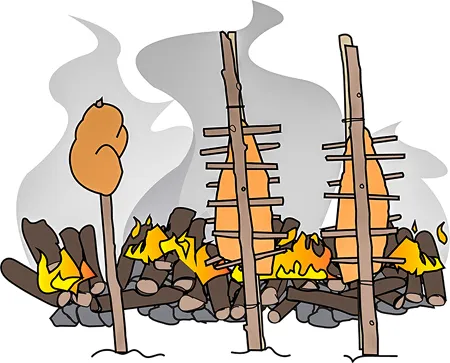
Piercing sticks technique. Illustration by Ben Dodd.
THE ROTATING SPIT
Colonial-era Europeans found this type of cooking most familiar. Instead of the metal rods that European cooks would have used, Indigenous people pierced chunks of meat with a large, sharpened piece of wood. That piece of wood in turn rested horizontally on two forked pieces of wood, spaced apart and planted vertically in the ground. The horizontal piece of wood through the meat was then turned by hand so that the meat roasted as it rotated over a fire and cooked evenly.
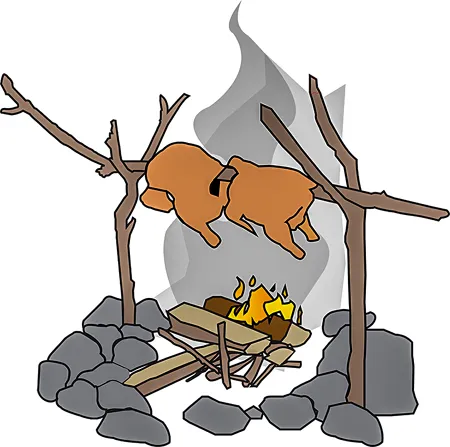
Rotating spit technique. Illustration by Ben Dodd.
An Englishman named John Smith described spit cooking in the early 1600s while living among the Powhatans in present-day Virginia. “Their fish and flesh they boyle either very tenderly, or broyle it so long on hurdles over the fire; or else, after the Spanish fashion, putting it on a spit, they turne first the one side, then the other, til it be as drie as their jerkin beefe in the west Indies, that they may keepe it a month or more without putrifying.”9 He, and others, observed Indigenous peoples as far north as present-day Delaware, and as far west as the Great Plains, using the spit-cooking method, especially when they cooked bison.10 Notably, Smith signals that this preparation was for later use versus immediate consumption. The closest analogue to a spit in contemporary meat cooking is a rotisserie. Getting closer, but still not what would become barbecue.
THE RAISED PLATFORM
In 1591, a Flemish engraver named Theodor de Bry created some of the earliest and most popular barbecue images for a western European audience. De Bry claimed that the engraving was based on a long-lost watercolor painting by Frenchman Jacques Le Moyne de Morgues, who accompanied an expedition to the area around present-day Jacksonville in the 1560s. That watercolor ostensibly depicts members of the Timucua tribe, whose ancestral homeland is northeastern Florida and southeastern Georgia, cooking small reptiles on a raised platform. De Bry’s engraving created a highly profitable sensation in Europe. It also brought together so many elements for barbecue researchers like me: Native Americans, smoking whole animals on a raised platform, in the American South!
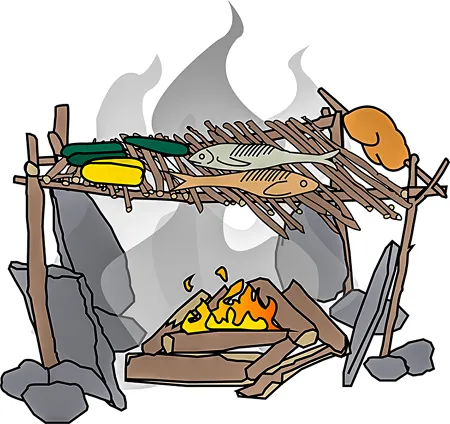
Raised platform technique. Illustration by Ben Dodd.
But the image, as well as many others of the Timucuas, is so riddled with errors and inconsistencies that Florida archaeologist Jerald T. Milanich asserts we’ve been “duped.” Milanich “question[s] whether Jacques le Moyne actually did any paintings of Florida Indians,” and he further concludes that the painting is likely based on images of Indigenous people barbecuing in South America.11
Putting aside de Bry’s and Le Moyne’s historical head fake, some Indigenous peoples in the American South did use this method during the 1700s. John Smith’s experience with the Powhatans in Virginia was much like Catesby’s observations of tribes in the Carolinas. “Besides roasting and boiling, they barbecue most of the flesh of the larger animals, such as buffalo’s [sic], bear and deer; this is performed very gradually, over a slow clear fire, upon a large wooden gridiron, raised two feet above the fire.”12 According to du Pratz, the Natchez in Louisiana also cooked that way.
This cooking method didn’t die out. In a 1990s cookbook about traditional Cherokee cooking, Lulu Gibbons gives a recipe for barbecued fish that a fifteenth-century Indigenous cook would immediately recognize: “Barbecued Fish—Build a rack with four corners of forked sticks driven into the ground, about 2½ feet high. Lay hickory sticks across rack. Clean fish and lay on hickory rack. Build fire of hickory wood—not too much fire; just so it will smoke good. Let fish cook half a day or until they are done. Fish may be eaten as is, or made into soup which is very good.”13 Most notably, Gibbons describes the fish as “barbecued.” Sounds good in today’s expanded definition of barbecue, but not in the narrower one that whites used in the eighteenth and nineteenth centuries.
THE VERTICAL HOLE
One finds the practice of cooking in a vertical hole, otherwise known as “earth ovens,” in cultures around the world. It was common among Indigenous peoples across a broad swath of North America—from Mexico northward to the Great Plains and east...
Table of contents
- Cover Page
- Title Page
- Copyright Page
- Dedication
- Contents
- Illustrations
- Recipes
- Sidebars
- Introduction: Kindling My Barbecue Passion
- 1. Pit Smoked: Barbecue’s Native American Foundation
- 2. How Did “Barbeque” Get So Black?
- 3. Burnt Offerings: Barbecue in African American Church Culture
- 4. Rising Smoke: The Ascendancy of the African American Barbecue Specialist
- 5. Barbecue Is My Business: The Emergence of African American Barbecue Entrepreneurs
- 6. Black Barbeque Is Beautiful: Toward an African American Barbeque Aesthetic
- 7. Liquid Black Smoke: The Primacy of Sauce
- 8. Short-Circuited: African Americans and Competition Barbecue
- 9. Blowing Smoke: The Fading Media Representation of African American Barbecuers
- 10. Glowing Embers: The Future of African American Barbecue
- Tending the Fire
- My Favorite African American Barbecue Restaurants
- Acknowledgments
- Notes
- Bibliography
- Index
- Back Cover
Trusted by 375,005 students
Access to over 1.5 million titles for a fair monthly price.
Study more efficiently using our study tools.
Frequently asked questions
Yes, you can cancel anytime from the Subscription tab in your account settings on the Perlego website. Your subscription will stay active until the end of your current billing period. Learn how to cancel your subscription
No, books cannot be downloaded as external files, such as PDFs, for use outside of Perlego. However, you can download books within the Perlego app for offline reading on mobile or tablet. Learn how to download books offline
Perlego offers two plans: Essential and Complete
- Essential is ideal for learners and professionals who enjoy exploring a wide range of subjects. Access the Essential Library with 800,000+ trusted titles and best-sellers across business, personal growth, and the humanities. Includes unlimited reading time and Standard Read Aloud voice.
- Complete: Perfect for advanced learners and researchers needing full, unrestricted access. Unlock 1.5M+ books across hundreds of subjects, including academic and specialized titles. The Complete Plan also includes advanced features like Premium Read Aloud and Research Assistant.
We are an online textbook subscription service, where you can get access to an entire online library for less than the price of a single book per month. With over 1.5 million books across 990+ topics, we’ve got you covered! Learn about our mission
Look out for the read-aloud symbol on your next book to see if you can listen to it. The read-aloud tool reads text aloud for you, highlighting the text as it is being read. You can pause it, speed it up and slow it down. Learn more about Read Aloud
Yes! You can use the Perlego app on both iOS and Android devices to read anytime, anywhere — even offline. Perfect for commutes or when you’re on the go.
Please note we cannot support devices running on iOS 13 and Android 7 or earlier. Learn more about using the app
Please note we cannot support devices running on iOS 13 and Android 7 or earlier. Learn more about using the app
Yes, you can access Black Smoke by Adrian Miller in PDF and/or ePUB format, as well as other popular books in Social Sciences & African American Studies. We have over 1.5 million books available in our catalogue for you to explore.