For all that is known about the depth and breadth of African American history, we still understand surprisingly little about the lives of African American children, particularly those affected by northern emancipation. But hidden in institutional records, school primers and penmanship books, biographical sketches, and unpublished documents is a rich archive that reveals the social and affective worlds of northern Black children. Drawing evidence from the urban centers of Boston, New York, and Philadelphia, Crystal Webster’s innovative research yields a powerful new history of African American childhood before the Civil War. Webster argues that young African Americans were frequently left outside the nineteenth century’s emerging constructions of both race and childhood. They were marginalized in the development of schooling, ignored in debates over child labor, and presumed to lack the inherent innocence ascribed to white children. But Webster shows that Black children nevertheless carved out physical and social space for play, for learning, and for their own aspirations.
Reading her sources against the grain, Webster reveals a complex reality for antebellum Black children. Lacking societal status, they nevertheless found meaningful agency as historical actors, making the most of the limited freedoms and possibilities they enjoyed.
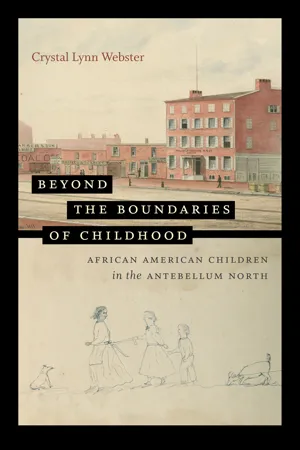
eBook - ePub
Beyond the Boundaries of Childhood
African American Children in the Antebellum North
- 224 pages
- English
- ePUB (mobile friendly)
- Available on iOS & Android
eBook - ePub
Beyond the Boundaries of Childhood
African American Children in the Antebellum North
About this book
Information
CHAPTER ONE
Fugitive Play
The Imaginative World of Northern Black Childhood
During his time at the Shelter for Coloured Orphans in Philadelphia from 1827 to 1832, Stephen Ricks greatly impressed the adults around him. He displayed behavior and intelligence that was “uncommon” and “unusual.” Ricks was drawn to school and favored learning over leisure. He “seldom inclined to mingle with other children at play,” and rarely left the schoolroom during the hours of recess. Instead, he preferred “retirement in pen and book.”
These descriptions of Stephen Ricks were primarily provided by white female reformers and observers concerned with the education and care of orphan children. These adults encouraged Ricks’s “mature” behavior and praised it publicly in their annual report to the Association for the Care of Coloured Orphans.1 Indeed, the white administrators of the Black orphanage idealized his childhood, representing him as a model of how Black children should behave. But his legibility as a Black child did not fit the dominant definition of childhood, which celebrated white children’s play and innocence. With his true desires and sensibilities mediated through these adult eyes, Ricks was described as adult-like, intellectual, pious, and reserved.
Individually and collectively, Black children like Stephen Ricks confronted constraints placed upon them by dominant cultural ideas about childhood, white reformers’ institutionalization of Black children, and Black activist notions of respectability. While normative notions of nineteenth-century childhood became enmeshed with behaviors of play and states of innocence, Black children like Stephen Ricks navigated social constructions of childhood from which they were increasingly excluded. Their evolving statuses of enslavement, indenture, and institutionalization placed them in a constant state of contradiction and pathologization. They were seen as mature yet too childish, too playful yet naturally suited for labor. Nonetheless, Black children imagined possibilities beyond limiting notions of childhood. Through their play, Black children challenged nineteenth-century white reformers’ appropriation of their labor and surveillance, as well as Black middle-class/elite representations of childhood. Northern Black children’s behavior and actions reveal the tensions between discourses on white childhood, idealized Black childhood, and the paradoxical nature of race and childhood.
As a group that straddled many social and legal boundaries, northern Black children strategically attempted to adhere to popular ideas about how children should behave. Moreover, their active and figurative play allowed them to navigate and challenge the physical and social boundaries of childhood. While northern Black children’s playful behavior is elusive within historical documentation, their play nonetheless haunts the archive of childhood itself. It has been intentionally, and at times strategically, obscured within literature, institutional records, and archival objects related to children.2 Black children themselves were marked by contradictory, racialized ideas about labor, play, innocence, dependence, and freedom. Play was (and remains) a way in which Black children worked through the metaphysical dilemma of childhood.
Throughout the antebellum period, Black children living in the U.S. North were impacted by cultural legacies and historical events, including the Middle Passage and migration, slavery and emancipation, and the coming of the Civil War. These processes and events influenced modern notions about childhood that emerged during the early part of the nineteenth century as an important element of a white middle-class identity that valued childhood innocence and play. Although the practice of play held special significance in the home, it was institutionalized through the designation of spaces and objects for Black children’s play. During the nineteenth century, whites admitted Black children into various orphanages and reformatories, but also challenged the basic premise of their childhoods. They indentured Black children instead of educating them, and only allowed them access to specific playful experiences if they African American children exhibited appropriate behavior. Simultaneously, white and middle-class children received formal schooling for longer periods of time, which in turn limited their required labor contributions to their families and encouraged playful exploration.3
The transatlantic slave trade impacted how northern Black children were treated in the antebellum era and produced a legacy of pejorative characterizations of Black childhood based in white supremacy. On the African continent, capture and the march to the sea disrupted prevailing experiences of childhood. As white slavers forcibly transported children of African descent across the Atlantic, the children’s notions of their own identities evolved. European traders and slavers oppressed child-bodies with little or no regard to social and cultural beliefs. European models of childhood were also evolving during the era of the transatlantic slave trade, and Europeans marked enslaved children as the other from which they defined normative notions of children from the moment of capture to sale and enslavement. Yet from the moment of capture to sale and enslavement, Black people in the African diaspora articulated their own childhoods by retaining elements of West African identity—and reframed the ways in which childhood was defined in the New World.
While West African recognition of the child varied across cultural landscapes, records of shared beliefs in precolonial Africa indicate that children—a category not necessarily defined by age but by spiritual, cultural, and physical stages—were highly valued in cultural life. Childhood and age were structured in relation to prevailing cultural systems, including gerontocracy. Under gerontocracy, West African groups defined children as dependents and thus subordinate to the head of the household. Adults marked children’s advancement and maturity through initiation and rite-of-passage ceremonies, and children demonstrated maturity through spiritual and cultural knowledge that did not necessarily correlate to age.4
In records from the Middle Passage and narratives of enslavement, accounts of Black childhood and the treatment of children indicate that people of African descent held different visions of their own childhoods than did people from the dominant European culture. Adults reflected on their childhoods and the ruptures of capture, the Middle Passage, and enslavement in ways that challenged European models of childhood. Olaudah Equiano and Ottobah Cugoano, for example, reveal in their autobiographies that childhood in Africa was a distinct stage of life marked by playful behavior. Beyond recounting that age was marked by moons in Agimaque, present-day Ghana, Cugoano described adults treating children in ways that did not delineate between labor and play.5 Adults viewed children’s work as an essential element of precolonial African life; however, children incorporated play into their lives after they completed domestic and economic tasks. Their play and leisure included unsupervised physical activities outdoors in addition to culturally significant activities, including participation in folktales, music, and dance.
Writers like Equiano and Cugoano influenced and reframed ideas about Black childhood by emphasizing how drastically European enslavers had altered their childhoods. Equiano wrote of his capture as the moment in which “an end was put to my happiness” at the age of eleven—he was then kidnapped and sold into slavery while at play with other children.6 Cugoano also described his capture as one in which he was “brought from a state of innocence and freedom, and, in a barbarous and cruel manner, conveyed to a state of horror and slavery.”7 Equiano, Cugoano, as well as other writers of African descent in the New World, used their autobiographies to frame and conceptualize African childhood by highlighting distinctions between the experiences of children and adults in West Africa—and by describing the moment of rupture caused by capture and enslavement.8
The transatlantic slave trade disrupted prevailing treatment of children and youth in ways that “streamlined, simplified, and erased the nuance and complexity of African childhood.”9 As scholar Sowande’ Mustakeem demonstrates, children of the Middle Passage were viewed by captives and enslavers alike as outside the social category of childhood—as “imagined bodies” of future labor.10 Enslavers attempted to remake African children into enslaved bodies while they remade the Eurocentric ideas of childhood through opposition to West African cultural beliefs.
Autobiographies of the Middle Passage make clear that children’s behavior, in particular humanizing actions like crying and playing, were restricted by enslavers. In one egregious instance aboard a slave ship, enslavers forced a captive woman to throw her crying infant overboard. The dehumanizing treatment of children during the Middle Passage was a “process of making and unmaking Black bodies.”11 Enslavers’ construction of the physical spaces in the early stages of enslavement—the slave ship, the sea, and the Middle Passage—reframed the boundaries of childhood to exclude Black children.
African-descended ideas about childhood established in West Africa and the Middle Passage conflicted with emerging notions of childhood in the United States. During the antebellum era in the United States, constructions of childhood evolved to encourage white children’s play and leisure in the domestic sphere. Middle-class white adults granted children permission to play as part of their schooling and domestic life. This evolution reflected changing settings and cultural attitudes towards children that resulted from industrialization, the public school reform movement, and changing demographics.12 However, social structures and economic circumstances limited the playful exploration of poor children and children of color, who often played outdoors in spaces that were not designated for children, such as streets in urban cities. Meanwhile, middle-class white children played indoors under adult supervision and with age-appropriate objects.13 Northern Black children were directly impacted by this racialized approach to play in the nineteenth century, as dominant society structured the culture of childhood in ways that marked Black children as other.
Scholars have offered various depictions of enslaved Black children’s play that range from the restricted and violent to romanticized views that the plantation environment offered unique opportunities. Eugene Genovese constructed the plantation scene as one filled “with woods and streams to explore and to provide a setting for mischievous adventures.” Enslaved children, argues Genovese, “did not have to rely as much as children in crowded urban environments on formal games to amuse themselves.”14 Bernard Mergen, however, challenges the notion that enslaved children were allotted unrestricted time to play, citing the lack of memories about play reflected within the narratives of enslavement collected as part of the Works Progress Administration (WPA) during the 1930s. Within the collection, only 10 percent of those interviewed mentioned play.15 Wilma King’s expansive study on nineteenth-century childhood describes play under slavery as “a voluntary, enjoyable, and liberating activity” that was not an uncharacteristic aspect of the enslaved experience. King provides a nuanced perspective of the ways in which children’s leisure became an inventive and imaginative space for resisting the oppressive nature of slavery. King argues that role-playing games “taught children the values and morals of the adult world.”16 Similarly, David Wiggins addresses the play activities of enslaved children during the antebellum era in ways that highlight play’s function within the establishment of the enslaved Black community. Wiggins argues that play and leisure allowed children to learn literacy, connect with peers, and manage the trauma of slavery.17
The childhoods and play of antebellum northern Black children were similar in that Black children were inherently marginalized as a result of the social and economic composition of the urban North. Northern cities in the United States experienced growth in their populations of African Americans during the early part of the nineteenth century as a result of emancipation and migration. New York City’s free African American population grew by more than 600 percent from 1790 to 1810, from 2,500 Black residents to 7,000.18 In 1800, African Americans accounted for 10.53 percent, 10.33 percent, and 4.71 percent of the total population in New York, Philadelphia, and Boston, respectively. Black children in these cities were a small minority of that population.19
Following industrialization, the majority of northern African American children lived in urban environments. Black children held important roles in the households of northern whites, often serving as domestics alongside their parents. However, Black children in the antebellum North were often orphaned by the process of enslavement, economic subjugation, and social and legal discriminat...
Table of contents
- Cover
- Series Page
- Title Page
- Copyright
- Dedication
- Contents
- List of Figures
- Acknowledgments
- Epigraph
- Introduction. The Intersections of Race and Age: Toward a New Approach to Black Childhood
- Chapter One. Fugitive Play: The Imaginative World of Northern Black Childhood
- Chapter Two. Inside the Walls of Childhood: Antebellum Institutions for Black Children
- Chapter Three. At Work: From Enslavement to Indentured Servitude
- Chapter Four. In School: The Journey to the Classroom and Equal Education
- Chapter Five. The World Their Parents Made: Activism and Discourse of Black Parents and Mothers
- Epilogue: From Stephen Ricks to Tamir Rice: Old and New Boundaries of Childhood
- Notes
- Bibliography
- Index
Trusted by 375,005 students
Access to over 1.5 million titles for a fair monthly price.
Study more efficiently using our study tools.
Frequently asked questions
Yes, you can cancel anytime from the Subscription tab in your account settings on the Perlego website. Your subscription will stay active until the end of your current billing period. Learn how to cancel your subscription
No, books cannot be downloaded as external files, such as PDFs, for use outside of Perlego. However, you can download books within the Perlego app for offline reading on mobile or tablet. Learn how to download books offline
Perlego offers two plans: Essential and Complete
- Essential is ideal for learners and professionals who enjoy exploring a wide range of subjects. Access the Essential Library with 800,000+ trusted titles and best-sellers across business, personal growth, and the humanities. Includes unlimited reading time and Standard Read Aloud voice.
- Complete: Perfect for advanced learners and researchers needing full, unrestricted access. Unlock 1.5M+ books across hundreds of subjects, including academic and specialized titles. The Complete Plan also includes advanced features like Premium Read Aloud and Research Assistant.
We are an online textbook subscription service, where you can get access to an entire online library for less than the price of a single book per month. With over 1.5 million books across 990+ topics, we’ve got you covered! Learn about our mission
Look out for the read-aloud symbol on your next book to see if you can listen to it. The read-aloud tool reads text aloud for you, highlighting the text as it is being read. You can pause it, speed it up and slow it down. Learn more about Read Aloud
Yes! You can use the Perlego app on both iOS and Android devices to read anytime, anywhere — even offline. Perfect for commutes or when you’re on the go.
Please note we cannot support devices running on iOS 13 and Android 7 or earlier. Learn more about using the app
Please note we cannot support devices running on iOS 13 and Android 7 or earlier. Learn more about using the app
Yes, you can access Beyond the Boundaries of Childhood by Crystal Lynn Webster,Crystal Webster in PDF and/or ePUB format, as well as other popular books in History & African American History. We have over 1.5 million books available in our catalogue for you to explore.