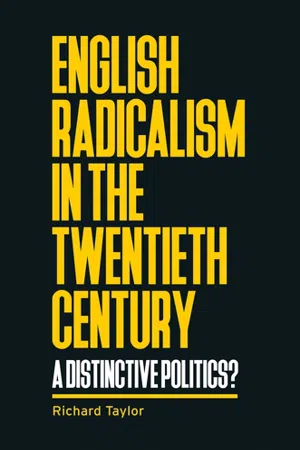
England has had a predominantly conservative political culture for some centuries. Yet there is a persistent, minority strand of radicalism that has challenged the practices, beliefs and structures of power of the established order. This book explores this 'radical tradition' as articulated in the twentieth century. The main currents of English radicalism range from liberal reformers, through socialist parliamentarians, to social movement activists in the peace, women's and labour movements. Despite their differing agendas, all have held their moral and political commitments to achieving a free, democratic, equal and just society in common. Moreover, all have believed, whatever their other differences, in the importance of extra-parliamentary social movements. What is it that has constituted this 'radical tradition'? Is it a coherent, distinctive and important political force in the twentieth century? And how do these ideas and practices relate to radical politics in England in the early twenty-first century?This book offers an analysis of the historical and ideological development of English radicalism from the English Civil War onwards. Richard Taylor examines how the problems of achieving radical change in England in the twentieth century were approached by the ten key figures from a range of ideological positions within the tradition: Bertrand Russell, Sylvia Pankhurst, Ellen Wilkinson, George Orwell, E.P. Thompson, Michael Foot, Joan Maynard, Stuart Hall, Tony Benn and Nicolas Walter.
- 288 pages
- English
- ePUB (mobile friendly)
- Available on iOS & Android
eBook - ePub
About this book
Information

1

The nature of English radicalism
The central aim of this book is to examine, in historical and political context, the nature and importance of English radicalism in the twentieth century. The analysis is undertaken primarily through the detailed study of ten key individuals, all of whom made significant contributions, in their different ways, to the development of English radicalism across the century.
As with most important social and political concepts ‘radicalism’ is hard to define precisely. This is in part because it draws on and overlaps with other ideological positions, in part because its context, and thus its impact, has varied over time, and in part because advocates and analysts have had sharply differing views on its proper nature. Here I seek to define ‘radicalism’, within the English radical tradition.
But why English rather than British (or even Western European) radicalism? There are illustrious precedents for such a focus (most notably E.P. Thompson),1 but the case nevertheless needs to be made and the interrelationships with other traditions and other politics need to be delineated.
And how important and relevant is the English radical tradition today? Few would contest the historical importance of this tradition. However, across the whole developed world, the Left, broadly defined, has been in decline since at least the late 1980s. Whilst it may be a matter of regret to those on the Left, it is clearly the case that the internationally pervasive ideology and practice of neo-liberalism appear more firmly embedded than ever, not least in the United Kingdom. So, why might English radicalism remain important politically as well as historically in the early twenty-first century?
Finally, there is the question of the selection of the ten figures chosen to represent English radicalism in the twentieth century: why were they chosen and others excluded; and how far do they embody the key aspects of the tradition?
Definitions
British society in general, and English society in particular, has been predominantly conservative (if not always Conservative), and it has been characterised by a remarkable degree of stability. Since at least the late seventeenth century, constitutional and political structures have evolved through reform, and, despite periods of turbulence, have remained broadly intact. Nevertheless, for centuries there have been movements, political parties and men and women from across the spectrum of radicalism who have opposed economic, political and cultural inequalities and injustices.
‘Radicalism’ has been a contested concept since the eighteenth century. Raymond Williams has traced its changing definitions through time. In the late eighteenth century, it was largely a term of abuse. By the end of the end of the nineteenth century, it had become ‘almost as respectable’ as liberalism and the distinction was made in political circles between ‘radicals’ and ‘socialists’. Radicalism was ‘often contrasted with “dogmatic” socialism or revolutionary programmes’. By the mid-twentieth century, ‘radicalism’ seemed ‘to offer a way of avoiding dogmatic and factional associations while reasserting the need for vigorous and fundamental change’.2
The often contradictory meanings to which Williams draws attention are reflected in the various studies of English radicalism.3 Maccoby, for instance, in his multi-volume study of The English Radical Tradition, traces the long evolution, as he sees it, from Whigs to radicals to liberals, from the mid-eighteenth to the mid-twentieth century.4 For Maccoby, by the 1920s the ‘old radicalism’ had largely dissolved as some of its adherents moved into ‘the anti-socialist camp’ and others joined the ‘new radicalism’ of collectivist Labour.
This view of radicals as relative moderates in contrast to ‘big state’ socialists finds its echoes in other writers5 and indeed in some left-of-centre political parties in continental Europe (notably the French radical party of the Fourth Republic). Such is not the perspective taken in this study. However, the emphasis upon the free individual, living in an open and free culture (and the corollary of an innate suspicion of the state), constitutes a key characteristic of the English radical tradition, especially in the twentieth century when the power of the state grew so significantly.
The a priori centrality of ‘the free individual’ in the English radical tradition merits further attention. George Watson has observed that ‘Liberty is the English ideology’;6 and Edward Vallance rightly emphasises that this was often articulated not as a series of specific policy commitments but rather as a mobilising myth: the radical tradition has recognised ‘the importance of recapturing lost freedoms, often located in an Anglo-Saxon Arcadia … and most of all, it saw itself as part of a tradition of people fighting for their liberties’.7
The main point of tension between English radicalism and the socialist tradition, both social democracy and, especially, orthodox Marxism, lies in the former’s giving absolute priority to freedom in all contexts, and the accompanying antipathy to the abrogation of power by the state and its agencies. For socialists, the dangers of an all-powerful state reside primarily in its capitalist nature: capturing and adapting the state for socialist purposes has been the objective. For the radical tradition, however, it is the power of the state per se that is the problem. The degree of emphasis given to this argument varies markedly within the English radical tradition, with many on the libertarian Left, notably anarchists such as Nicolas Walter (see Chapter 12), seeing the state as being the central problem, whilst others – for example, Russell (see Chapter 3), Wilkinson (see Chapter 5), and Foot (see Chapter 8) – saw civil and social freedoms being deliverable, at least in part, through a democratic, parliamentary socialist state.
There have been others, both on the liberal, social reform Left and on the libertarian Right,8 who have believed equally passionately in these individual and social freedoms. Whilst related to the radical tradition, they differ crucially on a number of levels. For the libertarian Right, the espousal of an unfettered capitalist market system – with all its inherent inequalities and its culture of individual greed and selfishness – is central to its ideology. And, on the liberal social reform Left, there is little if any acknowledgement of the class nature of the capitalist system and the consequent need for structural change.
All within the radical tradition have been agreed, however, that a range of freedoms for the great mass of the people had been denied consistently by the ruling orders across all historical periods in the modern era, including those in power in the modern capitalist state. Most, too, would agree with Orwell (Chapter 6) who, had ‘a deep feeling that liberty lay with the people, not with the state or some higher intellectual caste’.9
Why has this commitment to freedom been so central to the English radical tradition? I would argue that there are two related reasons: first, the ethical basis of English radicalism; and, secondly, the intellectual legacy of the Enlightenment. In his 1952 article ‘British Socialism Today’,10 R.H. Tawney articulated the ethical basis of English radicalism (for Tawney this is coterminous with Christian, ‘Sermon on the Mount’ morality). The movement for radical change in Britain has been ‘obstinately and unashamedly ethical’. At its base, he argues that it has been a ‘straightforward hatred of a system which stunts personality and corrupts human relations by permitting the use of man by man as an instrument of pecuniary gain’. Conscience is the final arbiter; and it is ‘the idolatry of money and success’ with which socialists have to grapple ‘in our hearts and minds’.11
Whilst many in the English radical tradition have been avowed secularists and atheists (or agnostics) – of those discussed in this study, Russell, Foot and Walter, for example – Christianity, especially Nonconformist Protestantism, was of central importance in the formation of English radicalism. For Tony Benn (Chapter 11), Dissenting, Protestant Christianity was at the very core of his ideology; but several of the others analysed here were also strongly influenced by their Christian, usually Nonconformist, upbringing and culture: including Michael Foot, E.P. Thompson and Joan Maynard.
‘Freedom’ is such a cardinal value for those espousing English radicalism not least because there is a strong emphasis upon the individual, as opposed to the focus upon the collective, the social class, as the point of reference for orthodox socialists. In this sense, the English radical tradition is philosophically and politically liberal and libertarian. However, this ‘radical individualism’ contrasts with the possessive individualism, characteristic of liberal capitalist ideology, and its accompanying credo of acquisitive self-interest as the motor of economic growth and social well-being.
The legacy of the Enlightenment was the other major intellectual basis for the radical tradition’s adherence to the primacy of ‘freedom’. Reason, and the employment of human intelligence to analyse and interpret the world, lay at the heart of the Enlightenment project. Free individuals, thinking and reasoning for themselves, untrammelled by religious or governmental authorities, constituted the essence of a new, optimistic vision of humanity and its potential. William Godwin, a pioneering idealist and one of the intellectual founders of anarchism, argued that ‘Man is perfectible, or in other words susceptible of perpetual improvement’.12 This positive perspective embodied ‘the belief in the goodness of man, the bright confidence in human reason, the distrust of governments, the distaste for established churches and authoritarian regimes’.13 ‘The sovereignty of the people’ as opposed to the state (personified before the French Revolution by the monarch) became a key tenet of Enlightenment thinking. The cultural and political import of this belief, in the context of post-revolutionary France, was very different from that operating in England. Nevertheless, the belief in the moral and philosophical priority to be given to the ‘common people’, and their role as the conscious bearers of progressive change, characterised the English radical tradition from the nineteenth century onwards.
All questions were open questions. Orthodoxies, particularly religious orthodoxies, were analysed through the lens of human reasoning. This relates to radical Nonconformism, often leading frequently to the sceptical, secular rationalism of men such as Godwin and David Hume. Any organisation or ideology proclaiming unquestioned authority was thus, at the very least, suspect. The overweening state was therefore just as much the enemy as the Roman Catholic Church; later, the collectivist approach of socialists, with their emphasis upon ‘the class’ rather than the individual, was regarded with similar suspicion, if not antipathy.
Nevertheless, the commitment to equality is just as central a value to the English radical tradition: but the emphasis has been upon individual social and political equality, rather than seeing systemic economic change as the key objective. The principal architect of revisionist social democracy in post-1945 Britain, Anthony Crosland, saw the primary objective for social and political progressives (in what he claimed was post-capitalist society) as achieving ‘equality of opportunity’.14 This contention was an important policy preoccupation for successive Labour leaders in the second half of the twentieth century. However, for English radicals this has been an inadequate formulation. Tawney, for example, was vehemently opposed to this revisionist position. ‘Nothing could be more remote from Socialist ideals than the competitive scramble of a society which pays lip-service to equality, but too often means by it merely equal opportunities of becoming unequal. Our aim should be the opposite. It should be to effect a complete divorce between differences of pecuniary income and differences in respect of health, security,...
Table of contents
- Cover
- Half Title
- Title Page
- Copyright
- Dedication
- Contents
- Preface
- 1 The nature of English radicalism
- 2 An overview of English radicalism
- 3 Bertrand Russell
- 4 Sylvia Pankhurst
- 5 Ellen Wilkinson
- 6 George Orwell
- 7 E.P. Thompson
- 8 Michael Foot
- 9 Joan Maynard
- 10 Stuart Hall
- 11 Tony Benn
- 12 Nicolas Walter
- 13 A distinctive politics?
- Select bibliography
- Index
Trusted by 375,005 students
Access to over 1.5 million titles for a fair monthly price.
Study more efficiently using our study tools.
Frequently asked questions
Yes, you can cancel anytime from the Subscription tab in your account settings on the Perlego website. Your subscription will stay active until the end of your current billing period. Learn how to cancel your subscription
No, books cannot be downloaded as external files, such as PDFs, for use outside of Perlego. However, you can download books within the Perlego app for offline reading on mobile or tablet. Learn how to download books offline
Perlego offers two plans: Essential and Complete
- Essential is ideal for learners and professionals who enjoy exploring a wide range of subjects. Access the Essential Library with 800,000+ trusted titles and best-sellers across business, personal growth, and the humanities. Includes unlimited reading time and Standard Read Aloud voice.
- Complete: Perfect for advanced learners and researchers needing full, unrestricted access. Unlock 1.5M+ books across hundreds of subjects, including academic and specialized titles. The Complete Plan also includes advanced features like Premium Read Aloud and Research Assistant.
We are an online textbook subscription service, where you can get access to an entire online library for less than the price of a single book per month. With over 1.5 million books across 990+ topics, we’ve got you covered! Learn about our mission
Look out for the read-aloud symbol on your next book to see if you can listen to it. The read-aloud tool reads text aloud for you, highlighting the text as it is being read. You can pause it, speed it up and slow it down. Learn more about Read Aloud
Yes! You can use the Perlego app on both iOS and Android devices to read anytime, anywhere — even offline. Perfect for commutes or when you’re on the go.
Please note we cannot support devices running on iOS 13 and Android 7 or earlier. Learn more about using the app
Please note we cannot support devices running on iOS 13 and Android 7 or earlier. Learn more about using the app
Yes, you can access English radicalism in the twentieth century by Richard Taylor in PDF and/or ePUB format, as well as other popular books in Historia & Historia británica. We have over 1.5 million books available in our catalogue for you to explore.