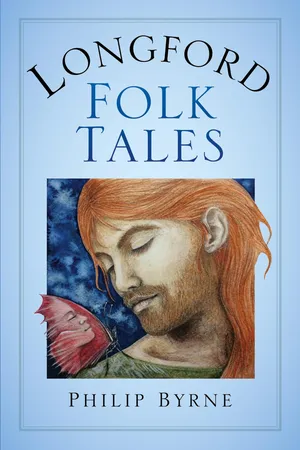
Longford Folk Tales is a treasure trove of wonderful stories of saints and deities, fairies and devils, kings and ghosts, shoemakers and other engaging characters. Read about The Blake Millions, butter stealing, the Wooing of Étaín, and 'The Walking Gallows', Hempenstall – all your favourite legends and many more.
This selection of tales and stories from every corner of the county of Longford reflects the wisdom of the countryside and its people. Legends, folk customs and local lore from earliest times up to the county's more recent past are expertly told by storyteller Philip Byrne.
Although Corn Hill, with a height of 280m, is the highest point of Co. Longford, it has the distinction of being the twelve hundredth highest mountain in Ireland. It is the third-lowest ‘county top’, with only Westmeath and Meath having lower high points.
Corn Hill is the modern popular name for the high point of Co. Longford. Despite its low summit, it was in the past possible to see nine counties from the top. Today, apart from a very unsightly television mast, the area is densely planted with Sitka spruce, which limit the view. Corn Hill is located between Drumlish and Ballinalee. The hill was also known as Cairn Hill or Sliabh Cairbré. In early mythological stories the hill is known as Sliabh Uillind.
St Patrick is very much associated with the hill. As is widely known, St Patrick travelled the length and breadth of Ireland, stopping at many places to preach the word of Christianity and to convert those he addressed. On his travels he came to the area of Corn Hill and stopped with a local chieftain. It was normal in such circumstances for the guest to be offered food and accommodation. Patrick was looking forward to a good meal as he was hungry from his travels. His meal was duly served. As soon as he tasted the meat, he realised that he had not been given lamb as he had been told but instead he was given dog meat.
The saint flew into the most terrible and unchristian-like rage because he realised that the meat he had been given was no accident but intended as an insult. It is dangerous to cross any saint, let alone St Patrick. According to the noted Irish scholar John O’Donovan, Patrick cursed all about him in no uncertain terms:
Accursed be Carbry’s barren mountains
On which this hound was drest for me
Accursed its heaths, its streams and fountains
As long as man and time shall be
Accursed its glens, may no kind showers
Descend upon them from the skies
May neither herbs, nor grass nor flowers
Be ever seen in them to rise
Accursed its people, now I strike them
With my red bolt and seal their doom
May all good men for e’er dislike them
May they sink in murkiest gloom.
There are two cairns on top of Corn Hill. Two piles of stones that are the distinctive feature of the hill. These are no ordinary piles of stones, they are stones that are steeped in folklore and legend. The Pattern Day or ‘climbing the hill’ used to take place on the first Sunday in June. When this tradition was at its strongest, hundreds of people from the parish of Killoe and surrounding parishes would make the ritual climb. The tradition was for each climber to carry with them a stone that they would place on one of the cairns. This would bring the bearer luck but if a stone were taken from the cairn the result would be bad luck for the culprit. Sadly, this long-standing tradition is no more.
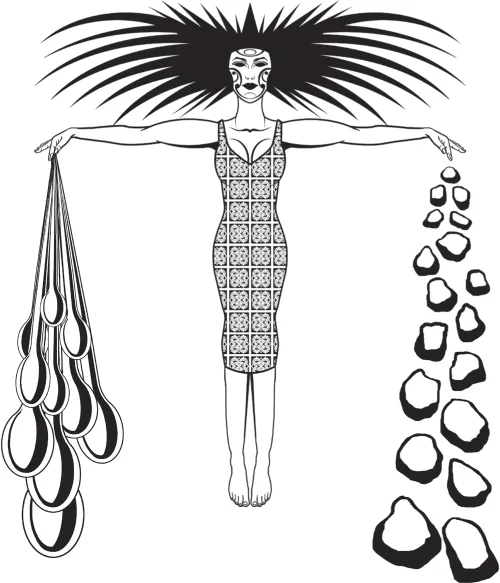
One of the cairns was originally formed by the infamous Calleach, or the divine hag, who was also the weather goddess. She ruled every winter from Samhainn (1 November) until Bealtaine (1 May). As a deity she was possessed of many supernatural qualities. On one occasion she flew through the lands of Taffia, which Corn Hill divides. As she flew over the hill, she dropped a pile of stones from her apron. They landed on top of the hill and formed one of the cairns.
The second cairn has a more intriguing story. It is said to be the burial mound of Furbaide Ferbend. The story of Furbaide Ferbend comes from the Ulster Cycle of Irish Mythology. One of the central figures in this story is Queen Medb, Queen of Connaught and main protagonist in the Táin Bó Cúailnge.
Eochaid Feidlig became High King. He ruled for twelve years and died peacefully at Tara. Eochaid had three sons and three daughters. The daughters were Eithne, Medb and Clothru.
Eochaid married Medb to Conchobar Mac Nessa, King of Ulster. It was a bad marriage that didn’t last very long. Eochaid then gave Conchobar another of his daughters, Eithne. They married and Eithne became pregnant. As Eithne’s pregnancy developed she was warned by her wise man that there was a plan to kill her. She left and travelled west towards Cruachan, where she planned to have her baby.
As Eithne was now married to the Ulster king, Medb hated her as well. In her hatred and her wish to have revenge on Conchobar she arranged to have Eithne killed. Near Abbeyshrule, as Eithne was crossing the river rapids at Tenelick, she was confronted by Medb and one of her men. Eithne was drowned and as she died her baby was cut from her womb with the sword of the killer. It was a baby boy. This boy was Furbaide. Ever after this deed the river was named after Eithne – the River Inny.
At the age of seventeen, Furbaide fought in Conchobar’s army at the Battle of Gáirech and later at the Battle of Ilgáirech, which came towards the end of the Táin Bó Cúailnge. It was said that he was so beautiful looking and fair that none of his enemies could bring themselves to wound him. Furbaide didn’t have any such qualms about his enemies and slaughtered at least three hundred men in his opponent’s army at the Battle of Ilgáirech.
As he matured his hatred of Queen Medb, his aunt, grew and festered. He knew he would have to avenge his mother who had died on the banks of the Inny. As she grew older, Medb often stayed on Inchcleraun an island in Lough Ree near Knockcroghery. It was Medb’s habit to bathe at a certain well close to the shore of Inchcleraun. Furbaide learned that this was her habit anytime she was on the island. He hatched a plan to kill Medb and avenge his mother.
He took a rope and measured the distance from the well where Medb would bathe to the shore of Lough Ree. He returned to his home with the measuring rope and marked out the exact distance from shore to well. Having done this, he placed a stake into the ground at what would approximately be head height. On top of the stake he placed an apple. Day after day while his friends enjoyed life in feasting and play, Furbaide practised hitting the apple on the stake with a missile hurled from his sling. At first his efforts were very frustrating. Shots were either too high or too low, too far left or too far right. As the days of practice continued his misses became less. With each shot he was getting nearer and nearer the target. Eventually, he became so good in firing at that exact distance at a target at that exact height that he had to replace the apple with every shot. Now all he needed was opportunity.
As it happened, there was a great assembly called between the men of Connaught from the west and the men of Ulster from the north. The assembly was to be held around Lough Ree. One morning, as the Ulster men sat eating their breakfast, there was commotion among some of the men. Medb had retained her good looks as she aged.
‘Look at the beautiful woman bathing on the island,’ said one. ‘Who is it?’
‘That’s Queen Medb of Connaught,’ was the reply.
Furbaide scrambled to get his sling. This was the opportunity for which he had been waiting. While he had the sling, he had no ammunition. If he went to get a missile, Medb might be gone and the window of opportunity closed. He had been eating his breakfast and was holding a large lump of hard cheese. With necessity being the mother of invention, he loaded the sling with the cheese.
As he ran towards the shoreline, he began to swing the sling. Faster and faster it spun until by the time he reached the water’s edge the sling and the cheese were just a speeding blur. He had just reached the water’s edge when Medb on the island stood up and looked at what was happening. At this point she was at the exact height and exact distance that Furbaide had practised hitting for so many hours. He flung the hard cheese at Medb and hit her square on the temple. She fell to the ground, having been instantly killed by the blow.
Medb’s body was recovered and she was taken to Knocknarea in Co. Sligo and there buried. They say she was buried in a standing position facing towards Ulster and her enemies. Lugaid came to avenge the death of Medb. He found Furbaide on the slopes of Sliab Ullenn (Corn Hill) and there killed him. The Dindshenchas says, ‘A stone for every man that the axe clove – so was the cairn built: the king’s son died in revenge for a woman: that is the origin of the Cairn.’
REFERENCES
‘The Metrical Dindshenchas’, Poem 10, ceLtucc.ie
‘Corn Hill Cairns’, visitinglongford.ie
‘Slibh Chairbe’, Teathbha: Journal of the Longford Historical Society, Vol. 1, p.1, 1969.
Celtic Literature Collective, www.maryjones.us/ctexts/medb.html
‘The Tragic Death of Medb’, www.headofdonnbo.wordpress.com/2016/04/19the-tragic-death-of-medb
‘Memories of Derrycassin Wood’, Derek Fanning, Ireland’s Own, p.64.
A Brief Guide to Celtic Myths and Legends, Martyn Whittock, Constable & Robinson Ltd, 2013.
The Yellow Book of Lecan, written at the end of the fourteenth century, details the ‘Wooing of Étaín’ or ‘Tochmarc Étaíne’. The story of Étaín and Midhir comes from the early Mythological Cycle with stories of the first people to come to Ireland in a series of invasions and is Co. Longford’s greatest legend. This version was given to me by Sorcha Hegarty, who runs an annual Bard Summer School, and Annette Corkery of Ardagh.
Midhir was a king of the Tuatha de Dannan, proud, handsome and regal. His wife was called Fuamnach and was his equal in every way. She too was tall and proud, and she was herself the daughter of a king. She was a good wife to Midhir, she looked after him, their children and foster children well.
One of these foster children was Aengus Óg, the God of Love. He was a lovely child and their favourite. Through the years they fell ever more in love with him – as you would expect with a love god. When he grew up, and moved away to his own home, they were bereft. Midhir especially missed him terribly.
One day, Midhir announced to Fuamnach that he was going to pay Aengus Óg a visit. On his way he met a very beautiful young lady. He stopped and asked her name. She told him it was Étaín and the moment she looked into his eyes, he fell in love with her and she with him. He asked her to come with him, and she readily agreed. The two of them then spent a year and a day at Aengus Óg’s house at Brúgh na Boinne, living as husband and wife. Then Midhir decided that it was time for him to go home, but he could not bear to be parted from Étaín and so he brought her with him.
The moment Fuamnach saw Étaín she realised what had happened and she was furious. In secret she performed a magic spell on Étaín, transforming her into a pool of water. Then she conjured up a magic wind that dried up the water. The steam from the water condensed into a butterfly and only then was Fuamnach satisfied. However, the butterfly then flew to Midhir and wafted him with its wings. Beaut...
Table of contents
Cover
Title
Copyright
Contents
Acknowledgements
Introduction
About Longford
1 Corn Hill, St Patrick, the Calleach and Furbaide Ferbend
2 The Wooing of Étaín
3 Longford and the Titanic
4 Hudden and Dudden and Donal O’Neill
5 The Stories of Nora ‘Oney’ Power
6 The Blake Millions
7 Phely Reilly and the Fairy Fort
8 Co. Longford Wake Games
9 Co. Longford Ghosts
10 He Stoops to Conquer
11 Butter Stealing
12 The Sleeping Beauty of the Lake and Other Tales of Lough Gowna
13 The Gate House on the Fairy Mound
14 Stolen Children
15 The Pot of Gold
16 Best Foot Forward
17 Hempenstall – ‘The Walking Gallows’
18 Whatever You Say, Say Nothing
19 Poems and Songs of ‘Leo’
20 The Stories of Mrs Hagan
21 The Corlea Trackway
22 Morgan Finn
23 The Sheriff’s Seizures
24 The Grave Digger
25 The Rejected Cub of the Fairies
26 Land War in Drumlish, 1881
27 The Maid of Moyne
28 Fourpence or the Blessing of God
29 Jack the Thief
30 The Cannon Chains and Gunner Magee
31 The King Congal of Granard
32 A Raking Pot of Tea
33 The Little Red Bull
34 Penny Wise and Pound Foolish
35 Some Longford Characters
Trusted by 375,005 students
Access to over 1.5 million titles for a fair monthly price.
Study more efficiently using our study tools.
Frequently asked questions
Yes, you can cancel anytime from the Subscription tab in your account settings on the Perlego website. Your subscription will stay active until the end of your current billing period. Learn how to cancel your subscription
No, books cannot be downloaded as external files, such as PDFs, for use outside of Perlego. However, you can download books within the Perlego app for offline reading on mobile or tablet. Learn how to download books offline
Perlego offers two plans: Essential and Complete
Essential is ideal for learners and professionals who enjoy exploring a wide range of subjects. Access the Essential Library with 800,000+ trusted titles and best-sellers across business, personal growth, and the humanities. Includes unlimited reading time and Standard Read Aloud voice.
Complete: Perfect for advanced learners and researchers needing full, unrestricted access. Unlock 1.5M+ books across hundreds of subjects, including academic and specialized titles. The Complete Plan also includes advanced features like Premium Read Aloud and Research Assistant.
Both plans are available with monthly, semester, or annual billing cycles.
We are an online textbook subscription service, where you can get access to an entire online library for less than the price of a single book per month. With over 1.5 million books across 990+ topics, we’ve got you covered! Learn about our mission
Look out for the read-aloud symbol on your next book to see if you can listen to it. The read-aloud tool reads text aloud for you, highlighting the text as it is being read. You can pause it, speed it up and slow it down. Learn more about Read Aloud
Yes! You can use the Perlego app on both iOS and Android devices to read anytime, anywhere — even offline. Perfect for commutes or when you’re on the go. Please note we cannot support devices running on iOS 13 and Android 7 or earlier. Learn more about using the app
Yes, you can access Longford Folk Tales by Philip Byrne in PDF and/or ePUB format, as well as other popular books in History & European History. We have over 1.5 million books available in our catalogue for you to explore.