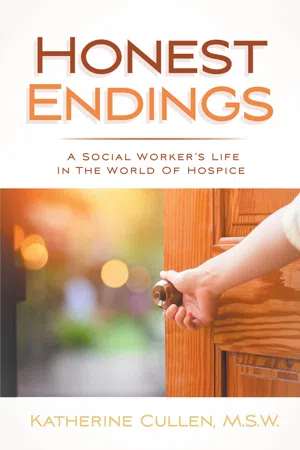
Meet Robbie, a forty-two-year-old with heart disease; Esther, a woman in her late fifties with metastatic breast cancer; and Matt and Janet, a very loving couple facing his extremely painful illness bravely together. All have one thing in common: they are dying. All the patients you will meet here are the dying patients of a caring, attentive hospice social worker, Katherine Cullen.This memoir is full of heartwarming stories of patients and their families. It is the story of one social worker navigating the ways of hospice work without much training or support. Learn about the hospice team and the stresses and pressures they face daily as patients come and go at an alarming rate.Watch a social worker's journey of life through death, maturing from a fear of dying to a sense of ease and comfort with the dying process. She faces her anxieties with courage, never shortchanging those who depend on her for strength, support, and emotional comfort. Katherine also shares about her conflict when her own parents health began to fail, and the irony involved in working at a hospice agency while her parents needed hospice care.This book is a simple, direct telling of a professional social worker's experience in a nonprofit hospice agency. It is a helpful read for professionals and the public alike, given its honest report of daily life in the field of hospice.
- 52 pages
- English
- ePUB (mobile friendly)
- Available on iOS & Android
eBook - ePub
About this book
Information
Chapter 3
All the Lonely People
Death by the numbers can be staggering.
I would be working with roughly fifteen to twenty-five hospice patients at any given time. About half of my caseload would die each month, invariably making room for more. That amounts to ten to fifteen deaths a month, maybe 125 a year. I did not go to all the funerals, perhaps a third of them. In three years, I met about three hundred people who would die well within the span of the same time period.
The official line at the hospice was that we did not “help people prepare for death,” that we instead “helped them live life until the end of it.” So untrue. It would have been cruel to not prepare someone for what was coming, as best we could.
After about eight months on the job, things became easier for me. I am not sure why. I suppose I got into the rhythm of working in the hospice environment and became somewhat hardened. I had been through a lot of death and dying by then, and so perhaps I had more confidence in my effectiveness. There is also this weird gallows humor that happens in hospices as a sort of coping mechanism—we would joke about a family that needed “slap therapy,” for example.
Whatever the reason, I stopped crying all the time.
By then, I had also built up a couple of relationships with other staff members and had some degree of comfort there, but we still did not talk much about our cases. We just sort of ignored it, though we did talk about the agency and how dysfunctional it was. That was good for a laugh.
None of this is to imply that the work ever really got easier. Sometimes it would be a case of “hurry up and wait,” and I got pretty good at that. If I was on call during the weekend, it was almost certain that I would get at least one call, so I might as well wait for it.
One morning at around 2:00 a.m., the phone rang—a rude awakening, even when you know it may be coming. The sister of one of my patients was very, very upset. Joan was going to die soon. The sister had thought she still had a couple of months to go, but things had taken a sudden downturn. She had finally grasped the true reality of her sister’s impending death.
The woman on the phone was on the verge of hysterics. I remember asking her some specific questions, partly as a way to calm her down in the dark as I pulled on some semiprofessional clothes, trying not to disturb Ed or the sleeping pets. Putting the dogs out at 2:15 a.m. was the last thing I needed at this point. Time was of the essence.
The agency’s rule was, I could not talk on the phone while I was driving. The problem was, Joan’s death was very likely imminent, and she was a good twenty to twenty-five minutes away. At the same time, the sister seemed to need immediate support. It was a balancing act.
The sister did not know what to do and was scared to be alone. It is very hard to be the only one there when a loved one is dying. You do not want to leave them, even for a second. She sounded a little better by the time we hung up in the car. I quickly turned the key.
As I was frantically driving a late-night commute to a nearby town, I prayed Joan would survive until I arrived. It was so tempting to speed, but safely obeying speed limits was an agency rule. There is not much traffic at that hour, luckily.
When I finally rang the doorbell, a thirtysomething woman with messy short blond hair, a red nose, and sad, droopy eyes met me at the door. She nearly collapsed into my arms, but just as quickly stepped back, wiped her face with the back of her hand, and mumbled, “Sorry.”
She grabbed my arm and pulled me into the living room, where a hospital bed was set up.
Thankfully, Joan was still alive, sleeping quietly, breathing slowly and unevenly.
I tried to calm down her sister and walk her through what was going on, explaining what the symptoms meant and what she could do in these final moments. I suggested that she sit and hold Joan’s hand, talk to her, and try to keep her sister calm. I told her that even if a person is unresponsive, we still believe that they can hear us.
It was not long before Joan died quietly and peacefully as her sister lovingly held her hand. Another “good” death.
This was the kind of scene I would become accustomed to. A lot of people die at night. Perhaps it is easier to relax and at a time when we are used to falling asleep.
Some people even seemed to decide when to die. They simply let go. Many would die all by themselves. A family would hold vigil for a long period of time and then step out of the room for five minutes to have a conversation or go to the bathroom. When they got back, their loved one was gone. There were people who did not express a lot of emotion to their families during their moments of lucidity. Sometimes they would not even say “I love you” or “Goodbye.”
One question came up a lot in my conversations with patients: “Whom are you having a hard time saying goodbye to?”, I would ask. Sometimes the patients would want me to talk to their friends or family members or would at least want me to be there when they talked to them.
Other patients were mainly concerned with how their family was handling the situation. One was Monica, a twenty-seven-year-old nursing student with an inoperable brain tumor. She had short blond hair, large round blue eyes, and a slight build. She had fallen down and had a seizure outside her classroom at Stanford Medical School one day. There had been no history of medical problems.
Monica was about my daughter’s age. Most of the young people I saw died of brain cancer. I did not do much life review with Monica or the other younger patients. Sadly, there was not a lot of life to review. Those cases took more of a toll on me than the older folks who had lived full lives. Fortunately, I never had children as patients, though I had colleagues who did.
Monica’s family had brought her to a hospice wing in one of the local nursing homes. She had been given one to two weeks to live.
“Well, I guess this is it,” she said when I first visited her.
In general, people were either pretty calm and settled about death, or they were pretty anxious and unfinished about it. This young woman was relatively accepting of her situation, lying on her bed, surrounded in this facility by people old enough to be her great-grandparents.
“This isn’t what I wanted,” she said with a sigh. “This isn’t how I thought it would be, but here I am, and I want to help my family get through this.”
Seeing her family in such emotional pain was very difficult for this young woman. She wanted me to help them more than help her. She was really brave. All you could do is just be with the family. There is not a lot you can say—and sometimes that is what you say.
This particular family did not want a lot of help. They wanted to be there for one another but did not really want assistance from an outsider, which I can certainly understand. The mother’s tearstained face told the story of practically no sleep and countless hours at the computer and on the telephone to hospitals and specialists across the country looking for a miracle cure.
We did have one meeting with the whole family and the doctor, who went over what to expect in the final days and hours so they could “prepare,” as much as they could. It was really tough.
I went to Monica’s funeral and burial. Her mother collapsed as her daughter’s body was lowered.
I ran into her a few years later and gently asked how she was doing.
“Thank you so much for asking. Well, I don’t cry every day anymore,” she said.
Another patient who had brain cancer, or glioblastoma, was Gene, thirty-eight. He was not a very pleasant man, especially to his wife, Cora. Gene ordered her around their small house, which was pretty messy most of the time. Cora had one bedroom devoted to sacks of clothes she would pick up at garage sales…a bit of a hoarder. As so often is the case with this behavior, the root cause was to be found i...
Table of contents
- Living with Death
- Welcome Aboard
- All the Lonely People
- Final Exit
- Reflections
Trusted by 375,005 students
Access to over 1.5 million titles for a fair monthly price.
Study more efficiently using our study tools.
Frequently asked questions
Yes, you can cancel anytime from the Subscription tab in your account settings on the Perlego website. Your subscription will stay active until the end of your current billing period. Learn how to cancel your subscription
No, books cannot be downloaded as external files, such as PDFs, for use outside of Perlego. However, you can download books within the Perlego app for offline reading on mobile or tablet. Learn how to download books offline
We are an online textbook subscription service, where you can get access to an entire online library for less than the price of a single book per month. With over 1.5 million books across 990+ topics, we’ve got you covered! Learn about our mission
Look out for the read-aloud symbol on your next book to see if you can listen to it. The read-aloud tool reads text aloud for you, highlighting the text as it is being read. You can pause it, speed it up and slow it down. Learn more about Read Aloud
Yes! You can use the Perlego app on both iOS and Android devices to read anytime, anywhere — even offline. Perfect for commutes or when you’re on the go.
Please note we cannot support devices running on iOS 13 and Android 7 or earlier. Learn more about using the app
Please note we cannot support devices running on iOS 13 and Android 7 or earlier. Learn more about using the app
Yes, you can access Honest Endings by Katherine Cullen, M.S.W. in PDF and/or ePUB format, as well as other popular books in Social Sciences & Sociology. We have over 1.5 million books available in our catalogue for you to explore.