- 102 pages
- English
- ePUB (mobile friendly)
- Available on iOS & Android
eBook - ePub
Perspectives in a Pandemic
About this book
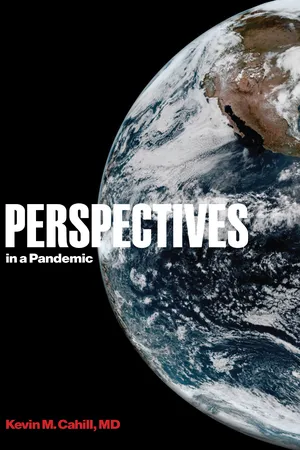
Perspectives in a Pandemic is a series of enlightening essays written by Kevin M. Cahill, M.D., providing a unique insight into the early phase of the COVID-19 pandemic. Dr. Cahill draws on his extensive experiences in earlier epidemics, natural disasters, and armed conflicts to offer lessons, wisdom, guidance, and support to frontline workers. While he wrote the essays as weekly reflections in the early months of the pandemic for the thousands of humanitarian-relief workers he has trained around the world, this book is a must-read for anyone seeking to understand and make some sense of the complexities and chaos inevitable in a pandemic.
Trusted by 375,005 students
Access to over 1 million titles for a fair monthly price.
Study more efficiently using our study tools.
Information
Edition
1Subtopic
International RelationsThe Other Prong
After thirty years dealing with humanitarian crises following natural disasters and conflict, I began in the early 1990s to establish formal academic programs so that our evolving knowledge of this complex discipline might be fashioned into curricula that would help train a new generation, establish best standards of good practice, and be able to provide degrees and diplomas to our candidates. That was one part of a two prong effort, and it succeeded beyond our best expectations; as noted earlier in these ‘Perspectives’ we now have 3,000 graduates from 140 nations, a cadre of humanitarian leaders working all around the world, and now training their own students at the local and regional level. The other prong was to publish books and Occasional Papers that could be available as a consistent source of information. There are now seventeen books and a dozen shorter papers in this International Humanitarian Affairs (IHA) Book Series; they include:
History and Hope: The International Humanitarian Reader is a compendium drawn from some of the best chapters on various aspects of humanitarian assistance that Fordham University Press has published since 2001. These books were composed with colleagues who also believed it was possible to distill our experiences from the harsh settings of crises into practical, field oriented, courses of university level quality.
The IHA Book Series began with Preventive Diplomacy: Stopping Wars Before They Start, a text that argued for recognition of the centrality of humanitarian action in foreign policy; they were usually peripheral afterthoughts overshadowed by other national interests. The contributors utilized the methodology of public health and the semantics of medicine in addressing the softer discipline of diplomacy. The second volume, Tradition, Values and Humanitarian Action, was also a philosophic book assessing what influences determine how both individuals and societies develop healthy—or destructive—policies and practices in international humanitarian assistance. Both those volumes provided solid foundations for the technical texts that followed.
The next two titles, Emergency Relief Operations and Basics of Humanitarian Action are self-explanatory. These books were primers that were needed as our academic programs developed. The chapters reflect the strong conviction that our texts (and teachers) should be deeply grounded in the difficult realities that are standard in complex emergencies. The next volume is the most personal. To Bear Witness: A Journey of Healing and Solidarity is a compilation of personal editorial pieces, unpublished lectures, short essays and introductions to earlier books.
The following three books provided more detailed information on specific problems. Human Security for All: A Tribute to Sergio Vieira de Mello was to honor the memory of a good friend who had paid the ultimate price for attempting to help those in humanitarian distress. Technology and Humanitarian Action evolved from my experience as Chief Medical Advisor for Counterterrorism in the New York City Police Department. Scientists associated with the U.S. Defense Advanced Research Policy Agency (DARPA) proposed imaginative technological solutions to many of the problems we faced in dealing with serious biological, chemical, and radiologic threats. As contact with these men and women deepened, it became very obvious how the intellectual and financial resources devoted to defense concerns dwarfed the attention given to the overwhelming, often intractable, problems that are the routine concerns for humanitarian workers. Tropical Medicine: A Clinical Text reflects my own professional background, as well as the cruel fact that in war zones, and after disasters, more people die of the treatable—and usually preventable—diseases that are the subject of this textbook. The eighth edition is a “Jubilee” version reflecting its use in medical education for over fifty years.
The next title, The Pulse of Humanitarian Assistance, also derives from my medical training. Taking the pulse—a basic diagnostic tool in medicine—is an ancient and trusted clinical exercise. So, too, one can measure the pulse of humanitarian action, and offer prognoses—predicting a way forward. If one is to address human suffering, and the confusion that characterizes complex humanitarian crises, then the etiologic significance of poverty, ignorance, corruption, as well as incompetence, and the all too often evil effects of religion and politics, are as valid areas to consider as the life cycles of microbes or the rhythm of the heartbeat.
Even in Chaos: Education in Times of Emergency and More with Less: Disasters in an Era of Diminishing Resources were books developed during my time as Chief Advisor for Humanitarian and Public Health Issues for three Presidents of the United Nations General Assembly (PGA). The PGA is the most senior position of the United Nations, and reflects the interests of all 193 Member States.
The Open Door: Art and Foreign Policy at the Royal College of Surgeons in Ireland (RCSI) is a collection of Distinguished Lectures delivered in a Department I directed in Dublin. This annual event welcomed a Secretary General of the United Nations, a Prime Minister, four Foreign Ministers, two Nobel Laureates (in Literature and Peace), world famous actress, a renowned artist, and two physicians-philosophers to enrich the College, and also allowed the Lecturers to share in some of the ancient traditions of medicine.
An Unfinished Tapestry reviews a six year period during which I managed a large public health system in the United States of America with 80,000 employees and an annual budget of 7 billion dollars; it compares domestic programs during a fiscal crisis with the challenges of overseas disaster relief work.
A Dream for Dublin, tells the arduous—but usually joyous—creation of a Department of International Health and Tropical Medicine at the RCSI. During a 36 year tenure as Professor and Chairman, I taught over 4,000 medical students from Ireland, Europe, and many countries in Africa and Asia.
Milestones in Humanitarian Action documents the development of the Institute of Humanitarian Assistance (IIHA) at Fordham University in New York. During the last quarter century, the IIHA has offered multiple courses, including the IDHA, Mental Health in War Zones, and other specialized topics, as well as a Master’s Degree and an undergraduate Major in this discipline (one of only four in the world). The last chapter is entitled “Preventive Diplomacy” and provides a direct link to the first book in this Series.
Labyrinths is a personal reflection that explores the influences of my childhood, education and early work in overseas crises and refugee camps.
The full Table of Contents of each book is available at www.fordham.edu/iiha. Seven of the texts are available in French, and others in Spanish, Italian, Portuguese, Arabic, and Japanese translations. Bernard Kouchner, the co-founder of Medicines Sans Frontieres and, later, Foreign Minister of France, wrote Forewords for several of the books. It is important to note that the contributors include the leading authorities in this field from the United Nations, national and non-governmental organizations in this field representing Doctors Without Borders (MSF), the ICRC, IFRC, International Rescue Committee, Catholic Relief Services, World Vision, Amnesty International, Jesuit Refugee Services, Save the Children, Care, Concern, USAID, Military experts from the U.S., U.K., Canada, Australia, and Pakistan. The United Nations contributors include two Secretary Generals as well as the Directors of the High Commission for Refugees, UNWRA, DHA, OCHA, UNDP, UNICEF, DPKO, et. al. All royalties from this International Humanitarian Affairs Book Series go toward the training of humanitarian workers.
I concluded several books with a poem; this is the first stanza from one by Sir Francis Drake in the 16th Century and should encourage those of us privileged to play a role in international humanitarian assistan...
Table of contents
- Cover
- Title Page
- Copyright
- Dedication
- Table of Contents
- Introduction
- Somalia
- Nicaragua
- South Sudan
- Foundations
- An Easter Offering
- Family
- Training from Reality
- The Other Prong
- Breaking Barriers
- Art and Artifacts
- The Drain Works
- An Unexpected Help
- Focus on the Individual
- About the CIHC
- Support the CIHC
- About the Refuge Press
Frequently asked questions
Yes, you can cancel anytime from the Subscription tab in your account settings on the Perlego website. Your subscription will stay active until the end of your current billing period. Learn how to cancel your subscription
No, books cannot be downloaded as external files, such as PDFs, for use outside of Perlego. However, you can download books within the Perlego app for offline reading on mobile or tablet. Learn how to download books offline
Perlego offers two plans: Essential and Complete
- Essential is ideal for learners and professionals who enjoy exploring a wide range of subjects. Access the Essential Library with 800,000+ trusted titles and best-sellers across business, personal growth, and the humanities. Includes unlimited reading time and Standard Read Aloud voice.
- Complete: Perfect for advanced learners and researchers needing full, unrestricted access. Unlock 1.4M+ books across hundreds of subjects, including academic and specialized titles. The Complete Plan also includes advanced features like Premium Read Aloud and Research Assistant.
We are an online textbook subscription service, where you can get access to an entire online library for less than the price of a single book per month. With over 1 million books across 990+ topics, we’ve got you covered! Learn about our mission
Look out for the read-aloud symbol on your next book to see if you can listen to it. The read-aloud tool reads text aloud for you, highlighting the text as it is being read. You can pause it, speed it up and slow it down. Learn more about Read Aloud
Yes! You can use the Perlego app on both iOS and Android devices to read anytime, anywhere — even offline. Perfect for commutes or when you’re on the go.
Please note we cannot support devices running on iOS 13 and Android 7 or earlier. Learn more about using the app
Please note we cannot support devices running on iOS 13 and Android 7 or earlier. Learn more about using the app
Yes, you can access Perspectives in a Pandemic by Kevin M. Cahill in PDF and/or ePUB format, as well as other popular books in Politics & International Relations & International Relations. We have over one million books available in our catalogue for you to explore.