- 118 pages
- English
- ePUB (mobile friendly)
- Available on iOS & Android
eBook - ePub
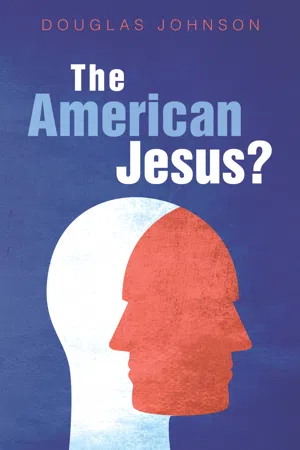
The American Jesus?
About this book
Is being a good American the same thing as being a good Christian? Are they the same thing? Are they opposed? Or perhaps they overlap in important ways.
The "Christ and Culture" question is not new. It showed itself in the reaction of many Jews to Jesus. The early Christians had to find some way to relate to their Greek and Roman societies, with questionable results for their faith and their cultures. This problem has haunted Christians throughout history, and still is with us today.
This book looks at much of the history of the church and the various answers that have been given to the issue. It does not attempt to arrive at a definitive answer to these questions but invites the reader to come to their own conclusions.
Information
Topic
Theology & ReligionSubtopic
Christian Theology1
Faith (1)
Abraham believed God, and it was reckoned to him as righteousness.
—Gen 15:6; Rom 4:3
Trust in the Lord with all your heart.
—Prov 3:5
The Biblical Background and Christianity
Any attempt to understand what Christianity is all about must clearly begin with a look at what faith means in the Scriptures. After all, Christianity is often rightly referred to as the Christian faith. We will also follow some of the historical twists and turns of Christian history and notice how that faith and various cultures sometimes collide.
It is clear that the Old Testament prophets were continually calling on the leaders and people to trust in the Lord, rather than in their own powers and cleverness, or in kings. In the New Testament, faith clearly takes central place. The Greek term pistis, or “faith,” is used over 270 times. Pisteuo, or “to be persuaded,” occurs at least 220 times. Sometimes the term simply refers to belief that something is true. But far more often it is a conviction or trust by which a person is impelled to action by an inner principle. It is used especially of a faith by which a person trusts Jesus, i.e., a confidence in him combined with obedience to him and/or faith in the Father; the giving up of oneself to him.
This latter usage is basic to the New Testament and is found virtually everywhere. The centurion is told to go. His servant was healed according to the centurion’s faith (Matt 8:13).
Jesus said the people did not believe in him because they did not believe in the one who sent him (John 5:38). Of course, we cannot omit the famous faith passage in the eleventh chapter of Hebrews. “By faith our ancestors received approval . . . By faith Abel offered a more acceptable sacrifice . . . By faith Enoch was taken so he did not see death,” and the author goes on through the whole Old testament, leading up to Jesus (Hebrews 11).
But as we have seen, it is Paul who was the great champion of faith in the New Testament. It was faith, not human effort, that was central to our relation to God: “salvation through faith in Jesus Christ” (2 Tim 3:13); “yet we know that a person is justified not by works of the law but through faith in Jesus Christ” (Gal 2:16). And again, “for Christ is the end of the law so that there may be righteousness for everyone who believes” (Rom 10:4).
It is important to notice at this point that Paul never proclaims that no law is to be observed by the believer. For him it is not a matter of either trust or obedience to the law. Rather, it is a matter of both/and. Trust is the basis of obedience, not a substitute for it.
The Early Church
As we have seen, Paul’s insistence that God’s grace is given through faith allowed him to break free of his Jewish cocoon and present a message that transcended a narrow Jewish worldview. As a result of his work and that of others, the early church was able to make its breakout into the wider, Greco-Roman world, offering God’s grace to all who believed, Gentiles as well as pious Jews. Yet this also brought with it, not only new opportunities, but also new threats. 9
At this time, the early church was being subjected to attack from both Roman political opposition and Greek intellectual criticism, even ridicule. First, the political opposition: That Rome was open to new religious ideas and sects is obvious if one only looks at the Pantheon, where gods from all over the empire were represented. But these same Romans were also particularly afraid of new religions, which could serve as masks for subversive groups. Christianity was new! How could Christians defend themselves? They could attempt to say that they were authentic Judaism, but during this period these very Jews were in rebellion against Rome.
But the issue was even deeper than fear of subversion. Rome could keep order by allowing all of these religions to exist together at the same time. So, there was relativism there for the sake of political order. But this was really a kind of absolutized relativism. If any group, such as the Christians, insisted that their beliefs were true, and simply that, then Roman “tolerance” would come down upon them in the name of tolerance, a reaction not entirely unknown in our own culture.
In the face of persecution, the Christians might simply insist that they were good Romans, never wanting to rebel against the powers that be. A host of Christian thinkers, known as the apologists, tried to defend their new faith in just such a way against Roman traditionalism. Christians were accused of being unpatriotic. The response: we are good citizens, but we do have a higher loyalty, to God. Another accusation: they were immoral; since non-believers were not allowed to be present at their Eucharist, something untoward must be going on. They answered that they were the most moral of Romans, since they knew that the eye of God was upon them.
One of the main accusations against them was that they were stupid! After all, Rome had inherited the great thoughts and thinkers of the Greeks. Christians had no such background about which they could boast. Of course, the stupidity charge is an accusation that has been brought against believers for centuries, including today. How could they respond? One defender, Justin, writing in the middle of the second century, attempted to mount just such a defense.
Justin did not ridicule Greek thinking. Far from it! In fact, he insisted that one of the schools of philosophy of the day was true. This was Stoicism, one of the schools that the Romans had taken over from the Greeks.
The Stoics believed in a god. Not the god who created the world, but the god who was the world! For them, god is what is! Stoicism had some popularity in the empire at that time and was even espoused by some emperors. Stoics not only believed that god is the same as the universe, but that he is rational, so the universe is rational. Their term for this rational organization of the world, the mind of god, was Logos, or “Word.” Our words are the expression of our inner logic; so also, the rational organization of the universe is god’s word.
All great thinkers, such as Socrates, the Stoics said, have had some of this word within them. But the Word in its fullness has only come, said Justin, in Jesus, whom the Gospel of John tells us was “the Word made flesh dwelling among us, full of grace and truth.” Thus, Justin tried to unite the message of Christianity with some of the best of classical thinking. His ideas were not accepted by that same classical world. In fact, he was executed for his faith. His full title is Justin Martyr. The culture of his day was not ready to hear his message.
In fact, for the first two centuries, Christians were often martyred for their faith. Sometimes persecutions were general, throughout the empire, instigated by one emperor or another. But sometimes they were simply the result of mob violence. Yet Christians never had secure footing in their new cultural world.
While the earliest Christians found themselves at odds with their own culture, the Jewish, now they were also rejected and persecuted by their new broader culture, the Greco-Roman.
Yet during the same period the empire itself was also suffering hard times. There was little if any stability at the top. One emperor after another arose from the military ranks and was quickly overthrown by another. In one sixty-nine-year period, from AD 235 to 284, there were twenty-six emperors, the so-called barracks emperors. Something had to be done! Diocletian, the last of them, decided to reorganize the empire and give it stability. He appointed three other emperors: two would be for the east and two for the west. In each part, one would be the emperor and the other would be his second, ready to take over if the leader was gone, thus ensuring stability. As part of his revitalization plan, he also persecuted Christians.
It seemed to be a good plan, but it did not work. Very soon many were fighting each other for the purple, and still others joined in. By the year 325 four generals were fighting: two in the west and two in the east. The western combatants were Maxentius at Rome, a persecutor, and Constantine, who did not persecute Christians, and was to some extent favorably disposed to the faith.
As Constantine related it, on the eve of the battle between their two forces, he saw in the sky the Greek letters chi and rho, the first two letters of “Christ.” Around them were the words “in this sign conquer.” He had his soldiers put these letters on their shields. In the ensuing battle Constantine won! Unde...
Table of contents
- Title Page
- Preface
- Introduction
- Chapter 1: Faith (1)
- Chapter 2: Faith (2)
- Chapter 3: Hope
- Chapter 4: Love
- Bibliography
Trusted by 375,005 students
Access to over 1.5 million titles for a fair monthly price.
Study more efficiently using our study tools.
Frequently asked questions
Yes, you can cancel anytime from the Subscription tab in your account settings on the Perlego website. Your subscription will stay active until the end of your current billing period. Learn how to cancel your subscription
No, books cannot be downloaded as external files, such as PDFs, for use outside of Perlego. However, you can download books within the Perlego app for offline reading on mobile or tablet. Learn how to download books offline
Perlego offers two plans: Essential and Complete
- Essential is ideal for learners and professionals who enjoy exploring a wide range of subjects. Access the Essential Library with 800,000+ trusted titles and best-sellers across business, personal growth, and the humanities. Includes unlimited reading time and Standard Read Aloud voice.
- Complete: Perfect for advanced learners and researchers needing full, unrestricted access. Unlock 1.5M+ books across hundreds of subjects, including academic and specialized titles. The Complete Plan also includes advanced features like Premium Read Aloud and Research Assistant.
We are an online textbook subscription service, where you can get access to an entire online library for less than the price of a single book per month. With over 1.5 million books across 990+ topics, we’ve got you covered! Learn about our mission
Look out for the read-aloud symbol on your next book to see if you can listen to it. The read-aloud tool reads text aloud for you, highlighting the text as it is being read. You can pause it, speed it up and slow it down. Learn more about Read Aloud
Yes! You can use the Perlego app on both iOS and Android devices to read anytime, anywhere — even offline. Perfect for commutes or when you’re on the go.
Please note we cannot support devices running on iOS 13 and Android 7 or earlier. Learn more about using the app
Please note we cannot support devices running on iOS 13 and Android 7 or earlier. Learn more about using the app
Yes, you can access The American Jesus? by Douglas Johnson in PDF and/or ePUB format, as well as other popular books in Theology & Religion & Christian Theology. We have over 1.5 million books available in our catalogue for you to explore.