- 206 pages
- English
- ePUB (mobile friendly)
- Available on iOS & Android
eBook - ePub
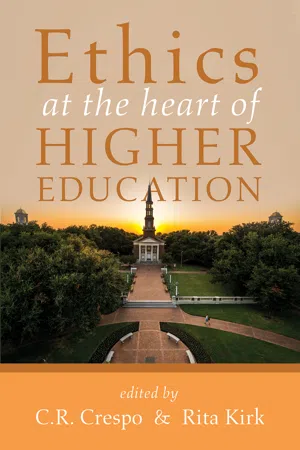
Ethics at the Heart of Higher Education
About this book
Today's college students have more knowledge available to them than can be absorbed; mastery of a subject area creates siloes where nearly every course is tailored to comprehending subject matter that may be outdated before they graduate. But learning is more than subject-matter expertise. Our fast-paced environment requires instantaneous reactions to complex questions. Our instant-messaging age champions quick response over reflection or thought--even the president governs by Twitter. Yet the ethical dilemmas are no less complex than the subject matter; cyber security, prison reform, labor rights, abortion, artificial intelligence, or gun laws are common table topics over lunch. Struggling through that complexity is central to understanding its implications for our culture. This book brings together some of the leading ethicists in the country to consider the rightful place of ethics in the university today. The authors make the case that higher education has a special duty to empower students to cultivate their character, ethically assess situations, and prepare them for an increasingly complex world.
With contributions from:
Mary Camp
Alexander Cole
Charles E. Curran
Robert J. Howell
D. Stephen Long
Robin Lovin
Richard O. Mason
William F. May
Thomas Wm. Mayo
John Sadler
Information
Topic
Theology & ReligionSubtopic
Christian Theology1
Can Ethics Be Taught? Connecting the Classroom to Everyday Life
Can we, should we, teach ethics in the modern university? Teaching ethics differs from teaching other disciplines. Few students arrive at the university aware of Organic Chemistry and the importance of Grignard reactions. They most likely have not studied the causes, major dates, or key persons in the French Revolution. The means for teaching and evaluating students in these subjects can be relatively straightforward. Either one has success in the laboratory forming carbon-carbon bonds or one does not. One can give the dates for Robespierre’s life and describe his role in the revolution or one cannot. But what about ethics? Our assumptions about teaching ethics cannot be the same as they are for teaching Organic Chemistry or French History. On the one hand, we assume students already have some sense of ethics before they arrive, which is why we hold them accountable for their behavior from their first day on campus. No one can avoid being disciplined for a violation of an honor code by protesting, “But I have not yet had my ethics course!” We would not hold a student accountable for her ignorance of Grignard reactions or French history prior to receiving instruction in the field, but we do hold students accountable for their actions with or without a course in ethics. On the other hand, we also assume that students should reflect on ethics across the curriculum, and that assumes that ethics needs to and can be taught. How do we make sense of both these assumptions? (1) Students arrive capable of being held accountable for ethical behavior. (2) Students arrive in need of an education in ethics.
A cursory reading of these assumptions might find them to be contradictory. If students can be held accountable for ethical behavior without an ethics course, then why teach ethics? If students need an education in ethics, then why hold them accountable for ethical failure? This essay explores these two assumptions, noting why they are not contradictory, and why the teaching of ethics should depend and build on the ordinary formation with which students arrive on campus. Teaching ethics in the university will be most successful when it connects with students’ previous histories of doing good and avoiding evil in their everyday life, connects that to the university’s moral history, and points toward the ordinary events that will constitute their future endeavors. It is in these histories that teaching ethics makes best sense.
If the two assumptions of my opening paragraph are granted—first, we assume students arrive at the university with some understanding of ethical behavior so that we can hold them accountable for their actions even if they never had a course in ethics; second, we assume students should be taught ethics in their curriculum, including courses in ethics across the curriculum—then two possible objections arise based on the possible contradiction present in the assumptions. We could argue that students do not arrive at the university with a sufficient understanding of proper ethical behavior such that we should hold them accountable for their actions. This argument, however, would make the life of the university nearly impossible. Even if we cannot give convincing theoretical reasons why we hold the first assumption, living together in a complex space like the university requires that practically we assume students arrive with at least a tacit awareness of doing good and avoiding evil. We do not need to assume they all share the same ethical convictions, or that every student has the same level of ethical awareness, but the practice of everyday, university life assumes students (along with everyone else associated with the university) have some tacit ethical awareness.
Universities are composed of adults who have already been formed into ways of seeing the world and acting within it from a diversity of social forms of life. They are also composed of persons who should reflect on what virtuous human action is, for as Socrates said, “the unexamined life is a life not worth living.” If the two assumptions above are conceded, then the task of teaching ethics must address these two questions: (1) from whence does ethics come? and (2) to where should ethics go? The first question assists us with the first assumption that students and others arrive at the university with a tacit awareness of proper ethical behavior. The second question assists us with the second assumption that students (and others) benefit from examining and reflecting upon that tacit awareness to bring it to a fuller one that can assist them in living well. They can do so by confronting the question of what is a good human life? But as most people already know, and as we shall see, answers to this question are so contested that the question readily gets neglected or abandoned in the modern university for fear that the answers will produce too much conflict.
From whence does ethics come?
Ethics never begins in a vacuum. Ethics cannot be taught like a science experiment that seeks to remove the contingencies of everyday existence and create ideal conditions. Human action is too complex for such a possibility. Plato famously argued that to have a just city we would need drastic actions. We find ourselves already in the middle of preferences and injustices that prohibit the necessary harmony for justice to prevail. Plato proposed that to acquire justice we would need to start anew by exiling or killing everyone over the age of ten. Whether Plato was being ironic or conveying how difficult it is to bring about justice in a city has been debated and never fully answered, but he found the contingencies of human existence thwarting ethical pursuits. Unfortunately, some political leaders have attempted his experiment, trying to destroy everything that stands in the way of ideal conditions. Teaching ethics in the university can fall into the trap of assuming the university is an ideal condition in which students can now slough off everything that prevents them from adopting a putative ideal ethical theory. This assumption rejects the first assumption above that students arrive at the university with some measure of ethical formation, a formation that can be built upon but does not need to be destroyed. From whence does this ethical formation come?
It arises from diverse sources—family, friendships, attention to nature, participation in culture through a diversity of means such as novels, television, education, oral stories, worship, and everyday practices like athletics, music, theatre. These means are mediated through neighborhoods, local schools, urban, suburban or rural living, ethnic and racial identities, citizenship in nation-states, participation in civil society or in corporations and the market. Ethical formation takes place in religious institutions, churches, synagogues, mosques. Students who enter an ethics class already have a complex formation derived from these and other sources. Of course, student’s formations from these sources differ widely. Perhaps this complexity is why ethicists are tempted to reduce students to either autonomous, rational or self-interested individuals. It is easier and gives them something in common, but it is also similar to Plato’s odd counsel in that it takes the history of the student as something to overcome rather than build upon. It treats an ethics course as if it is a retraining camp in which everything the student has been taught to this point must be destroyed for the sake of making him or her anew.
Let’s briefly consider how we receive ethical formation from these diverse sources beginning with the family. For most of us, ethical formation begins with the care received from immediate or extended family located within neighborhoods. We learn practices before we learn any theory. I doubt few parents set their children down at a certain age, went over possible ethical theories by which they could live, and encouraged them to choose one and live consistently with it. John Mill, J. S. Mill’s father, approximated such an education with his son. J. S. Mill published an autobiography in which he tells of his father’s rigid educational instruction. He was taught Greek at the age of three, Latin at eight and had a complete course in political economy by thirteen. In 1822 at the age of sixteen he started a Utilitarian society, and when he turned twenty he had a nervous breakdown.1 Perhaps his strict education had no bearing upon his breakdown, but few of us are given a rigid ethical and political education as he was. Our ethical formation was less planned, less systematic and we are the better off for it.
How are we formed by our familial and neighborly relations? It usually occurs informally. Within them we learn to cooperate, to care for others, to eat appropriately so that others might be able to do so as well. We learn to take our turn, and ask for and give forgiveness. We learn by example, both positive and negative. Let me offer an example. My grandfather never returned from World War II. He did not die in the war; in fact, he was never deployed overseas. He betrayed my grandmother, took up with another woman and had children with her without my grandmother’s knowledge. It devastated her emotionally and financially. She had to raise five children by herself, my father being the oldest. They were so poor that he would be “farmed out” in summer to a local family who gave him shelter, food, and a stipend to work their farm. He remembers that time fondly, but he also taught his children and grandchildren that there were consequences to sexual and marital relations. We were not supposed to be like our grandfather, whom we never knew. Each family has narratives like mine that set forth positive and negative ethical exemplars that make possible the ethical projects that we find ourselves in the middle of, and that is why acknowledging students arrive at the university with an ethical formation matters—they are already in the middle of ethical projects of which they may or may not be aware.
Families and neighborhoods bring with them histories that make possible the exercise of virtues or vices; those virtues and vices will differ depending upon those histories. In his retrieval of an Aristotelian virtue ethics, Alasdair MacIntyre wrote, “What the good life is for a fifth-century Athenian general will not be the same as what it was for a medieval nun or a seventeenth-century farmer. But it is not just that different individuals live in different social circumstances; it is also that we all approach our own circumstances as bearers of a particular social identity. I am someone’s son or daughter, someone else’s cousin or uncle; I am a citizen of this or that city, a member of this guild or profession; I belong to this clan, that tribe this nation. Hence what is good for me has to be good for one who inhabits these roles. As such, I inherit from the past of my family, my city, my tribe, my nation, a variety of debts, inheritances, rightful expectations and obligations. These constitute the given of my life, my moral starting point. This is in part what give my life its own moral particularity.”2 MacIntyre distances his virtue approach from individualism. An individualist approach to ethics falsely assumes each student emerges without moral particularity so that their histories do not matter. If we take their histories as moral starting points, then teaching ethics will connect more with their lives and become more complex. For instance, a white student from the US inherits ethical obligations arising from the long history of the slavocracy, Jim Crow, segregation and mass incarceration that will differ from a black student in the US. Someone with a Christian, Jewish, Islamic or secular history will also differ in their moral starting points.
Beginning with particular histories raises the question, But do we not have anything in common, anything we share by nature? The question is important. There is no reason that a focus on histories should reject the assumption that some of our ethical formation also comes from what we hold in common such as “nature.” Humans have a “nature,” which is why the term “human nature” makes sense. The term “nature,” like the term “culture” that we will examine momentarily, is a complex and difficult term, especially when it is appropriated for teaching ethics. The ancient Stoics founded ethics upon a “natural law.” The universe has a natural purpose amenable to the right use of reason. There are a variety of teachings about the natural law, but on the whole the natural law assumes this basic form: moral norms are present in nature and can be accessed by reason. Within that basic form, natural law teaching has great variation. Some interpret the natural law as a set of rules. Jean Porter contests this interpretation. Drawing upon Thomas Aquinas she suggests that the natural law is better “described as a capacity or power for moral discernment rather than as essentially or primarily a set of rules for right conduct.”3 As a capacity for moral discernment rather...
Table of contents
- Title Page
- Contributors
- Gratitudes
- Introduction
- Chapter 1: Can Ethics Be Taught? Connecting the Classroom to Everyday Life
- Chapter 2: Should Ethics Be Taught? Ethics in the Secular University
- Chapter 3: Christian Ethics, the University, and the Broader Human Society
- Chapter 4: STEM as a Calling
- Chapter 5: Using the Humanities to Explore Professionalism in Medical and Law Schools
- Chapter 6: Embedded Ethics in Medical Education
- Chapter 7: Sacred Spaces for Ethical Inquiry: Communicating Ideas on University Campuses
- Chapter 8: The Founding of an Ethics Center
- Chapter 9: Higher Education and Public Moral Discourse
- Appendix A: The Cary M. Maguire Center for Ethics and Public Responsibility
- Bibliography
Trusted by 375,005 students
Access to over 1.5 million titles for a fair monthly price.
Study more efficiently using our study tools.
Frequently asked questions
Yes, you can cancel anytime from the Subscription tab in your account settings on the Perlego website. Your subscription will stay active until the end of your current billing period. Learn how to cancel your subscription
No, books cannot be downloaded as external files, such as PDFs, for use outside of Perlego. However, you can download books within the Perlego app for offline reading on mobile or tablet. Learn how to download books offline
Perlego offers two plans: Essential and Complete
- Essential is ideal for learners and professionals who enjoy exploring a wide range of subjects. Access the Essential Library with 800,000+ trusted titles and best-sellers across business, personal growth, and the humanities. Includes unlimited reading time and Standard Read Aloud voice.
- Complete: Perfect for advanced learners and researchers needing full, unrestricted access. Unlock 1.5M+ books across hundreds of subjects, including academic and specialized titles. The Complete Plan also includes advanced features like Premium Read Aloud and Research Assistant.
We are an online textbook subscription service, where you can get access to an entire online library for less than the price of a single book per month. With over 1.5 million books across 990+ topics, we’ve got you covered! Learn about our mission
Look out for the read-aloud symbol on your next book to see if you can listen to it. The read-aloud tool reads text aloud for you, highlighting the text as it is being read. You can pause it, speed it up and slow it down. Learn more about Read Aloud
Yes! You can use the Perlego app on both iOS and Android devices to read anytime, anywhere — even offline. Perfect for commutes or when you’re on the go.
Please note we cannot support devices running on iOS 13 and Android 7 or earlier. Learn more about using the app
Please note we cannot support devices running on iOS 13 and Android 7 or earlier. Learn more about using the app
Yes, you can access Ethics at the Heart of Higher Education by C. R. Crespo,Rita Kirk, C. R. Crespo, Rita Kirk in PDF and/or ePUB format, as well as other popular books in Theology & Religion & Christian Theology. We have over 1.5 million books available in our catalogue for you to explore.