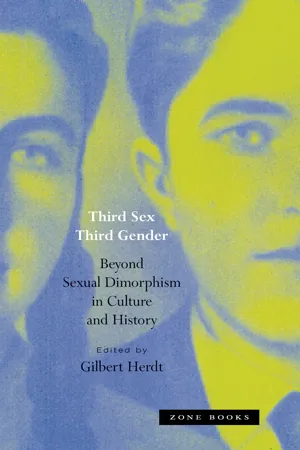
Most modern discussions of the relationship of biological sex to gender presuppose that there are two genders, male and female, founded on the two biological sexes. But not all cultures share this essentialist assumption, and even Western societies have not always embraced it. Bringing together historical and anthropological studies, Third Sex, Third Gender challenges the usual emphasis on sexual dimorphism and reproduction, providing a unique perspective on the various forms of socialization of people who are neither "male" nor "female."
The existence of a third sex or gender enables us to understand how Byzantine palace eunuchs and Indian hijras met the criteria of special social roles that necessitated practices such as self-castration, and how intimate and forbidden desires were expressed among the Dutch Sodomites in the early modern period, the Sapphists of eighteenth-century England, or the so-called hermaphrodite-homosexuals of nineteenth-century Europe and America. By contextualizing these practices and by allowing these bodies, meanings, and desires to emerge, Third Sex, Third Gender provides a new way to think about sex and gender systems that is crucial to contemporary debates within the social sciences.
- 624 pages
- English
- ePUB (mobile friendly)
- Available on iOS & Android
eBook - ePub
About this book
PART ONE
Historical Contributions
CHAPTER ONE
Living in the Shadows: Eunuchs and Gender in Byzantium
Kathryn M. Ringrose
Introduction
For almost a thousand years a loosely defined group of castrated men played key roles in Byzantine society, performing courtly, ceremonial, religious and other, less elevated functions. In an apparent paradox the practice of castrating men within the confines of the empire was forbidden under Roman law.1 Christian teachings disapproved of the practice while applauding its outcome – permanent celibacy. Sources often notice and discuss eunuchs, but frequently hide them in the shadows in a way that belies their importance to society. Careful analysis of these references can provide access to societal attitudes about a wide range of matters involving sexuality and gender. Previous work on eunuchs in the Byzantine Empire has centered on their political and social roles at court, but little has been said about how they actually fitted into other parts of society. Most studies of eunuchs have been colored by the pejorative language used about them in the sources and by modern abhorrence of the practice of castration. This interesting antipathy toward eunuchs has deep and complex roots, roots that lie in definitions of gender that can be examined by a study of language and verbal imagery.
This essay explores the social and cultural placement of eunuchs in Byzantine society, going beyond a simple catalog of the positions they held to discuss several aspects of their sexual and gender identities. It attempts to show how they were perceived by the society in which they lived and worked. In the process it also demonstrates that sexual and gender definitions changed over time as Byzantine society changed. Finally, it raises issues regarding sex and gender as defined in current social science. A better understanding of the ways in which eunuchs were integrated into Byzantine society, in the cultural and anthropological sense as well as in political and institutional terms, will tell us more not only about the eunuchs themselves but also about the roles of men and women in Byzantine culture.2
Men, Women and Eunuchs: Some Definitions of Sex and Gender
The term eunuch as used in Late Antique and Byzantine sources was broader and more nuanced than the simple phrase “castrated male” seems to imply. Moreover, its definition changed within Byzantine society between the third and twelfth century. In its broadest sense the word eunuch refers not only to an individual who is physiologically incapable of engendering an offspring but also to one who has chosen to withdraw from worldly activities and thus refuses to procreate. Thus, until the ninth century the term encompassed anyone who did not as well as could not produce children, including men who were born sterile, men who became sterile through illness, accident or birth defect, men who were lacking in sexual desire and men and women who embraced the celibate life for religious reasons. It also encompassed men who had had themselves castrated voluntarily for personal reasons, including Christian priests who wanted to have easier contact with women parishioners, intellectuals who wanted to preserve their vital body fluids to increase their intellectual powers and men who wanted to have intercourse with women without fear of pregnancy. The term also encompassed men who had been castrated, or whose families had them castrated as children, so that they could qualify for positions at court traditionally reserved for eunuchs. Also included were castrated male slaves from the outer reaches of the empire (e.g., Cappadocia, Armenia, the Caucasus Mountains) who were castrated as young children and then brought to the empire and sold, and, finally, illegitimate offspring of the imperial house – such as Romanos’s illegitimate son, Basil – who were often castrated and reared as part of the household staff.3 Thus, such a broadly used term is not very useful without a brief look at the way in which the Roman and Byzantine world conceptualized views of sex and gender.4
Aristotle and Galen, while taking for granted that men and women constituted polar opposites, conceptualized sexuality in terms of ascending ladders reaching toward perfection. The rungs of these ladders, some “biological” and others socially determined, were derived from theories of the humors prevalent in medical thought, ideal norms for the education and acculturation of young men and women, ideas about appropriate social behavior for the sexes and assumptions about the intellectual and moral potential of men and women. At the bottom of the ladder were women and girls, who were associated with coldness and dampness. Part of the way up the ladder were boys and adolescent males, who, having left the socialization of the women’s quarters, were learning to be aristocratic men. At the top of the ladder were those men who possessed the ultimate masculine attributes – heat, dryness, activity, fertility and training in aristocratic male behavior. As they matured and were acculturated into appropriate aristocratic male behavior, young males gradually moved up the ladder.5 Men who were castrated before puberty were “stuck” in a kind of arrested development. They certainly were more manly than women or young male children, but they could not reach the status of sexually mature men and thus could never attain the culturally defined attributes of full masculinity.
The ladder image implies not only a hierarchy of gender but also a male and female polarity. Thomas Laqueur argues in favor of a single-sex model for antiquity in which gender was more important than biological sexuality and then goes on to suggest that the female body is therefore always culturally constructed relative to a male reference point.6 His argument has many merits, but it has to be reconciled with two other issues. In the Byzantine world male bodies were both culturally and physiologically constituted into individuals who were referenced positively toward men and negatively toward women. That is, when sources wanted to speak well of an individual they used positive attributes traditionally ascribed to men. When they wanted to be critical they employed negative values traditionally ascribed to women.
Moreover, despite this orientation to the ideal male, both Aristotle and Galen are also tied to language that leads them to express themselves in terms of sexual polarities. Thus, Aristotle says that eunuchs are changed into women, or, as he puts it, into a female state.7 Galen, in discussing castration, says that it makes eunuchs similar to women, that is, they are lacking in heat.8 Thus, he tends to class eunuchs with women and boys, perhaps implying that eunuchs are changed into women. The language used seems to imply that maleness and femaleness are polar opposites.
Galen actually presents a theory that goes beyond defining the female in terms of a lack of male attributes. He suggests that biological sexuality is related to the testes and argues that both men and women have testes and produce seed. Then, in an argument that runs parallel to the modern medical understanding of hormones, he says that it is the male testes that give men their masculine attributes and the female testes that give women their feminine attributes. Galen then speculates about the existence of a third group of mature animals, once either male or female, that have been surgically altered so that they lack testes.9 The two types of altered animals develop similar physical traits and are “neither male nor female, but a third being different from both of the two.” This passage comes close to describing a third sex, but it is one of the few sources to do so explicitly and uses pigs as the illustrative example. It is important to remember that Galen is talking here about animals, and he does not speculate directly in this way about human beings. But note, however, the underlying assumption of male/female polarity in the way that Galen presents the idea.
Following in the tradition of Aristotle and Galen, Alexander Trallianus and Aetius Amidensus Medicus, medical writers of the sixth century C.E., also discussed these issues. Using classifications based on the texture of human flesh, the appearance of the complexion in different individuals and their physical strength or hardness as opposed to bodily softness, these authors follow the earlier writings of Aristotle and Galen and classify women, children and eunuchs together while setting men aside as a separate group, lending support to Laqueur’s conceptual model.10
Other authors classify the world in terms of generative powers. Clement of Alexandria separates men, women and eunuchs. For him eunuchs constitute a broad category similar to the one given at the beginning of this section. It includes those who are born sterile, those who are castrated and those who choose not to be sexual, including celibate men and women.11 Eustratius the Philosopher says that a eunuch, in his lack of fertility, is to a man as a dead man is to a living man. Fertility, like life, is essential to the definition of manliness; therefore eunuchs are not fully men. Here, of course, the gender alternative is referenced to the “normal” man. Eunapios of Sardis clearly implies that eunuchs are not really men when he says, “Since he was a eunuch he passed his life as a man” or “since he was a eunuch he used force to make himself a man.”12 Gregory Nazianzos seems to accept a male-female polarity and places eunuchs in a nebulous third category as women/men, individuals who are “womanlike and, among men, are not manly, of dubious sex.”13 Similarly John of Damascus, quoting Saint Basil, points out that a eunuch cannot suckle and therefore is not a woman and yet is also not a man.14
What we see here are several intellectual traditions occurring side by side. The medical/scientific tradition of Aristotle and Galen certainly supports a vertical continuum that attempts to explain physiological differences among men, women, children and eunuchs as a progression toward masculinity. It also offers convenient explanations for old age – elderly men move down the physiological ladder in the direction of women, children and eunuchs.
Yet despite the tidiness of this single-sex structure, a bipolar model was clearly also lurking in the language available to Late Antique and Byzantine authors.15 The very structure of the Greek language demands that individuals be either masculine or feminine. In this linguistic context eunuchs invariably took the masculine gender and were never associated with feminine or neuter grammatical forms. Greek society reflexively placed individuals in fixed masculine or feminine categories. Its language did not readily allow for a definition of individuals of indeterminate sexual categories. Aristotle, however, did use the adjective ἀμϕíϐολος, meaning an individual of indeterminate gender, for eunuchs. This term continues to be applied to eunuchs throughout the Late Antique and Byzantine period. Whether the conceptualization of gender was bipolar or single-sex-oriented, however, it remained difficult to define individuals who neither conformed to accepted polarities nor progressed along the ladder that bridged the sexual polarities and led to the male ideal.
The ability to procreate was important in defining gender. Byzantine society, like the Roman society from which it grew, was patriarchal in structure. Maintenance of the family was central, and loss of the generative function placed an individual outside of the logic of conventional, family-derived social categories. All of our texts acknowledge this and set eunuchs apart from this patriarchal schema, citing their lack of procreative ability, their origins outside the empire and their servile origins.16 Yet none of them expressly states that eunuchs are a specific “third sex” or “third gender.” The patterns of thought that involved sexual polarities were much too strong.
Children, because they also do not procreate, constituted a similar anomaly. But for them the condition was not permanent, and with proper societal conditioning boys became men and girls became women. Thus, while preadolescent boys were often seen as magically or spiritually distinct from adult men, they could be accommodated into the system. Ultimately the language and logic of polarity that was derived from procreation left eunuchs in limbo.
At the same time Byzantine society apparently did not rigidly link sexual activity with procreation. While eunuchs could not procreate, they could be sexually active. Eunuchs are often portrayed as engaging in sexual activity with both men and women. Since this sex act was not seen as a procreative activity and since procreation rather than sexual activity was the critical component of gender, the sexuality of eunuchs did not help place them in a clearly defined gender.
Constructing a Gender: Castration and Physiology
The inclusiveness of the term eunuch in the early Byzantine centuries reflects the ambiguities of definition regarding their sexual status found in our sources. It also reflects the many ways in which the eunuchs who appear in our sources were castrated. The type of mutilation carried out, and the age at which it was done, varied greatly and affected the physiological outcome in ways that were evident to a society in which external appearances were important in establishing rank, status and moral worth as well as gender. We can make only educated guesses about some of the technical details of this complex problem, but in part the variety of people defined as eunuchs reflects the variety of ways in which castration could be performed and the fact that it could be done at almost any age.17
Medical texts indicate that surgeons...
Table of contents
- Cover Page
- Title Page
- Copyright Page
- Contents
- Dedication
- Epigraphs
- Preface
- Introduction: Third Sexes and Third Genders, Gilbert Herdt
- Part One: Historical Contributions
- Part Two: Anthropological Contributions
- Photo Credits
- Notes
- Contributors
- Index
- Series List
Trusted by 375,005 students
Access to over 1.5 million titles for a fair monthly price.
Study more efficiently using our study tools.
Information
Publisher
Zone BooksYear
2020Topic
HistoryPrint ISBN
9780942299823
9780942299816
Subtopic
Social HistoryeBook ISBN
9781942130529
Index
HistoryFrequently asked questions
Yes, you can cancel anytime from the Subscription tab in your account settings on the Perlego website. Your subscription will stay active until the end of your current billing period. Learn how to cancel your subscription
No, books cannot be downloaded as external files, such as PDFs, for use outside of Perlego. However, you can download books within the Perlego app for offline reading on mobile or tablet. Learn how to download books offline
Perlego offers two plans: Essential and Complete
- Essential is ideal for learners and professionals who enjoy exploring a wide range of subjects. Access the Essential Library with 800,000+ trusted titles and best-sellers across business, personal growth, and the humanities. Includes unlimited reading time and Standard Read Aloud voice.
- Complete: Perfect for advanced learners and researchers needing full, unrestricted access. Unlock 1.5M+ books across hundreds of subjects, including academic and specialized titles. The Complete Plan also includes advanced features like Premium Read Aloud and Research Assistant.
We are an online textbook subscription service, where you can get access to an entire online library for less than the price of a single book per month. With over 1.5 million books across 990+ topics, we’ve got you covered! Learn about our mission
Look out for the read-aloud symbol on your next book to see if you can listen to it. The read-aloud tool reads text aloud for you, highlighting the text as it is being read. You can pause it, speed it up and slow it down. Learn more about Read Aloud
Yes! You can use the Perlego app on both iOS and Android devices to read anytime, anywhere — even offline. Perfect for commutes or when you’re on the go.
Please note we cannot support devices running on iOS 13 and Android 7 or earlier. Learn more about using the app
Please note we cannot support devices running on iOS 13 and Android 7 or earlier. Learn more about using the app
Yes, you can access Third Sex, Third Gender by Gilbert Herdt in PDF and/or ePUB format, as well as other popular books in History & Social History. We have over 1.5 million books available in our catalogue for you to explore.