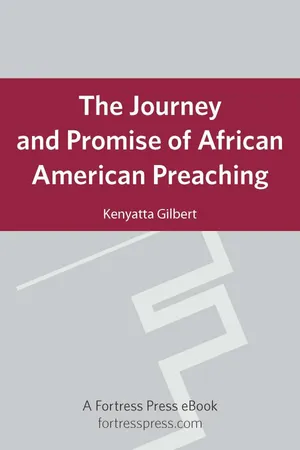
- 160 pages
- English
- ePUB (mobile friendly)
- Available on iOS & Android
eBook - ePub
Journey & Promise of African American Preach
About this book
In many communities, both black megachurches and storefront congregations have been infected by a so-called prosperity gospel, far removed from the liberatory gospel that has been a mark of the black church since the earliest incarnation of the African Methodist Episcopal Church, and most celebrated in the preaching and oratory of the Rev. Dr. Martin Luther King Jr. This book examines all these strains of African American preaching and points to a theologically and socially responsible renewal of black churches and their pastoral, prophetic, and wisdom functions in their communities.
Information
Topic
Theology & ReligionSubtopic
Religion1
The State of African American Preaching Today
Follow the grain in your own wood.
—HOWARD THURMAN1
The spoken Word in America’s Black pulpits has long been esteemed for its persistent calls for justice, church reform, moral and ethical responsibility, and spiritual redemption. These commitments have been central to the Black church’s identity. More importantly, though, these commitments to the spoken Word provide a way to take up the more fundamental matter of how one may, for example, determine what relational continuities exist between the prophets, priests, and sages of Scripture and the basic character of the Black preacher’s peculiar speech and communal obligations.
I set out working on this project with three primary audiences in mind—the student of homiletics,2 the working preacher, and the teacher of preachers. These are the individuals I know best since I am a former seminarian, an ordained minister, and a teacher of preachers. But not only this, I have come to view this book as generating a productive friction of sorts among Black homiletical theorists. Though my work, in some respects, builds on earlier scholarship, this book takes the tack that claims that critical reflection on African American preaching is, on the one hand, relatively underdeveloped and, on the other, vying for more forward-thinking scholarly discussion.
A critical analysis of the state of twenty-first-century African American preaching can unfold in a number of ways depending on how one thinks the picture should be painted. It is important to begin our conversation about the state of African American preaching today from three frames of reference: (1) theological education and the intellectual tradition of contemporary African American homiletics; (2) the broad range of congregational and secular community concerns and expectations; and (3) the character and moral agency of the Black preacher. By focusing in this way, we are provided a wider lens to investigate what is at stake in contemporary preaching practices in African American churches and communities.
Learning Habitats and the Preacher’s Humanity
Contemporary homiletics has insufficiently attended to theological matters pertaining to incarnation and the historical conditioning of culture, and how these matters shape the message of the gospel in different contexts. A number of African American homiletical theorists echo this claim, having now sufficiently demonstrated in their scholarship that African Americans are subjects of their own histories rather than objects under someone else’s principles of scrutiny.3 Despite this, across the lines of race, ethnicity, and culture, homiletical proposals have in general uncritically accepted many Enlightenment presuppositions, tending toward foundationalist assumptions for preaching, specifically, the commitment to embracing claims to knowledge in some fundamental certitude. One-size-fits-all homiletical methods do not work because our thinking about preaching is ever evolving, always subject to challenge, and definitive interpretations are thus difficult to find.
Our current picture of theological education, namely the way clergy leaders are trained to preach, is an outflow of circumscribed ideals that follow theoretical principles and guidelines, techniques and approaches that are supposedly historically and culturally neutral.4 Predictably, for both student and homiletics instructor, the classroom setting often does not become transformed space for authentic Christian praxis. Having attended a predominantly white seminary where Eurocentric theological points of view are privileged I quickly learned that doing well in preaching class carried with it the expectation that I would cope with and conform to a particular set of homiletical norms without questioning the authority of them.
Participants bring their own conceptualizations, convictions, mores, and folkways—those emanating from local congregational life—to the classroom setting. The sensible homiletics instructor will take great care to help each student stave off the ensnaring trap of cultural abandonment and feelings of disconnection from their actual preaching habitats and context-determined ways to preach. Learning to preach involves one’s conscious resistance to forces that strive to domesticate one’s voice. That is why the role of the pedagogue is so important. Theological seminaries and divinity schools often become principal players in the domestication process. When I have taught courses in predominantly white settings the chief complaint of students of color is one that centers on the issue of cultural invasion. Cultural invasion is the act of the teacher—who becomes invader—imposing his or her own worldview upon students in ways that inhibit their creativity by dismissing, camouflaging, or curbing their expression.5
One inattentive to the vital role context plays in African American preaching, for example, will hardly notice the indigenous character of the “chanted sermon,” and may not perceive it as theo-rhetorical artistry and experienced Word. Despite the common portrayal of the Black folk preacher as comic figure, James Weldon Johnson has rightly expressed: “The old-time Negro preacher … was an important figure and at bottom a vital factor. It was through him that the people of diverse languages and customs who were brought here from diverse parts of Africa and thrown into slavery were given their first sense of unity and solidarity.”6
In recent years, even some African Americans have come to disdain this preaching style. I believe this is in part due to its misuse in the hands of charismatic charlatans. One might also point out the fact that preachers from many “high-brow,” “silk-stocking,” “demure” congregations consider some communities “low class” or “uncouth.” This may be less true in some historically Black denominations—Baptist, Church of God in Christ (COGIC), and African Methodist Episcopal (AME)—and more true in the so-called mainline denominations, for example, Episcopal and Lutheran. But more than that, contemporary homiletics, it seems, continues to privilege African American preaching modes that seem to cohere best to the nomenclature of white academicians. To be precise, when the African American “chanted sermon” is attempted or examined in academic contexts without regard to the actual preaching habitats from which the “chanted sermon” arises, not only will context-determined ways of listening be overlooked, but also missed is the aesthetic genius of this preaching style’s interconnected dance of Scripture, culture, body, and voice. Like the Negro spiritual, there is a subtext, an internal logic, to the authentic “chanted sermon” that is only accessible when the hearer is helped by cultural history.
This known fact should inspire creative pedagogy as well as encourage greater sensitivity to what is fitting for hearers. “One of the tasks of theological education,” writes homiletician Richard Ward, “is to help more of the student’s story become available for reflection as a [learning] resource.”7 This means, of course, that teaching methods must be constantly scrutinized to guard against self-serving acts of cultural invasion that consciously or unconsciously devalue the contributions of pupils who have much to share from their own socio-ecclesial habitats. Because cultural identity and religious formation are principal determiners of how a sermon will be preached and heard, one truly committed to the work of transforming churches and communities through the gospel of Jesus Christ will “pay attention” to the vital importance context plays in preaching. Our preaching contexts matter when our concern is the gospel. For this reason, to understand the Christian faith contextually “is really a theological imperative.”8 There is no gospel “for us” that is not clothed in human culture and is not mediated through the sociocultural concerns of where we live, who we are, and what we value. Constructive pedagogy asks if our theologies of preaching are constructed with the local idioms of our students in view. In an age of suspicion hermeneutics, competing narratives, and reality redescription, without a revised understanding of what is at stake culturally and communally in contemporary preaching, our homiletical theorizing will be scantily useful.
Black Homiletics Coming of Age: Two Leading Proposals
Since the release of Henry H. Mitchell’s Black Preaching in 1970, considerable attention has been devoted to carving out Black preaching’s nomenclature in academic reflection, and rightly so. But only a few proposals since then have furthered the discussion of Black preaching beyond contrasting it with Eurocentric preaching, most notably that of homiletician Dale Andrews.9 Given this impasse, the future direction of African American preaching remains indistinct. In order to provide some context for thinking about the intellectual tradition of African American homiletics, and to reiterate the importance of attending to matters of context in Christian preaching, I now draw our attention to the homiletic scholarship of Henry H. Mitchell and Cleophus J. LaRue.
Henry H. Mitchell: Event and Experience
The consistent refrain in Henry Mitchell’s landmark work Black Preaching and subsequent magnum opus Celebration and Preaching (1990), which emerged twenty years later, is that context matters and must never be overlooked if our concern is preaching. In 1970 Mitchell’s intended readership had been mostly African American, but in his more recent reflections he anticipates both an African American and Anglo American readership. On the heels of the great civil rights social revolution, Mitchell’s scholarship soared as it invited a multiethnic readership into a primarily oral religious tradition. In Celebration and Preaching, Mitchell states that preaching’s goal is to reclaim “heart religion,” that is, to counter the objective and detached preaching approaches that only appeal to the cognitive aspects of one’s being. With this orientation, he works to synthesize elements of the “mainstream” Protestant pulpit tradition and Black church pulpit traditions. Identifying the rhetorical dynamics in both streams, the preacher finds right entry into what he labels “experiential encounter.” He argues that the coalescence of rhetorical vehicles—guidelines of concrete images, familiar language, familiar details, timing of impact, and so forth—when understood and appropriated by the called preacher, promotes encounter and hence can reach people at the core of their belief.
For Mitchell, the authentication of Black preaching has all to do with human reception of the spoken Word. In the sermon event the congregation rouses the preacher to a celebratory high point characterized by chanting, humming, or moaning under the auspices of the Holy Spirit. This momentum-building sermon event forms the distinctive worship ethos where Black preaching is made visible. In other words, without congregational response, there can be no genuine Black sermon. By this paradigm, the sermon, as Mitchell defines it, is “reasonable and relevant sequences of biblical affirmation planted in or offered to the intuitive consciousness of hearers, by way of what might be called homiletical coworkers with the Spirit.”10
In Mitchell’s theory of celebration, the intuitive consciousness and emotive consciousness are the locus points for faith formation. In the spoken Word, they are the listener’s pathway, sectors of one’s belief system and worldview.11 Intuitive consciousness or emotive consciousness is faith forming. It honors, reflectively, one’s gathered life stories; it is the seat of one’s tastes as well as prejudices. Relative to faith insights gathered from intuitive consciousness is always this stream that defies rational examination. Because the intuitive realm is built upon gathered stories—“tapes,” if you will—the preacher’s principal concern is helping listeners “to improve these ‘tapes’ or habitual replays of response to particular circumstances.”12 Still, the emotive consciousness grounds the celebratory dimension of his theory.
This biblically based, unanalytical phenomenon of celebration, as Mitchell claims, is an expression of joy in God. According to Mitchell, celebration has five central commitments: (1) it frees up the listener to experience the spontaneous workings of the Holy Spirit in worship; (2) it fosters a deep connection between the hearer and the sermon’s subject matter; (3) its contagion is infectious in the context of worshipers in fellowship; (4) it honors the fact that emotion is essential to the ecstatic enforcement of the Word for the people; and (5) it promotes identification when rhetorical details and imagery are placed before the hearer during the sermon.13 Mitchell’s clear rejection of the old homiletic preaching models, first developed by early-eighteenth-century neoclassical rhetoricians, which equate the sermon with rational argumentation through propositional speech or logic, is clear. In fact, his emphasis on experiential encounter links him to the stylistic, performative tradition of the sixteenth-century elocutionists and, more evidently, to theorists of the New Homiletic.14
The New Homiletic movement began in the late 1960s and gained momentum following the proposals of several homiletical theorists, most notably Fred Craddock, Eugene Lowry, and Charles Rice. According to the New Homiletic school, effective preaching of the gospel is dialogical, imaginative, primarily narrative in form and inductive in movement, and shaped to the listener. These theorists prize preaching that unfolds inductively instead of through propositional logic. Hermeneutically, there are three major implications in relation to preaching from this perspective: (1) the Word of God must be spoken; (2) preachers must see themselves as listeners; and (3) the fundamental nature of the spoken Word is a community-creating event. Put differently, the theological and hermeneutic trajectory of the New Homiletic perspective is that preaching is an event and experience concerned with “message bearing” and interpreting the Word of God freshly in the way of reality in the vernacular of the people.15 Though theorists in this movement such as Mitchell view preaching as “creating experience,” it is not always clear what is actually being said about God that creates the experience.
Clear of the vestiges of old-school homiletics, Mitchell’s working hermeneutic seeks distinction in Black preaching through the matrix of language. In his view, Black preaching conforms to certain patterns of language indigenous to Black culture.16 Despite his good insights concerning the relationship of African culture and its influences on Christianity in Black churches, one of the most contestable claims he makes is that Black preaching “requires the use of ‘Black language’—the rich rendition of English spoken in the ghetto.”17 Few would consider this a hallmark since there is no consensus about what constitutes “Black language.” It is more accurate to say that Black preaching is always responsive to and mindful of the vernacular of the people. Clearly, rhetorical interests drive Mitchell’s preaching theory; so the “message-bearing” task of the preacher is what reveals the essence of Black preaching.
Cleophus J. LaRue: Belief and Marginalization
Insofar as the term “Black preaching” describes a rich tradition of varying theological orientations and methods of sermon construction and del...
Table of contents
- Cover
- Title
- Copyright
- Dedication
- Contents
- Acknowledgments
- Introduction
- 1. The State of African American Preaching Today
- 2. A Venerable Yet Vanishing Tradition
- 3. The Trivocal Impulse: A Call for Holistic Preaching
- 4. A Homiletical Plan for Recovering One’s Voice
- 5. Trivocal Preaching in African America
- 6. What the Church Expects, What the Village Needs
- Appendix: A Pocket Map for Four Tasks of Sermon Preparation
- Annotated Bibliography
- Notes
- Index
Trusted by 375,005 students
Access to over 1.5 million titles for a fair monthly price.
Study more efficiently using our study tools.
Frequently asked questions
Yes, you can cancel anytime from the Subscription tab in your account settings on the Perlego website. Your subscription will stay active until the end of your current billing period. Learn how to cancel your subscription
No, books cannot be downloaded as external files, such as PDFs, for use outside of Perlego. However, you can download books within the Perlego app for offline reading on mobile or tablet. Learn how to download books offline
Perlego offers two plans: Essential and Complete
- Essential is ideal for learners and professionals who enjoy exploring a wide range of subjects. Access the Essential Library with 800,000+ trusted titles and best-sellers across business, personal growth, and the humanities. Includes unlimited reading time and Standard Read Aloud voice.
- Complete: Perfect for advanced learners and researchers needing full, unrestricted access. Unlock 1.5M+ books across hundreds of subjects, including academic and specialized titles. The Complete Plan also includes advanced features like Premium Read Aloud and Research Assistant.
We are an online textbook subscription service, where you can get access to an entire online library for less than the price of a single book per month. With over 1.5 million books across 990+ topics, we’ve got you covered! Learn about our mission
Look out for the read-aloud symbol on your next book to see if you can listen to it. The read-aloud tool reads text aloud for you, highlighting the text as it is being read. You can pause it, speed it up and slow it down. Learn more about Read Aloud
Yes! You can use the Perlego app on both iOS and Android devices to read anytime, anywhere — even offline. Perfect for commutes or when you’re on the go.
Please note we cannot support devices running on iOS 13 and Android 7 or earlier. Learn more about using the app
Please note we cannot support devices running on iOS 13 and Android 7 or earlier. Learn more about using the app
Yes, you can access Journey & Promise of African American Preach by Kenyatta R. Gilbert in PDF and/or ePUB format, as well as other popular books in Theology & Religion & Religion. We have over 1.5 million books available in our catalogue for you to explore.