- 256 pages
- English
- ePUB (mobile friendly)
- Available on iOS & Android
eBook - ePub
About this book
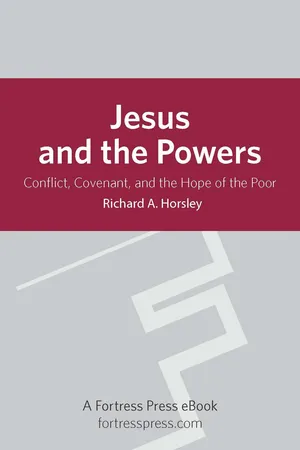
Refuting a false dichotomy between "politics" and "religion" in Jesus' world (and our own), Jesus and the Powers rediscovers Jesus' response to the imperial power of his day. Richard A. Horsley describes the relevance of political realities under great empires for understanding the rise of covenantal theology and apocalyptic vision in Israel's history; then he explores aspects of Jesus' activity in the context of the Roman Empire. Horsley examines Jesus as an exorcist and prophetic figure and the character of his death by crucifixion; then turns to discuss how the community life in the early Pauline assemblies gave form to a new response to imperial powers—and stimulus to contemporary readers to re-imagine their own response to political realities in our own day.
Information
Topic
Theology & ReligionSubtopic
ReligionChapter 1
The Powers of Empire
Jesus worked among people subject to the Roman Empire. His renewal of Israel, moreover, was a response to the longings of those people, who had lived under the domination of one empire after another for centuries, to be free of imperial rule. Israelite tradition from which Jesus worked in his mission bore the marks of a prolonged struggle of the people both to adjust to and to resist the effects of the powers of empire.
Ancient empires were all about power, or rather, a whole network of interrelated powers. While some of those powers were relatively more natural, others more political, others more economic, and others more religious in their operation, there was no separation between these aspects, as is often assumed in modern Western society. The principal powers were superhuman, far beyond the control of humans, but they were usually not “supernatural” or “otherworldly,” as is often assumed by modern “scientifically” minded people. Indeed, the powers of ancient empire, mysterious in their operation, were thought of as divine, as gods. Modern science, including the academic field of biblical studies, has tended to misunderstand or to demythologize these superhuman Powers, imagining that they were “just” vestiges of a prerational worldview or even “just” a certain premodern mode of language. But biblical and other ancient Near Eastern sources do not share Enlightenment theology of sophisticated intellectuals (ancient and modern).
IN THE “CRADLE OF CIVILIZATION”
The most accessible example of how the powers of empire operated as a cosmic-political-economic-religious system is that of ancient Babylon. It also happens to be the empire from which the ancient Hebrew Bible and the subsequent Abrahamic traditions of Christianity and Islam made their decisive departure. A fuller examination of the civilization of ancient Mesopotamia, and especially its main myth of origins, can illuminate the powers in response to which Israel established an alternative society and Jesus strove to renew Israel.1
The great civilization that developed in the land “Between the Rivers” was a truly remarkable achievement. In the area that is now modern-day Iraq, the ancient Mesopotamians built many large cities along the Tigris and Euphrates Rivers. The burgeoning population built an extensive irrigation system to sustain the agriculture that supported the “great ones” and their armies as well as the people themselves. The construction of the cities, with their massive monuments (ziggurats, like “the tower of Babel”), as well as the vast system of irrigation canals, required sophisticated organization of the people’s labor. And that required a complex hierarchical administration, from the (district) commanders at the top to the foremen in command of gangs of laborers at the bottom, all under the autocratic command of the principal “great one.” The construction of the massive monuments to the glory of the gods and the rulers, the ziggurats in Mesopotamia, like the pyramids of Egypt, also required the commandeering (by “trade”) and transport of stone and timber from upriver. The whole imperial system of powers, great ones, administration, and construction was supported by the agricultural produce of the people who worked the irrigated fields.2
But what motivated those people to toil in the fields in the stifling heat and humidity day after day? What led them to submit to the forced labor necessary to construct the extensive irrigation system and palaces for the great ones and for the Powers who communicated with them? Apparently it was an intense fear of the terrifying superhuman Powers that determined their lives. They lived in constant fear, for example, that River, the Power that supplied water to the fields, would overflow his banks in a fit of rage, destroying both the irrigation ditches and the crops to which they brought water. They were terrified lest that even greater Power, Storm-Kingship, would suddenly swoop down upon the cities so laboriously built along the banks of River and topple buildings and fill the irrigation canals with sand from the desert. So, to appease the terrible wrath of these forces, at whose whim their collective life might be devastated (a tsunami, or a Katrina), the people rendered up tithes and offerings to the Powers. They surrendered a certain percentage of their crops to the chief servants of the Powers in their “houses” (the priests-managers in the palaces-temples-storehouses), who tended to the care and feeding of the Powers.
As in any ancient society, religion was inseparable from political and economic life. In Mesopotamian civilizations, a single term, “the great ones,” could refer to people we would distinguish as “king,” or “high priest,” or “manager.” More obviously than in Rome centuries later, the annual cycle of festivals celebrated the annual cycle of productivity. Planting and harvesting were surrounded with special prayers, sacrifices, and fertility rituals. In ancient Babylon, the climax of the annual natural-economic-political-religious cycle was the New Year festival (Akitu). This week-long festival celebrated both the end and the beginning, both the completion and the regeneration of the cyclical political-economic-natural divine order, the delicate balance among the great Powers that determined the people’s lives.
The renewal of order against (the threat of) chaos was focused in the great ritual drama enacted in the grand temple-palace of Marduk, principal Power of Babylon, who as Storm King stood at the head of the divine forces of order. This ritual drama offers fascinating glimpses of the relationships among the divine Powers and of the people’s relationship to them. The “text” of this ritual drama, the Babylonian epic of origins, Enuma Elish (“When on high …,” its opening phrase in Akkadian), even provides a sense of the two major stages in which this imperial civilization developed.
In the first act of the drama, River and Sea, intermingling their waters, “begat” Silt and Sediment, who in turn “begat” Horizon of Sky and Horizon of Earth. The latter generated Sky-Authority, who generated Irrigation-Wisdom and other offspring. It is clear from their names and roles in the drama that they were the principal Powers of nascent civilization in the land Between the Rivers. Annoyed by the noise that the forces of civilization were making, Father River threatened to destroy them all. But the enterprising Irrigation-Intelligence, drawing a map of the (Mesopotamian) universe and casting a spell, put River to sleep (“killed” him).
In this first act of the drama we discern that the Mesopotamians’ sense of the origins of their civilization centered on the “houses” of the divine forces, presided over by high-ranking specialists (priests-managers) in communicating with those forces. At this still relatively simple stage of irrigation civilization, the temple-communities were held together by authority (Sky) and intelligence (Irrigation), no coercion by military force yet being necessary to maintain order.
As the nascent civilization became more complex, however, with the emergence of larger cities up and down the rivers, the system experienced chronic conflict. In the next “act” of the ritual drama, Sea (Chaos) went on a violent rampage to avenge her consort’s defeat. Sky-Authority and Irrigation-Wisdom, the older forces of social cohesion, were unable to withstand the assault. To cope with the desperate situation of civilization in chaos, Irrigation generated a new force, Storm, who was acclaimed King by the forces struggling to reassert order over chaos. In a scene of horrifying violence that disturbingly juxtaposes domestic relations with the order of the universe, Marduk (god of Babylon) as Storm-King slaughtered (his ever-so-great grand-) Mother Sea. He then butchered her body to produce both the heavenly order, symbolized by the zodiac, and the earthly order in the land of the two rivers (Mesopotamia), which flowed through her eye sockets. After the victory of the forces of order over the forces of chaos, palaces had to be built for Storm-King/Marduk and the other victorious Powers. But it would have been unseemly for the vanquished forces, who were also divine, to be subjected to physical labor. So Marduk created people to be slaves of the gods, to build palaces for the divine Powers. In the final scene, Marduk (= Storm-Kingship) is celebrated as eternal King of the universe.
The climax of the ritual drama both reflects and models the establishment of empire by military violence in Mesopotamian civilization. After a period of chronic warfare between the city-states that developed along the Tigris and the Euphrates, one city-state finally imposed its rule by conquering the others. The imperial order, achieved by Babylon’s military conquest in the land of the two rivers, was understood as the earthly counterpart of the imperial order achieved in the violent victory of Marduk and his forces of order over the disrupting forces of chaos.
Regularly reminded by the annual New Year ritual drama of the precarious order established by the violence of the great Powers, and reminded also of their own origin as the slaves of the Powers, the people acquiesced not just in worship of but in concrete economic service to the Powers. The great ones of Babylon, such as Hammurabi, in the role of the chief servant of Marduk and the other Powers, maintained the cosmic-political-economic order with the threat of military violence against any who might act as agents of Sea and her forces of chaos. And, of course, also being in control of the produce and labor of the masses of “slaves of the gods,” the great ones lived in wealth and privilege. Agricultural surplus was transformed into the wealth of conspicuous display for the glory of the gods, products of high civilization such as gold inlay in the gods’ palaces, artistically designed plates and goblets of precious metals for the gods’ dining pleasure. And they hired intellectuals, who developed writing, initially to keep records of payment of tithes and offerings, and studied the heavenly powers of sun, moon, and the stars (astronomy) in order to determine the right time for planting and harvest, along with the timing of the rituals that synchronized the agrarian political economy with the annual cycle of the heavenly powers.
What powered the Babylonian Empire or the similar imperial system in ancient Egypt was the labor and produce of the people as the servants of the Powers. But the way the system worked was that when the people rendered up their labor to build the ziggurats and their agricultural produce to feed the Powers, their labor and produce became power in the control of the great ones who managed the religious ceremonies, the administrative organization of labor, and the military forces. The imperial civilizations of the ancient Near East were thus systems in which the labor-power of the people, yielded up as offering to the Powers, was transformed into power wielded over the people by their rulers, the great ones.
One of the many stories of Joseph’s exploits at the court of Pharaoh (Genesis 41, continued in Genesis 47) offers a vivid illustration of how, in the parallel imperial system of Egypt, the (labor-) power of the people was expropriated by the central rulers and transformed into power over the people. Pharaoh dreamed of “seven sleek and fat cows,” followed by seven ugly and thin cows, who “ate up the seven sleek cows.” Joseph interpreted the dream to mean that there would be seven years of abundant harvests followed by seven years of drought and famine. Joseph advised Pharaoh to appoint additional managers, presumably with strong-arm backup, to expropriate one-fifth of the produce during the years of plentiful harvests to be stored under the authority of the pharaoh. As Pharaoh’s newly appointed CEO, Joseph thus built up a huge surplus.
What ensued would be called extortion on a grand scale were it not so familiar from the practices of contemporary megacorporations that manipulate supply and demand while ostensibly operating under the sacred impersonal “law” of supply and demand. When the famine became severe and the people clamored for grain, Joseph demanded in exchange all their “goods” or “possessions,” presumably meaning (since money had not been invented yet) precious metals, jewelry, and other such movable goods of value. When the starving people again clamored for grain, Joseph further demanded all the livestock (draft animals, flocks, herds). Finally, when the desperate people again came begging for relief, they had nothing left as collateral for loans but their land and labor. “We with our land will become servants of Pharaoh; just give us grain, so that we may live and not die.” All the land became Pharaoh’s and the people themselves became slaves—or more like sharecroppers or serfs—who no longer controlled their land and labor. By manipulating the people, who were utterly vulnerable to drought and famine, the rulers, who had extracted and now controlled huge reserves of grain and other produce, used their power over the peasants to escalate their now permanent share to one-fifth of the harvest (GDP). The story in Genesis leaves out the religious dimension of the people’s slavery in the Egyptian system. As in Babylon, however, what motivated people to render up their labor and produce was the fear of the powers that determined their lives.
THE “SHOCK AND AWE” OF THE “SOLE SUPERPOWER”
The Roman Empire was more complicated than its Near Eastern counterparts but displayed many of the same features and the corresponding powers. The Romans, like the Greeks, feared and honored, many of the same powers that determined their societal life with temples, sacrifices, and festivals. Here we are interested in reviewing various aspects of power in the historical working of the Roman Empire, particularly as it affected the eastern Mediterranean and the Middle East, the context of Jesus’ mission and the earliest Jesus movements.
Rome built its empire by military conquests, which it pretended were necessary to defend its own territory, interests, and “allies.” Rome’s destruction of both Carthage and the classical Greek city of Corinth (146 B.C.E.) signaled to the rest of the world that it would brook no rival for power in the Mediterranean. After the Hellenistic empires that succeeded the conquest by Alexander the Great had collapsed from making war on one another, the Romans sent large military expeditions to conquer the lands and peoples on the eastern shores of the Mediterranean. As the sole superpower, Rome was the dominant military power of its time. Overwhelming military force, however, supplied the necessary but not the sufficient power to invade and control subject peoples who resisted in serious and persistent ways, such as the Judeans and Galileans. Only after repeatedly sending in huge military forces to conquer and reconquer them over a period of two centuries were the Romans finally successful in effectively “pacifying” the populace.
The Roman warlords practiced an ancient equivalent of “shock and awe,” that is, the use of overwhelming destructive force to terrorize the targeted populations into submission. The ancient Romans’ version of “shock and awe” was extremely low-tech, but intentionally and systematically executed. They devastated the countryside, burned villages, and either slaughtered or enslaved the people. For good measure they then rounded up those who had put up the greatest resistance and hung them on crosses along the roadways as a public warning to any who had survived the conquest.
For centuries, Roman warlords relied on this means of expanding their imperium, conquering one people after another. The Greek historian Polybius, who identified with the Roman advance, was nevertheless candid about their “scorched-earth” practices. He personally witnessed the Roman devastation of a city that left in its wake a horrific scene littered with animal as well as human corpses. “It seems to me that they do this for the sake of terror,” he commented (10.15–17).3 The Roman historian Tacitus minced no words about Germanicus’s slaughter of the tribes across the Rhine: “for fifty miles around he wasted the country with sword and flame. Neither age nor sex inspired pity. Places sacred and profane were razed indifferently to the ground.… Only the destruction of the race would end the war” (Ann. 1.51.56; 2.21). A ...
Table of contents
- Cover
- Title Page
- Copyright
- Contents
- Abbreviations
- Introduction: “You Shall Not Bow Down and Serve Them”
- Chapter 1: The Powers of Empire
- Chapter 2: Israel’s Covenant and Prophetic Protest
- Chapter 3: Heavenly Powers and People Power
- Chapter 4: The Power of Hope
- Chapter 5: Jesus and the Struggle for Power
- Chapter 6: The Collective Power of Covenant Community
- Chapter 7: Speaking Truth to Power
- Chapter 8: The Power of the Crucifixion
- Conclusion: Jesus and the Struggle with the Powers
- Notes
- Bibliography
- Indexes
Trusted by 375,005 students
Access to over 1.5 million titles for a fair monthly price.
Study more efficiently using our study tools.
Frequently asked questions
Yes, you can cancel anytime from the Subscription tab in your account settings on the Perlego website. Your subscription will stay active until the end of your current billing period. Learn how to cancel your subscription
No, books cannot be downloaded as external files, such as PDFs, for use outside of Perlego. However, you can download books within the Perlego app for offline reading on mobile or tablet. Learn how to download books offline
Perlego offers two plans: Essential and Complete
- Essential is ideal for learners and professionals who enjoy exploring a wide range of subjects. Access the Essential Library with 800,000+ trusted titles and best-sellers across business, personal growth, and the humanities. Includes unlimited reading time and Standard Read Aloud voice.
- Complete: Perfect for advanced learners and researchers needing full, unrestricted access. Unlock 1.5M+ books across hundreds of subjects, including academic and specialized titles. The Complete Plan also includes advanced features like Premium Read Aloud and Research Assistant.
We are an online textbook subscription service, where you can get access to an entire online library for less than the price of a single book per month. With over 1.5 million books across 990+ topics, we’ve got you covered! Learn about our mission
Look out for the read-aloud symbol on your next book to see if you can listen to it. The read-aloud tool reads text aloud for you, highlighting the text as it is being read. You can pause it, speed it up and slow it down. Learn more about Read Aloud
Yes! You can use the Perlego app on both iOS and Android devices to read anytime, anywhere — even offline. Perfect for commutes or when you’re on the go.
Please note we cannot support devices running on iOS 13 and Android 7 or earlier. Learn more about using the app
Please note we cannot support devices running on iOS 13 and Android 7 or earlier. Learn more about using the app
Yes, you can access Jesus and the Powers by Richard A. Horsley in PDF and/or ePUB format, as well as other popular books in Theology & Religion & Religion. We have over 1.5 million books available in our catalogue for you to explore.