This book brings two leading lights in Jesus studies together for a long-overdue conversation with one another and with significant scholars from other disciplines.
eBook - ePub
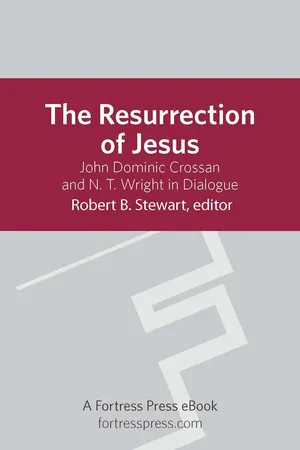
Resurrection of Jesus
John Dominic Crossan and N. T. Wright in Dialogue
- 220 pages
- English
- ePUB (mobile friendly)
- Available on iOS & Android
eBook - ePub
About this book
Two of today's most important and popular New Testament scholars, John Dominic Crossan and N. T. Wright, here air their very different understandings of the historical reality and theological meaning of Jesus' Resurrection. The book highlights points of agreement and disagreement between them and explores the many attendant issues.
Trusted by 375,005 students
Access to over 1.5 million titles for a fair monthly price.
Study more efficiently using our study tools.
Information
Topic
Theology & ReligionSubtopic
Religion1
THE RESURRECTION
Historical Event or Theological Explanation? A Dialogue
Opening Statement
N. T. Wright
Thank you all for being here this evening and for coming to this extraordinary weekend. I am very grateful to the seminary and to Bob Stewart, who, as he said, has been after me for five years to do this, and for the chance to participate in this first Greer-Heard Point-Counterpoint Forum and, of course, as we have already said, to the sponsors themselves. I am grateful, too, to Dom Crossan for his willingness to go once more round the tracks in this debate. Dom and I have had several enjoyable and, I hope, fruitful discussions over the last decade and more, and my respect and affection for Dom have steadily increased through that. I have been fascinated to see the ways in which our thinking has converged at some points while remaining firmly divergent at others.
So my primary task in this session this evening, as I understand it, is to outline briefly the argument which I have set out in my book The Resurrection of the Son of God, which was published nearly two years ago. The book has, of course, a positive role, but one of its main tasks, if I can put it like this, was to negate the negative—that is, to show that the normal historical proposals about the rise of resurrection faith in the early church, the normal proposals that try to explain things without the actual bodily resurrection of Jesus, simply won’t work historically.
I see what I was doing as primarily a ground-clearing task, sweeping away the rubble and debris behind which bad arguments had been hiding. Thus, for instance, I have shown against Gerd Lüdemann that the idea of resurrection is not something which ancient people could accept easily because they didn’t know the laws of nature, whereas we moderns, with post-Enlightenment science, have now discovered that resurrection can’t be true. That is simply absurd. From Plato to Homer, from Aeschylus to Pliny, the ancients knew perfectly well that dead people didn’t rise. We didn’t need modern science to tell us that. I’ve shown against Greg Riley that ancient pagan stories about people eating with the dead, or seeing the dead in realistic visions and so on, are completely different from the idea of resurrection, and that the same ancient pagans who knew all about visions and the like continued to reject resurrection with some scorn. I’ve shown against Kathleen Corley that the Hellenistic novels which feature stories of empty graves and so on cannot provide an explanatory context for the rise of Christian belief. And I’ve shown against many writers that in Judaism as in paganism, the word resurrection was not a general term for life after death, as it is often used today, to our shame in some Christian circles. Rather, the word resurrection always denoted the second stage in a two-stage process of what happens after death: the first stage being nonbodily and the second being a renewed bodily existence, what I have often called life after “life after death.” Likewise, I’ve shown conclusively that Paul really did believe in the bodily resurrection, despite generations of critics going back as far as the second century who tried to make out that he didn’t.
I have, I think, demolished the central thesis of the influential 1981 SBL [Society of Biblical Literature] presidential address by James Robinson—namely, that the early Christian experience of the risen Jesus was an experience of some kind of luminosity which could be interpreted as what we would call an essentially private religious experience rather than evidence for an occurrence in the public world and which developed rather slowly into a belief in bodily resurrection, on the one hand, and into gnostic theology, on the other. I’ve shown that we can’t account for early Christian faith by suggesting that stories about appearances and stories about an empty tomb have nothing whatever to do with one another. I have shown that the idea of resurrection faith being generated by some kind of cognitive dissonance simply doesn’t work. And I believe I’ve shown against Dom and others that the early Christian belief in the resurrection of Jesus could not have been generated from the combination of their previous knowledge of Jesus and their study of particular biblical texts, however much both of those things contributed to their interpretation of the event once it had happened.
Now the point to all this negative exercise, I stress, is not first and foremost to prove the resurrection by modernist or supposedly neutral or naturalistic historiography. The point is rather to force the question back where it ought to be rather than allowing yet another generation of students to be taught that the Easter stories and the Gospels are simply mythical back projections of early Christian consciousness rather than accounts of something exceedingly strange and unprecedented in the real world. Now I appreciate that in some circles this task may seem otiose. So, say people who have never taken history particularly seriously, why should you worry what historical critics and exegetes are saying and thinking? But for the seminarian in college and the parishioner in the pew, it matters a great deal. Enormous forces in our culture are determined to deny Jesus was raised from the dead. And, over and over again, they use arguments which can be shown to be invalid, and they propose alternative scenarios about the rise of Christianity which can be shown to be impossible. And that, I think, is an important exercise in itself.
But my book is, I think, more than merely negative. Let me spell out its main positive argument. Perhaps the most original aspect of the book—I’m honestly not sure now, my head was so full of it—is its compilation of six Christian mutations within first-century Jewish resurrection belief. My case here is that we can track with considerable precision and over a wide range of early evidence a phenomenon so striking and remarkable that it demands a serious and well-grounded historical explanation. Early Christian belief in resurrection is clearly not something derived from any form of paganism; it is a mutation from within Judaism, or rather six mutations.
First, belief in resurrection has moved from being a peripheral item of belief, as it is in Judaism, to the center. Second, the meaning of resurrection has been sharpened up. Jewish sources leave it vague as to what form the new body will take, but the early Christian sources, again and again, indicate that the body will be transformed into a new type of immortal physicality.
Third, there is no spectrum of belief in early Christianity on what happens after death, as there is in both Judaism and paganism; there were many different opinions out there. But from Paul through to Tertullian, there is development and reflection about what precisely resurrection would mean, and how to argue it before a skeptical audience. But they all, except the Gnostics and the semi-Gnostics, believe in resurrection. No Christians known to us retain signs of the other main beliefs of the period.
Fourth, resurrection as an event has split into two. Those first-century Jews who expected the resurrection saw it as a single event, the raising to new bodily life of all at the very end. But it is central to Paul and, after him, to all other early Christian writers that the resurrection is now a two-stage event—or better, a single event taking place in two moments, as Paul puts it: Christ the first fruits, and then at his coming, those who belong to Him.
Fifth, resurrection functions in a newly metaphorical way. Resurrection, the word or the concept, could be used in Judaism, as in Ezekiel 37, as a metaphor for the return from exile. That has disappeared in early Christianity. Instead, we find the term resurrection, still possessing its literal, bodily meaning, also functioning metaphorically, as in Romans 6 or Colossians 2 and 3 with reference to baptism and holiness.
Sixth, nobody expected the Messiah to be raised from the dead, for the simple reason that nobody in Judaism at the time expected a Messiah who would die, especially one who would die shamefully and violently. But not only did the early Christians believe that the Messiah had been raised from the dead, they made the resurrection a key element in their demonstration that he was the Messiah, developing several brand-new exegetical arguments to make the point, particularly from the Psalms and Isaiah, as in Romans 1, Romans 15, Acts 2, and so forth.
These six mutations, which I have tracked in considerable detail across the book, lend weight to the pressing historical question,” What caused these mutations within Judaism, and why, and how?” And it isn’t difficult, then, to show that all the early Christians for whom we have evidence, and I have even argued that this would include Q people, supposing such people ever existed, would have given the answer that they really did believe that Jesus of Nazareth really had been bodily raised from the dead and that what they knew of the resurrection had precipitated these mutations.
Only when I have tracked all this in the book do I allow the reader to get into the resurrection narratives themselves. I sent a copy of this book, as I send everything that I write, to my parents. My father is in his middle eighties now, and he reads everything I write, bless him. He’s not a trained historian or theologian. And a few days later, I got a phone call from him saying, “I have just finished the book,” which is some feat within a week, seven hundred pages. He said, “I started to enjoy it about page six hundred.” The reason was he finally had been given permission to think about the resurrection narratives themselves, which was what he thought we were going to be doing all along. This delay in presenting the final chapters of the four Gospels, not to mention the so-called Gospel of Peter, was quite deliberate, and I conceived it as a way of outflanking the begging of the question that has often taken place when people have assumed that they knew what resurrection might mean to early Christians and then projected that onto the narratives.
I eschew, to the dismay of some, any attempt at a tradition-history of the stories, since trying to write a tradition-history of the resurrection narratives presupposes that we know which elements in such stories must be early, whereas, in fact, we can only know such a thing with the help of an a priori belief about the development of resurrection belief in the early church. And such attempts, in my experience, routinely make the mistake of starting with the assumption of one or another of the revisionist schemes, whose foundations, as I have shown, are built upon quicksand. Instead, I draw attention to several features of the stories which demonstrate that they must be very early indeed even though they have been shaped and edited by the evangelists in their eventual writing down. Noting that even when they are telling the exact same story, the evangelists manage to use remarkably different words, making any theory of literary borrowing in the resurrection narratives very difficult. I point out that the stories, first, are remarkably free of scriptural quotation, illusion, and echo, and, second, that they give the women an extraordinarily prominent place, which has already disappeared by the time Paul writes 1 Corinthians 15. Third, they do not mention the future Christian hope, unlike almost all passages about Jesus’ resurrection elsewhere in early Christianity. Those of you who are going to preach on Easter Sunday, please note that the resurrection stories in the Gospels do not say Jesus is raised, therefore we’re going to heaven or therefore we’re going to be raised. They say Jesus is raised, therefore God’s new creation has begun and we’ve got a job to do. Very interesting. And, fourth, these stories convey, across all four accounts, a picture of Jesus himself which is neither that of a resuscitated corpse nor that of someone shining like a star—as in Daniel 12, which is the main biblical passage referred to in many Jewish discussions of resurrection—nor that of a ghost or a disembodied spirit, nor simply that of someone with the same kind of body that he had before. The same stories which speak of Jesus breaking bread, eating broiled fish, and inviting the disciples to touch him are those which also speak of his appearing and disappearing through locked doors, not being recognized instantly, and, finally, disappearing into God’s space, that is, heaven. Each of these features is extraordinary in itself, and it is all the more remarkable that all four of these features—no scriptural quotation, the place of the women, no mention of the future hope, and this very odd picture of Jesus—are sustained across the four Gospels despite their very different language and the obvious apparent surface inconsistencies. None of these four features can be explained, I’ve argued, if the stories are as late in origin even as the fifties, let alone as the seventies, eighties, or nineties, as some have persisted in arguing.
This analysis of the stories, then, sits alongside my analysis of the early Christian resurrection belief, and together they press the historical question “How can we best account for all these extraordinary phenomena?” From this point on, I conclude the book with an argument, which still seems to me rock solid, that the empty tomb and the appearances of Jesus together constitute a sufficient condition for the rise of early Christian faith as we have studied it—that is to say, if Jesus did rise bodily and was seen not only having left an empty tomb but appearing in the garden and elsewhere, then this would offer a complete explanation of why the early Christians not only believed in his resurrection but told the stories the way they did and modified dramatically the basic Jewish resurrection belief.
I then go on to the more difficult argument that the empty tomb and the appearances constitute the necessary conditions for these phenomena. And here I appreciate that, if you take the phrase “necessary condition” in quite a strong sense, I do seem to be offering what some would call a “proof,” in some sense, of the resurrection. I perhaps should have made it clearer that I mean it in a somewhat weaker sense, namely, that having examined as many of the alternative explanations as I could find, and having shown them all to be completely inadequate, the one that we are left with, however unlikely, must press itself upon us as being true.
One last thing about the book, something which forms a bridge to the concerns which I know Dom Crossan and I both share: I’ve hinted throughout the book that resurrection was a politically revolutionary doctrine and that it remains so for the early Christians. I use as an epigraph for the last section of the book the lovely quotation from Oscar Wilde’s play Salome in which Herod Antipas hears by messengers about Jesus going around healing people, doing extraordinary things, and even raising the dead. It’s a wonderful moment in which Wilde has caught exactly the politically subversive nature of resurrection. Herod hears that Jesus is doing these extraordinary things, and he is quite happy to have somebody going around healing people, but then, “He raises the dead?” And the servant says, “Yes, sir, he raises the dead.” And Herod goes into bluster, “I do not wish Him to do that. I forbid Him to do that. I allow no man to raise the dead. This Man must be found and told that I forbid Him to raise the dead.” The tyrant knows that death is the last weapon he possesses, and if someone is raising the dead, everything is going to be turned upside down.
Now it is because Jesus had been raised from the dead that he was Messiah and Lord, the true King of the Jews and the true Lord of this world. However, resurrection has often been co-opted within post-Enlightenment conservative Christianity into becoming part of a demonstration of the conservative modernist claim about supernaturalism over against the naturalism of the liberal modernist. I regard this as deeply misleading, not least because it has led those liberals who badly needed the resurrection as the ground for their proper social concern to reject it because it seems to them to be about mere pie in the sky. It is, in fact, (and I’ve hinted this throughout the book and have developed it in some of my other writings) only with the bodily resurrection of Jesus, demons...
Table of contents
- Cover
- Title Page
- Copyright
- Dedication
- Contents
- Contributors
- Preface
- Acknowledgments
- Introduction
- 1. The Resurrection: Historical Event or Theological Explanation? A Dialogue
- 2. In Appreciation of the Dominical and Thomistic Traditions: The Contribution of J. D. Crossan and N. T. Wright to Jesus Research
- 3. The Hermeneutics of Resurrection: How N. T. Wright and John Dominic Crossan Read the Resurrection Narratives
- 4. Mapping the Recent Trend toward the Bodily Resurrection Appearances of Jesus in Light of other Prominent Critical Positions
- 5. The Epistemology of Resurrection Belief
- 6. The Gospel of Peter: Does it Contain a Precanonical Resurrection Narrative?
- 7. The Resurrection: Faith or History?
- 8. Wright and Crossan on the Historicity of the Resurrection of Jesus
- 9. The Future of the Resurrection
- Appendix: Bodily-Resurrection Faith
- Notes
- Index
Frequently asked questions
Yes, you can cancel anytime from the Subscription tab in your account settings on the Perlego website. Your subscription will stay active until the end of your current billing period. Learn how to cancel your subscription
No, books cannot be downloaded as external files, such as PDFs, for use outside of Perlego. However, you can download books within the Perlego app for offline reading on mobile or tablet. Learn how to download books offline
Perlego offers two plans: Essential and Complete
- Essential is ideal for learners and professionals who enjoy exploring a wide range of subjects. Access the Essential Library with 800,000+ trusted titles and best-sellers across business, personal growth, and the humanities. Includes unlimited reading time and Standard Read Aloud voice.
- Complete: Perfect for advanced learners and researchers needing full, unrestricted access. Unlock 1.5M+ books across hundreds of subjects, including academic and specialized titles. The Complete Plan also includes advanced features like Premium Read Aloud and Research Assistant.
We are an online textbook subscription service, where you can get access to an entire online library for less than the price of a single book per month. With over 1.5 million books across 990+ topics, we’ve got you covered! Learn about our mission
Look out for the read-aloud symbol on your next book to see if you can listen to it. The read-aloud tool reads text aloud for you, highlighting the text as it is being read. You can pause it, speed it up and slow it down. Learn more about Read Aloud
Yes! You can use the Perlego app on both iOS and Android devices to read anytime, anywhere — even offline. Perfect for commutes or when you’re on the go.
Please note we cannot support devices running on iOS 13 and Android 7 or earlier. Learn more about using the app
Please note we cannot support devices running on iOS 13 and Android 7 or earlier. Learn more about using the app
Yes, you can access Resurrection of Jesus by Robert B. Stewart in PDF and/or ePUB format, as well as other popular books in Theology & Religion & Religion. We have over 1.5 million books available in our catalogue for you to explore.