"The purpose of this collection of Brueggemann's essays is to bring to the fore a much more extensive critical engagement on his part with the current discussion about the Old Testament, its character, its authority, its theology, and especially its God.... Readers of these essays who think they may have grasped what Brueggemann has to say about the theology of the Old Testament from reading his magnum opus will find that he is still thinking, still listening, and still helping us understand the scriptures of Israel and the church at an ever deeper level."
from the foreword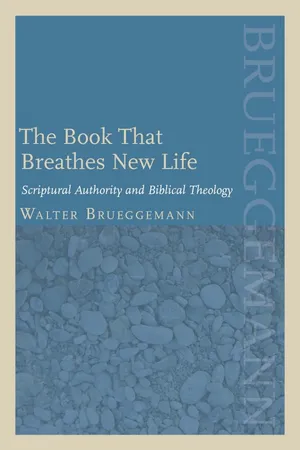
eBook - ePub
Book that Breathes New Life
Scriptural Authority and Biblical Theology
- 252 pages
- English
- ePUB (mobile friendly)
- Available on iOS & Android
eBook - ePub
About this book
Trusted by 375,005 students
Access to over 1.5 million titles for a fair monthly price.
Study more efficiently using our study tools.
Information
Topic
Theology & ReligionSubtopic
ReligionII.
Old Testament Theology in the Twentieth Century
CHAPTER FOUR
Twentieth-Century Old Testament Studies
A Quick Survey
The contours of Western cultural history through the twentieth century are in large sweep identifiable: an initial moment of innocence until 1914, the willful barbarism of the two wars (1914–1945), the long tense stand-off of the cold war (1945–1989), and a final decade of localism in the presence of “the last superpower” (1989–2000). I do not suggest that the story of critical Old Testament study is dictated or controlled by the forces of public history. But neither does this particular tale of scholarship exist in a vacuum, without reference to context. In reviewing and assessing such scholarship, it is important to remember that scholarship is conducted by real people who live in the real world with its immense gifts and dangers.
I
Old Testament studies at the outset of the twentieth century were completely dominated by the historical methods and synthesis of the nineteenth century. Julius Wellhausen’s great book of synthesis was at the turn of the century only twenty years old, and it largely carried the field.1 Indeed, the force of nineteenth-century scholarship continued well into the mid-twentieth century, and it continues to exercise important influence even now. That nineteenth-century synthesis had, of course, reached certain “consensus” conclusions on substantive issues, most notably the “documentary hypothesis” concerning the formation of the Pentateuch.
The defining power of that scholarship, however, is not so much in the substantive conclusions it reached, but in the way in which it legitimated the asking of certain questions. Nineteenth-century scholarship, in almost every intellectual discipline, had come to regard historical issues as primary; not surprisingly, Old Testament study was at the time largely a historical enterprise, asking not only “What happened?” but “When was it written?” The governing assumption was that historical context would decisively illuminate the intent of the text.
Two subpoints need to be noticed under the unchallenged dominance of a historical perspective. First, nineteenth-century history was premised on an assumption of progressive, unilateral evolution within the dynamic interpretive categories of Hegel, Marx, Darwin, and Freud. That is, everything was understood to develop from the simple to the complex, from the primitive to the sophisticated. It was no stretch then for the religion of ancient Israel to be understood as a movement from the “mythical” to the “ethical,” reflected in the “development of God” and the presentation of God from J through E to DP. Second, such a developmental approach, shared by almost all critical scholars, had the effect of making every religious claim relative to context and sure to be superseded by the next new development. This perspective dissolved all normative claims of the text, and rendered normative theological reflection almost impossible. Indeed, this phase of scholarship is completely lacking in what has since come to be seen as theology of the Old Testament.
II
It is impossible to overstate the importance of Karl Barth for the altered shape of Old Testament studies in the mid-twentieth century. As is well known, Barth, in the context of World War I, published his radical summons to theological reflection and theological obedience in his Romans commentary of 1919.2 It was Barth’s insistence that scholarly interpretation must break from liberal relativism and must voice normative theological claims that provide a theological place to stand against the emerging barbarism of Europe. Barth’s urgency in the wake of World War I was only made more urgent by the rise of National Socialism in Germany in the 1930s, against which Barth stood immovably.
Barth had no particular interest in Old Testament studies per se, but he did trenchantly observe that historical-evolutionary interpretation and the niceties of critical scholarship must not stand as an impediment to decisions about the theological claims of the Bible made for the God who is offered in the testimony of ancient Israel and in the confession of the early church. Barth’s daring challenge became a decisive turning point for Old Testament studies. He attracted to his urgent theological enterprise a great company of those who would become the most influential and defining Old Testament scholars in the next generation, since until midcentury Old Testament studies of a critical kind were largely a German enterprise. For some, of course, Barth’s break with nineteenth-century evolutionary thought was too radical, too theological, too authoritarian. He was emphatically not followed by all scholars. Those who did not follow his daring challenge by and large continued the evolutionary-historical scholarship of the previous century.
III
We may observe that the 1930s, the time of Barth’s most spectacular theological thought, was a period of uncommon generativity in Old Testament studies, a generativity that was to govern the next decades in the discipline.3 We may identify two developments that lived in considerable tension with each other.
First, Barth’s influence evoked and legitimated important efforts at “Old Testament theology,” attempts at stating the God-claims of the Old Testament in some-coherent fashion. Two scholarly efforts have been most influential. Walther Eichrodt, a Calvinist scholar and colleague of Barth at Basel, published a three-volume theology of the Old Testament.4 This effort was an immense breakthrough against the dominance of evolutionary relativity. While Eichrodt paid attention to “developmental” matters, he was concerned to identify the abiding “constancies” of faith that endure in flexible and resilient ways through every stage of religious development. He found these constancies under the rubric of “covenant,” that is, the durable God–Israel, God–world relationship that is definitional for the faith of Israel in the Old Testament. Eichrodt made use of old and proven Calvinist categories.5 In the 1950s, under the impetus of George Mendenhall and Klaus Baltzer, the idea of covenant came to a dominant position in much critical Old Testament interpretation.6
The second and more influential effort at Old Testament theology was by Gerhard von Rad, who wrote two volumes in the 1950s on the basis of essays he had written already in the 1930s.7 Just prior to his death in 1971, von Rad published Wisdom in Israel, a book that constituted something of a third volume to his theology.8 In his first and most important volume, von Rad proposed that Old Testament theology consists in the endless, ongoing recital of “God’s mighty deeds in history.” By this formulation, von Rad was able to focus theology on a distinct inventory of God’s “miracles” in the life of Israel, and was able to attend to the “historical” issues related to those “historical miracles.” In this way he made room for the dynamic processes in the continuing development of the classic and stylized recital on the lips of Israel.
It is impossible to overstate the emancipatory power of von Rad’s work, which exercised immense impact in the United States as well as in Europe. It was only later noticed that von Rad had not at all resolved the vexed relationship between the relativity of history and the normativeness of theological claim. In dealing with that issue, he averred:
Historical investigation searches for a critically assured minimum—the kerygmatic picture tends towards a theological maximum.9
Indeed, it is not clear that a resolution of the issue identified by Lessing is possible. This lack of resolution was to continue to haunt Old Testament interpretive work with its legacy of nineteenth-century historicism.
IV
While the theological proposals of Eichrodt and von Rad are the most noticed and enduring German-Swiss contributions, and while conventional historical-critical work continued, a very different enterprise emerged in the United States under the leadership of William Foxwell Albright. This brilliant researcher at Johns Hopkins University almost single-handedly fashioned archaeology to be a credible scientific way to investigate the historical antecedents of the Old Testament.10 By his excavations in Palestine in the 1930s, his creative powers matched to his vast learning, Albright formulated methods of research that could be replicated in various digs and assessed on common ground by other scholars. His methods came to be shared by a number of scholars, most especially his brilliant cadre of students who came to dominate Old Testament studies in the United States for over a generation.
The product of Albright’s work, summarized and popularized by John Bright in his much-used A History of Israel, was a consensus presentation of Israelite history that in large measure showed the biblical record to be historically reliable.11 In retrospect, subsequent scholars have been able to see that Albright’s work proceeded too much on the grounds of historical positivism to be well connected to theological claim. There is, moreover, the current suggestion that Albright set out to “prove” the Bible in a way that undermines claims to historical objectivity.12 Be that as it may, the methods of archaeology at midcentury dominated much U.S. scholarship and offered assurance of the historical reliability of the biblical account of Israel’s past. While Albright broke decisively with the evolutionary assumptions of the nineteenth century, he continued to be focused primarily upon issues of historicity.
V
These twin developments in the 1930s—post-Barthian articulations of normative theological claims and Albrightian claims of historical reliability—dominated the field of Old Testament studies. It may be observed that there was a good deal of tension between these two enterprises; while that tension was voiced and noticed (especially from the Albrightian side), it is now clear that both approaches were deeply concerned with the normative authority of the Bible that was to be established by insisting upon its early dating of historical traditions. Neither approach could break with historical bases for theological claims.
The key figure in U.S. Old Testament studies at midcentury was George Ernest Wright, a Presbyterian teacher who established the premier Old Testament program in the United States at Harvard in the 1950s. Wright was a foremost student of Albright, and he himself led important excavations and wrote extensively on archaeological matters.13 At the same time, Wright emerged as a foremost theological interpreter of the Bible. He published a series of monographs that exercised immense influence, most notably God Who Acts and The Old Testament against Its Environment.14 Wright’s primary theological point was to insist upon the profound and intentional distinctiveness of YHWH as the God of Israel, and derivatively to show that Israel, as the people of God, lived in the world with a distinct identity and a distinct ethic that we may at every point contrast with “Canaanite religion.” It is evident that Wright’s account of Israel’s faith stands in important continuity with Barth’s rejection of “religion,” even as Wright polemicized against “Canaanite religion.”
In retrospect one may see some irony in Wright’s work, for his archaeological leaning appealed to the evidence of borrowings from context, but his theological work in every way possible contrasted Israel with context. In any case, Wright’s great synthetic work, scientifically informed and theologically propelled, came to dominate the scholarly enterprise and to exercise immense influence more popularly in the life of the church in the United States that flourished in the 1950s. (I should note that after the papal encyclical of 1943, granting freedom to engage in critical scholarship, Roman Catholic scholars began also to participate in the critical enterprise.15 Given the differences due to confessional awareness, it is fair to say that Roman Catholic scholars participated in the same scholarly work that had heretofore been the domain of Protestants.)
The main lines of influence, in terms of assumptions and methods, that emerged in the 1930s—theological and archaeological—continued to dominate the field through the 1960s. The scholarly synthesis that arose out of these twin perspectives resulted in a great revival of interest in biblical study in seminaries and in graduate programs, a revival in the churches, and the beginning of a new season of publication, most of which sought to move from evolutionary historical concerns to the normative theological claims now celebrated from the text. The decades of the 1950s and 1960s were a time of stability, confidence, and positive energy in the field.
VI
The end of the 1960s and the decade of the 1970s were, of course, a time of great upheaval in the United States and in western Europe. This was the time of the civil rights movement, the Vietnam War, and the Watergate hearings. Perhaps the pivotal symbolic moment was the student revolts in Paris in 1968, matched in this country by the disastrous Democratic convention in Chicago in the same year. Many things came to a decisive and brutal ending in these years, most especially a widespread readiness to accept ...
Table of contents
- Cover
- Title
- Copyright
- Dedication
- Contents
- Editor’s Foreword
- Preface
- Acknowledgments
- I. Biblical Authority
- II. Old Testament Theology in the Twentieth Century
- III. A Conversation with Other Theologians
- Abbreviations
- Notes
- Index of Names
- Index of Biblical References
Frequently asked questions
Yes, you can cancel anytime from the Subscription tab in your account settings on the Perlego website. Your subscription will stay active until the end of your current billing period. Learn how to cancel your subscription
No, books cannot be downloaded as external files, such as PDFs, for use outside of Perlego. However, you can download books within the Perlego app for offline reading on mobile or tablet. Learn how to download books offline
Perlego offers two plans: Essential and Complete
- Essential is ideal for learners and professionals who enjoy exploring a wide range of subjects. Access the Essential Library with 800,000+ trusted titles and best-sellers across business, personal growth, and the humanities. Includes unlimited reading time and Standard Read Aloud voice.
- Complete: Perfect for advanced learners and researchers needing full, unrestricted access. Unlock 1.5M+ books across hundreds of subjects, including academic and specialized titles. The Complete Plan also includes advanced features like Premium Read Aloud and Research Assistant.
We are an online textbook subscription service, where you can get access to an entire online library for less than the price of a single book per month. With over 1.5 million books across 990+ topics, we’ve got you covered! Learn about our mission
Look out for the read-aloud symbol on your next book to see if you can listen to it. The read-aloud tool reads text aloud for you, highlighting the text as it is being read. You can pause it, speed it up and slow it down. Learn more about Read Aloud
Yes! You can use the Perlego app on both iOS and Android devices to read anytime, anywhere — even offline. Perfect for commutes or when you’re on the go.
Please note we cannot support devices running on iOS 13 and Android 7 or earlier. Learn more about using the app
Please note we cannot support devices running on iOS 13 and Android 7 or earlier. Learn more about using the app
Yes, you can access Book that Breathes New Life by Walter Brueggemann in PDF and/or ePUB format, as well as other popular books in Theology & Religion & Religion. We have over 1.5 million books available in our catalogue for you to explore.