- 222 pages
- English
- ePUB (mobile friendly)
- Available on iOS & Android
eBook - ePub
About this book
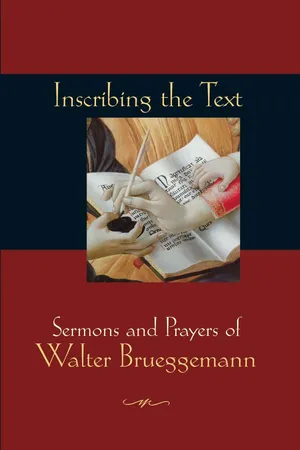
This volume contains the most recent collection of Walter Brueggemann's sermons and prayers.
Information
Topic
Theology & ReligionSubtopic
ReligionOn Reading Psalm 1
You voice the worlds into being,
You voice the church into obedience,
You voice us, now and then, into newness,
You speak and call into existence that which does not exist.
You speak and address us,
and make all things new.
And we should answer you:
we in our shabbiness before your splendor,
we in our timidity before your magnificence,
we in our poverty before your wealth,
we in our foolishness before your wisdom.
We stammer and stutter and pause and parry,
silent, mute, reluctant,
with only one gift back to you—that of tongue.
So for our tongues—thousands and thousands of them,
we give you thanks:
that we may speak back to you your wonder,
that we may sing back to you your presence,
that we may vow back to you our obedience.
You speak and we are,
You listen and we are voiced,
always again on our way rejoicing. Amen.
June 17, 2002 (Montreat)
On Signal: Breaking the Vicious Cycles
Leviticus 25:8–24; Isaiah 61:1–4; Luke 4:16–30
My father-in-law, Patrick D. Miller, was a distinguished Presbyterian minister—pastor at Druid Hills Church, denominational executive, and moderator of the General Assembly. One day he and I were discussing how to translate the Lord’s Prayer … “forgive us our trespasses, forgive us our sins, forgive us our debts.” He said, only half joking, “I would rather have my debts forgiven than my sins.” Of course, he was a Calvinist, and Calvinists are the ones who think most about money and loans and debts, and interest, and taxes, and capital gains, and wealth. In such a world, forgiveness of debts matters a lot.
Long before my father-in-law, Moses—probably a secret Calvinist—announced to Israel God’s will for money and property, one of the most distinctive marks of biblical ethics. It is called Jubilee. Moses—the secret Calvinist—declared as God’s will: every fifty years you must give back to the people the land and property that is inalienably theirs that they have lost in the rough and tumble of the economy. You must give it back, even if you own it legally and it is properly yours. You must give it back, because in the end it is theirs and not yours, inalienably. The start of the occasion for the return of property is signaled by a trumpet, in Hebrew yabal, from which we get Jubilee, Jubilation, a huge celebration of bringing things back to where they ought to be. So imagine, when the yabal sounds, when the signal is given, everybody returns property, everybody cancels debts, everybody breaks off the mad scramble of accumulation and acquisition. It is a signal not unlike the great gavel that ends the fury of Wall Street every day, only it signifies something very different. At the center of biblical faith is a command from God that curbs economic transactions by an act of communal sanity that restores everyone to proper place in the economy, because life in the community of faith does not consist in getting more but in sharing well. We focus on Jubilee because this is Trinity’s fiftieth year (Trinity Presbyterian Church, Atlanta, Georgia), and the yabal is sounding in Trinity; when we hear it we think “Jubilee.” I want to tell you three things about Jubilee as you ponder how Trinity should practice it at the end of fifty glorious years.
I
Jubilee is a concrete, material, economic act that is undertaken with discipline and intentionality. It is not just a kind thought or a good intention or a religious idea. It is about money and property being transferred. That preoccupation with money and property is central to biblical faith. One could think that the Bible is all about sex. In truth, the Bible is much more concerned with money and property than it is about sexuality. And at the center of its economic teaching is this business of Jubilee.
While those old folk did not know about the intricacies of the modern market and moving wealth by electronic means, they knew all about commerce. Indeed, it is likely that the word “Canaanite,” the ones feared the most by Israel, means “traders” who bought and sold and moved money and goods. When Moses wanted to state the distinctive mark of Israel alongside the Canaanites, he knew that the distinction is not territorial or ethnic or linguistic. It is ethical. Moses observed the working of the market, the practice of accumulation and acquisitiveness and greed and monopoly. He observed, as anyone can see, that in the long run the operations of accumulation and acquisitiveness tend to monopoly, so that some end up with a lot and some end up with a little or with none, have and have-nots, wealth and poverty. And what Moses figured out is that such a process is an impossible way to run a community. And so he announces in that long speech in Leviticus 25, at the end of forty-nine years of accumulation, the property will be returned to its proper owners (vv. 27–28). The land cannot be sold to perpetuity (v. 23), that is, irreversibly, because the land belongs to God and not to the accumulators. God wants the little ones, who always lose in the market game, to have their stuff. When the signal is given, the vicious cycles of accumulation are broken, wealth is divested back to the ones who do not have it. It is an act of divestment.
II
This practice of divestment on signal is exceedingly difficult, and folks do not want to do it. It is the most difficult, most demanding, most outrageous requirement of biblical faith. It surely seems so in the modern world with our deep practices of accumulation and our intense yearning to have ours and keep ours and make it grow. Indeed, in all my teaching of the Bible, when this subject comes, somebody—seminarian, pastor, lay person—inevitably asks and wants to be reassured, “There is no evidence that they really did this, is there?” But it is not really a question. It is an act of resistance. Because we do not want to divest for the sake of someone else. I do not want to return to someone else what I have been able to acquire. What is mine is not his! It is likely here, more than anywhere, that the Bible questions our usual assumptions about our life in the world.
The command, however, is no more objectionable now than it was then. In a related law, Moses chides Israel:
Be careful that you do not entertain a mean thought, thinking, the year of release is near and therefore view your needy neighbor with hostility and give nothing … do not consider it a hardship. (Deut 15:9, 18)
But the most dramatic resistance to Jubilee is reported in Luke 4. Jesus came to the synagogue and read the scripture lesson from Isaiah 61:
He has sent me to proclaim release to the captives … to let the oppressed go free, to proclaim the year of the Lord’s favor.
What this text is doing is proclaiming Jubilee, “the year of the Lord’s favor.” To let the oppressed go free is to cancel debts, to let the poor back into the economy with their rightful stuff. And then he made it worse; he said, “Today this scripture has been fulfilled in your hearing.” What he meant was, “I am the Jubilee. Isaiah wrote about it. I am going to enact it.” And he set about giving social power and social access and social goods to the poor and excluded. And says Luke, “They were filled with rage.” They tried to kill him by throwing him off a cliff, and he barely escaped. They did not want to hear about the Jubilee that would curb their accumulation, not even for Jesus. It is a hard command.
III
The only reason one might obey such a hard command that is concrete, material, and economic divestment is that we have a different, large vision of the future. We know what is promised and what will be, by the power of God. The command is to serve the great social vision of the Gospel, because that vision of God will only become reality when there is enough human obedience. This vision of God is not a vision of accumulation and monopoly so that those who have the most when they die win. This vision of God’s future is not about angels who have gone to heaven floating around in the sky with their loved ones. This vision, rather, is about God’s kingdom coming on earth as it already is in heaven. God’s rule where the practices of justice and mercy and kindness and peaceableness are every day the order of the day. It is a vision of the world as a peaceable neighborliness in which no one is under threat, no one is at risk, no one is in danger, because all are safe, all are valued, all are honored, all are cared for. And this community of peaceableness will come only when the vicious cycles of violent accumulation are bro...
Table of contents
- Cover
- Title Page
- Copyright
- Dedication
- Contents
- Editor’s Foreword
- Acknowledgments
- On Generosity
- The Preacher as Scribe
- On Reading the Old Testament
- Waiting in Central Casting
- On Reading Psalm 1
- On Signal: Breaking the Vicious Cycles
- On Reading Psalm 116
- Strategies for Humanness
- On Reading Psalm 104
- On People Who Do “Great Things”
- On Reading Psalms 50, 88, 109
- Uttered beyond Fear
- On Reading Genesis 12–25
- A Fourth-Generation Sellout
- On Reading Genesis 25–50
- Misreading the Data
- On Enthronement Psalms
- Disciples of the Great Connector
- On Reading Kings
- What a Difference Mercy Makes
- On Reading Psalm 2
- Newness from God that Unlearns Family
- On Reading Joshua and Judges
- One Exorcism, One Earthquake, One Baptism … and Joy
- On Reading Psalm 5
- The Stunning Outcome Of a One-Person Search Committee
- On Reading Psalm 4
- Dreaming with Freedom midst Chaos
- On Reading Exodus 1–15
- Joined in Suffering … Reliant on God’s Power
- On Beginning Lament Psalms
- Missing by Nine Miles
- On Reading Samuel
- The Big Yes
- On Reading the Sinai Pericope
- Saints Remembered and Saints to Come
- On Reading Psalm 3
- The Secret of Survival
- On Reading Jeremiah 1
- Variations from the Barrio
- On 9/11: One Year Later
- Shrill Faith for the Nighttime
- On Reading Jeremiah 2
- Bragging about the Right Stuff
- On Reading Jeremiah 3
- “Until” … Endlessly Enacted, Now Urgent
- On Reading Jeremiah 4
- A Resurrection Option
- On Reading Jeremiah 5
- First Class in Psalms
- Index of biblical references
Trusted by 375,005 students
Access to over 1.5 million titles for a fair monthly price.
Study more efficiently using our study tools.
Frequently asked questions
Yes, you can cancel anytime from the Subscription tab in your account settings on the Perlego website. Your subscription will stay active until the end of your current billing period. Learn how to cancel your subscription
No, books cannot be downloaded as external files, such as PDFs, for use outside of Perlego. However, you can download books within the Perlego app for offline reading on mobile or tablet. Learn how to download books offline
Perlego offers two plans: Essential and Complete
- Essential is ideal for learners and professionals who enjoy exploring a wide range of subjects. Access the Essential Library with 800,000+ trusted titles and best-sellers across business, personal growth, and the humanities. Includes unlimited reading time and Standard Read Aloud voice.
- Complete: Perfect for advanced learners and researchers needing full, unrestricted access. Unlock 1.5M+ books across hundreds of subjects, including academic and specialized titles. The Complete Plan also includes advanced features like Premium Read Aloud and Research Assistant.
We are an online textbook subscription service, where you can get access to an entire online library for less than the price of a single book per month. With over 1.5 million books across 990+ topics, we’ve got you covered! Learn about our mission
Look out for the read-aloud symbol on your next book to see if you can listen to it. The read-aloud tool reads text aloud for you, highlighting the text as it is being read. You can pause it, speed it up and slow it down. Learn more about Read Aloud
Yes! You can use the Perlego app on both iOS and Android devices to read anytime, anywhere — even offline. Perfect for commutes or when you’re on the go.
Please note we cannot support devices running on iOS 13 and Android 7 or earlier. Learn more about using the app
Please note we cannot support devices running on iOS 13 and Android 7 or earlier. Learn more about using the app
Yes, you can access Inscribing the Text by Walter Brueggemann in PDF and/or ePUB format, as well as other popular books in Theology & Religion & Religion. We have over 1.5 million books available in our catalogue for you to explore.