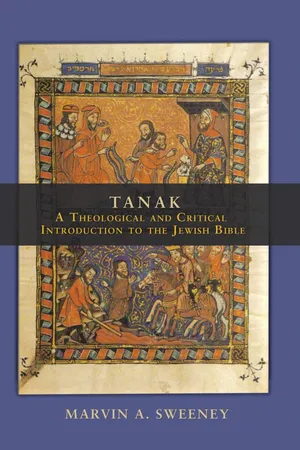
Though "biblical theology" has long been considered a strictly Christian enterprise, Marvin A. Sweeney here proposes a Jewish theology of the Hebrew Bible, based on the importance of Tanak as the foundation of Judaism and organized around the major components: Torah, Nevi'im (Prophets), and Kethuvim (Writings). Sweeney finds the structuring themes of Jewish life: the constitution of the nation Israel in relation to God; the disruption of that ideal, documented by the Prophets; and the reconstitution of the nation around the Second Temple in the Writings. Throughout he is attentive to tensions within and among the texts and the dialogical character of Israel's sacred heritage.
- 464 pages
- English
- ePUB (mobile friendly)
- Available on iOS & Android
eBook - ePub
About this book
Information
Topic
Theology & ReligionSubtopic
ReligionPart I
Introduction
A. THE TANAK AS THE FOUNDATION OF JUDAISM
THE TANAK, OR THE JEWISH BIBLE, stands as the quintessential foundation for Jewish life, identity, practice, and thought from antiquity through contemporary times. The five books of the Torah, or the Instruction of G-d to the Jewish people and the world at large, constitute the foundation of the Tanak. According to Jewish tradition (Exod 19–Num 10), the Torah was revealed to the nation Israel at Mount Sinai while the people were journeying from Egypt through the wilderness of Sinai on their way to return to the land of Israel to take up residence in the land promised by G-d to their ancestors, Abraham and Sarah; Isaac and Rebecca; Jacob, Rachel and Leah; and the twelve sons of Jacob. The four books of the Nevi’im Rishonim, or the Former Prophets, provide an account of Israel’s life in the land from the time of the conquest under Joshua until the time of the Babylonian exile, when Jerusalem and the Temple were destroyed and Jews were exiled to Babylonia and elsewhere in the world. The four books of the Nevi’im Ahronim, or the Latter Prophets, provide an assessment of the reasons why G-d chose to exile Jews from the land of Israel and the scenarios by which G-d would choose to restore Jews to the land of Israel once the exile was completed. The eleven books of the Ketuvim, or the Writings, include a variety of books of different form and purpose that address various aspects of Jewish worship, critical thought, future expectations, history, and life in the world, both in the land of Israel and beyond.
The Torah and the other books of the Tanak hardly stand as the exclusive foundation for Judaism. The Torah is read in continuous conversation with the other books of the Prophets and the Writings, and the Tanak as a whole is read in continuous conversation with the other writings of Judaism, such as the Rabbinic literature of the Talmuds, the Midrashim, the Targums, and the speculative or mystical literature; the medieval and modern works of Jewish liturgy, halakhah, commentary, philosophy, Kabbalah, and Hasidism. With regard to the books of the Tanak, it is not clear that all of them were intentionally composed for the purpose of intertextual dialogue among them, but their inclusion in the Tanak requires that they be read as such in Jewish tradition. With regard to the Tanak and the rest of Jewish tradition, it is not clear that the Tanak was composed to be in intentional dialogue with the later works, but it is clear that most of the later writings were intentionally composed to be in dialogue with the Torah and the rest of the Tanak to some degree. In order to understand that dialogue fully, it is essential to understand the literature of the Torah and the rest of the Tanak in and of itself, recognizing that the Tanak cannot function as a complete and self-contained revelation analogous to the manner in which the Old and New Testaments are read in much of Protestant Christianity. The Torah and the rest of the Tanak are the foundation of Jewish tradition, but the Tanak cannot be viewed as complete in Judaism without ongoing dialogue with the rest of the tradition that constitutes Judaism throughout its history and into the future.
In an effort to interpret the Tanak as the foundational sacred scriptures of Judaism, this volume proposes a systematic critical and theological study of the Jewish Bible. It draws upon the Christian discipline of biblical or Old Testament theology, although its aims and presuppositions are very different, in large measure due to the different aims and presuppositions of Judaism and Christianity. It is critical insofar as it draws heavily on modern critical study of the Bible, although throughout the volume it will be clear that the critical foundations must themselves be self-critically examined at every point in order to provide a secure basis for theological assessment of the biblical works. The reason for such self-critical analysis lies in the fact that modern interpreters are so frequently influenced by their own religious and cultural traditions in reading the Bible and making claims for what the Bible has to say. It is theological insofar as it attempts to discern the theological viewpoints articulated by the biblical texts by close attention to its formal linguistic features and modes of expression, its historical and cultural contexts, and its willingness to grapple with the major theological, hermeneutical, and historical questions of its time. At the same time, this work recognizes that the process of reading biblical literature necessarily entails construction of the biblical text by readers who bring their own worldviews and presuppositions to the interpretative task. It is also theological insofar as it includes dialogue with the Jewish tradition at large. Such an interpretative stance recognizes that the interpretations offered in this work are nothing more than that. They are interpretations of the Bible that may or may not withstand the test of critical scrutiny and that may or may not be accepted as correct, useful, insightful, or even complete. As such, they are part of the ongoing dialogue that has taken place among the Jewish people—and among all interpreters of the Tanak at large—from the time that the books of the Tanak were first written and read. On that basis, a systematic critical and theological assessment of the Tanak provides foundations for dialogue with the rest of the Jewish tradition and perhaps also for dialogue with other Jewish and non-Jewish interpreters of the Bible.
B. CHRISTIAN OLD TESTAMENT THEOLOGY
Jon Levenson argues that Jews are not interested in biblical theology because the field is inherently Christian and because so much of its teaching is antithetical to that of Judaism if not outright anti-Jewish.1 To a certain degree, he is correct. Biblical and Old Testament theology are quintessentially Christian theological disciplines designed to address questions of Christian theological thought, particularly the interrelationship between the biblical text as read in Christianity and the formulation of dogmatic or systematic Christian theological teachings that play such an important role in Christian life and thought. Judaism does not rely on systematic theology or doctrines in quite the way that Christianity does. Instead, Jewish interpreters pay close attention to the details of the biblical text in an effort to discern the various aspects of its meaning and its impact on Jewish life and thought. Nevertheless, Christian biblical and Old Testament theology provide a model of systematic interpretation of the Bible from which Jewish biblical interpretation may benefit. Although Christian efforts at such systematic interpretation of the whole of the Christian Bible or the Old Testament are not always successful, the question raised by the field—viz., to what degree can the Old Testament as a whole be interpreted?—is a valid question that may be asked by Jews of the Tanak. Biblical theology provides a synthetic overview of the interpretation of the Bible that aids interpreters in understanding the Bible at its most general and overarching levels. That is not to say that detailed exegesis of individual passages is no longer necessary; rather, biblical theology is ideally based on the detailed exegesis of individual passages that contribute to the overall interpretation of the biblical text. For Jews, biblical theology provides the means to incorporate the interpretation of the individual passages of the Tanak into an overarching scheme that will facilitate fuller understanding of the interpretation of the Tanak at large. Such an effort has the potential to provide Judaism with a fuller reading of its foundational scriptures. It also has the potential to provide similar insight to non-Jewish readers via a Jewish reading of the biblical text that is frequently quite distinct from Christian (or Muslim) readings of the same.
A brief and selective survey of the field of Christian biblical or Old Testament theology illustrates both Levenson’s concerns about the field and the possibilities that a Jewish biblical theology might offer.2
The origins of biblical theology appear in the 1787 inaugural lecture of Johan P. Gabler, “An Oration on the Proper Distinction between Biblical and Dogmatic Theology and the Specific Objectives of Each,” which celebrated Gabler’s appointment to the faculty of the University of Altdorf.3 Gabler took up a problem faced by Protestant theologians concerning the interrelationship between interpretation of the biblical text and dogmatic theology as the foundations for Christian thought and practice. Although the Protestant Reformation, initiated by Martin Luther in the early sixteenth century, asserted the principle of sola scriptura, “scripture alone,” as the foundation for Christian thought, dogmatic theology, derived from a combination of scriptural interpretation and human reason, actually governed the formation of Protestant theology, often confusing the boundaries between the two fields and giving ascendancy to dogmatic theology. The issue was exacerbated by the question of the interrelationship between the New Testament and the Old Testament, particularly because the New Testament so frequently overrode the Old Testament in Christian thought, thereby undermining the status of the Old Testament as sacred scripture. Gabler argued that interpreters must distinguish between historical and universal concerns or between human and divine concerns. In Gabler’s understanding, the Bible provided a combination of historical/human and universal/divine concerns that must be considered in the development of Christian dogmatic theology. That is, the Bible would have to be analyzed to determine which of its elements were historical/human and which were universal/divine and therefore fit for the development of dogmatic theology. Of course, Christian doctrines concerning G-d, Christ, sin, and salvation would be considered universal/divine in Gabler’s reckoning; other aspects, such as Esther’s portrayal of divine absence at a time of threat to the Jewish people, would be considered historical or human and therefore less influential in the development of Christian doctrine. Gabler did not offer further writings on the field of biblical theology, but his essay nevertheless inaugurated the field and defined its basic parameters for well over a century.
Throughout much of the nineteenth and early twentieth centuries, the field of biblical theology focused especially on Gabler’s distinction between the historical and the universal, as well as the interrelationship between the Old Testament and the New Testament. The New Testament was generally given theological priority since it spoke directly of Christ as the foundation for Christianity, and the Old Testament tended to be treated as a historical document that paved the way forward for the New Testament. The historically oriented source-critical research of the time, identified especially with Julius Wellhausen, and the prevailing anti-Semitism of the period played important roles delegitimizing major portions of the Old Testament as historical.4 Wellhausen’s schema for the formation of the Pentateuch and the development of Israelite religion posited a progressive decline in which the early J source of the Pentateuch presented face-to-face encounters between human beings and G-d, much like the Prophets, whereas the later E, D, and P sources displayed increasing distance between G-d and humanity, culminating in the Priestly source which, in Wellhausen’s view, focused on issues of ritual, law, and the self-interests of the priesthood at the expense of an authentic relationship between G-d and human beings. Thus, the priesthood represented the particularism of Judaism, which ultimately produced Rabbinic Judaism, while works such as Deutero-Isaiah represented the universalism of Judaism, which would culminate in the development of Christianity as the true fulfillment of the Old Testament. Wellhausen viewed himself as a historian, but his work and that of his followers had tremendous impact on the field of biblical theology, which increasingly set aside historical elements of the particularistic Old Testament in favor of the so-called universal elements that would be found in the New Testament. Many biblical theologians would therefore focus on ...
Table of contents
- Cover
- Title Page
- Copyright
- Contents
- Acknowledgements
- Abbreviations
- Part I. Introduction
- Part II. The Torah
- Part IIIA. The Former Prophets
- Part IIIB. The Latter Prophets
- Part IV. The Ketuvim/Writings
- Part V. Conclusion
- Bibliography
- Index of Authors Cited in the Text
- Index of Subjects
Trusted by 375,005 students
Access to over 1.5 million titles for a fair monthly price.
Study more efficiently using our study tools.
Frequently asked questions
Yes, you can cancel anytime from the Subscription tab in your account settings on the Perlego website. Your subscription will stay active until the end of your current billing period. Learn how to cancel your subscription
No, books cannot be downloaded as external files, such as PDFs, for use outside of Perlego. However, you can download books within the Perlego app for offline reading on mobile or tablet. Learn how to download books offline
Perlego offers two plans: Essential and Complete
- Essential is ideal for learners and professionals who enjoy exploring a wide range of subjects. Access the Essential Library with 800,000+ trusted titles and best-sellers across business, personal growth, and the humanities. Includes unlimited reading time and Standard Read Aloud voice.
- Complete: Perfect for advanced learners and researchers needing full, unrestricted access. Unlock 1.5M+ books across hundreds of subjects, including academic and specialized titles. The Complete Plan also includes advanced features like Premium Read Aloud and Research Assistant.
We are an online textbook subscription service, where you can get access to an entire online library for less than the price of a single book per month. With over 1.5 million books across 990+ topics, we’ve got you covered! Learn about our mission
Look out for the read-aloud symbol on your next book to see if you can listen to it. The read-aloud tool reads text aloud for you, highlighting the text as it is being read. You can pause it, speed it up and slow it down. Learn more about Read Aloud
Yes! You can use the Perlego app on both iOS and Android devices to read anytime, anywhere — even offline. Perfect for commutes or when you’re on the go.
Please note we cannot support devices running on iOS 13 and Android 7 or earlier. Learn more about using the app
Please note we cannot support devices running on iOS 13 and Android 7 or earlier. Learn more about using the app
Yes, you can access TANAK by Marvin A. Sweeney in PDF and/or ePUB format, as well as other popular books in Theology & Religion & Religion. We have over 1.5 million books available in our catalogue for you to explore.