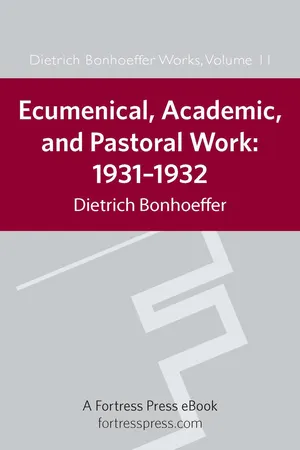
Volume 11 in the sixteen-volume Dietrich Bonhoeffer Works English Edition, Ecumenical, Academic, and Pastoral Work: 1931-1932, provides a comprehensive translation of Bonhoeffers important writings from 1931 to 1932, with extensive commentary about their historical context and theological significance. This volume covers the significant period of Bonhoeffer's entry into the international ecumenical world and the final months before the beginning of the National Socialist dictatorship. It begins with Bonhoeffer's return to Berlin in June 1931 after his year of study in the United States. In the crucial period that followed, Bonhoeffer continued his preparations for the ministry, began teaching at Berlin University, and became active at international ecumenical meetings. His letters and lectures, however, also document the economic and political turbulence on the European and world stage, and Bonhoeffer directly addresses the growing threat of the Nazi movement and what it portends not only for Germany, but for the world. Several of the documents in this volume, particularly the student notes of his university lecture on "The Nature of the Church" and his lectures on Christian ethics, give important insights into his theology at this point. His ecumenical lectures and reports are significant documents for understanding the ecumenical debates of this period.
eBook - ePub
Ecumenical, Academic, and Pastoral Work
1931-1932 Dietrich Bonhoeffer Works
- 576 pages
- English
- ePUB (mobile friendly)
- Available on iOS & Android
eBook - ePub
Ecumenical, Academic, and Pastoral Work
1931-1932 Dietrich Bonhoeffer Works
About this book
Trusted by 375,005 students
Access to over 1.5 million titles for a fair monthly price.
Study more efficiently using our study tools.
Information
Topic
Theology & ReligionSubtopic
Christian TheologyA. Reports on Ecumenical Work
Late 1931
Late 1931
1. Report on a Conference of the World Alliance in Cambridge[1]
The International Conference of the World Alliance for Promoting
International Friendship through the Churches
in Cambridge (September 1–5, 1931)
International Friendship through the Churches
in Cambridge (September 1–5, 1931)
Those who view the World Alliance with disinterest or resentment[2] should take the opportunity either to confirm their judgment based on the results of the Cambridge meeting or to revise it. The forthcoming disarmament conference in Geneva[3] and the world crisis,[4] whose problems are not insignificantly related to it, dictated the theme of the conference for the assembled representatives of the churches. In the disarmament question, which was the banner under which the conference took place, the important thing for the churches was not primarily the political debate among the nations that were particularly affected by it, but rather the question whether the nations[5] that are presently rearming will be resolved to stand by their given word (in Article 8 of the League of Nations covenant[6] and in the Preamble of Part V of the Versailles treaty)[7] or whether, by breaking their word,[8] the first attempt toward a moral order in international relations among nations[9] shall hopelessly collapse. At the very edge of the abyss of yet another complete moral chaos in the lives of the nations, the churches are standing firm and summon all to truthfulness and faithfulness, to respect and honor the foresworn promise. The honor of the rearming nations and the justice of this cause are at stake. The English and the Americans expressed this at the conference with unparalleled clarity. Even the French presentation on the disarmament question was in agreement with this thinking and, furthermore, was characterized by an extension of the concept of securité as a fundamental international principle, as opposed to their previously narrower version. This included a clear recognition of the justice of the German position, which means that an attempt was made to engage with deep sincerity on the level of unconditional equality of rights that serve the common cause. In this way, the conference was able to issue the proclamation unanimously to the churches of the world that, in its conviction, war as a means of settling international disputes contradicts the spirit (“mind and method”!)[10] of Christ and his church. Further, the conference called for (1) a substantial reduction in armaments of every form down to the lowest level; (2) reasonable and just relations between the armed peoples; and (3) security for all peoples against potential attacks. This message is to be advocated publicly by the churches, and the regional governments should place their full support along these lines.
It will not be possible to avoid the criticism coming from the most diverse sides that too much or too little has been said here or, on the other hand, that once again something has been merely said. We don’t wish to minimize this criticism but would simply explain some things. The “too much” rests particularly in the theological formulations, which have been determined essentially by Anglo-Saxon theology and grasp the problematic of something like war only in the realization of an already well-established ideal, that is, conceiving the matter as a problem of action rather than as a problem of its essential nature. This is what so often gives the international church resolutions a full-bodied ring and yet to our ear a tone that is devoid of real content. The “too little” certainly lies in what was said. At the conclusion of the plenary meeting, a man from India vehemently called upon the assembly to say something more, something conclusive, that is, about what the church’s actual position would be, were it to find itself again in a catastrophe. This was simply the expression of the justified and yet repeatedly disappointed hope that the church would finally, finally speak out very concretely for once.[11] It is precisely at such conferences that “Christian principles”—the applied art—become most dangerous to authentic Christianity. Nonetheless, such principles must be articulated as long as one simply doesn’t know what more to do, in which case it would certainly be good to admit that openly. Most circles in our countries will simply overlook the fact that the churches have once again drafted a resolution. As long as the churches do not know how to do otherwise . . . [12]
¶It is not a significant counterargument that people in England and America still believe in resolutions more than we do. And yet it will not do here to try to force more than is given us at this point. It is of more decisive importance for the meaning and progress of the work of the World Alliance that the churches give the message of the World Alliance the fullest resonance in their countries and that they provide for a hearing in the congregations as well as in the broadest public arena. Thus, in England on the day after the conference ended, the president of the English group, the Lord Bishop of Ripon,[13] Bishop Dr. Ammundsen (Hadersleben), Prof. D.[14] Dr. Martin Dibelius (Heidelberg), and others in various large churches spoke in their worship services about the message of the World Alliance. In the evening, there was also a worship service in three languages broadcast by radio, in which the retired president of the German Supreme Court, D. Dr. Walter Simons,[15] delivered the message and the bishop of Ripon in his sermon summoned the congregation to the work of Christian peace.
It is worth noting that the international youth conference affiliated with the World Alliance was unable to decide to issue a resolution. The sense was too strong that they needed first to learn to see the new circumstances in a fresh way and not immediately enter into the matter with grand pronouncements. The major conference had other things to consider here, and we must be grateful that it brought about such a resolution, which without doubt signifies a stronger step forward than all that had been conveyed previously. Nowhere has the critique against the entire enterprise, from the most different viewpoints, been louder than in the circle of the youth conference. Incidentally, here again there has been a very pronounced intellectual [geistig] grouping of the Continental and particularly the German-French (and Danish) on the one side and the Anglo-American on the other. The young French saw many essential matters very much as we did, particularly theological matters. In these young circles, there was much thought, with great honesty, about the enormous barriers that stand in the way of total openness in our relations. Not only here, however, but essentially in the lack of a major, fundamentally theological understanding of our work (for which the hitherto almost universally accepted Anglo-Saxon foundation simply does not suffice), we saw a mutual need and a common obligation. In order to carry on the ecumenical work among young people, perceived as an urgent necessity, three international youth secretary offices have been established, for which England, France, and Germany each provide one secretary.[16] For all the criticism, however, it remained evident that the work of the World Alliance is progressing slowly but surely. The urgency of its work today must fire the heart and soul of every person, but at this point we do not yet know how we could pursue it better and faster.
Despite its extremely cautious wording, the recently drafted resolution from the twentieth international YMCA (CVJM)[17] convention in Cleveland, U.S.A., opposing the idea of Germany’s exclusive guilt for the war,[18] is characteristic of a strong shift in American thinking right now—though the churches didn’t initiate it—especially if it is compared to the similar message of the Federal Council of Churches of Christ in America in November 1930.[19]
¶The resolution, furthermore, is clearly of very great...
Table of contents
- General Editor’s Foreword to Dietrich Bonhoeffer Works
- Abbreviations
- Editors’ Introduction to the English Edition
- PART 1Letters and Documents
- PART 2Reports, Theological Studies, andTexts from the University Period
- A. Reports on Ecumenical WorkLate 1931
- PART 3Sermons and Meditations
- Editor’s Afterword to the German Edition
- Appendices
- Bibliography
- Index of Scriptural References
- Index of Names
- Index of Subjects
- Editors and Translators
Frequently asked questions
Yes, you can cancel anytime from the Subscription tab in your account settings on the Perlego website. Your subscription will stay active until the end of your current billing period. Learn how to cancel your subscription
No, books cannot be downloaded as external files, such as PDFs, for use outside of Perlego. However, you can download books within the Perlego app for offline reading on mobile or tablet. Learn how to download books offline
Perlego offers two plans: Essential and Complete
- Essential is ideal for learners and professionals who enjoy exploring a wide range of subjects. Access the Essential Library with 800,000+ trusted titles and best-sellers across business, personal growth, and the humanities. Includes unlimited reading time and Standard Read Aloud voice.
- Complete: Perfect for advanced learners and researchers needing full, unrestricted access. Unlock 1.5M+ books across hundreds of subjects, including academic and specialized titles. The Complete Plan also includes advanced features like Premium Read Aloud and Research Assistant.
We are an online textbook subscription service, where you can get access to an entire online library for less than the price of a single book per month. With over 1.5 million books across 990+ topics, we’ve got you covered! Learn about our mission
Look out for the read-aloud symbol on your next book to see if you can listen to it. The read-aloud tool reads text aloud for you, highlighting the text as it is being read. You can pause it, speed it up and slow it down. Learn more about Read Aloud
Yes! You can use the Perlego app on both iOS and Android devices to read anytime, anywhere — even offline. Perfect for commutes or when you’re on the go.
Please note we cannot support devices running on iOS 13 and Android 7 or earlier. Learn more about using the app
Please note we cannot support devices running on iOS 13 and Android 7 or earlier. Learn more about using the app
Yes, you can access Ecumenical, Academic, and Pastoral Work by Dietrich Bonhoeffer,Isabel Best,Victoria J. Barnett, Anne Schmidt-Lange, Isabel Best, Anne Schmidt-Lange,Isabel Best in PDF and/or ePUB format, as well as other popular books in Theology & Religion & Christian Theology. We have over 1.5 million books available in our catalogue for you to explore.