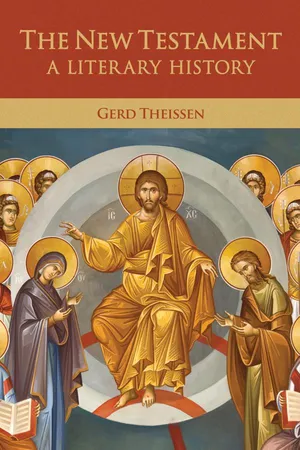
Gerd Theissen takes up the problem of the emergence of the New Testament canon out of the wide variety of early Christian literature. Drawing from Max Weber's discussion of the evolution of religious organizations, Theissen describes the development of early Christian literature as a series of phases in the life of the movement: the charismatic, the pseudepigraphic, the functional, and the canonical.
- 304 pages
- English
- ePUB (mobile friendly)
- Available on iOS & Android
eBook - ePub
About this book
Information
Topic
Theology & ReligionSubtopic
Religion1
The Twofold Beginnings of a History of Early Christian Literature
1
The Oral Prehistory of Early Christian Literature with the Historical Jesus
The Beginning of the History of Early Christian Literature
A. The Charismatic Beginnings of Gospel Literature in Jesus
One may speak of literature in the strict sense only when a text (1) exists in written form and (2) is addressed to a general audience. In this regard the two basic forms of the New Testament moved in different directions. The Jesus tradition existed in oral form at first, but it was addressed to the whole people of Israel. It was used in the mission to Israel and thus was not initially directed to all people. It became literature when it was written down and extended to all peoples in the 60s/70s c.e. Paul’s letters, by contrast, existed in written form from the beginning. They were addressed to individual Gentile communities. It is true that the letter to the Romans came close to being a public document, but it was only the posthumous collection of all Paul’s letters that gave them a common addressee, as private letters often become public literature when they are collected for publication. This also took place in the 60s/70s. Those years saw the universalizing of the audience for the traditions of Paul and Jesus, and in the case of Jesus the writing down of the traditions as well. Thereby these texts became literature for the first time. Our question is now: Were comparable factors at work in the gospels as in the letters that caused them to become literature? Can the prehistory of the gospels and the letters of Paul properly be assigned to one and the same phase? Further, why were the letters fifteen years earlier (with the letter to the Romans) in becoming written literature than the gospels? Why, within the same literary-historical phase, was there a temporal delay for the gospels?
Jesus is said once to have written something—but he wrote in sand, in which the traces vanish (John 8:8). We have retained not a single line from him. He taught in synagogues and undertook the reading of scripture in worship (Luke 4:16-21). Such traditions would not have arisen if he had not been able to read and write. Nevertheless, he did not commit his message to writing. The reason is that he lived in a culture of oral communication. We must first ask: How did this differ from written communication? Can we detect anything at all of the oral prehistory of the tradition behind the written texts before us, to say nothing of reconstructing it? One relevant conclusion of form criticism is that in the case of oral tradition what is primarily visible is its formal language.[1] We may be uncertain whether Jesus spoke certain words, but that he used particular forms is undisputed: he taught as a prophet, a wisdom teacher, a teacher of the Law, and a storyteller. The storyteller is known especially from his similitudes; his are the first such to be attested in Jewish literature. The stories about him must be strictly distinguished from his words, for these are texts that were not shaped by Jesus. They include the apophthegms that appear in Jewish tradition for the first time in the Jesus traditions: short, polished statements with narrative frames; in addition, there are the miracle stories, which have many parallels in Jewish and non-Jewish antiquity; and finally, there is also the passion story.
Jesus was not the only person who left no writings. His “teacher,” John the Baptizer, did not write any books either. Jesus used the oral culture of communication much more deliberately for his purposes than did the Baptizer; the latter let people come to him, but Jesus went out as a wandering teacher to the people and brought his message into their world. He strengthened his effectiveness by sending disciples out into the villages with his message. They asserted a public claim within Israel, but the groups they addressed remained limited to Jews.[2] His disciples do not appear to have left any writings, either, although secondarily a number of writings were attributed to them; however, the Gospel of Matthew was certainly not written by the apostle Matthew, the Gospel of John is not by the apostle John, and the letters of Peter are not by Peter. What is true of all these figures is that they lived in an oral culture. Oral communication was the sole means of mass communication among ordinary people. Other “media” were controlled by the powerful. They made coins that passed through many hands; these were used by the rulers to spread political messages. Public inscriptions were also erected by those who had money and power, and these were read by many people. They were not the people’s medium. The only medium everyone could use was oral report, the news spread from mouth to mouth. There is much in favor of the supposition that Jesus organized and used this medium of communication in a new and effective form.
About twenty to thirty years of oral communication elapsed before his tradition was written down—first in the Sayings Source (between 40 and 65 c.e.), then in the Gospel of Mark shortly after 70 c.e. Even after it was written, the oral transmission of his words continued alongside it. The writings in turn affected the oral tradition, for in antiquity writings were primarily read out loud. Often the primary and secondary oral traditions merged.
It is true that skeptics ask: Was there ever really such an oral tradition before the gospels? Can we be sure that it was not some gifted writer who composed the Jesus tradition, as Walter Schmithals thinks? [3] We cannot, of course, look behind the written texts. We can only draw conclusions. “Constructive conclusions” permit us to make a few direct statements about the oral tradition: Jesus directed his disciples to proclaim his message orally. He did not say: “Whoever reads you, reads me!” but “Whoever listens to you listens to me!” (Luke 10:16). The commission in Matthew 28:19-20 makes oral preaching by itinerant teachers an obligation. The Acts of the Apostles depicts the oral dissemination of this preaching but makes no mention of a written medium—with the exception of the letter containing the apostolic decree (Acts 15:23-29). The Lukan prologue speaks clearly of eyewitnesses whose tradition was only secondarily written down. Even Papias, at the beginning of the second century c.e., gives preference to the “living and enduring voice,” that is, oral tradition, over what is written (Eusebius, Hist. eccl. 3.39.4). Added to these constructive conclusions based on direct statements about oral tradition are “analytical conclusions” based on the form of these texts: the memorable form of the tradition points to an oral origin. It consists of brief pericopes shaped mnemonically for oral tradition by parallelisms, alliteration, and antitheses. The factual variability of the tradition can be better explained by oral variants than by conscious scribal activity. Even the words of Jesus handed on in the apostolic fathers do not always indicate written sources. Here, too, the oral tradition has not died out.[4] Finally, we can make some comparisons. Charismatic movements also prefer oral traditions: this was true for John the Baptizer, and also for the Montanist prophecy![5]
But we must also ask: During the years of oral tradition, was the Jesus tradition changed so much as to become unrecognizable, so that the memory of Jesus was overlain by other factors? In fact, the degree to which the Jesus traditions had pre-Easter origins, or whether they were radically reshaped by the post-Easter faith, as well as whether they were subject to some control or were able to develop freely and without restraint are matters of dispute among scholars. This question is mainly discussed within the framework of Jesus research, but it is also important for a literary history of the New Testament: the issue here is whether the formative phase of the gospel tradition began with Jesus or only after his death.
Beginnings of Oral Tradition with the Historical Jesus?
Classic form criticism regarded faith in the cross and resurrection as the crucial formative factor in the Jesus tradition: in particular instances it is traceable to the historical Jesus, but it has been so thoroughly reworked through the faith of the first Christians and their needs that the burden of proof of a historically accurate memory of Jesus rests with the advocates of the historicity of the Jesus traditions. The tradition is said not to have been subject to any formal controls (for example, by appointed “teachers”). Recurring situations in which the tradition was used, the Sitz im Leben, are supposed to have given it a certain stability, but since this Sitz im Leben was radically changed in the transition from Palestinian to “Hellenistic” early Christianity, there was not much continuity! To summarize, one can formulate the form-critical view as follows: Post-Easter shaping and little social control of the Jesus tradition are reasons for a broad historical skepticism. Early post-Easter Christianity is the formative phase of the gospel traditions.
The Scandinavian view of tradition (Birger Gerhardsson), in contrast, was oriented to contemporary analogies in Judaism: as a rabbi, it says, Jesus taught his disciples, his “pupils,” to learn and memorize his words. Thus the tradition was shaped by its pre-Easter origins and was “tended” after Easter as normative tradition. It is much more reliable than form criticism supposed. Samuel Byrskog [6] expanded this concept: according to him, in antiquity it was the eyewitnesses and their oral history that were conclusive. They were sought out so that one might appeal to them. To summarize this in a formula: here we assume a pre-Easter shaping and strict control of the Jesus tradition. The result is a high degree of trust in the historicity of the tradition. Jesus’ teaching activity is the crucial formative phase of the gospel tradition.
The new concept of tradition (James D. G. Dunn)[7] begins with the study of oral literature in antiquity. Homer’s epics are interpreted in light of Serbo-Croatian heroic hymns.[8] Observations on oral tradition in the contemporary Mediterranean world show that oral tradition is independent of any “original version”; its handing on is not the reproduction of a model, but a new creation based on a wealth of existing formulae, themes, and structures. Every version is an original.[9] The handing on is not arbitrary, but is influenced by the hearers, whose social control of the tradition is all the more rigorous the more important it is for the identity of the society. It is more strict with regard to brief, pointed sayings than for stories with narrative development.[10] The beginnings of the tradition are seen to lie with Jesus before Easter: the group of disciples was the first Sitz im Leben for the tradition (Heinz Schürmann).[11] In my opinion, this new view of tradition is only a refinement of classic form criticism. If we reduce it to a formula, it says that the pre-Easter beginnings and informal social control by listeners make it likely that we can critically evaluate the tradition for knowledge of the historical Jesus. Both the historical Jesus and post-Easter early Christianity are parts of the formative phase of the gospel tradition.
In my view, the “new” understanding of tradition comes closest to the truth. Negatively, we can say that at certain points the tradition was not, as one might expect, shaped by the needs of the post-Easter communities. What we know of the social needs of the early Christian communities has often left little trace in the Synoptic traditions. For example, every social group has to define who belongs to it and who does not belong. There was a quarrel over this in the early Christianity of the 40s: Was male circumcision a necessary criterion for acceptance, or not (Gal 2:1-21; Acts 15:1-29)? This dispute left no traces in the Synoptic tradition. Nowhere do we find any saying of Jesus for or against circumcision. Only the Gospel of Thomas contains a corresponding saying of Jesus (Gos. Thom. 53). The legitimation of authority structures is just as important. In the first generation we already hear about “presbyters” (Acts 11:30 and elsewhere), or “episkopoi and diakonoi” (Phil 1:1). But nowhere do we find any saying of Jesus to back this up. Can the influence of the Sitz im Leben really have been so thorough, if elementary social needs did not shape the tradition?
However, we can also trace the beginnings of the tradition back to the historical Jesus in a positive sense. During his life there naturally arose situations that caused Jesus’ disciples to learn the basic features of his preaching and be able to hand them on independently.
- Jesus was an itinerant teacher, traveling with his disciples from place to place. He offered the same message everywhere. There was no need to say something different each time. Rather, he would have repeated his words often, with the variations typical of oral tradition. So there is no need to suppose some kind of orderly schooling to explain the repetitions. The existence of an itinerant teacher outside the routine of daily life created quite enough opportunity for repetition!
- Jesus lived with his disciples in close community. Their common itinerant existence had to draw them together. Communities develop rules and rituals. So he would have taught his disciples the “Our Father” as a commun...
Table of contents
- Cover
- Title Page
- Copyright
- Table Of Contents
- List of Tables and Figures
- Preface
- Introduction: The Problem of a Literary History of the New Testament
- The Twofold Beginnings of a History of Early Christian Literature
- The Fictive Self-Interpretation of Paul and Jesus: The Pseudepigraphic Phase
- The Authority of the Independent Forms: The Functional Phase
- The New Testament on Its Way to Becoming a Religious World Literature
- Bibliography
Trusted by 375,005 students
Access to over 1.5 million titles for a fair monthly price.
Study more efficiently using our study tools.
Frequently asked questions
Yes, you can cancel anytime from the Subscription tab in your account settings on the Perlego website. Your subscription will stay active until the end of your current billing period. Learn how to cancel your subscription
No, books cannot be downloaded as external files, such as PDFs, for use outside of Perlego. However, you can download books within the Perlego app for offline reading on mobile or tablet. Learn how to download books offline
Perlego offers two plans: Essential and Complete
- Essential is ideal for learners and professionals who enjoy exploring a wide range of subjects. Access the Essential Library with 800,000+ trusted titles and best-sellers across business, personal growth, and the humanities. Includes unlimited reading time and Standard Read Aloud voice.
- Complete: Perfect for advanced learners and researchers needing full, unrestricted access. Unlock 1.5M+ books across hundreds of subjects, including academic and specialized titles. The Complete Plan also includes advanced features like Premium Read Aloud and Research Assistant.
We are an online textbook subscription service, where you can get access to an entire online library for less than the price of a single book per month. With over 1.5 million books across 990+ topics, we’ve got you covered! Learn about our mission
Look out for the read-aloud symbol on your next book to see if you can listen to it. The read-aloud tool reads text aloud for you, highlighting the text as it is being read. You can pause it, speed it up and slow it down. Learn more about Read Aloud
Yes! You can use the Perlego app on both iOS and Android devices to read anytime, anywhere — even offline. Perfect for commutes or when you’re on the go.
Please note we cannot support devices running on iOS 13 and Android 7 or earlier. Learn more about using the app
Please note we cannot support devices running on iOS 13 and Android 7 or earlier. Learn more about using the app
Yes, you can access The New Testament by Gerd Theissen in PDF and/or ePUB format, as well as other popular books in Theology & Religion & Religion. We have over 1.5 million books available in our catalogue for you to explore.