- 320 pages
- English
- ePUB (mobile friendly)
- Available on iOS & Android
eBook - ePub
About this book
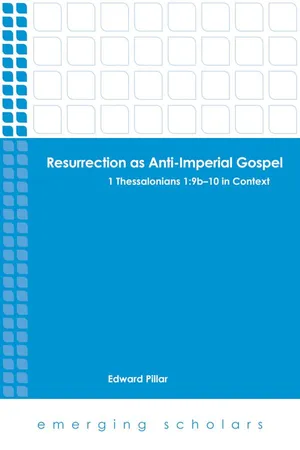
Presuming that the heart of Paul's gospel announcement was the news that God had raised Jesus from the dead (as indicated in 1 Thessalonians 1:9b-10), Pillar explores the evidence in Paul's letter and in aspects of the Roman imperial culture in Thessalonica in order to imagine what that proclamation would have evoked for its first hearers. He argues that the gospel of resurrection would have been heard as fundamentally anti-imperial: Jesus of Nazareth was executed by means of the epitome of imperial power. The resurrection thus subverts and usurps the empire's immense power. The argument is verified in aspects of the response of those living in a thoroughly imperialized metropolis.
Information
3
Turning to God from idols
Introduction
I have argued that Paul’s statement ἐπεστρέψατε πρὸς τὸν θεόν is intended to be understood as the Thessalonians’ turning to the God who, through the raising of Jesus Christ from the dead, stakes a claim as holder of a greater power—and thereby a claim to a greater devotion—than can be claimed in either case by the Roman Empire. However, Paul specifically states that the Thessalonians’ turning is ἀπὸ τῶν εἰδώλων.[1] Now, I have previously argued that there exists a clear and close link between the “anti-imperial action” of God in raising Jesus Christ and the decisive action of the Thessalonians in turning to him. This assumption gives rise to a necessary question: Is there any evidence to suggest that there is a link between the idols from which the Thessalonians have turned and the imperial culture against which the resurrection is set? In the previous chapter, as I explored the meaning of ἐπιστρέφω in Galatians 4, I affirmed the claim that “beings that by nature are not gods” (Gal. 4:8) are most likely “the deified living emperor and members of the imperial family . . . identified as divinities ‘upon the earth.’”[2] What we need now to do is explore the possibility that the εἰδώλων Paul references in 1 Thess. 1:9b are similarly intended to be understood in some way as—or representative of—the rulers of the imperial world.
I begin with a brief examination of the place of deities in the lives of Thessalonians and then consider the way in which deities were bound up with political life. However, it becomes apparent that although Dionysos was the tutelary deity in Thessalonica, his significance spanning the years from approximately 50 bce to 50 ce is uncertain. It is interesting then to note the importance of the Egyptian deities during this period, and I pay particular attention to the reasons for this—specifically with the apparent absence of Dionysos in mind. What are the reasons for this? Ultimately, I consider the prominence or otherwise of the cult of Cabirus and then the potential for the prominence of the imperial cult in Thessalonica.
Deities in Everyday Life in Thessalonica
As we examine the context of the Thessalonian believers’ turning from idols and the subsequent implications for their lives, it is immediately apparent that we cannot presume the Thessalonians’ experience of worship in their pre-Christian days to be limited to just one or two deities. The Garland of Philip makes abundantly clear that numerous gods were honored, and it is to this work that we shall turn first. We cannot know precisely who Philip was, as “no other author mentions Philip nor do [Anthologia Palatina] scholiasts give any clue about his dating”; and also, “He relates nothing personal”[3] that might give us a clue about his background and his interests other than collecting epigrams. Gow and Page are confident, however, that the epigrams they have gathered for their Greek Anthology: The Garland of Philip, are “more or less dateable between c. 90 b.c. and a.d. 40.”[4] Particularly striking from my point of view is that among these epigrams there are dedications to nearly twenty different named deities. These dedications appear to demonstrate that religious life in and around Thessalonica and Macedonia in the first centuries bce and ce was certainly varied; it engaged ordinary people in the ordinary, regular, and perhaps even mundane aspects of their lives.
We encounter, for example, dedications to Aphrodite over concerns of the heart. One notes that three women “got the love they prayed for, and now each belongs to one man,” while another makes a plain and direct request: “a husband’s loving heart is all she asks.”[5] There are dedications from young men who have shaved for the first time. To Apollo, a young man dedicates “‘his cheeks’ messengers of manhood”;[6] while to Zeus and Artemis another dedicates the “earliest bloom of spring on his cheeks.”[7] The hope or request in both cases is that they might grow old and need to shave grey hairs in later life. There is a dedication to Ares by nine warriors asking for success in battle,[8] while to Artemis a weapon denotes a soldier’s appreciation for the deity’s help to defeat an enemy.[9] Then there is a dedication from a hunter for Pan[10] and another for the Nymphs,[11] while also from a fisherman for Priapus[12] and from a farmer for Demeter[13] following success and harvest. There are dedications from those concerned and eager for success in their endeavors, whether that be in fishing, hunting, or farming fruit in an orchard. Euphrantê makes an offering in the temple of Artemis when she had “been delivered of the burden in her womb with easy pangs,”[14] and Dogenes offers thanks to Cabirus for protection following a violent storm at sea and asks, “Do you protect him from poverty too?”[15] Interestingly, the larger number of dedications come as folk reach the age when they are no longer able to practice their life skill that has gained them employment over the years. In this category, there is a plow dedicated to Demeter,[16] and to Athena a trumpet.[17] To Hephaestus, cooking implements from a cook;[18] to Heracles, a spear from a hunter;[19] to Hermes, a fishing net[20] and also a goldsmith’s tools.[21] Finally, to Cybelê after “frenzied feet have grown too old”[22] and to Muses, “Callimenes dedicated when his eyes were veiled with age.”[23]
A simple conclusion to draw at this point is that these dedications clearly indicate a religious belief enmeshed within and around everyday life. There is surely no way that one could live outside of and oblivious to such a fundamental and essential approach to religion and spirituality. This particular view is stressed by Green, who insists that Paul and Silas “did not enter into a religious vacuum” when they visited Thessalonica, and he goes on to speak of the “plethora of deities” and the “sea of great religious pluralism and [in Green’s opinion] confusion.”[24] Thus when Paul speaks to the Thessalonian Christians about their having “turned to God from idols,” there may have been no need to elaborate any further on the basis of this evidence. Everyone would have clearly understood what was meant by his words. The Thessalonians would most likely have understood—what I propose was Paul’s clear intention—that their turning from idols would have involved turning away from what was considered normal, everyday practice in and around Thessalonica. Moreover, as I now suggest, this apparently simple act of turning from idols would have had significant consequences for the Thessaloni...
Table of contents
- Cover
- Title Page
- Copyright
- Dedication
- Table Of Contents
- Preface
- Abbreviations
- Introduction
- “Whom he raised from the dead”
- Turning to God
- Turning to God from idols
- “To serve . . .”
- “The living and true God”
- Waiting . . .
- “The son from the heavens”
- “Jesus, who rescues us from wrath”
- Conclusion
- Bibliography
- Index of Subjects
- Index of Authors
- Index of Biblical and Ancient Literature References
Trusted by 375,005 students
Access to over 1.5 million titles for a fair monthly price.
Study more efficiently using our study tools.
Frequently asked questions
Yes, you can cancel anytime from the Subscription tab in your account settings on the Perlego website. Your subscription will stay active until the end of your current billing period. Learn how to cancel your subscription
No, books cannot be downloaded as external files, such as PDFs, for use outside of Perlego. However, you can download books within the Perlego app for offline reading on mobile or tablet. Learn how to download books offline
Perlego offers two plans: Essential and Complete
- Essential is ideal for learners and professionals who enjoy exploring a wide range of subjects. Access the Essential Library with 800,000+ trusted titles and best-sellers across business, personal growth, and the humanities. Includes unlimited reading time and Standard Read Aloud voice.
- Complete: Perfect for advanced learners and researchers needing full, unrestricted access. Unlock 1.5M+ books across hundreds of subjects, including academic and specialized titles. The Complete Plan also includes advanced features like Premium Read Aloud and Research Assistant.
We are an online textbook subscription service, where you can get access to an entire online library for less than the price of a single book per month. With over 1.5 million books across 990+ topics, we’ve got you covered! Learn about our mission
Look out for the read-aloud symbol on your next book to see if you can listen to it. The read-aloud tool reads text aloud for you, highlighting the text as it is being read. You can pause it, speed it up and slow it down. Learn more about Read Aloud
Yes! You can use the Perlego app on both iOS and Android devices to read anytime, anywhere — even offline. Perfect for commutes or when you’re on the go.
Please note we cannot support devices running on iOS 13 and Android 7 or earlier. Learn more about using the app
Please note we cannot support devices running on iOS 13 and Android 7 or earlier. Learn more about using the app
Yes, you can access Resurrection as Anti-Imperial Gospel by Edward Pillar in PDF and/or ePUB format, as well as other popular books in Theology & Religion & Biblical Criticism & Interpretation. We have over 1.5 million books available in our catalogue for you to explore.