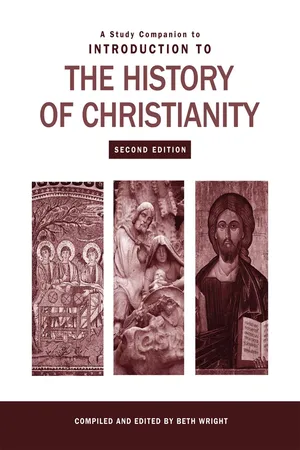
The Study Companion is a valuable additional resource for introductory courses in church history that use Tim Dowley's popular Introduction to the History of Christianity. Packed with the essential primary readings for introductory courses in the history of Christianity, the Study Companion also provides biographical information, thematic explorations of historical themes that are important today, as well as a host of other pedagogical tools that will enrich the student's experience.
- 192 pages
- English
- ePUB (mobile friendly)
- Available on iOS & Android
eBook - ePub
A Study Companion to Introduction to the History of Christianity
About this book
Information
Topic
Theology & ReligionSubtopic
Christianity1
Guide to Part 1: Beginnings
Key Terms
The number in parentheses refers to the page where the term is explained. Those terms marked with asterisks also appear in the Glossary.
agape (93)* Greek word for “love” that has come to express the Christian understanding of God’s love, which does not depend on any worthiness or attractiveness of the object of his love. Christians are taught to demonstrate this love to each other in Christian fellowship and to others.
apologists (90)* Early Christian writers who used reason to defend and explain the faith to nonbelievers.
canon (26)* Authoritative collection of Christian scripture comprising the accepted books of the Old and New Testaments.
Dead Sea Scrolls (28)* Sacred writings of a breakaway Jewish sect discovered in 1947 at Qumran, on the western shore of the Dead Sea. The several scrolls and fragments include much of the Hebrew Bible, as well as hymns, treatises, and rules for the life of the sect. Many scholars identify the sect with the Essenes.
Gnosticism (68)* Movement of esoteric teachings rivaling, borrowing from, and contradicting early Christianity. Gnostic sects were based on myths that described the creation of the world by a deluded demiurge and taught a way of salvation through gnosis, or knowledge of one’s true divine self. Gnostics contrasted their knowledge with faith, which they considered inferior.
heresy (77–78)* The denial of a defined, orthodox doctrine of the Christian faith. The word means “chosen thing” and refers to the heretic’s preference for an individual option over the consensus of the church.
kingdom of God (31)* The rule of God on earth. Jesus of Nazareth proclaimed the arrival of the kingdom in himself.
Logos (76)* Greek for “word” or “principle.” In Stoicism it identified the principle of reason, immanent in nature. Speculations about the logos were developed by the Jewish philosopher Philo of Alexandria. The Prologue to the Gospel of John identifies Christ with the preexistent logos of God.
martyr (54)* Title, meaning “witness,” originally applied to Christians who died, rather than renounce their faith, during times of persecution. Now applied to anyone who dies for a religious belief.
messiah (24)* Hebrew word meaning “anointed one” and referring to the person chosen by God to be king. (1) After the end of the Israelite monarchy it came to refer to a figure who would restore Israel, gathering the tribes together and ushering in the Kingdom of God. Modern Jews are divided as to whether the messiah is a symbolic or a representative figure, and whether the founding of the Jewish state is a prelude to his coming. (2) In the Christian New Testament, Jesus of Nazareth is described by messianic titles, e.g. messiah, Christ, “the King,” “the One who Comes.” The account of Jesus’ entry into Jerusalem is deliberately phrased in messianic terms. Jesus himself was cautious about claiming to be the messiah.
Septuagint (27)* Greek version of the Hebrew scriptures produced by Jews in Alexandria, completed in 132 bce. Often abbreviated as lxx.
Key Personalities
Numbers in parentheses refer to the pages where the text provides the individual’s biographical details and historical significance.
Eusebius (75)
(c. 263–c. 339) Considered the father of church history: his work Church History was the first attempt to write Christian history on a comprehensive scale. His political ideas influenced the empire of Byzantium.
Primary Sources
1. From Eusebius, The Church History, Book 1:1, Translated by G. A. Williamson (Minneapolis: Augsburg Books, 1975), 31–33.
The chief matters to be dealt with in this work are the following:
a. The lines of succession from the holy apostles, and the periods that have elapsed from our Saviour’s time to our own; the many important events recorded in the story of the Church; the outstanding leaders and heroes of that story in the most famous Christian communities; the men of each generation who by preaching or writing were ambassadors of the divine word.
b. The names and dates of those who through a passion for innovation have wandered as far as possible from the truth, proclaiming themselves as founts of Knowledge falsely so called while mercilessly, like savage wolves, making havoc of Christ’s flock.
c. The calamities that immediately after their conspiracy against our Saviour overwhelmed the entire Jewish race.
d. The widespread, bitter, and recurrent campaigns launched by unbelievers against the divine message, and the heroism with which when occasion demanded men faced torture and death to maintain the fight in its defence.
e. The martyrdoms of later days down to my own time, and at the end of it all the kind and gracious deliverance accorded by our Saviour.
Could I do better than start from the beginning of the dispensation of our Saviour and Lord, Jesus the Christ of God?
I trust that kindly disposed readers will pardon the deficiencies of the work, for I confess that my powers are inadequate to do full justice to so ambitious an undertaking. I am the first to venture on such a project and to set out on what is indeed a lonely and untrodden path; but I pray that I may have God to guide me and the power of the Lord to assist me. . . It is, I think, most necessary that I should devote myself to this project, for as far as I am aware no previous Church historian has been interested in records of this kind; records which those who are eager to learn the lessons of history will, I am confident, find most valuable. It is true that in the Chronological Tables that I compiled some years ago I provided a summary of this material; but in this new work I am anxious to deal with it in the fullest detail. As I said before, my book will start with a conception too sublime and overwhelming for man to grasp—the dispensation and divinity of our Saviour Christ. Any man who intends to commit to writing the record of the Church’s history is bound to go right back to Christ Himself, whose name we are privileged to share, and to start with the beginning of a dispensation more divine than the world realizes.
Reading Questions
What can you surmise about the intended audience of this text? Based on this opening passage, what might the overall thesis of the text be?
Related Works
Eusebius. The Church History. Trans. and commentary by Paul L. Maier. Grand Rapids, MI: Kregel, 2007.
Johnson, Aaron, and Jeremy Schott, eds. Eusebius of Caesarea: Tradition and Innovations. Hellenic Studies Series. Washington, DC: Center for Hellenic Studies, 2013.
Ignatius (79)
(died c. 98–117). The bishop of the church at Antioch in the early second century. Known for his seven letters written on his way to Rome to be executed. Addressed to churches around the empire and to Bishop Polycarp, his letters argued for each congregation to be led by one bishop. He believed he possessed the Holy Spirit’s gift of prophecy.
Primary Sources
From The Early Christian Fathers, edited and translated by Henry Bettenson (New York, Oxford University Press, 1956), 42–43, 48–49.
To the Magnesians
I advise you, be eager to act always in godly accord; with the bishop presiding as the counterpart of God, the presbyters as the counterpart of the council of apostles, and the deacons (most dear to me) who have been entrusted with the service (diaconate) under Jesus Christ, who was with the father before all the ages and appeared at the end of time. Therefore do all of you attain conformity with God, and reverence each other; and let none take up a merely natural attitude towards his neighbor, but love each other continually in Jesus Christ. Let there be nothing among you which will have power to divide you, but be united with the bishop and with those who preside, for an example and instruction in incorruptibility.
Thus, as the Lord did nothing without the Father (being united with him), either by himself or by means of his apostles, so you must do nothing without the bishop and the presbyters. And do not try to think that anything is praiseworthy which you do on your own account: but unite in one prayer, one supplication, one mind, one hope; with love and blameless joy. For this is Jesus Christ, and there is nothing better than he. Let all therefore hasten as to one shrine, that is, God, as to one sanctuary, Jesus Christ, who came forth from the one Father, was always with one Father, and has returned to the one Father. To the Magnesians, vi-vii
To the Smyrnaeans
I perceived that you are settled in unshakable faith, nailed, as it were, to the cross of our Lord Jesus Christ, in flesh and spirit, and with firm foundations in love in the blood of Christ, with full conviction with respect to our Lord that he is genuinely of David’s line according to the flesh, son of God according to the divine will and power, really born of a virgin and baptized by John that ‘all righteousness might be fulfilled’ by him, really nailed up in the flesh for us in the time of Pontius Pilate and the tetrarchy of Herod—from this fruit of the tree, that is from his God-blessed passion, we are derived—that he might ‘raise up a standard’ for all ages through his resurrection, for his saints and faithful people, whether among Jews or Gentiles, in one body of his church. For he suffered all this on our account, that we might be saved. And he really suffered, as he really raised himself. Some unbelievers say that he suffered in appearance only. Not so—they themselves are mere apparitions. Their fate will be like their opinions, for they are unsubstantial and phantom-like. To the Smyrnaeans, i-ii
Reading Question
Paul (Saul) of Tarsus, another key figure from Part 1, is also known for the letters he wrote—some of which are found in scripture. How do Paul’s letters to the Corinthians (1 and 2 Corinthians) from the New Testament compare to these letters from Ignatius?
Related Works
Howell, Kenneth J. Ignatius of Antioch & Polycarp of Smyrna. Early Christian Fathers. Rev. and exp. ed. Zanesville, OH: CH Resources, 2009.
Staniforth, Maxwell, trans. Early Christian Writings: The Apostolic Fathers. Penguin Classics. London: Penguin, 1987.
Irenaeus (80)
(c. 115–c. 202) The most important of the anti-Gnostic authors. His writing helped develop Christian theology by promoting the canon and establishing the role of the Eucharist while basing his arguments on Scripture.
Primary Sources
From Theological Anthropology, edited and translated by J. Patout Burns (Philadelphia: Fortress Press, 1981), 26–28 and Understandings of the Church, edited and translated by E. Glenn Hinson (Philadelphia, Fortress Press, 1987), 44-45.
Human beings acquired the knowledge of good and evil. Good is to obey God, to believe in him, to keep his command; this means life for human beings. On the other hand, not to obey God is evil; this is death for human beings. God has exercised patience, and human beings have come to know both the good of obedience and the evil of disobedience. Thus by experiencing them both the mind’s eye would choose the better things with discernment and never become sluggish or negligent of God’s command. By learning through experience the evil of not obeying God, which would deprive them of life, human beings would never try it. Rather knowing the good of obeying God, which preserves their life, they would diligently maintain it. Human beings have this twofold power of perceptions which gives the knowledge of good and evil so that they might choose the better things intelligently. How can someone be intelligent about good when he does not know what is contrary to it? Certain understanding of the issue to be decided is more solid than a conjecture based on guessing. The tongue experiences sweet and sour by tasting; the eye distinguishes black from white by seeing; the ear perceives the difference between sounds by hearing. In this same way, by experiencing good and evil, the mind comes to understand good and is strengthened to preserve it by obeying God. First by repentance it rejects disobedience because it is bitter and evil. By grasping the nature of what is opposed to the sweet and good, it will never again try to taste disobedience to God. If a person avoids the twofold power of perception and the knowledge of both of these, therefore, he implicitly destroys his humanity.
How will one who has not yet become human be God? How can one just created be perfect? How can one who has not obeyed his Maker in a mortal nature be immortal? You should first follow the order of human existence and only then share in God’s glory. You do not make God; God makes you. If you are God’s artifact, then wait for the hand of the Master which makes everything at the proper time, at the proper time for you who are being created. Offer him a soft and malleable heart; then keep the shape in which the master molds you. Retain your moisture, so that you do not harden and lose the imprint of his fingers. By preserving your structure you will rise to perfection. God’s artistry will conceal what is clay in you. His hand fashioned a foundation in you; he will cover you inside and out with pure gold and silver. He will so adorn you that the King himself will desire your beauty. If, however, you immediately harden yourself and reject his artistry, if you rebel against god and are ungrateful because he made you human, then you have lost not only his artistry but life itself at the same time. To create belongs to God’s goodness; to be created belongs to human nature. If, therefore, you commit to him the submission and trust in him which are yours, then you hold on to his artistry and will be God’s perfect work. Against Heresies (IV:39,1-2)
Reading Questions
In one sentence, how would you summarize Irenaeus’s argument about the “twofold power of perceptions” which humans hav...
Table of contents
- Cover
- Title Page
- Copyright
- Table Of Contents
- For the Student: How to Use This Guide
- Guide to Part 1: Beginnings
- Guide to Part 2: Acceptance and Conquest
- Guide to Part 3: A Christian Society
- Guide to Part 4: Reform and Renewal
- Guide to Part 5: Reason, Revival, and Revolution
- Guide to Part 6: Cities and Empires
- Guide to Part 7: A Century of Conflict
- Guide to Part 8: Epilogue
- Supplemental Readings
- Reading Historical Documents
- A Short Guide to Writing Research Papers on the History of Christianity
Trusted by 375,005 students
Access to over 1.5 million titles for a fair monthly price.
Study more efficiently using our study tools.
Frequently asked questions
Yes, you can cancel anytime from the Subscription tab in your account settings on the Perlego website. Your subscription will stay active until the end of your current billing period. Learn how to cancel your subscription
No, books cannot be downloaded as external files, such as PDFs, for use outside of Perlego. However, you can download books within the Perlego app for offline reading on mobile or tablet. Learn how to download books offline
Perlego offers two plans: Essential and Complete
- Essential is ideal for learners and professionals who enjoy exploring a wide range of subjects. Access the Essential Library with 800,000+ trusted titles and best-sellers across business, personal growth, and the humanities. Includes unlimited reading time and Standard Read Aloud voice.
- Complete: Perfect for advanced learners and researchers needing full, unrestricted access. Unlock 1.5M+ books across hundreds of subjects, including academic and specialized titles. The Complete Plan also includes advanced features like Premium Read Aloud and Research Assistant.
We are an online textbook subscription service, where you can get access to an entire online library for less than the price of a single book per month. With over 1.5 million books across 990+ topics, we’ve got you covered! Learn about our mission
Look out for the read-aloud symbol on your next book to see if you can listen to it. The read-aloud tool reads text aloud for you, highlighting the text as it is being read. You can pause it, speed it up and slow it down. Learn more about Read Aloud
Yes! You can use the Perlego app on both iOS and Android devices to read anytime, anywhere — even offline. Perfect for commutes or when you’re on the go.
Please note we cannot support devices running on iOS 13 and Android 7 or earlier. Learn more about using the app
Please note we cannot support devices running on iOS 13 and Android 7 or earlier. Learn more about using the app
Yes, you can access A Study Companion to Introduction to the History of Christianity by Beth Wright in PDF and/or ePUB format, as well as other popular books in Theology & Religion & Christianity. We have over 1.5 million books available in our catalogue for you to explore.