Walter Wink's writing has been described as brilliant, provocative, passionate, and innovative. His skills in critical scholarship were matched by an engaging and honest style that make his work a must read for twenty-first century theologians and all who seek deeper understanding at the intersection of Bible, theology, social ethics, and more.

- 224 pages
- English
- ePUB (mobile friendly)
- Available on iOS & Android
eBook - ePub
About this book
Information
4
Engaging the Powers
8
Introduction
In the final volume of the Powers trilogy, Walter Wink takes as his task “engaging” the Powers in such a way that their negative (evil) and positive (good) functions are held together. His belief is that they can be redeemed in order that they might be reclaimed for the “humanizing purposes of God.” Wink here briefly describes five competing worldviews—the ancient, the spiritualistic, the materialistic, the theological, and the integral. To varying degrees, each of these worldviews finds adherents today, but Wink argues that only the integral worldview is adequate to the task of engaging the Powers redemptively. Like the ancient worldview, the integral worldview affirms the inner and outer aspect of all things but does not see the inner or spiritual aspect as the earthly counterpart of heavenly realities. Rather, the integral worldview sees the inner spirituality of things as “inextricably related to an outer concretion or physical manifestation.” This conceptual move allows Wink to introduce the concept of “domination systems,” and assert that the real spiritual force we experience within domination systems emanates from actual institutions, structures and systems. Theologically, the utility of the Powers for examining structural/systemic evil is clear.
Source: Wink 1992: Introduction
| FUGITIVE. | The beast is in the king. |
| JOURNEYER. | The beast is in the king? |
| FUGITIVE. | But the king doesn’t see it. In the palace only the slaves see the beast. |
| JOURNEYER. | But the king sent me to kill the beast. To bring back its claws! |
| FUGITIVE. | The king was a liar. He told you to “get claws” So you would believe there were claws. He told you to “kill it” So you would believe it could be killed. But the beast has no claws. It can’t be killed. In the palace we killed the king. |
| JOURNEYER. | You killed the king! |
| FUGITIVE. | But there was still the beast. We put a doll on the throne. But there was still the beast. We destroyed the doll But there was still the beast. |
| JOURNEYER. | In my village we need help. In my village they are forgetting. |
| FUGITIVE. | But if the beast has no claws, If the beast can’t be killed— |
| JOURNEYER. | Still, I have to find the beast Whatever it is, Or isn’t. —Jean Claude von Itallie, A Fable[1] |
One of the most pressing questions facing the world today is, How can we oppose evil without creating new evils and being made evil ourselves?
It is my conviction that any attempt to face the problem of evil in society from a New Testament perspective must be bound up with an understanding of what the Bible calls the “Principalities and Powers.” I am also convinced that no social ethic can be constructed on New Testament grounds without recognition of the role of these Powers in sustaining and subverting human life.
The Powers, unfortunately, have long since been identified as an order of angelic beings in heaven, or as demons flapping about in the sky. Most people have simply consigned them to the dustbin of superstition. Others, sensing the tremendous potential in the concept of the Powers for interpreting social reality, have identified them without remainder as institutions, structures, and systems. The Powers certainly are the latter, but they are more, and it is that “more” that holds the clue to their profundity. In the biblical view they are both visible and invisible, earthly and heavenly, spiritual and institutional. The Powers possess an outer, physical manifestation (buildings, portfolios, personnel, trucks, fax machines) and an inner spirituality, or corporate culture, or collective personality. The Powers are the simultaneity of an outer, visible structure and an inner, spiritual reality. The Powers, properly speaking, are not just the spirituality of institutions, but their outer manifestations as well. The New Testament uses the language of power to refer now to the outer aspect, now to the inner aspect, now to both together, as I have shown in Naming the Powers. It is the spiritual aspect, however, that is so hard for people inured to materialism to grasp.
Perhaps this understanding of the Powers can be clarified by a comparison of worldviews, since our perception of the Powers is colored to a great extent by the way we view the world.
1. The Ancient Worldview

This is the worldview reflected in the Bible (see fig. 1). In this conception, everything earthly has its heavenly counterpart, and everything heavenly has its earthly counterpart. Every event is thus a simultaneity of both dimensions of reality. If war begins on earth, then there must be, at the same time, war in heaven between the angels of the nations involved on earth. Likewise, events initiated in heaven would be mirrored on earth. There is nothing uniquely biblical about this imagery. It was shaped not only by the writers of the Bible, but also by Greeks, Romans, Egyptians, Babylonians, Assyrians, Sumerians—indeed, by everyone in the ancient world—and it is still held by large numbers of people in Africa, Asia, and Latin America. It is a profoundly true picture of reality.
2. The Spiritualistic Worldview
![4837_001[3]](https://book-extracts.perlego.com/1733749/images/4837_00133-plgo-compressed.webp)
What distinguishes this worldview (see fig. 2) from all other types is that it divides human beings into “soul” and “body”; one understands oneself as the same as one’s “soul” and other than one’s “body.” In this account, the created order is evil, false, corrupted. Creation was itself the fall. Matter is either indifferent or downright evil. Earthly life is presided over by imperfect and evil Powers. When the soul leaves its heavenly bliss, and is entrapped in the body, as a result of sexual intercourse, it forgets its divine origins and falls into lust, ignorance, and heaviness. The body is a place of exile and punishment, but also of temptation and contamination. Salvation comes through the knowledge of one’s heavenly origins and the secret of the way back. This worldview is usually associated with Gnosticism, Manichaeism, some forms of Neoplatonism, and in regard to sexuality, Puritanism. (Something of the same picture would fit some forms of Eastern religions, except that they would see the world not as evil but as illusion.)
3. The Materialistic Worldview
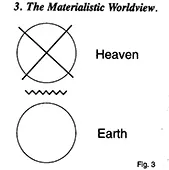
This view (see fig. 3) became prominent in the Enlightenment, but is as old as Democritus (ca. 460—ca. 370 b.c.e.), and is in many ways the antithesis of the world-rejection of spiritualism. In this view, there is no heaven, no spiritual world, no God, no soul—nothing but material existence and what can be known through the five senses and reason. The spiritual world is an illusion. There is no higher self; we are mere complexities of matter, and when we die we cease to exist except as the chemicals and atoms that once constituted us. This materialistic worldview has penetrated deeply even into many Christians, causing them to ignore the spiritual dimensions of systems or the spiritual resources of faith.
4. The “Theological “Worldview”
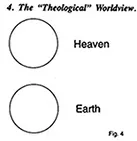
In reaction to materialism, Christian theologians invented the supernatural realm (see fig. 4). Acknowledging that this supersensible realm could not be known by the senses, they conceded earthly reality to modern science and preserved a privileged “spiritual” realm immune to confirmation or refutation at the cost of an integral view of reality and the simultaneity of heavenly and earthly aspects of existence. This view of the religious realm as hermetically sealed and immune to challenge from the sciences has been held not only by the Christian center and right, but by most of theological liberalism and neoorthodoxy.
5. An Integral Worldview.
![4834_001[1]-19](https://book-extracts.perlego.com/1733749/images/4834_0011-193-plgo-compressed.webp)
This new worldview (see fig. 5) is emerging from a confluence of sources: the reflections of Carl Jung, Teilhard de Chardin, Morton Kelsey, Thomas Berry, Matthew Fox, process philosophy, and the new physics. It sees everything as having an outer and an inner aspect. It attempts to take seriously the spiritual insights of the ancient or biblical worldview by affirming a withinness or interiority in all things, but sees this inner spiritual reality as inextricably related to an outer concretion or physical manifestation. It is no more intrinsically “Christian” than the ancient worldview, but I believe it makes the biblical data more intelligible for people today than any other available worldview, including the ancient.
The integral worldview that is emerging in our time takes seriously all the aspects of the ancient worldview, but combines them in a different way. Both images are spatial. The idea of heaven as “up” is a natural, almost unavoidable way of indicating transcendence. But in the West, which has been irremediably touched by modern science, few of us can any longer actually think that God, the angels, and departed spirits are somewhere in the sky, as most ancients literally did. (And some people today who disbelieve still do—including atheists. Remember the glee of the Soviet cosmonauts in announcing to the world that they had encountered no supernatural beings in space?)
The image of the spiritual as “withinness” is not, however, a flat, limited, dimensionless point. It is a within coterminous with the universe—an inner realm every bit as rich and extensive as the outer realm. The psychologist Carl Jung spoke of this rich inner dimension as the collective unconscious, meaning by that a realm of largely unexplored spiritual reality linking everyone to everything. The amazement of mystics at the discovery of this realm within is matched only by the amazement of physicists upon discovering that the “final” building block of matter, the atom, has an interiority also, and that the electrons and protons they had once thought so substantial are not best described as matter but as energy-events: what we might call, from the perspective of this book, spiritmatter. It appears that everything, from photons to subatomic particles to corporations to empires, has both an outer and an inner aspect.
My thesis is that what people in the world of the Bible experienced and called “Principalities and Powers” was in fact real. They were discerning the actual spirituality at the center of the political, economic, and cultural institutions of their day. The spiritual aspect of the Powers is not simply a “personification” of institutional qualities that would exist whether they were personified or not. On the contrary, the spirituality of an institution exists as a real aspect of the institution even when it is not perceived as such. Institutions have an actual spiritual ethos, and we neglect this aspect of institutional life to our peril.
When people speak to me about their experiences of evil in the world, they often use the language of the ancient worldview, treating demons and angels as separate beings residing in the sky somewhere, rather than as the spirituality of institutions and systems. When I suggest restating the same thought using the new integral worldview, they often respond, “Oh, yes, that’s what I meant.” But it is not at all what they have said. In fact, they have just said something utterly different. I can only explain this anomalous behavior, not as woolly thinking (these are generally exceptionally perceptive people, or they would not have discerned these spiritual realities), but as an indication that this new integral worldview has only just come of age, and that the old conceptuality is repeated merely for lack of a better one. When a more adequate language is suggested, it is instantly recognized, not as a new idea to which they capitulate, but as what they wanted to say all along, and simply lacked the vocabulary for saying. People are groping for a more adequate language to talk about spiritual realities than the tradition provides. I conclude that a very rapid and fundamental sea change has been taking place in our worldview that has passed largely unrecognized but is everywhere felt. A new conceptual worldview is already in place, latently, and can be triggered by its mere articulation.
The less-known aspect of the Powers is the spiritual or invisible dimension. It is generally only indirectly perceptible, by means of projection. In New Testament times, people did not read the spirituality of an institution straight off from its outer manifestations. Instead, they projected its felt or intuited spiritual qualities onto the screen of the universe, and perceived them as cosmic forces reigning from the sky.
There were, in the first century, both Jews and Christians who perceived in the Roman Empire a demonic spirituality that they called Sammael or Satan.[2] But they encountered this spirit in the actual institutional forms of Roman life: legions, governors, crucifixions, payment of tribute, Roman sacred emblems and standards, and so forth. The spirit that they...
Table of contents
- Cover
- Title Page
- Copyright
- Table Of Contents
- Foreword
- Editor's Introduction
- Bibliography of Works Cited
- Abbreviations
- An Autobiographical Essay: “Write What You See”
- The Bible in Human Transformation
- Naming the Powers
- Unmasking the Powers
- Engaging the Powers
- The Human Being
- Bibliography
- Index
Trusted by 375,005 students
Access to over 1.5 million titles for a fair monthly price.
Study more efficiently using our study tools.
Frequently asked questions
Yes, you can cancel anytime from the Subscription tab in your account settings on the Perlego website. Your subscription will stay active until the end of your current billing period. Learn how to cancel your subscription
No, books cannot be downloaded as external files, such as PDFs, for use outside of Perlego. However, you can download books within the Perlego app for offline reading on mobile or tablet. Learn how to download books offline
Perlego offers two plans: Essential and Complete
- Essential is ideal for learners and professionals who enjoy exploring a wide range of subjects. Access the Essential Library with 800,000+ trusted titles and best-sellers across business, personal growth, and the humanities. Includes unlimited reading time and Standard Read Aloud voice.
- Complete: Perfect for advanced learners and researchers needing full, unrestricted access. Unlock 1.5M+ books across hundreds of subjects, including academic and specialized titles. The Complete Plan also includes advanced features like Premium Read Aloud and Research Assistant.
We are an online textbook subscription service, where you can get access to an entire online library for less than the price of a single book per month. With over 1.5 million books across 990+ topics, we’ve got you covered! Learn about our mission
Look out for the read-aloud symbol on your next book to see if you can listen to it. The read-aloud tool reads text aloud for you, highlighting the text as it is being read. You can pause it, speed it up and slow it down. Learn more about Read Aloud
Yes! You can use the Perlego app on both iOS and Android devices to read anytime, anywhere — even offline. Perfect for commutes or when you’re on the go.
Please note we cannot support devices running on iOS 13 and Android 7 or earlier. Learn more about using the app
Please note we cannot support devices running on iOS 13 and Android 7 or earlier. Learn more about using the app
Yes, you can access Walter Wink by Walter Wink,Henry F. French in PDF and/or ePUB format, as well as other popular books in Theology & Religion & Biblical Criticism & Interpretation. We have over 1.5 million books available in our catalogue for you to explore.