- 224 pages
- English
- ePUB (mobile friendly)
- Available on iOS & Android
eBook - ePub
About this book
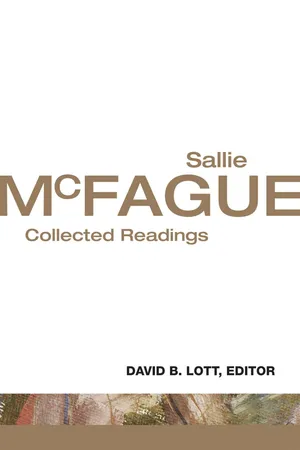
Sallie McFague offers a lucid and powerful guide to theological thinking about God and the world, individual and community, humanity and nature, reality and metaphor, the sacramental and the prophetic, and the critical issue of climate change for today's world. She calls Christians to new feeling, new acting, and new thinking.
Information
Topic
Theology & ReligionSubtopic
Christian Theology3
Constructing Theology: God, Humans, and the World
13
The Christian Paradigm
This selection from Models of God steps back into the world of parable and metaphor to explore how a metaphorical approach might change how we understand and practice Christian faith. The earlier exploration of Jesus’ parables is here put into service to set forth a new understanding of Jesus himself and of his ministry, focused particularly on those parables, his practice of table fellowship, and the cross, as “a paradigm of God’s relationship to the world.” For McFague, this reinterpretation of the faith is imperative, necessitated by the ecological sensibility that emphasizes interdependence rather than the triumphalist and hierarchal understandings that have marked Christian tradition.
Source: 1987:45–57
The material norm of Christian faith involves a specification of what distinguishes this faith. It involves risking an interpretation of what, most basically, Christian faith is about. Such interpretation is, of course, not done in general or for all time; it is always a partial, limited account of the contours of the salvific power of God in a particular time in light of the paradigmatic figure Jesus of Nazareth. To see the story of Jesus as paradigmatic means to see it as illuminative and illustrative of basic characteristics of the Christian understanding of the God-world relationship. These characteristics are not known solely from that story nor exemplified only in it, but that story is a classic instance, embodying critical dimensions of the relationship between God and the world. A metaphorical theology . . . does not take the Christian constant, in either its formal or material mode, as the only source and resource for theology. The question as we approach the issue of the paradigmatic figure Jesus of Nazareth is not whether everything we need in order to do theology in our time can be generated from that figure but whether there are clues or hints here for an interpretation of salvation in our time. That is to say, are there distinguishing marks of the story of Jesus that are relevant to a holistic, nuclear age? If one understands the life and death of Jesus of Nazareth as a parable of God’s relation to the world, and if to be a Christian means to be willing to look ‘“God-wards” through his story, then one is constrained to say in what ways that story is significant now.[1]
This will involve understanding the story differently from in the past, but, I believe, in a way that has “demonstrable continuities” with the past. My perspective on that story is similar to that of the so-called liberation theologies. Each of these theologies, from the standpoint of race, gender, class, or another basic human distinction, claims that the Christian gospel is opposed to oppression of some by others, opposed to hierarchies and dualisms, opposed to the domination of the weak by the powerful. These theologies, however, unlike the short-lived death-of-God or play theologies, are not just another fad; like other major revisions of the Christian paradigm, they are a new way of understanding the relationship between God and the world, a new way of interpreting what salvation means. These theologies are not marginal, strange, or even particularly novel enterprises, relevant only to the groups from which they emerge. Rather, they are in the classical tradition of fundamental reformulations of Christian faith, just like the theologies of Augustine, Luther, and Schleiermacher. In the case of each of these writers, something about the writer’s own experience did not fit with current understandings of Christianity: his experience presented an anomaly that could not be contained in the contemporary paradigm. A changed interpretation was imperative if the writer was to continue to identify himself as a Christian—and if Christian faith was to speak to the critical issues of the times. These theologians, however, believed they were interpreting Christianity not just for themselves or their own kind but for all. From a particular perspective came a universal claim.
These two notes of fundamental revisionist interpretation—experience and universality—are present also in the liberation theologies. The experience of being oppressed by gender, race, or poverty does not limit the theology that emerges to women, people of color, or the poor. Rather, the particular experiences of oppression serve as glasses bringing into sharper focus what one asserts the heart of the gospel truly to be for one’s own time. There are important differences among the liberation theologies, but there are common notes as well, and they stand in significant contrast to some other readings of Christianity. But such theologies, and the material norm of Christianity that they suggest, should be judged in the same way and with the same criteria as other theologies. Here I am echoing Letty Russell’s objection that feminist, black, and Third World theologies need to be qualified by an adjective, whereas white, male, Western theologies are called just theology. These other theologies are also just theology. As with all theology, they emerge out of a concrete, social context; they identify what they believe the central vision of Christianity to be; they offer particular insights, insights that emerge in part because of special perspectives—insights that ought to be seen as illuminating to all people, if they are indeed in continuity with the Christianity paradigm and an appropriate rendering of it for our time. The crucial difference between these new theologies and classical theology is that for the first time they are coming from women, from people of color, and from the poor.
These theologies share a common reading of the material norm of Christianity in certain respects. First, Christian faith is seen as destabilizing conventional expectations and worldly standards. At the very least, it is a disorienting perspective that upsets usual divisions and dualisms. Second, Christian faith is inclusive, reaching out to the weak, to the outsider, to the stranger, to the outcast. Third, Christian faith is antihierarchical and antitriumphalist, epitomized in the metaphor of the king who became a servant, one who suffers for and alongside the oppressed. These points are general ones (and different liberation theologies would orient them differently—toward, especially, the oppressive situation of women, people of color, or the poor); nonetheless, they constitute a significantly different rendering of Christian faith from that found in other interpretations. It is not the traditional and still-popular message that Jesus Christ, fully God and fully man, died for the sins of all humanity and was resurrected to new life, as his followers shall be also. Nor is it the more recent so-called liberal interpretation that Jesus is the power by which the individual can overcome alienation, meaninglessness, and despair. In the first case, the issue to which the gospel speaks is death from sin; hence, the good news is eternal life. In the second case, the issue to which the gospel speaks is personal, existential anguish; hence, the answer is new meaning. Liberation theologies claim (in different ways) that the issue to which the gospel speaks is the destructive, oppressive domination of some over others; hence, the answer is a new way of being in the world free of all hierarchies. If one were to identify the heart of the gospel for these theologies—their material norm—it would be the surprising invitation to all, especially to the outcast and oppressed. It is a destabilizing, inclusive, nonhierarchical vision of Christian faith, the claim that the gospel of Christianity is a new creation for all of creation—a life of freedom and fulfillment for all.
But is this vision in continuity with the Christian paradigm? Is it a revision, a reseeing of that vision, or is it a substitution for it? Can a claim be advanced that it is one credible, strong candidate for interpreting salvation in our time within the Christian paradigm, or is it a marginal or even bogus view? To answer these questions, we will first look briefly at the story of Jesus as a destabilizing, inclusive, nonhierarchical vision. Second, we will go beyond most of the liberation theologies to extend this vision to the cosmos and our responsibility for it. That is, we will look at the paradigmatic story of Jesus for clues and hints concerning the kind of metaphors most appropriate for modeling the relationship between God and the world, and hence between human beings and the world, in an ecological, nuclear era.
It is clear that the story of Jesus is a resource, but not the only source, for the material norm of the liberation theologies, that Christian faith gives a destabilizing, inclusive, nonhierarchical vision of fulfillment for all of creation. For although that vision is compatible with and illuminated by the paradigmatic story of Jesus, it is generated as much by the social, economic, political, and ecological realities of the late twentieth century. Nonetheless, if the paradigmatic story is revelatory of God’s “way with the world,” then it will be relevant to our world and can, without misrepresentation or distortion, be shown to be. Does this mean that each age reads into the story what it needs to, what it must, in order to make it speak to the deepest crises of its own time? Perhaps. Still, each theology—and liberation theologies are no exception—claims that its interpretation is a truer, less distorted interpretation of the story. Interpretations can and must change from age to age, and often they change substantially in order to address radically new situations; nevertheless, the theologian is constrained to return to the paradigmatic story of Jesus for validation and illumination.
What case can be made that the paradigmatic Christian story is a destabilizing, inclusive, nonhierarchical vision of fulfillment for all of creation? Can a portrait—though not necessarily the only portrait—be sketched along these lines? Nothing more than a “cartoon,” in the sense of a preliminary draft, is possible here, but that is sufficient, for what we seek are the chief features or characteristics of that story, not its historical basis or subsequent interpretation. Three aspects that appear to be characteristic of the story of Jesus are his speaking in parables, his table fellowship with outcasts, and his death on a cross. Each is suggestive, and much has been made of each. The parables have been interpreted as moral imperatives; the table fellowship as a symbol of the eucharistic sacrifice; the death on the cross as God’s triumph over sin, death, and the devil. But whatever the interpretations, few dispute that these three features are part of the story. A liberation theologian would interpret them differently: the parables illuminate the destabilizing aspect of the good news of Christianity; the table fellowship its inclusive character; and the death on the cross its nonhierarchical emphasis. As we look at each of these in more detail, what is being sought is not primarily validation of the story of Jesus as having these characteristics but illumination of our situation by that paradigmatic story.
The interpretation of the parables of Jesus in the last quarter century makes the case that they are a destabilizing, disorienting inversion of expectations and conventional standards. The parables, brief stories told in the secular language of Jesus’ time, are extended metaphors that say something about the unfamiliar, the “kingdom of God,” in terms of the familiar, a narrative of ordinary people doing ordinary things. They work, however, on a pattern of orientation, disorientation, and reorientation: the parable begins in the ordinary world with its conventional standards and expectations, but in the course of the story a radically different perspective is introduced, often by means of a surrealistic extravagance, that disorients the listener, and finally, through the interaction of the two competing viewpoints tension is created that results in a reorientation, a redescription of life in the world. A parable is, in this analysis, an assault on the accepted conventions, including the social, economic, and mythic structures that people build for their own comfort and security. A parable is a story meant to invert and subvert these structures and to suggest that the way of the kingdom is not the way of the world. In Jesus’ parables we see an elder son who does not get what he deserves and a younger son who gets what he does not deserve; late workers being paid the same as those who have labored all day; a feast that is given for the poor and the outcasts when the prominent guests decline; a foreigner who comes to the aid of a Jew when his own religious leaders walk by on the other side. Throughout the parables two standards are in permanent tension with each other, and the effect of their interaction is disorientation for the listener. As John Dominic Crossan points out, not “liking” the parables is the appropriate reaction to them, for they undermine efforts at conventional security: “You have built a lovely home, myth assures us: but, whispers parable, you are right above an earthquake fault.”[2]
At the very least the parables suggest that attempts at separating the “worthy” from the “unworthy,” dualisms such as rich/poor, Jew/Gentile, elder/younger son, etc.—and by implication, male/female, white/colored, straight/gay, Christian/non-Christian—are without basis in the vision of existence alluded to by the phrase “the kingdom of God.” What is suggested is a radically egalitarian, nondualistic way of being in the world. Liberation theologies make the case that Scripture is on the side of the poor and oppressed, but what is distinctive in the parables is not primarily a reversal that elevates the “unworthy,” but a destabilization of all dualisms. Such destabilization is far more radical than an inversion, for it means refusing all categorizations of insider/outsider, though human beings appear naturally and deeply to desire such distinctions. But the parables, as one aspect of the portrait of our paradigmatic story, sketch a world in which such categorizations are disrupted and overturned.
Is it appropriate to extend this disruption beyond the human dualisms to those of spirit/flesh, mind/matter, soul/body, human/nonhuman, sky/earth? Flesh, matter, body, the nonhuman, and the earth are conventionally, perhaps even “naturally,” considered inferior, and notably in the Christian tradition they have been so considered. But if the destabilization of the parables is to support the holistic sensibility needed in our time, then the oppression of flesh, matter, body, the nonhuman, and the earth must also be ended. If sin from the perspective of parabolic destabilization is the “natural” desire of human beings to separate themselves, in superior/inferior dualisms, from one another and from the earth, then salvation from this perspective would be an overturning of those patterns—a making whole or healing of the divisions. What is needed for a holistic sensibility to become a reality in our time is a change of consciousness in the way we see our world and ourselves in relation to the world. The destabilization of the parables is a necessary radical first step: when extended to the cosmos, it proclaims the end of the conventional, hierarchical, oppressive dualism of human/nonhuman.
What we see in Jesus’ parables becomes more explicit in his table fellowship: the destabilization of the parables bec...
Table of contents
- Cover
- Title Page
- Copyright
- Table Of Contents
- Introduction
- Bibliography
- Prologue: A Religious Autobiography
- The Language of Theology: Parables, Metaphors, and Models
- Theology and Spirituality: Metaphorical, Ecological, and Kenotic Approaches
- Constructing Theology: God, Humans, and the World
- Index of Names and Subjects
Trusted by 375,005 students
Access to over 1.5 million titles for a fair monthly price.
Study more efficiently using our study tools.
Frequently asked questions
Yes, you can cancel anytime from the Subscription tab in your account settings on the Perlego website. Your subscription will stay active until the end of your current billing period. Learn how to cancel your subscription
No, books cannot be downloaded as external files, such as PDFs, for use outside of Perlego. However, you can download books within the Perlego app for offline reading on mobile or tablet. Learn how to download books offline
Perlego offers two plans: Essential and Complete
- Essential is ideal for learners and professionals who enjoy exploring a wide range of subjects. Access the Essential Library with 800,000+ trusted titles and best-sellers across business, personal growth, and the humanities. Includes unlimited reading time and Standard Read Aloud voice.
- Complete: Perfect for advanced learners and researchers needing full, unrestricted access. Unlock 1.5M+ books across hundreds of subjects, including academic and specialized titles. The Complete Plan also includes advanced features like Premium Read Aloud and Research Assistant.
We are an online textbook subscription service, where you can get access to an entire online library for less than the price of a single book per month. With over 1.5 million books across 990+ topics, we’ve got you covered! Learn about our mission
Look out for the read-aloud symbol on your next book to see if you can listen to it. The read-aloud tool reads text aloud for you, highlighting the text as it is being read. You can pause it, speed it up and slow it down. Learn more about Read Aloud
Yes! You can use the Perlego app on both iOS and Android devices to read anytime, anywhere — even offline. Perfect for commutes or when you’re on the go.
Please note we cannot support devices running on iOS 13 and Android 7 or earlier. Learn more about using the app
Please note we cannot support devices running on iOS 13 and Android 7 or earlier. Learn more about using the app
Yes, you can access Sallie McFague by Sallie McFague, David B. Lott in PDF and/or ePUB format, as well as other popular books in Theology & Religion & Christian Theology. We have over 1.5 million books available in our catalogue for you to explore.