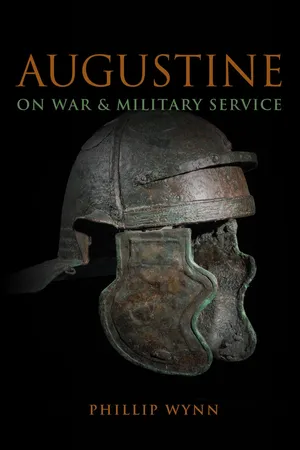
Did our modern understanding of just war originate with Augustine? In this sweeping reevaluation of the evidence, Phillip Wynn uncovers a nuanced story of Augustines thoughts on war and military service, and gives us a more complete and complex picture of this important topic.
- 350 pages
- English
- ePUB (mobile friendly)
- Available on iOS & Android
eBook - ePub
Augustine on War and Military Service
About this book
Information
Topic
Theology & ReligionSubtopic
Christian Theology2
5
Interpreting Augustine
In retrospect it is understandable that there would eventually emerge an interpretation of St. Augustine that would make him an authority on the Christian view of war. To begin with, more of his writings survive than is the case for any other Christian writer of the first millennium. In the small-print Migne edition of the Patrologia Latina, they fill fourteen quarto volumes. The survival of so much material is in itself a testament not only to how much he wrote during his lifetime, but also to the authority with which his works were regarded in subsequent centuries, since succeeding generations were motivated to the laborious task of repeatedly copying works of his that were often quite lengthy and involved. Furthermore, since Augustine wrote in the late fourth and early fifth century, the very time when Christian writers were grappling with issues presented by the rise to prominence and dominance of their fellow believers in the Roman empire, it is only to be expected that in the vast bulk of his writings one can find instances where issues of war and military service were addressed. Yet there is actually relatively little to be found in his works on these issues in comparison to the amount of material devoted to other subjects.
In evaluating both the place that Augustine’s thoughts on war and military service occupied in the context of his time and how his views were regarded by succeeding generations, there arises for a modern interpreter the question of how common or unique his ideas were in comparison with those of his Christian contemporaries. Nowadays we tend to prize originality in a writer, and consequently a modern interpreter of Augustine might tend to emphasize his distinctiveness among contemporaries. Such was not the way his ideas were viewed during, for example, the medieval period. In becoming one of the premier Latin Fathers, what became valued in his work was evidence of its congruence with the consensus doctorum. By that reading, Augustine’s difference with his contemporaries would be minimized, and anything that fell outside that consensus marginalized or ignored. This consideration sets up a conceptual filter, so to speak, which in succeeding centuries tended to constrict the content of his original views on war and military service. One must seek to set aside the constraints placed on that material by especially his medieval interpreters, the canonists and theologians who helped to construct him as an authority on war.
It is true that at this date it is arguably impossible to free oneself entirely from the accumulated weight of the intervening centuries of scholarship on Augustine that has often been shaped by the conceptual filters of his medieval interpreters. But even a cursory attempt to do so reveals that much of what has been written on Augustine’s views on war and military service in especially twentieth-century scholarship is at best misconceived, and at worst simply wrong. It would not be very productive to engage in an unenlightening “ordeal by footnotes” whenever anything in what follows contradicts one writer or another. Although arguably there is at least something new in what follows, it is also true that there is much that is familiar here to those who have looked at Augustine’s views on war. In particular, there is marked congruence with the path laid out in Herbert Deane’s classic work The Political and Social Ideas of St. Augustine.[1] One could argue that that work presented an Augustine that was overly schematized and inadequately historicized, but the same could be said to some extent of any interpretation of Augustine, including the present one.[2]
This investigation of Augustine’s views on war and military service has been guided by at least three overriding interpretive considerations. First, due to the often protean nature of what we can recover of his views, as well as the variety of genres he employed over a literary career spanning more than four decades, it can be argued that not only did Augustine seemingly contradict himself at times, but that he also changed his mind on certain things. Particularly pertinent in this regard is the argument of Robert Markus that Augustine reacted against his earlier embrace of Christian “triumphalism” at the end of the fourth century and moved to a more jaundiced view of the possibilities of a Christian empire.[3] To the extent such an interpretation is valid, it would also imply a change in Augustine’s view of war.[4] But I hope to show that Augustine’s views on war and military service were actually fairly consistent over the span of his literary career. The following investigation is therefore largely organized topically rather than chronologically. Besides, any attempt to chart the development of Augustine’s thinking on war and military service is rendered difficult by the impossibility of dating many of his works, particularly his sermons. Therefore, unless an argument for the dating of a particular sermon appears in a note, the dates I give for his sermons are quite provisional.
Another, related consideration has to do with evaluating Augustine’s statements on war and military service in the original contexts in which they appeared. But this is easier said than done. Augustine wrote no treatise De bello or De militia. All his statements relevant to our inquiry appear in works whose purpose was other than our current focus. And since the underlying ideas for much of what Augustine did write on war and military service are common to much of his work entire, it cannot be denied that in fact the only proper context for such statements is his entire oeuvre![5] Realistic choices, then, have to be made, and I have striven for what I judge to be a usable level of context, while recognizing that by so doing I necessarily perpetuate to some degree the misleading view of Augustine as a self-conscious authority on war.
Finally, it is understandable given Augustine’s genius and energy that his ideas have often been treated as though sui generis, without sufficient attention to framing them within the context of contemporary Christian writers and ideas. Augustine was nothing if not argumentative, and it is the case with much of what he wrote on war and military service that he cast it originally in opposition to the views not only of pagans and heretics, but also to those of more “orthodox” Christian contemporaries. A difficulty in recognizing this practice arises from the fact that Augustine often did not expressly name his Christian interlocutors or explicitly detail their views.[6] Augustine himself provides probably the best clue as to why he avoided naming his Christian opponents in his De gestis Pelagii, written as a brief history of his involvement with Pelagius and his followers. At one point early in the controversy he wrote concerning the Pelagians that “we thought it would be of greater benefit in acting against them if the errors themselves were refuted and disproved while not mentioning their names.”[7] When he did come to write a work against a book written by Pelagius himself
still, I did not introduce the name of Pelagius in my work in which I refuted the same book, thinking that it would be more useful if by still preserving a friendly relationship with him I could keep him from losing face (“eius verecundiae parcerem”).[8]
But later, when it became clear that Pelagius could not be convinced of the error of his ways, Augustine did not hesitate to name him expressly in his works.[9]
Aurelius Augustinus was born in 354 at Thagaste in the province of Numidia in Roman North Africa, the son of Patricius, a modest burger of the town, and Monica, who imparted something of her Christianity and strong personality to her son.[10] After receiving a classical education and moving to Carthage, Augustine, who was put off by what he regarded as the coarse and vulgar language of the Christian Bible, became briefly a follower of Manichaeism. That religion, considered a Christian heresy by some, posited a radically dualistic cosmology, in which the good God was engaged in a cosmic struggle against an equally potent god of evil. We know from Augustine’s works later written against them that Manichaeans were highly critical of what they considered the vengeful, violent God of the Old Testament, and contrasted that with the pacific principles of the New Testament.
In coming to Milan in 384, a city then the de facto capital of the We...
Table of contents
- Cover
- Title Page
- Copyright
- Table Of Contents
- Acknowledgments
- Abbreviations
- Introduction
- Bibliography
- Augustine's Texts Cited
- Index of Augustinian Citations
- General Index
Trusted by 375,005 students
Access to over 1.5 million titles for a fair monthly price.
Study more efficiently using our study tools.
Frequently asked questions
Yes, you can cancel anytime from the Subscription tab in your account settings on the Perlego website. Your subscription will stay active until the end of your current billing period. Learn how to cancel your subscription
No, books cannot be downloaded as external files, such as PDFs, for use outside of Perlego. However, you can download books within the Perlego app for offline reading on mobile or tablet. Learn how to download books offline
Perlego offers two plans: Essential and Complete
- Essential is ideal for learners and professionals who enjoy exploring a wide range of subjects. Access the Essential Library with 800,000+ trusted titles and best-sellers across business, personal growth, and the humanities. Includes unlimited reading time and Standard Read Aloud voice.
- Complete: Perfect for advanced learners and researchers needing full, unrestricted access. Unlock 1.5M+ books across hundreds of subjects, including academic and specialized titles. The Complete Plan also includes advanced features like Premium Read Aloud and Research Assistant.
We are an online textbook subscription service, where you can get access to an entire online library for less than the price of a single book per month. With over 1.5 million books across 990+ topics, we’ve got you covered! Learn about our mission
Look out for the read-aloud symbol on your next book to see if you can listen to it. The read-aloud tool reads text aloud for you, highlighting the text as it is being read. You can pause it, speed it up and slow it down. Learn more about Read Aloud
Yes! You can use the Perlego app on both iOS and Android devices to read anytime, anywhere — even offline. Perfect for commutes or when you’re on the go.
Please note we cannot support devices running on iOS 13 and Android 7 or earlier. Learn more about using the app
Please note we cannot support devices running on iOS 13 and Android 7 or earlier. Learn more about using the app
Yes, you can access Augustine on War and Military Service by Phillip Wynn,Douglas W. Stott in PDF and/or ePUB format, as well as other popular books in Theology & Religion & Christian Theology. We have over 1.5 million books available in our catalogue for you to explore.