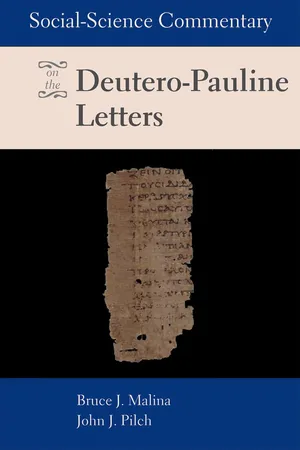
The Social-Science Commentary series pioneers an alternative commentary genre, providing in this volume the text of the deutero-Pauline letters and cultural notes on them. The Social-Science Commentary on the Deutero-Pauline Letters provides essential reading scenarios on specific cultural phenomena in these letters, including forgery, normative conflict, paideia (training), and Household Codes. This volume highlights the transformation of the memory of Paul in early Christianity as reflecting the concerns and interest of communities after Pauls death.
- 208 pages
- English
- ePUB (mobile friendly)
- Available on iOS & Android
eBook - ePub
Social Science Commentary on the Deutero-Pauline Letters
About this book
Information
Topic
Theology & ReligionSubtopic
Biblical Studies4
The Pastoral Epistles: 1-2 Timothy and Titus
Since the publication of Paul Anton’s “exegetical essays on the Pastoral Epistles of Paul to Timothy and Titus” in Halle, Germany (1753–1755), the Epistles to Timothy and the Epistle to Titus have been known as the Pastoral Epistles. Current New Testament scholarship is nearly unanimous in rejecting the Pauline authorship of these documents. The manuscript Vaticanus does not contain these texts. Lexical and stylistic comparisons with the authentic Pauline letters as well as other issues support this conclusion. Therefore, in our commentary, we refer to the author writing in Paul’s name as “the Pastor.” The documents are dated after 80ce, that is, after Paul’s death in the mid-60s. It is very likely that Paul’s companions, Timothy and Titus, were also dead at the time of the composition of these letters.
As we have explained in the introduction, these Epistles are forgeries. An anonymous writer who cherished the memory of Paul and sought to contemporize his teaching for new circumstances traded on his authority in composing these letters in his name. The recipients, Timothy and Titus, are also literary fictions intended to actualize Paul’s presence. In the Hellenistic world, some considered the noble falsehood (such as forgeries) to be an acceptable rhetorical tool (Plato, Republic 2.282c-283a; Cicero, Brutus 11.42). The forgery could be used to discredit the person to whom it was attributed or, conversely, to enhance that person’s honorable status.
More specifically, then, these letters originated from a third-generation Pauline Jesus-group in Ephesus. In their lifetimes, Paul was a change-agent, and Timothy and Titus were change-agent coworkers or aides, as documented in the authentic Pauline letters (Malina and Pilch 2006). These Pastoral Epistles single out Timothy and Titus as ideal “supervisors,” an appropriate social-scientific translation of the Greek episkopoi. 1 Timothy 1:12—2:9 relates how and why Paul became a change-agent. The rest of this letter sets out instructions for Timothy, who was to remain in Ephesus (1 Tim. 1:3). His career as change-agent coworker is now ended, likely because the real Timothy is dead. The Timothy of these letters is presented as a young and inexperienced person. If he were alive, the real Timothy would be quite old. The Timothy of these letters, therefore, is based on recollections of the sort of person Timothy must have been. His role as change-agent aide is ended. Now he is to act as the local supervisor.
The letters more than amply prove that innovations, even those proclaimed by Paul and his team, will be reinterpreted and contextualized by later adapters, even though these innovations have been in the Pauline tradition from its inception. Such reinterpretations also demonstrate that a change-agent’s task will always end with a termination of the relationship by having some local person take over. For the Jesus-groups addressed in these letters, the successor to the traveling change-agent (Paul) was the local or sedentary supervisor (episkopos, “bishop”).
The language and concepts in these letters are those commonly used by Hellenistic writers of the period. We believe this confirms our position argued earlier, that Paul’s mission (and that of his coworkers) was primarily directed to fully enculturated Israelites, Hellenists, living as minority groups in the Diaspora (Malina and Pilch 2006:14–17; Pilch 2008:1–16). They were so fully enculturated that they knew and kept many Hellenistic values and behaviors along with Israelite traditions. Hence, the general argument of the Pastorals is to encourage these people to continue to live that lifestyle and not to be swayed by Judaizers to revert to Israelite traditions.
Finally, while one writer is quite likely responsible for all three of these letters, it is difficult to determine an order. In this commentary, we follow a sequence that other scholars have adopted: Titus (because it reflects an undeveloped church order), 1 Timothy (because the church order here is more developed), and 2 Timothy (because it reminisces about Paul’s life work and his death, almost in the style of a testamentary document).
We begin with Titus because it appears to have been directed to a community (perhaps even a large geographic area, symbolized by Crete) that is fairly well structured but has no organization chart for this structure. The letter focuses more on qualifications for positions than on duties. It presents Paul as a model to be imitated by individuals and the community in order to give good example to outsiders. Titus and Timothy are entrusted by Paul with a ministry of overseeing the community, and they are expected to pass this ministry on to persons whom they judge to be qualified. The supervisor/overseer (bishop) is at the top of the administrative group, but titles remain fluid in this period. The problems troubling this community include bickering over Torah, severe ascetical practices, and useless speculation.
5
Titus
I. Letter Opening (Superscription) 1:1-4
II. Body of the Letter 1:5—3:11
Part 1 1:5—2:10 : Conduct expected of various classes in the church
Section 1: 1:5-16: The assignment of community leaders
1:5-9: Qualifications for a community leader
1:10-16: Specific culturally conditioned function: oppose heterodox teachers
Section 2: 2:1-10 Concerning others in the community
2:1: Personalizing introduction
2:2-6: About men and women, young and old
2:7-8: The role of “Titus” himself
2:9-10: On slaves
Part 2 2:11-15: Motivation for this conduct
Part 3 3:1-11: General lines of conduct expected of Jesus-group members
III. Conclusion 3:12-15
I. Letter Opening (Superscription) 1:1-4
The historical Paul and Titus were coworkers. They knew each other well. The detailed presentation of Paul and his credentials to Titus confirms the fact that this letter was not written by Paul to Titus. This is a third Pauline generation letter (or fourth Jesus-group generation letter) trading on memories about Paul and Titus, who were coworkers and fellow change agents in their lifetimes. The Jesus Tradition. Third- and fourth-generation communities who cherished these memories would recognize that the letter is addressed in general to successors of Titus who are now supervisors (episkopoi) of the Jesus-groups.
The letters to Timothy and Titus are called “pastoral” letters, letters dealing with ecclesiastical matters by and for a church pastor. The unknown, hypothetical writer is called the “Pastor.” The Pastor (under the name of Paul) offers advice to the pastors in question. Now the Pastor’s advice is directed to a fictional Titus, perhaps Paul’s well-known disciple.
1:1-4 Letter Opening
1:1 Paul, a servant of God and an apostle of Jesus Christ, for the sake of the faith of God’s elect and the knowledge of the truth that is in accordance with godliness, 2 in the hope of eternal life that God, who never lies, promised before the ages began— 3 in due time he revealed his word through the proclamation with which I have been entrusted by the command of God our Savior, 4 To Titus, my loyal child in the faith we share: Grace and peace from God the Father and Christ Jesus our Savior.
Textual Notes: Titus 1:1-4
Hellenistic letters opened with a formula consisting of the name of the sender(s), the name of the addressee(s), and a greeting. These three elements are called a superscription (or prescript). The next element, connecting the superscription with the body of the letter, is a thanksgiving, or better, an expression of indebtedness for favors received. The thanksgiving consists of a statement of gratitude to God for something done in the past plus wishes for the proximate future. Hellenistic Letter.
1:1: The letter writer presents Paul (who is long dead) as a slave (NRSV “servant”) of God and an apostle of Jesus Christ (1 Cor. 1:1; 2 Cor. 1:1).
Paul usually called himself a slave of Jesus Christ, but the Pastor gives him this unusual title: slave of God. This document derives from a society in which slavery was well known. Slavery. A slave was a person who underwent a symbolic ritual of dishonor (social death—self or other inflicted) through which he/she was deprived of freedom of decision and action by means of force or enforced solidarity with a view to the social utility of the enslaving agent. By calling himself a “slave of God,” Paul—and here the Pastor—means that any freedom of decision or action on Paul’s part belonged to the God of Israel. The title reflects a rich Israelite tradition in which prophets (Ahijah, Elijah, Jonah), leaders (Moses and David), and many others were so termed. As slave of God, Paul has as his special task to be an apostle of Jesus Christ for the sake of faith of God’s “chosen ones.” While 1 and 2 Timothy speak of “Christ Jesus,” Titus prefers “Jesus Christ.”
The purpose of Paul’s commission (from God, of course) is to “promote knowledge of the truth,” (or true knowledge) which intimates a long-term relationship during which believers will learn the finer points of the gospel faith. This contrasts with the Paul of Acts and his authentic letters in which he generally does not stay anywhere for a significant length of time. Such knowledge should lead to eusebeia (NRSV: “godliness”) best translated as “respectful conduct.” Respectful Conduct (eusebeia).
1:2: The description of “God, who never lies,” underscoring true knowledge, is very likely intended to comfort and give assurance to believers in Crete (and elsewhere in the circum-Mediterranean world), where secrecy, deception, and lying are culturally acceptable strategies in the protection of one’s honor (see Titus 1:12). Lying. Honor is the core value of the culture continent extending from Persia to Peru (or Turkey to Brazil). This statement may also have been considered necessary if the letter’s recipients were familiar with the incident where God seems to have been party to a lie (1 Kgs. 22:23). However, the primary purpose of describing God in this way is to present a contrast with the false teachers mentioned in the Pastorals (1 Tim. 4:1; 2 Tim. 3:13; Titus 3:3). God’s promise of eternal life is from time immemorial, and God’s promises are trustworthy (Ps. 12:6).
1:3: “Word” refers to the gospel message (1:9; 2:5) entrusted to Paul to be proclaimed (1 Tim. 1:11). This not only provides further credentials to Paul but also highlights his obedience (1 Tim. 1:1) and suggests the obedience expected of other ministers (2 Tim. 2:2) as well as all who hear the word. Savior is someone who rescues another from a bad situation. Here God is given that title (see also 2:10; 3:4), but Jesus is also recognized as savior (1:4; 3:6).
1:4: The relationship between Paul and Titus in their lifetimes was one of friendship. They were coworkers (2 Cor. 8:23), or in social-science parlance, fellow change agents acting on behalf of the change agency, the God of Israel. Change Agent. Titus accompanied Paul to the so-called council of Jerusalem (Gal. 2:1, 3; compare Acts 15, where he is not explicitly mentioned). This meeting, in our view, decided that the totally enculturated Hellenist Israelites, that is, non-observant Israelites living as minorities in the western Dispersion should not be compelled to be circumcised. Titus was one of these Hellenist Israelites.
Recall that, as we argued earlier, Israelites living in the western Diaspora lived at some distance from the halakah of Israel in the eastern Diaspora. As Arye Edrei and Doron Mendels have made the case,
The western Greek-speaking Jews lost touch with the Halakhah and the Rabbis, a condition that had far-reaching consequences on Jewish history thereafter. The Rabbis paid a high price for keeping their Halakhah in oral form, losing in consequence half of their constituency. An oral law did not develop in the western diaspora, whereas the existing eastern one was not translated into Greek. Hence it is not surprising that western Jews contributed nothing to the development of the oral law in the east. The Jewish communities that were isolated from the Rabbinic network served as a receptive basis for the development of an alternative Christian network by Paul and the apostles, which enabled it to spread throughout the Mediterranean basin. The Jews that remained “biblical” surfaced in Europe in the Middle Ages. (Edrei and Mendels 2007:91)
As far as Crete is concerned, by the second century bce, a sizable Israelite community lived in the area of Gortyna, Crete. In 141bce, they won Roman favor and were considered loyal subjects (1 Maccabees 15, especially v. 23). They continued to flourish, and in 67 bce, Crete and Cyrene (Libya) became a Roman province and remained such until the time of Constantine. The Pastor claims that Paul left Titus in Crete to supervise the Jesus-group there (v. 5). It is therefore plausible to consider this fourth-generation Jesus-group document as addressed primarily to Hellenist Israelite leaders (episkopoi, overseers) and the believers they supervised in Crete and, by extension, to similar Hellenist Israelite believers living elsewhere in the circum-Mediterranean world.
Titus is addressed in strong fictive-kinship language as “true child.” Paul may well have played a role in Titus’s joining the Jesus-group. Nevertheless, this fictive-kinship terminology is further strengthened by acknowledging a mutually shared “common faith” constituting a united front against the false teachers who shortly will be mentioned.
The standard greeting “grace and peace” concludes the letter opening. Curiously, the final greeting is addressed to a community: “you all” confirming that the Pastorals were indeed circular letters intended for various Jesus-groups.
II. Body of the Letter 1:5—3:11
Part 1:1:5—2:10
Section 1:1:5-16
1:5-9: Qualifications for community leaders
1:5 I left you behind in Crete for this reason, so that you should put in order what remained to be done, and should appoint elders in every town, as I directed you: 6 someone who is blameless, married only once, whose children are believers, not accused of debauchery and not rebellious. 7 For a bishop, as God’s steward, must be blameless; he must not be arrogant or quick-tempered or addicted to wine or violent or greedy for gain; 8 but he must be hospitable, a lover of goodness, prudent, upright, devout, and self-controlled. 9 He must have a firm grasp of the word that is trustworthy in accordance with the teaching, so that he may be able both to preach with sound doctrine and to refute those who contradict it.
Textual Notes: Titus 1:5-9
1:5: This verse presents information t...
Table of contents
- Cover
- Title Page
- Copyright
- Table Of Contents
- Other Books by Author
- Abbreviations
- Preface
- Introduction
- Ephesians
- Colossians
- 2 Thessalonians
- The Pastoral Epistles: 1-2 Timothy and Titus
- Titus
- 1 Timothy
- 2 Timothy
- Hebrews
- Bibliography
- Reading Scenarios for the Deutero-Pauline Letters
- List of Reading Scenarios
Trusted by 375,005 students
Access to over 1.5 million titles for a fair monthly price.
Study more efficiently using our study tools.
Frequently asked questions
Yes, you can cancel anytime from the Subscription tab in your account settings on the Perlego website. Your subscription will stay active until the end of your current billing period. Learn how to cancel your subscription
No, books cannot be downloaded as external files, such as PDFs, for use outside of Perlego. However, you can download books within the Perlego app for offline reading on mobile or tablet. Learn how to download books offline
Perlego offers two plans: Essential and Complete
- Essential is ideal for learners and professionals who enjoy exploring a wide range of subjects. Access the Essential Library with 800,000+ trusted titles and best-sellers across business, personal growth, and the humanities. Includes unlimited reading time and Standard Read Aloud voice.
- Complete: Perfect for advanced learners and researchers needing full, unrestricted access. Unlock 1.5M+ books across hundreds of subjects, including academic and specialized titles. The Complete Plan also includes advanced features like Premium Read Aloud and Research Assistant.
We are an online textbook subscription service, where you can get access to an entire online library for less than the price of a single book per month. With over 1.5 million books across 990+ topics, we’ve got you covered! Learn about our mission
Look out for the read-aloud symbol on your next book to see if you can listen to it. The read-aloud tool reads text aloud for you, highlighting the text as it is being read. You can pause it, speed it up and slow it down. Learn more about Read Aloud
Yes! You can use the Perlego app on both iOS and Android devices to read anytime, anywhere — even offline. Perfect for commutes or when you’re on the go.
Please note we cannot support devices running on iOS 13 and Android 7 or earlier. Learn more about using the app
Please note we cannot support devices running on iOS 13 and Android 7 or earlier. Learn more about using the app
Yes, you can access Social Science Commentary on the Deutero-Pauline Letters by Bruce J. Malina,John J. Pilch in PDF and/or ePUB format, as well as other popular books in Theology & Religion & Biblical Studies. We have over 1.5 million books available in our catalogue for you to explore.