eBook - ePub
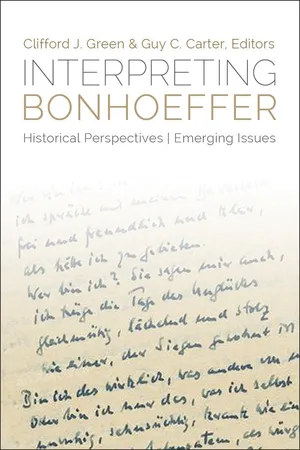
Interpreting Bonhoeffer
Historical Perspectives, Emerging Issues
- 250 pages
- English
- ePUB (mobile friendly)
- Available on iOS & Android
eBook - ePub
Interpreting Bonhoeffer
Historical Perspectives, Emerging Issues
About this book
In the early twenty-first century, interest in the life and work of Dietrich Bonhoeffer is increasing significantly. In this environment, how should we understand and interpret Bonhoeffer? Interpreting Bonhoeffer explores the many questions surrounding the complexities of Bonhoeffer's life, work, and historical context and what they might mean for how we understand and interpret Bonhoeffer now and in the future.
Information
Topic
Theology & ReligionSubtopic
Christian Theology1
Interpretation from Historical Perspectives
1
A. Bonhoeffer and Public Ethics in Six Nations, 1945-2010
Inspiration, Controversy, Legacy: Responses to Dietrich Bonhoeffer in Three Germanys
Wolfgang Huber
I have been invited to present the German case for the influence of Dietrich Bonhoeffer on public ethics. As a German myself, I may seem an obvious choice to interpret Bonhoeffer’s influence from a German perspective. But there is an enormous difference between Bonhoeffer’s time, ending in 1945, and the later contexts of the responses to his life and work. It is true that Dietrich Bonhoeffer cannot be read ahistorically, but this is equally true for the reception of his work. The way Bonhoeffer’s legacy was used in different contexts depended on the respective social circumstances, political developments, and ecclesial preconditions.
Our reflection on Bonhoeffer’s influence on public ethics begins with the German case. But there is not a single German case; there are at least three. The response to Dietrich Bonhoeffer in Germany took place in three different arenas. That is due to the political history of Germany after the end of the Nazi regime and the liberation of Germany as well as Europe from the terror of violence and war that originated in Germany, followed by the division not only of this country but of Europe. There were quite different conditions and ways in which Bonhoeffer’s theology was received and interpreted after 1945 in the two parts of Germany, the (old) Federal Republic of Germany in the West and the (former) German Democratic Republic in the East, the one belonging to the political alliance of western democratic countries under the leadership of the United States of America, the other forming a part of the Warsaw Pact under the leadership of the Soviet Union. Now for some twenty years, since 1989/90, we have another Germany—a third Germany—after the opening of the wall on November 9, 1989 and the reunification of the country eleven months later.
But even such a distinction between three Germanys includes many problematic simplifications. The predominant challenge for such an approach consists in the fact that the response to Dietrich Bonhoeffer’s life and work took place from the very beginning in an international framework. In the immediate aftermath of his death as a conspirator and martyr his role was interpreted internationally. Those who heard about him in the first years after the end of World War II had to listen to voices like that of the American theologian Reinhold Niebuhr, the Anglican bishop of Chichester George Bell from Great Britain, or the General Secretary of the emerging World Council of Churches, the Dutch theologian Willem Visser ’t Hooft. It was in the first instance his personal life story that made Dietrich Bonhoeffer an international figure. His two visits to Union Theological Seminary, in 1930/31 and 1939, played an outstanding role in the international formation of this theologian. But his time as a vicar in Barcelona, his years as a pastor in London, his visits to Sweden or Switzerland, and his participation in many ecumenical conferences in different countries also contributed their part. His plan to visit Mahatma Gandhi in India shows in a nutshell the global perspective in which he understood what we call today public ethics. After 1945 his work therefore found a worldwide resonance and has always had an international dimension. The present discussion will surely give some evidence for that. I shall restrict myself to just one example in this connection, the fact that the very latest piece of research on Bonhoeffer’s peace ethics that has come to my attention was written by a theologian from Rwanda who presented his investigation as a doctoral dissertation at a German university.[1]
My first impulse is to say that public ethics in Dietrich Bonhoeffer’s sense has to be put in an international perspective and cannot be limited to a national horizon. Or, to quote Carl-Friedrich von Weizsäcker, Bonhoeffer understood oecumene “in its original sense as the whole earth populated by human beings,” and “as a modern person he could breathe only with difficulty in the provincialism which he found around himself.”[2]
However, the following observations concentrate on the impact of Bonhoeffer’s theology for public ethics in the three Germanys after 1945. I shall set aside other vivid debates on his theology, for instance on his Christological concentration, on his ethical concept in general, or on his idea of a nonreligious interpretation of biblical concepts—to name only these three. Some of these issues I addressed on other occasions. I choose only three examples for this specific look at Bonhoeffer and public ethics, namely resistance, peace, and the church for others.
Bonhoeffer’s Reception in a Divided Germany
My retrospective examination of Bonhoeffer’s role in public ethics begins with the insight that his influence, from the very beginning, is predominantly not based on his theoretical concepts but on his personal example.[3] His decision to risk his life for a future in peace and justice, and his death as a martyr only a few weeks before the end of Hitler’s dictatorship, made him an example of a responsible life in difficult times. His relevance for public ethics relates first of all to his importance as a role model. To trust in God and to act responsibly in the real world are the two basic elements of a way of life that inspired people to follow Bonhoeffer’s example under quite different circumstances.
It has to be seen under this perspective that the fragments of Ethics, published by Eberhard Bethge already in 1949, and the Letters and Papers from Prison, published in 1951, found a completely different resonance. It was the German title “Resistance and Submission” (Widerstand und Ergebung) that was formative for the picture of Dietrich Bonhoeffer for at least two decades. Key quotations from this book were characteristic for the public posture of persons who tried to transfer Bonhoeffer’s example into their private and public life. “By powers of good so wondrously protected, // we wait with confidence, befall what may. // God is with us at night and in the morning // and oh, most certainly on each new day” became characteristic for the dimension of submission to God’s will and of trust in his guidance.[4] “Not always doing and daring what’s random, but seeking the right thing, // Hover not over the possible, but boldly reach for the real” can be seen as one of the key sentences for the preparedness to address the real challenges of the present time.[5]
However, the term “resistance” created trouble. For a remarkably long time the step from Christian witness to political resistance was seen by people in positions of political responsibility, and even more by church officials, as highly ambiguous. Although the inner legitimacy of the new democracy on West-German soil depended to a high degree on the courage (and the failure) of the conspirators of July 20, 1944, it took several years until the Federal Republic of Germany officially recognized the conspirators as precursors of this new democracy. And only then could a discussion start on the question whether or not all their convictions really met democratic standards. Disobedience against political authorities, and the decision to break the military oath, were mostly understood as incompatible with the duties of a citizen, and even more with the obligations of a military person. It took therefore a remarkably long time until the judgments against the conspirators were withdrawn or the deserters in World War II were vindicated.
Theology was a little bit quicker than the general public in this regard. As early as 1952 the two Protestant theologians Ernst Wolf and Hans-Joachim Iwand presented a memorandum in the context of the “Remer Trial” on the legitimacy of political resistance, including so-called tyrannicide.[6] These two representatives of Lutheran theology, who were at the same time inspired by the theology of Karl Barth, used the examples of Dietrich Bonhoeffer and the Norwegian Lutheran Bishop Eivind Berggrav to present the duty of every individual Christian to resist, if necessary even including violent means, in cases of an absolute perversion of the state, or in the case of duties based on justice that follow from obligations toward one’s neighbor. That statement stood clearly in opposition to the official concept of the Protestant churches in remembering the victims of Nazism. The official politics of commemoration separated Christian martyrdom very clearly from political resistance. Martyrs in this sense were only those persons who did not suffer “because they disagreed with the politics of the Third Reich . . . but only and alone because they were convinced that the confession of the church was attacked.”[7] It was therefore unusual and an important breakthrough at the same time, when Wolf and Iwand argued in 1952 for the legitimacy of tyrannicide on theological grounds.
Two years later the President of the Federal Republic of Germany, Theodor Heuss, expressed his respect for the German Resistance on the occasion of the tenth anniversary of July 20, 1944.[8] That was a time in which Letters and Papers from Prison were not yet published in East Germany. The book appeared there only in 1957, six years after its publication in the West. The hesitation of the censors was due to the prominent place of resistance already in the title of the book.[9] The East-German theologian Christoph Haufe functioned as an expert for the censors. He warned that the politics of the church in East Germany could also be treated under the heading of “Resistance and Submission” (Widerstand und Ergebung). It was exactly the time in which the state attacked young Christians, put them in prison, and tried to discourage them as much as possible. Christoph Haufe feared that people could regard the situation in which Bonhoeffer had written as parallel to the actual situation in the German Democratic Republic. The censors were not as fearful as this theologian. They thought that readers could distinguish between Nazi Germany and the communist regime of those days. From then onwards it was more or less obligatory in the GDR to call Bonhoeffer’s resistance “antifascist” and to use the phrase “antifascist resistance” as often as possible in order to underline that there was no comparison possible between the first and the second dictatorship on German soil. The hope was that it would become self-evident that there was no reason to draw connections between Bonhoeffer’s attitude toward the Nazi regime and the question of political responsibility in the system of the so-called “really existing socialism” of the GDR.
In West-Germany, Bonhoeffer’s example was from time to time used in the context of civil disobedience as a means of political demonstration on moral grounds. That contributed to a perspective that even gained additional importance in the third, the united Germany. Now Bonhoeffer’s actual contributions to an ethic of responsibility play the central role in the reception of his public ethics. Not an assumed heroism of our actions, but the question of how a future generation can live, that is decisive. This is shown in our days by the contrast between global poverty on the ...
Table of contents
- Cover
- Title Page
- Copyright
- Dedication
- Table Of Contents
- Editors' Foreword
- Abbreviations
- Interpretation from Historical Perspectives
- Emerging Issues of Interpretation
- Afterword
- Contributors
- Index
Trusted by 375,005 students
Access to over 1.5 million titles for a fair monthly price.
Study more efficiently using our study tools.
Frequently asked questions
Yes, you can cancel anytime from the Subscription tab in your account settings on the Perlego website. Your subscription will stay active until the end of your current billing period. Learn how to cancel your subscription
No, books cannot be downloaded as external files, such as PDFs, for use outside of Perlego. However, you can download books within the Perlego app for offline reading on mobile or tablet. Learn how to download books offline
Perlego offers two plans: Essential and Complete
- Essential is ideal for learners and professionals who enjoy exploring a wide range of subjects. Access the Essential Library with 800,000+ trusted titles and best-sellers across business, personal growth, and the humanities. Includes unlimited reading time and Standard Read Aloud voice.
- Complete: Perfect for advanced learners and researchers needing full, unrestricted access. Unlock 1.5M+ books across hundreds of subjects, including academic and specialized titles. The Complete Plan also includes advanced features like Premium Read Aloud and Research Assistant.
We are an online textbook subscription service, where you can get access to an entire online library for less than the price of a single book per month. With over 1.5 million books across 990+ topics, we’ve got you covered! Learn about our mission
Look out for the read-aloud symbol on your next book to see if you can listen to it. The read-aloud tool reads text aloud for you, highlighting the text as it is being read. You can pause it, speed it up and slow it down. Learn more about Read Aloud
Yes! You can use the Perlego app on both iOS and Android devices to read anytime, anywhere — even offline. Perfect for commutes or when you’re on the go.
Please note we cannot support devices running on iOS 13 and Android 7 or earlier. Learn more about using the app
Please note we cannot support devices running on iOS 13 and Android 7 or earlier. Learn more about using the app
Yes, you can access Interpreting Bonhoeffer by Clifford J. Green, Guy C. Carter, Clifford J. Green,Guy C. Carter in PDF and/or ePUB format, as well as other popular books in Theology & Religion & Christian Theology. We have over 1.5 million books available in our catalogue for you to explore.