eBook - ePub
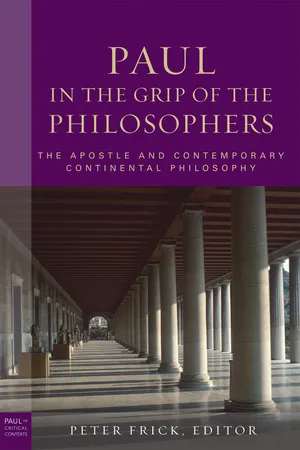
Paul in the Grip of the Philosophers
The Apostle and Contemporary Continental Philosophy
- 192 pages
- English
- ePUB (mobile friendly)
- Available on iOS & Android
eBook - ePub
About this book
One of the remarkable developments in the contemporary study of Paul is the dramatic interest in his thought amongst European philosophers. This collection of leading scholars makes accessible a discussion often elusive to those not already conversant in the categories of European philosophy. Each scholar address's systematically what major philosophers have made of Paul–and why it matters.
Information
4
Jacob Taubes—Paulinist, Messianist
Larry L. Welborn
Jacob Taubes—The Enigma
In an editorial note at the end of The Political Theology of Paul, Aleida Assmann relates one of the many Taubes stories that circulated among his students and friends: “In June 1986, Taubes brought a prescription to a pharmacy at the Roseneck in Berlin. The pharmacist deciphered the name and asked, to make sure: ‘Is your name Paulus?’ Upon which Taubes answered, ‘Actually, yes, but on the prescription it says Taubes’.”[1] That Taubes’ identification with Paul was more than light-hearted is demonstrated by explicit statements in the transcript of his lectures, such as: “Now I of course am a Paulinist, not a Christian, but a Paulinist.”[2] What this identification meant to Taubes, and how his identity as a Paulinist related to the other identities that Taubes claimed as a Jew and a philosopher,[3] grants entrée not only to what Taubes said about Paul in his lectures of 1987, but also to what Taubes did not say, yet toward which he gestured, with his concluding exhortation to the theologians: “So: Begin anew to interpret Paul!”[4]
The ambiguities of Taubes’ identity have been a cause of ire for his interpreters, both with respect to his politics and his theology. Mark Lilla chafes at the fact that “in New York in the late Forties he taught Talmud to some future neoconservatives,” while “in Berlin you will find a photo of him addressing a demonstration of Sixties radicals while Rudi Dutschke and Herbert Marcuse sit admiringly at his side.”[5] Christoph Schmidt (of the Hebrew University of Jerusalem) describes Taubes’ book on Paul as “the quintessence of his constant vacillation between Jewish and Christian traditions.”[6] Schmidt seeks to expose Taubes’ dependence upon “the modern Catholic ‘church fathers’ of the twentieth century,” asserting that Taubes’ 1947 doctoral thesis on the eschatology of the West[7] “owes far more than is fitting to the Jesuit Hans Urs von Balthasar’s Apocalypse of the German Soul,”[8] and that his presentation of Paul’s political theology “evidences more than just a deep affinity with the reconstruction of Paul’s Epistle to the Romans by the 1929 convert to Catholicism Erik Peterson.”[9] With unconcealed animosity, Schmidt observes that, fortunately, neither Taubes’ Jewish nor his Protestant readers were aware of his dependence upon these Catholic authors,[10] and so took for a “genius” one who was really a “charlatan.”[11] Evidently, Taubes, too, found the no-man’s land of his identity a site of combustion: Aleida Assmann quotes a letter in which Taubes writes about his “uneasy Ahasueric lifestyle at the borderline between Jewish and Christian, at which things get so hot that one can only (get) burn(ed).”[12]
Twenty years after the publication of Taubes’ Heidelberg seminar,[13] there are useful summaries of Taubes’ interpretation of Paul by scholars of the New Testament and Judaism (Alain Gignac, Angela Standhartinger, Elizabeth Castelli, Daniel Langton),[14] alongside the indispensable “Afterword” to Taubes’ lectures by Wolf-Daniel Hartwich, Aleida Assmann, and Jan Assmann.[15] More importantly, Taubes’ understanding of Paul has had an impact upon historians of religion such as Daniel Boyarin,[16] and philosophers such as Alain Badiou and Giorgio Agamben.[17] Indeed, Agamben’s commentary on Paul’s letter to the Romans bears the dedication: “Jacob Taubes in memoriam.”[18] Agamben asserts that the publication of Taubes’ Political Theology of Paul “marks an important turning point” in the project of reclaiming Paul as the fundamental messianic thinker in the Western tradition.[19] Thus, the time for introductions to Taubes’ thought and overviews of his argument has long passed, and what is called for at the present moment is an assessment of the implications of Taubes’ interpretation of Paul and an hypothesis regarding its origin and aims, focused, as indicated above, on the question of Taubes’ identity and, more importantly, on the identity of that future community of “Paulinists” whom Taubes sought to summon through his lectures.
Taubes’ Thesis: Paul, the Founder of the New People of God
The central thesis of Taubes’ interpretation of Romans is that “For Paul, the task at hand is the establishment and legitimation of a new people of God.”[20] Paul’s undertaking is thus an historic instance of what the German constitutional theorist Carl Schmitt called “political theology” with the special meaning which Schmitt gave to that term.[21] In Schmitt, “political theology” discloses the ultimate basis of every constitutional order in a decision made by a “sovereign,” a revolutionary act that can be glimpsed whenever the legal order breaks down in a “state of emergency.”[22] Taubes attributes to Paul a keen awareness of the arrival of a “state of emergency” for the Jewish people: “The basis of such an idea is that the orgē theou, God’s anger, wants to annihilate the people because it has sinned.”[23] Hence Paul’s “great sorrow” and “unceasing anguish in heart” over his “kinspeople according to the flesh” (Rom. 9:2-3). In the face of this existential danger, Paul’s Epistle to the Romans announces the sovereign decision of God to establish and legitimate a new people which includes Gentiles along with Jews.[24] The catalyst for this new congregation is the paradoxical faith in a Messiah “who was nailed to the cross by nomos.”[25] The νόμος that condemned and crucified the Messiah was not the Torah of Moses, however, but...
Table of contents
- Cover
- Title Page
- Copyright
- Dedication
- Table Of Contents
- Paul in the Grip of Continental Philosophers
- Nietzsche
- Heidegger on the Apostle Paul
- Paul of the Gaps
- Jacob Taubes—Paulinist, Messianist
- Circumcising the Word
- Gianni Vattimo and Saint Paul
- Badiou’s Paul
- Agamben’s Paul
- Mad with the Love of Undead Life
- The Philosophers’ Paul and the Churches
- Bibliography
- Index of Subjects
- Index of Names
- Index of Biblical References
Trusted by 375,005 students
Access to over 1.5 million titles for a fair monthly price.
Study more efficiently using our study tools.
Frequently asked questions
Yes, you can cancel anytime from the Subscription tab in your account settings on the Perlego website. Your subscription will stay active until the end of your current billing period. Learn how to cancel your subscription
No, books cannot be downloaded as external files, such as PDFs, for use outside of Perlego. However, you can download books within the Perlego app for offline reading on mobile or tablet. Learn how to download books offline
Perlego offers two plans: Essential and Complete
- Essential is ideal for learners and professionals who enjoy exploring a wide range of subjects. Access the Essential Library with 800,000+ trusted titles and best-sellers across business, personal growth, and the humanities. Includes unlimited reading time and Standard Read Aloud voice.
- Complete: Perfect for advanced learners and researchers needing full, unrestricted access. Unlock 1.5M+ books across hundreds of subjects, including academic and specialized titles. The Complete Plan also includes advanced features like Premium Read Aloud and Research Assistant.
We are an online textbook subscription service, where you can get access to an entire online library for less than the price of a single book per month. With over 1.5 million books across 990+ topics, we’ve got you covered! Learn about our mission
Look out for the read-aloud symbol on your next book to see if you can listen to it. The read-aloud tool reads text aloud for you, highlighting the text as it is being read. You can pause it, speed it up and slow it down. Learn more about Read Aloud
Yes! You can use the Perlego app on both iOS and Android devices to read anytime, anywhere — even offline. Perfect for commutes or when you’re on the go.
Please note we cannot support devices running on iOS 13 and Android 7 or earlier. Learn more about using the app
Please note we cannot support devices running on iOS 13 and Android 7 or earlier. Learn more about using the app
Yes, you can access Paul in the Grip of the Philosophers by Peter Frick in PDF and/or ePUB format, as well as other popular books in Theology & Religion & Biblical Criticism & Interpretation. We have over 1.5 million books available in our catalogue for you to explore.